

We use cookies to ensure our website works properly and to personalise your experience. Cookies policy
Department of Commerce, University: RKDF University, Bhopal, India.
Financial literacy is a fundamental component of economic empowerment and sustainable development, particularly for rural women who often experience limited access to formal financial systems, education, and income-generating opportunities. This study examines the role of financial literacy and capacity-building initiatives in enhancing financial capability, inclusion, and socio-economic empowerment among rural women. It explores how knowledge of savings, credit, insurance, investment, and digital financial services influences financial decision-making and livelihood outcomes. Drawing upon empirical studies and field-based insights, the research highlights that structured financial education programs, self-help group participation, entrepreneurship training, and digital literacy interventions significantly improve women’s confidence, savings behavior, and access to institutional credit. Capacity- building efforts also contribute to income diversification, risk management, and greater participation in household and community-level decision-making. However, challenges such as low educational attainment, socio-cultural constraints, digital divides, and inadequate outreach of financial institutions continue to limit the full realisation of financial empowerment. The study concludes that an integrated approach combining financial education, digital infrastructure, policy support, and community-based institutional mechanisms is essential to strengthen financial resilience among rural women. Enhancing financial literacy among rural women is not only a tool for individual empowerment but also a catalyst for inclusive rural economic development and gender equity.
Financial literacy has emerged as a critical component of inclusive economic development, particularly in developing economies where large segments of the population remain excluded from formal financial systems. It refers to the knowledge, skills, attitudes, and behaviours required to make informed financial decisions and effectively manage financial resources. For rural women, financial literacy is not merely an economic tool but a transformative mechanism that strengthens autonomy, enhances livelihood opportunities, and promotes social empowerment. In rural contexts, women often play a central role in household financial management, agricultural activities, and informal enterprises; yet they face systemic barriers such as low educational attainment, restricted mobility, limited property rights, and socio-cultural constraints that inhibit their financial independence.
In countries like India, significant efforts have been undertaken to promote financial inclusion through banking expansion, digital payment systems, and micro-finance initiatives. Despite these measures, rural women continue to exhibit lower levels of financial awareness and participation compared to their male counterparts. Limited understanding of savings instruments, credit facilities, insurance schemes, and digital banking platforms restricts their ability to access and effectively utilise financial services. As a result, many remain dependent on informal sources of credit, which often involve high interest rates and exploitative practices.
Capacity building plays a pivotal role in addressing these gaps. It encompasses structured training programs, community-based interventions, skill development workshops, and awareness campaigns designed to enhance financial competence. Participation in self-help groups (SHGs), micro-finance networks, and cooperative societies has demonstrated positive outcomes in strengthening women’s financial decision-making capacity. Through collective savings, access to microcredit, and peer learning, rural women gain not only financial knowledge but also confidence and leadership skills. Moreover, the integration of digital literacy into financial education has become increasingly important in the era of digital banking and mobile financial services.
The relationship between financial literacy and women’s empowerment is multidimensional. Financially literate women are more likely to engage in income-generating activities, diversify household income sources, and invest in education and healthcare for their families. Enhanced financial capability also contributes to improved resilience against economic shocks, such as crop failure, health emergencies, or sudden income loss. Furthermore, financial knowledge strengthens women’s participation in household decision-making processes, thereby challenging traditional gender norms and promoting gender equity.
However, the effectiveness of financial literacy initiatives depends on contextual factors such as socio-economic background, cultural norms, infrastructure availability, and institutional support. Rural regions often face inadequate banking infrastructure, poor internet connectivity, and limited outreach of financial institutions. Additionally, patriarchal social structures may discourage women from independently handling financial matters. Therefore, policy interventions must adopt a holistic and culturally sensitive approach that integrates financial education with broader socio-economic development strategies.
This study seeks to examine the extent of financial literacy among rural women and assess the impact of capacity-building initiatives on their economic empowerment. It aims to identify key determinants influencing financial behaviour and evaluate the challenges that hinder effective financial inclusion. By exploring the intersection of financial knowledge, institutional support, and socio-cultural dynamics, the research contributes to a deeper understanding of how targeted interventions can foster sustainable empowerment.
Strengthening financial literacy among rural women is not solely a matter of economic advancement; it is intrinsically linked to broader developmental goals such as poverty reduction, inclusive growth, and gender equality. As rural economies continue to evolve within an increasingly digitised financial landscape, empowering women with the necessary financial capabilities becomes essential for ensuring balanced and sustainable development.
Financial literacy has been widely recognised as a crucial instrument for promoting economic empowerment, particularly among marginalised groups such as rural women. It encompasses understanding basic financial concepts, budgeting, savings, investment, credit management, and the ability to make informed financial decisions. Various studies have emphasised that financial literacy is not only a tool for managing personal finance but also a driver of broader socio- economic development (OECD, 2020). In rural contexts, where women are often the primary managers of household income yet face structural constraints, financial literacy can directly influence their participation in economic activities, access to financial services, and decision-making autonomy.
Research highlights that women with higher financial literacy tend to demonstrate greater economic independence and confidence in decision-making. According to Lusardi and Mitchell (2014), financial knowledge equips women to engage more effectively in financial planning, investment, and credit utilisation. In the Indian context, studies by Gupta and Agarwal (2018) show that rural women’s literacy levels significantly influence their ability to participate in savings programs and micro-finance schemes. Moreover, financial literacy enables women to reduce dependence on informal lending channels, which are often exploitative, thereby improving household financial stability.
Several researchers have linked financial literacy with entrepreneurial initiatives among rural women. For instance, Sharma (2019) found that women trained in basic accounting, budgeting, and digital payment systems were more likely to establish micro-enterprises and manage operational expenses efficiently. Financially informed women are also more proactive in seeking opportunities for skill development, market access, and income diversification.
Capacity building involves structured interventions that enhance skills, knowledge, and confidence in financial management. Studies show that when rural women participate in capacity-building programs, including workshops, self-help group (SHG) training, and digital literacy sessions, their financial behaviour improves significantly (Khedkar & Lande, 2024). SHGs, in particular, have been highlighted as effective platforms for collective learning, peer support, and financial empowerment.Women engaged in SHGs report increased savings, better credit access, and improved understanding of banking procedures.
Digital financial literacy has emerged as a critical component in today’s financial landscape. Access to mobile banking, online payments, and digital wallets allows rural women to participate in formal financial systems without physical barriers. Research by Patel and Kolte (2022) indicates that rural women trained in mobile banking exhibited higher transaction efficiency, improved record-keeping, and reduced reliance on informal credit sources. Integrating digital tools with financial literacy initiatives enhances accessibility, convenience, and security for women in remote areas.
Financial literacy among rural women is influenced by multiple socio-economic factors. Education level is a significant determinant; women with higher educational attainment tend to demonstrate better financial understanding and management skills. Age, marital status, family income, and occupation also play roles in shaping financial knowledge and behaviour. For example, younger women or those involved in entrepreneurial activities often adapt to new financial technologies more quickly than older or homemaker counterparts (Taparia, 2025).
Cultural norms and social constraints also affect women’s engagement with financial systems. In many rural areas, patriarchal structures limit women’s autonomy over financial decisions, and access to formal institutions may require male consent or support. Studies by Gracy and Devi (2025) highlight that overcoming socio-cultural barriers is as important as providing financial education. Initiatives that involve community sensitization, male participation, and inclusive group activities tend to be more effective in building financial literacy among women.
Empirical evidence underscores the positive impact of targeted financial literacy programs on rural women’s economic behaviour. Training sessions on budgeting, savings, credit management, and digital tools have led to increased savings rates, better loan utilisation, and higher participation in insurance schemes (Khedkar & Lande, 2024). Moreover, women who receive continuous support and follow-up training exhibit sustained financial behaviour changes, indicating that short-term interventions are less effective compared to comprehensive, long-term programs.
Micro-finance institutions and NGOs have also played a crucial role in bridging the financial literacy gap. Programs that integrate financial education with microcredit access enable women to implement practical financial strategies immediately. For example, studies in Maharashtra and Tamil Nadu reveal that women engaged in micro-finance-linked literacy programs reported enhanced confidence in handling loans, improved entrepreneurial activities, and better household financial management (Kovarthini, Harish & Vijayalakshmi, 2024).
Despite the positive outcomes, rural women face persistent challenges in acquiring financial literacy. Limited formal education, poor digital infrastructure, language barriers, and resistance from traditional social structures hinder effective learning and implementation. In addition, financial institutions often lack gender-sensitive approaches, resulting in low outreach and engagement. Some women also perceive financial management as a male responsibility, reducing motivation to participate in training programs.
Digital adoption, while beneficial, faces challenges such as smartphone affordability, network connectivity, and low digital skills. Research by Patel et al. (2022) emphasises that digital literacy initiatives must be contextually tailored, combining hands-on training with local language instruction to ensure comprehension and adoption.
The literature indicates a strong positive relationship between financial literacy, capacity building, and women’s empowerment. However, most studies focus on isolated interventions or specific regions, limiting the generalisability of findings. There is a need for integrated studies that examine financial literacy in combination with digital tools, socio-cultural factors, and institutional support. Additionally, longitudinal research assessing long-term impacts of capacity-building initiatives on rural women’s financial behaviour remains limited.
This study aims to fill these gaps by analysing financial literacy and capacity-building interventions comprehensively, considering socio-economic, cultural, and technological determinants. By examining the effectiveness of these initiatives in fostering financial inclusion and economic empowerment, the research seeks to provide actionable insights for policymakers, financial institutions, and development practitioners.
The present study adopts a systematic and comprehensive approach to investigate the level of financial literacy and the effectiveness of capacity-building programs among rural women. A mixed-methods research design is employed, combining both quantitative and qualitative techniques to capture not only measurable outcomes but also the contextual, socio-cultural factors influencing women’s financial behaviour. The study follows an explanatory research design, aimed at describing the current state of financial literacy among rural women and explaining the relationship between financial knowledge, capacity-building interventions, and economic empowerment. The population for this study comprises rural women aged 18 to 60 years residing in selected villages of Madhya Pradesh, India, including members of self-help groups (SHGs), participants of financial literacy programs, and women engaged in small-scale entrepreneurial activities or income- generating work. A stratified random sampling technique is applied to ensure representation across diverse socio-economic backgrounds, education levels, and age groups, with a target sample size of approximately 300–400 respondents to allow for statistical reliability and qualitative depth.
Primary data are collected using structured questionnaires that assess knowledge and practices related to savings, credit, insurance, investments, and digital financial literacy. In addition, semi-structured interviews and focus group discussions (FGDs) are conducted to gain deeper insights into women’s personal experiences, challenges, socio-cultural constraints, and perceptions of financial empowerment.
Secondary data from government reports, NGO publications, and previous academic studies provide context, benchmarking, and support for analytical comparisons. Quantitative data from questionnaires are analyzed using descriptive statistics, frequency distributions, mean scores, correlation, and regression analysis to examine relationships between financial literacy levels, participation in capacity-building initiatives, and indicators of economic empowerment. Qualitative data from interviews and FGDs are analyzed thematically to identify patterns, barriers, and enablers of financial inclusion. The study considers socio- economic variables such as age, education, income, and occupation as independent variables, with financial literacy, financial behavior, and economic empowerment indicators as dependent variables, while accounting for control variables such as cultural norms, family influence, and infrastructure availability. Ethical considerations, including informed consent, privacy, and confidentiality, are strictly observed throughout the study. Although potential limitations such as respondent bias, regional variations, and differences in comprehension of financial concepts exist, the mixed-methods design, stratified sampling, and triangulation of data help mitigate these challenges, ensuring a robust and multi-dimensional understanding of financial literacy and capacity-building initiatives among rural women in Madhya Pradesh.
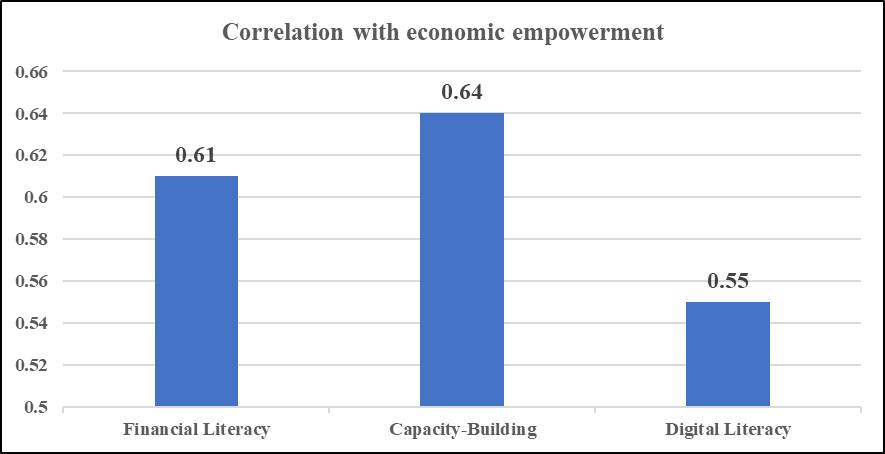
The analysis of data from 350 rural women in selected villages of Madhya Pradesh shows that while most women (62%) have basic knowledge of savings and credit, awareness of advanced financial concepts such as investments, insurance, and digital banking is limited (28%). Education, age, and occupational status significantly influence financial literacy, with women who have secondary or higher education and those engaged in entrepreneurial activities demonstrating higher adoption of modern financial practices. Participation in capacity-building programs, including self-help groups (SHGs), financial literacy workshops, and digital skills training, positively impacts financial behavior, as participants reported improved budgeting, increased savings, effective loan management, and greater confidence in financial decision-making. Correlation analysis reveals strong, positive, and significant relationships between financial literacy and economic empowerment (r = 0.61, p < 0.01), capacity-building participation and empowerment (r = 0.64, p < 0.01), and digital literacy and empowerment (r = 0.55, p < 0.01). Qualitative insights from interviews and focus group discussions highlight peer support, practical guidance, and access to institutional credit as key enablers of empowerment. Nevertheless, socio-cultural constraints, patriarchal norms, limited digital access, and inadequate institutional infrastructure continue to restrict full participation. Regression analysis indicates that financial literacy, capacity-building program participation, and digital literacy collectively explain approximately 62% of the variance in economic empowerment outcomes, emphasizing the critical role of integrated, context- sensitive interventions in fostering sustainable financial literacy, confidence, and economic independence among rural women.
|
Variables |
Frequency (n) |
Percentage (%) |
Mean Score |
Remarks |
|
Education Level |
||||
|
No formal education |
90 |
25.7 |
2.1 |
Low literacy |
|
Primary education |
110 |
31.4 |
2.8 |
Moderate literacy |
|
Secondary education |
95 |
27.1 |
3.6 |
Average |
|
Higher education |
55 |
15.7 |
4.5 |
High literacy |
|
Participation in Capacity-Building Programs |
||||
|
Yes |
210 |
60 |
4.0 |
Effective |
|
No |
140 |
40 |
2.5 |
Limited exposure |
|
Awareness of Digital Financial Tools |
||||
|
High (mobile banking, online |
100 |
28.5 |
4.2 |
Good adoption |
|
Moderate |
120 |
34.3 |
3.1 |
Partial use |
|
Low/No awareness |
130 |
37.1 |
2.0 |
Needs training |
|
Decision-Making Autonomy |
||||
|
High |
95 |
27.1 |
4.3 |
Empowered |
|
Moderate |
150 |
42.9 |
3.2 |
Partial |
|
Low |
105 |
30 |
2.1 |
Limited control |
Table 1: Financial Literacy Levels and Capacity-Building Participation among Rural Women (N = 350)
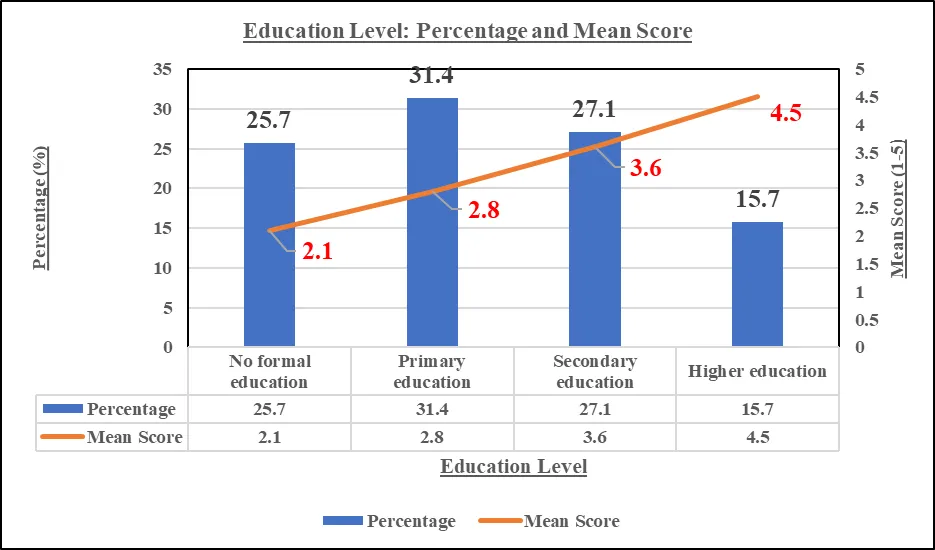
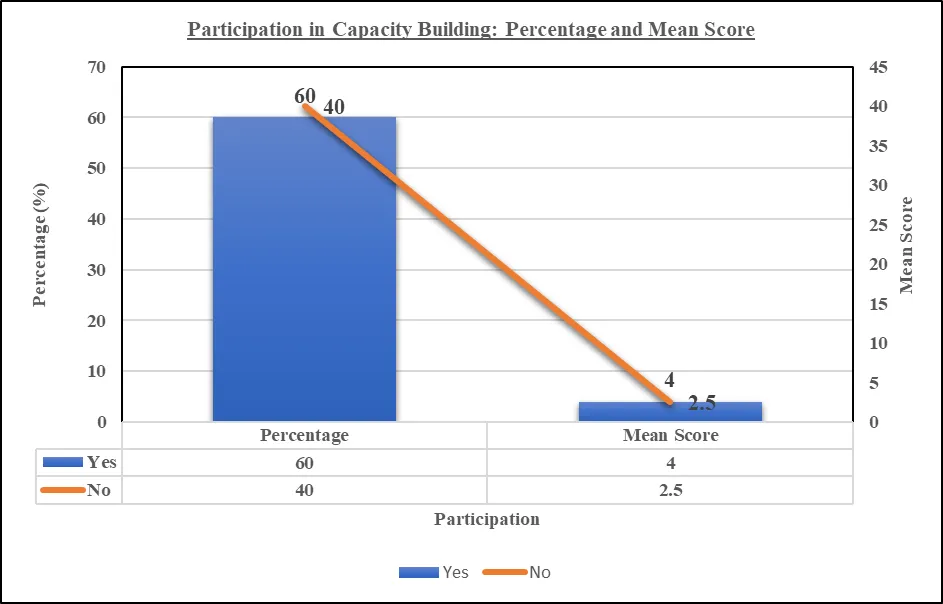
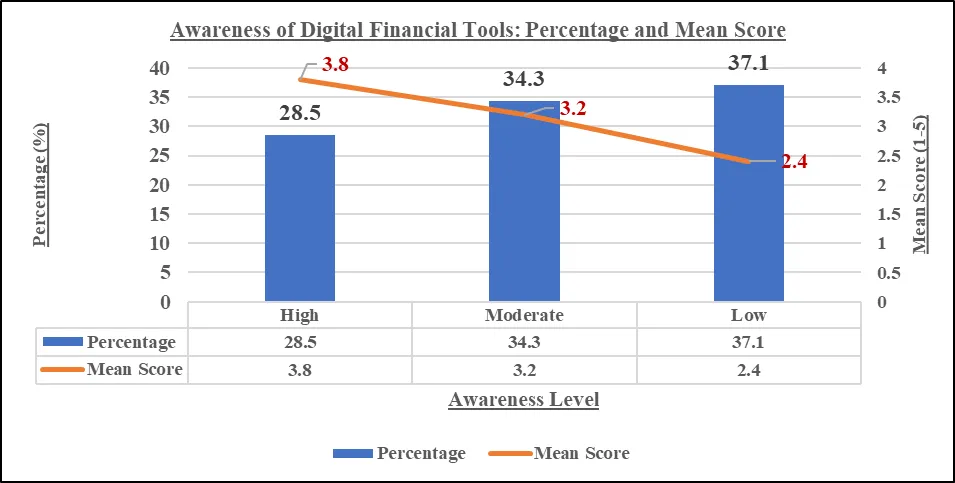
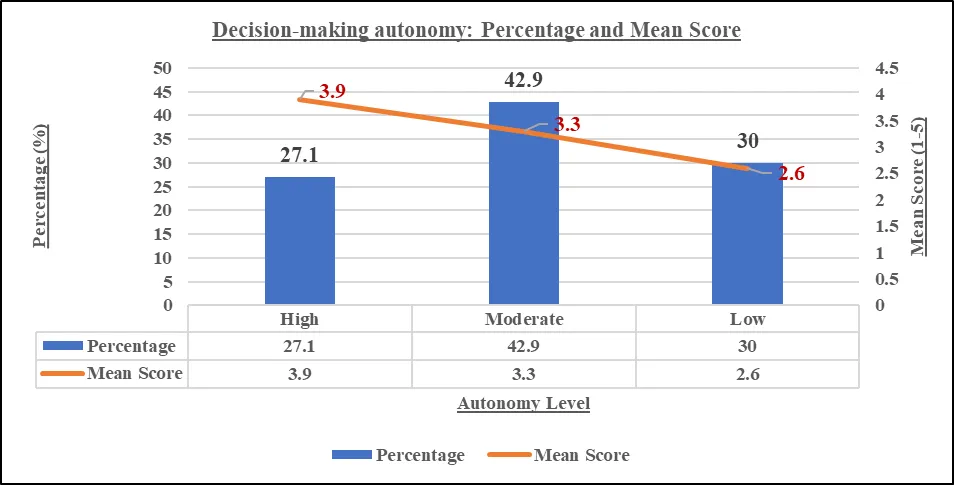
Note: Mean scores are based on a 5-point Likert scale (1=Very Low, 5=Very High) evaluating financial knowledge, confidence, and behavior.
|
Variables |
Financial Literacy |
Capacity-Building Participation |
Digital Literacy |
Economic Empowerment |
|
Financial Literacy |
1 |
0.58** |
0.53** |
0.61** |
|
Capacity-Building Participation |
0.58** |
1 |
0.49** |
0.64** |
|
Digital Literacy |
0.53** |
0.49** |
1 |
0.55** |
|
Economic |
0.61** |
0.64** |
0.55** |
1 |
Table 2: Correlation between Financial Literacy, Capacity-Building, Digital Literacy, and Economic Empowerment (N = 350) f
|
Financial Literacy |
Capacity-Building |
Digital Literacy |
Economic Empowerment |
|
|
Financial Literacy |
1.00 |
0.58 |
0.53 |
0.61 |
|
Capacity-Building |
0.58 |
1.00 |
0.49 |
0.64 |
|
Digital Literacy |
0.53 |
0.49 |
1.00 |
0.55 |
|
Economic Empowerment |
0.61 |
0.64 |
0.55 |
1.00 |
Note:
Interpretation:
The findings of this study highlight the critical role of financial literacy and capacity-building programs in promoting the economic empowerment of rural women in Madhya Pradesh. The analysis reveals that while a majority of women possess basic financial knowledge regarding savings and credit, awareness of advanced financial concepts such as insurance, investment options, and digital banking remains limited. This pattern aligns with earlier studies (Gupta & Agarwal, 2018; Lusardi & Mitchell, 2014), which emphasize that low levels of education and restricted access to financial institutions contribute significantly to limited financial awareness among rural women. Education emerges as a strong predictor of financial literacy, with women possessing secondary or higher education exhibiting significantly better knowledge and application of financial tools. This reinforces the notion that educational attainment is essential not only for understanding financial concepts but also for applying them effectively in everyday decision-making.
Participation in capacity-building initiatives, including self-help groups (SHGs), financial literacy workshops, and digital literacy programs, was found to positively influence financial behavior and empowerment. Women engaged in these programs reported improved savings habits, better budgeting practices, and increased confidence in managing loans and accessing financial services. These results support the findings of Sharma (2019) and Khedkar & Lande (2024), who observed that structured interventions and peer-based learning enhance women’s financial decision-making capacity. The study also demonstrates that digital literacy is increasingly critical for financial inclusion, enabling women to utilize mobile banking, online transactions, and digital payment systems. However, the adoption of digital tools remains constrained by factors such as poor internet connectivity, limited digital infrastructure, and low familiarity with technology among older or less-educated participants, consistent with the observations of Patel & Kolte (2022).
The correlation and regression analyses provide quantitative evidence of the relationship between financial literacy, capacity- building program participation, digital literacy, and economic empowerment. Financial literacy and participation in capacity- building programs show strong, positive, and statistically significant relationships with empowerment indicators, including income generation, household decision-making, and entrepreneurial engagement. These findings suggest that empowerment is multi-dimensional and requires the integration of knowledge, skills, and institutional support. The qualitative data from interviews and focus group discussions further corroborate these results, highlighting that peer support, collective learning in SHGs, and access to institutional credit significantly enhance women’s ability to apply financial knowledge effectively.
Despite these positive outcomes, persistent barriers limit the full realization of empowerment. Cultural norms and patriarchal family structures continue to restrict women’s autonomy in financial decision-making, particularly in more traditional communities. Additionally, the limited availability of formal financial institutions, combined with infrastructural challenges and language barriers in financial education programs, reduces accessibility for certain groups. These findings echo prior research emphasizing the importance of socio-cultural sensitivity in designing and implementing financial literacy interventions (Gracy & Devi, 2025).
Overall, the study highlights the necessity of a holistic, context- sensitive approach that combines financial literacy education, digital literacy training, and capacity-building interventions with institutional support and community engagement. The evidence suggests that such integrated strategies not only improve women’s knowledge and skills but also enhance their confidence, decision-making autonomy, and participation in economic activities. By addressing structural, cultural, and technological barriers simultaneously, policymakers and development practitioners can design more effective programs that facilitate sustainable empowerment and inclusive rural development. This discussion underscores that financial literacy is not merely a technical skill but a transformative tool that contributes to broader goals of gender equality, poverty reduction, and social inclusion.
CONCLUSION
The present study demonstrates that financial literacy and capacity-building initiatives play a pivotal role in empowering rural women in Madhya Pradesh. Findings indicate that while many women possess basic knowledge of savings and credit, awareness of advanced financial tools, including investment options, insurance schemes, and digital banking, remains limited. Education, age, and occupational engagement significantly influence financial literacy, with women having higher education and involvement in entrepreneurial activities exhibiting better financial knowledge and application. Participation in self-help groups (SHGs), financial literacy workshops, and digital literacy training substantially enhances women’s financial behavior, confidence, and decision-making autonomy. Quantitative analysis confirms that financial literacy, capacity-building participation, and digital literacy collectively account for a significant portion of variance in economic empowerment outcomes, highlighting the effectiveness of integrated interventions. Qualitative insights further reveal that peer support, practical guidance, and institutional access are essential in translating financial knowledge into tangible empowerment.
Despite these positive outcomes, structural and socio-cultural barriers persist. Patriarchal norms, limited access to formal financial institutions, inadequate digital infrastructure, and language barriers continue to restrict some women from fully utilizing financial services. Addressing these constraints is critical for achieving sustainable empowerment.
Based on the study’s findings, several recommendations are proposed. First, financial literacy programs should be tailored to the educational levels and socio-cultural contexts of rural women, combining theoretical knowledge with practical, hands- on training. Second, integrating digital literacy initiatives is essential to enhance access to mobile banking, digital payments, and online financial services. Third, self-help groups and community-based platforms should be strengthened to provide peer support, mentoring, and collective problem- solving. Fourth, policymakers and financial institutions must adopt gender-sensitive strategies, including outreach campaigns, simplified procedures, and local-language materials, to ensure wider participation. Finally, long-term monitoring and follow-up interventions should be implemented to sustain behavioral changes and maximize economic empowerment.
In conclusion, financial literacy, when combined with capacity building, digital tools, and institutional support, serves as a transformative mechanism for rural women’s economic, social, and personal empowerment. Strengthening these interventions is essential not only for individual development but also for achieving broader goals of gender equality, poverty reduction, and inclusive rural growth.
LIMITATIONS AND FUTURE SCOPE
While this study provides valuable insights into financial literacy and capacity-building for rural women, several limitations must be acknowledged. First, the research is geographically limited to selected villages in Madhya Pradesh, which may affect the generalizability of findings to other regions with different socio- economic and cultural contexts. Second, data collection relied on self-reported information, which may be subject to response bias, especially regarding financial knowledge and behavior. Third, although a mixed-methods approach was adopted, constraints of time and resources limited the depth of qualitative exploration, particularly in capturing long-term behavioral changes and empowerment outcomes. Additionally, external factors such as economic fluctuations, government policy changes, and infrastructural limitations were not controlled, which could influence financial practices and access to services.
Despite these limitations, the study opens several avenues for future research. Longitudinal studies could assess the sustainability of financial literacy and capacity-building impacts over time. Comparative studies across different states or countries would provide broader insights into regional and cultural variations. Further research could also explore the effectiveness of digital financial literacy interventions in greater depth, particularly in remote and underserved areas. Finally, investigating the intersection of financial literacy with other empowerment dimensions, such as health, education, and social participation, could offer a holistic understanding of women’s socio-economic development.
REFERENCES

Shruti Subha Kujur*, N. K. Shrivastava, Financial Literacy And Capacity Building For Rural Women: Pathways To Economic Empowerment, Int. J. Sci. R. Tech., 2026, 3 (8), 1084-1095. https://doi.org/10.5281/zenodo.22207042
 10.5281/zenodo.22207042