

We use cookies to ensure our website works properly and to personalise your experience. Cookies policy
1P.E.T. Research Foundation, Affiliated to University of Mysore, Mandya, India.
2Department of Commerce and Management, P.E.S. College of Science, Arts and Commerce, Mandya, India
Arecanut (Areca catechu L.) is simultaneously an agricultural commodity, a culturally embedded consumption product, a livelihood resource, and an increasingly important feedstock for value-added and bio-based products. Yet its marketing scholarship remains fragmented across agricultural economics, consumption studies, supply-chain research, sustainability, materials valorization, and health-related fields. This study maps that fragmented knowledge base and asks how far the literature has developed toward an integrated understanding of the marketing mix, market dynamics, and emerging themes. A Scopus-based corpus of 224 documents published during 1984-2026 and distributed across 180 sources was analyzed using Biblioshiny/Bibliometrix. Performance analysis, citation analysis, co-word analysis, thematic mapping, co-citation analysis, trend-topic analysis, and collaboration indicators were combined with an interpretive reading of marketing-salient records. The corpus shows a 6.49% annual growth rate, with 62.5% of documents published from 2020 onward and a publication peak of 35 documents in 2025. The conceptual structure is highly multidisciplinary: health/consumption and demographic-risk clusters remain prominent, while a rapidly expanding production-sustainability cluster centers on Areca catechu, sustainable development, agroforestry, natural fibers, and value creation. Explicit marketing is comparatively underdeveloped: the keyword 'marketing' occurs only seven times in the trend-topic output, whereas sustainability (25), sustainable development (23), and arecanut (17) dominate recent discourse. The study's incremental contribution is a synthesis showing that arecanut marketing research has evolved unevenly across the 4Ps: price and place are anchored in forecasting, cooperatives, traders, and relational exchange; product is expanding through adaptation and circular value addition; promotion remains the least developed dimension. We propose an integrated market-system agenda linking the 4Ps with digital analytics, responsible consumption, sustainability, and farmer value capture.
Arecanut (Areca catechu L.) occupies an unusual position in agricultural markets. It is a perennial plantation crop, a culturally embedded consumption good, an input into processed and value-added products, and a source of biomass that is increasingly being redirected toward plates, fibers, composites, biochar, packaging, and other circular-economy applications. These multiple identities complicate the meaning of 'arecanut marketing'. At one level, the topic concerns farm-gate prices, market arrivals, cooperatives, traders, intermediaries, export demand, and producer returns. At another, it involves consumer preferences, product adaptation, brand awareness, health-risk communication, and new value propositions built from what were previously treated as plantation residues. The literature therefore spans disciplinary communities that often do not speak to one another.
This fragmentation matters for both scholarship and practice. A commodity-market perspective can explain price formation and channel structure but may overlook the product and promotion decisions required for diversification. A consumer perspective can identify preferences but may remain detached from farmer value capture and channel governance. Sustainability research can demonstrate new uses for husk, leaf sheath, or fibers but may stop before examining market feasibility, positioning, willingness to pay, or distribution. Conversely, conventional marketing frameworks can become superficial if they are applied without attention to production constraints, health controversies, informal trading institutions, and rural livelihoods. What is missing is a field-level account that shows how these streams fit together and where the most consequential gaps remain.
The existing corpus itself signals this problem. The supplied Scopus-Biblioshiny dataset contains 224 documents from 180 sources over 1984-2026, with an annual growth rate of 6.49%. However, the trend-topic output records the term 'marketing' only seven times, while recent topics are dominated by sustainability, sustainable development, arecanut, crops, biomass, cost effectiveness, livelihood, and agroforestry. This contrast suggests that the knowledge base relevant to arecanut markets has expanded more quickly than the explicit marketing vocabulary used to organize it. The field is therefore better understood as an emerging market-system literature than as a mature, internally coherent marketing subdiscipline. Against this background, the present study asks four research questions. RQ1: How has the arecanut market-related knowledge base evolved in terms of publication growth, authorship, citation impact, and collaboration? RQ2: What conceptual and intellectual structures organize the literature? RQ3: How do the observed themes map onto the marketing-mix dimensions of product, price, place, and promotion and onto broader market dynamics? RQ4: Which emerging themes are most likely to define the next phase of scholarship and what research agenda follows from them?
The paper makes three incremental contributions. First, it moves beyond a descriptive bibliometric inventory by treating bibliometric structures as evidence about the maturity of marketing knowledge. Second, it overlays the 4P framework on the mapped literature and shows an asymmetric development pattern: price and place are comparatively established, product is rapidly expanding through value addition and circular innovation, and promotion is structurally thin. Third, it integrates market dynamics with sustainability, digital analytics, farmer livelihoods, and responsible consumption, thereby reframing arecanut marketing as a multi-level market system rather than a narrow question of selling an agricultural commodity. This integrative contribution is especially important because the most rapidly growing themes now sit at the boundaries of agriculture, engineering, sustainability, and consumer research rather than within traditional marketing journals.
2. Conceptual Background and Literature Positioning
2.1 From commodity marketing to a market-system perspective
Early arecanut market studies were concerned with institutional behavior, cooperatives, prices, processing economics, and the socio-economic organization of consumption. This orientation remains visible in later work on the role of traders and middlemen in Melanesian betel-nut markets, where exchange is not merely a transactional act but is embedded in social relations, bargaining, trust, mobility, and moral expectations (Croucher & Islam, 2002; Sharp, 2013, 2016, 2019). Such studies are important because they warn against treating 'place' as a mechanical distribution channel. In informal and semi-formal commodity systems, market access is produced through institutions and relationships as much as through physical logistics. A second stream emphasizes productivity, resource-use efficiency, and farm-system sustainability. Intercropping, mixed farming, and nutrient-management studies show that farm-level efficiency, diversified outputs, and ecosystem services can alter the economic basis on which marketing decisions are made (Nath et al., 2011; Paramesh et al., 2019; Sujatha et al., 2011; Sujatha & Bhat, 2015). This stream is not always labeled 'marketing', yet it is central to market dynamics because product quantity, quality, seasonality, cost structure, and risk determine both bargaining power and the feasibility of downstream value addition. A third stream has become more visible since the late 2010s: market creation from arecanut-derived products. Research and case evidence on arecanut processing, biodegradable leaf-sheath products, product adaptation, and consumer preference illustrate a shift from selling the nut as a relatively standardized agricultural commodity toward creating differentiated value propositions from the whole palm and its residues (Aithal & Dasgupta, 2018; Chaitra, 2024; Dewi et al., 2025; Koeslulat et al., 2024; Mula et al., 2018). This shift expands the relevant unit of analysis from the commodity to the portfolio of products, by-products, experiences, and sustainability claims that can be built around the crop.
2.2 Marketing mix as an organizing lens
The marketing-mix framework conventionally organizes managerial market decisions around product, price, place, and promotion (McCarthy, 1960). For arecanut, these dimensions require sector-specific interpretation. Product includes grades, processing forms, new consumer products, leaf-sheath tableware, fiber-based materials, and other value-added outputs. Price includes farm-gate price discovery, volatility, forecasting, demand elasticity, cooperative influence, and export realization. Place includes local markets, traders, middlemen, cooperatives, processors, wholesale networks, and international channels. Promotion includes branding, awareness, consumer education, product positioning, and, in the specific context of arecanut, the governance of claims and communications associated with health-sensitive consumption.
The value of the 4P lens in this study is diagnostic rather than prescriptive. The objective is not to force every bibliometric cluster into a textbook framework. Instead, the framework provides a common vocabulary for identifying where knowledge is concentrated and where it is missing. A bibliometric field can be large while still being managerially incomplete. If price and channel structures are well represented but promotion research is absent, for example, the literature may explain market outcomes without explaining how new categories are created or responsibly communicated.
2.3 Market dynamics and emerging themes
Market dynamics refer here to the changing mechanisms that shape exchange outcomes over time: price volatility, demand shifts, export competitiveness, institutional arrangements, technology, bargaining structures, regulation, livelihood dependence, and the emergence of substitute or complementary products. Forecasting research demonstrates the growing role of predictive analytics in price-related decision-making (Sabu & Kumar, 2020), while recent demand-elasticity work signals a move toward more formal modeling of international market position (Futrinelsa et al., 2025). In parallel, sustainability and circular-economy research creates new product-market possibilities by transforming plantation residues into commercial inputs and consumer products. The intersection of these streams is where a more integrated arecanut marketing literature can emerge.
3. Methodology
3.1 Data source and search strategy
The study used Scopus as the bibliographic database because of its broad multidisciplinary coverage and structured export fields. The search was executed on 28 August 2026 and targeted publications whose titles, abstracts, or keywords connected arecanut terminology with marketing, market structure, pricing, channels, consumer behavior, value chains, trade, sustainability, or related market concepts. Medical and toxicological terms most likely to retrieve clinically focused literature were excluded at the search stage. The supplied Biblioshiny report was then used as the primary analytical output. Because the 2026 publication year was incomplete at the date of retrieval, its annual count is interpreted as partial-year data rather than as a decline in research activity.
|
Element |
Specification |
|
Database / field |
Scopus; TITLE-ABS-KEY |
|
Search date / timespan |
28 August 2026; retrieved corpus 1984-2026 |
|
Arecanut concept block |
arecanut OR areca nut OR betel nut OR Areca catechu |
|
Market concept block |
marketing; marketing mix/strategy/channel/system; market structure/dynamics/access/efficiency/integration; price; consumer behavior/preferences; supply/value/distribution chains; wholesale/retail/traders/intermediaries; branding/promotion; digital marketing/e-commerce; sustainability; value addition; export/trade |
|
Clinical exclusion block |
cancer; carcinoma; carcinogenic terms; pharmacology; toxicity/toxicology; arecoline; oral submucous fibrosis |
|
Primary analysis software |
Biblioshiny/Bibliometrix |
|
Core analyses |
Performance, citation, co-word, thematic map, co-citation, trend topics, collaboration |
|
Interpretive layer |
Marketing-mix and market-dynamics synthesis of marketing-salient records |
Source: Authors' search protocol and Scopus/Biblioshiny files. The exact reproducible query is reported in Appendix A.
Table 1. Scopus search design and analytical scope
3.2 Bibliometric and interpretive procedures
Bibliometric analysis was selected because it supports reproducible evaluation of both research performance and relationships among documents, authors, references, and keywords. The analytical logic follows established guidance distinguishing performance analysis from science mapping (Donthu et al., 2021; Zupic & ÄŒater, 2015). Biblioshiny, the web interface to the Bibliometrix R package, was used for the science-mapping outputs supplied with the dataset (Aria & Cuccurullo, 2017). The report contains annual scientific production, descriptive corpus statistics, prolific authors, globally cited documents, word-frequency outputs, trend topics, keyword co-occurrence networks, thematic mapping, co-citation networks, and country-collaboration links.
A two-level interpretation was adopted. At level one, all 224 records were retained for the bibliometric landscape because the purpose was to reveal how the broad arecanut market-related knowledge base is actually structured, including its disciplinary spillovers. At level two, titles and identifiable marketing-salient records were read interpretively to connect the mapped structures with product, price, place, promotion, market dynamics, and emerging themes. This second layer did not alter the network statistics; it served to translate bibliometric patterns into a marketing contribution. This distinction is important because a purely mechanical keyword interpretation would otherwise overstate the maturity of the explicit marketing literature.
Network interpretation used frequency together with centrality measures reported by Biblioshiny. PageRank was treated as an indicator of structural prominence within the co-word network, while betweenness was used as a signal of terms that connect otherwise distinct parts of the conceptual structure. The thematic map was interpreted through Callon centrality and density, where high-centrality/high-density clusters represent motor themes, high-centrality/low-density clusters represent basic themes, low-centrality/high-density clusters represent niche themes, and low-centrality/low-density clusters represent emerging or declining themes. Trend-topic medians and interquartile ranges were used to infer temporal shifts in vocabulary.
4. Results
4.1 Corpus profile and growth trajectory
The dataset comprises 224 documents published across 180 sources between 1984 and 2026. The corpus contains 866 authors, only 18 single-authored documents, and an average of 4.23 co-authors per document, indicating that the field has become strongly collaborative. International co-authorship accounts for 19.64% of documents. Articles are the dominant document type (163; 72.8%), followed by conference papers (22; 9.8%), book chapters (14; 6.3%), and reviews (14; 6.3%). The average document age is 7.45 years and the average citation rate is 11.25 citations per document.
|
Indicator |
Value |
|
Timespan / sources / documents |
1984-2026 / 180 / 224 |
|
Annual growth rate |
6.49% |
|
Average document age / citations |
7.45 years / 11.25 citations per document |
|
References |
26,811 |
|
Keyword fields |
2,221 Keywords Plus; 782 author keywords |
|
Authors / single-authored documents |
866 / 18 |
|
Co-authors per document |
4.23 |
|
International co-authorship |
19.64% |
|
Main document types |
163 articles; 22 conference papers; 14 book chapters; 14 reviews |
Source: Authors' compilation from the supplied Biblioshiny Main Information output.
Table 2. Main bibliographic characteristics of the corpus
Publication growth is highly concentrated in the recent period. Only six documents were published during 1984-1999 and 22 during 2000-2009. Output increased to 56 documents in 2010-2019 and then accelerated sharply to 140 documents during 2020-2026, equivalent to 62.5% of the entire corpus. Annual production reached 21 documents in 2022, 33 in 2024, and a dataset peak of 35 in 2025. The 2026 count of 14 represents an incomplete year and should not be interpreted as evidence of contraction.
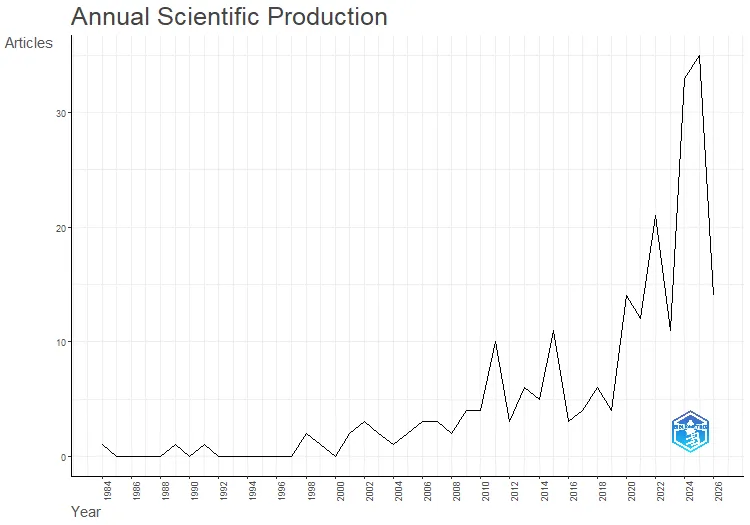
Source: Supplied Biblioshiny report based on Scopus records. Note: 2026 is a partial year.
Figure 1. Annual scientific production, 1984-2026
4.2 Citation structure and influential market-facing studies
The most globally cited document in the full corpus is Krishnaswamy et al. (2013) with 119 citations, although its principal contribution is ecological rather than marketing-oriented. The strongest market-facing citation signal comes from Sabu and Kumar (2020), whose predictive analytics study on forecasting arecanut prices in Kerala records 116 citations and the highest citation-per-year rate among the leading documents. This result is substantively important: the most visible explicitly market-related paper in the dataset is not a conventional marketing-mix study but a data-analytics contribution to price forecasting.
Other influential market-facing works reveal a different intellectual lineage. Croucher and Islam (2002) connect areca-nut use to socio-economic contexts, while Sharp's studies of Melanesian betel-nut trade examine traders, relational transactions, marketplaces, middlemen, and moral economy (Sharp, 2013, 2016, 2019). Together, these papers establish that channel behavior is shaped by social institutions and exchange relationships. On the production side, resource-use and farm-system studies demonstrate the economic significance of diversification and sustainable management (Nath et al., 2011; Paramesh et al., 2019; Sujatha et al., 2011; Sujatha & Bhat, 2015). More recent market-facing records turn toward product adaptation, biodegradable value chains, demand elasticity, and consumer preference (Chaitra, 2024; Dewi et al., 2025; Futrinelsa et al., 2025; Koeslulat et al., 2024). The citation structure therefore reflects a transition from foundational socio-economic and production studies toward analytics and market creation, with the newest contributions not yet old enough to accumulate comparable citation counts.
|
Study |
Primary lens |
Focus |
TC |
Interpretive contribution |
|
Sabu & Kumar (2020) |
Price |
Forecasting prices of arecanuts in Kerala |
116 |
Predictive analytics links market intelligence to price decisions. |
|
Croucher & Islam (2002) |
Market context |
Socio-economic aspects of areca nut use |
45 |
Shows that consumption and exchange are embedded in social and economic conditions. |
|
Sharp (2013) |
Place |
Traders in the making of a Melanesian market |
19 |
Positions traders as active market makers rather than passive intermediaries. |
|
Sharp (2016) |
Place |
Relational transactions in Papua New Guinea trade |
18 |
Highlights relational value and non-price dimensions of exchange. |
|
Sharp (2019) |
Place |
Marketplaces, middlemen and moral economy |
13 |
Extends channel analysis to bargaining and moral economy. |
|
Aithal & Dasgupta (2018) |
Product/market growth |
Tamul Plates Marketing: growth challenge |
1 |
Connects arecanut-derived products with scaling and market-development decisions. |
|
Chaitra (2024) |
Product/place |
Leaf-sheath plate and bowl value chain |
1 |
Illustrates circular value addition and value-chain reconfiguration. |
|
Koeslulat et al. (2024) |
Product |
Product adaptation to enhance the areca-nut market |
1 |
Makes product adaptation an explicit market-development mechanism. |
|
Futrinelsa et al. (2025) |
Price/demand |
Global market position and demand elasticities |
0 |
Introduces demand-system analysis for export competitiveness. |
|
Dewi et al. (2025) |
Product/consumer |
Consumer preference for betel-nut coir handicraft paper |
0 |
Brings formal consumer preference analysis into residue-based product design. |
Source: Authors' synthesis from the Biblioshiny document and citation outputs. TC = total citations in the supplied report; very recent papers are citation-disadvantaged by publication age.
Table 3. Representative market-facing documents and their contribution to the emerging marketing architecture
4.3 Conceptual structure: three connected but uneven knowledge domains
The keyword co-occurrence network separates into three visually distinct but connected communities. The first cluster is dominated by human, humans, betel nut, areca, smoking, health promotion, and related consumption terms. The second is dominated by article, adult, male, female, Taiwan, prevalence, and risk-related terms. The third is organized around Areca catechu, India, sustainable development, sustainability, agriculture, crops, agroforestry, natural fibers, cellulose, and related production or material themes. This structure explains why a market-oriented search still contains a substantial health and epidemiological footprint: arecanut markets cannot be separated cleanly from consumption practices and health-sensitive demand, while the crop's production and residue streams increasingly connect to sustainability and materials research.
Centrality measures reinforce this interpretation. In the co-word network, human (PageRank 0.0607), article (0.0532), humans (0.0511), male (0.0480), female (0.0433), and adult (0.0431) remain structurally prominent. However, sustainable development (0.0250), Areca catechu (0.0248), and India (0.0213) form the most important non-health bridge into the rapidly growing sustainability-production domain. The thematic map similarly identifies an 'areca catechu' cluster with the highest cluster frequency (665) but lower Callon centrality and density than the two health-demographic clusters, placing it in the emerging/declining quadrant of the specific map configuration. In context, the trend-topic evidence strongly suggests emergence rather than decline: sustainability and sustainable development have median topic years of 2024, and arecanut itself has a median year of 2024.
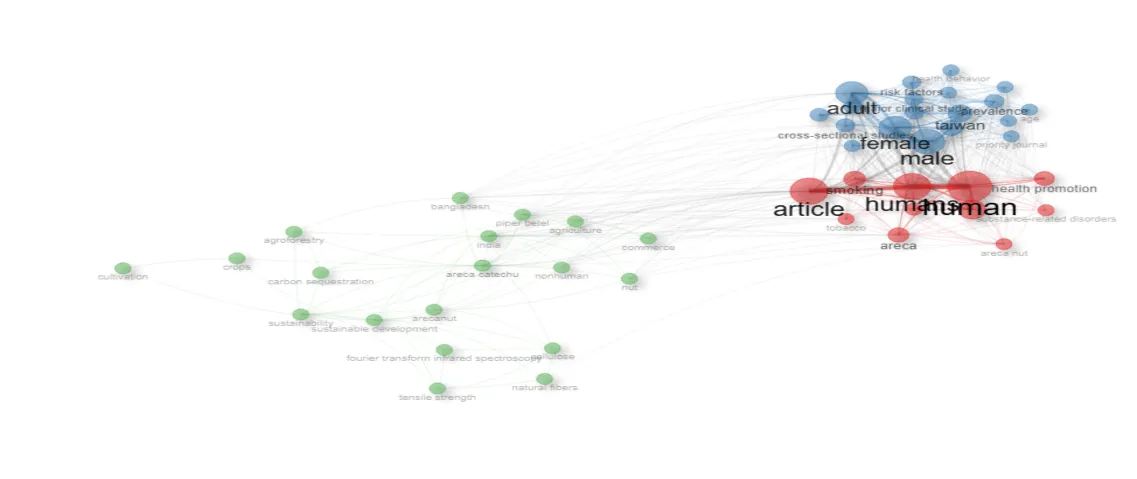
Source: Supplied Biblioshiny report based on the merged keyword field. Node size reflects prominence; colors indicate network communities.
Figure 2. Keyword co-occurrence network and major conceptual communities
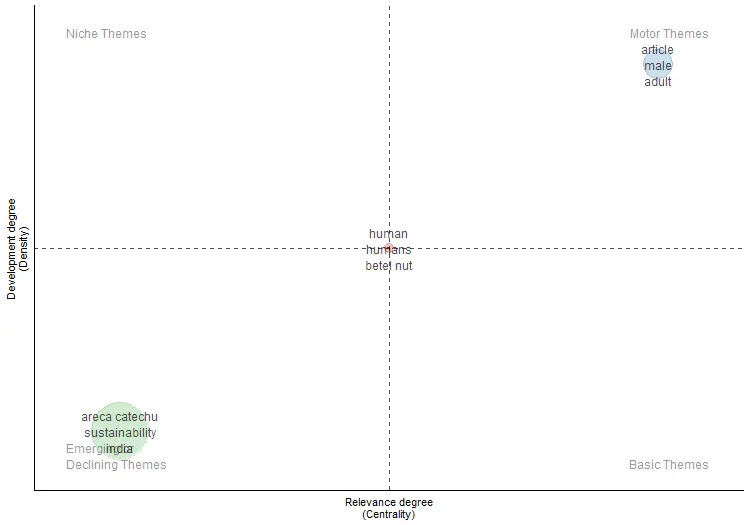
Source: Supplied Biblioshiny report. Interpretation follows Callon centrality (relevance) and density (development).
Figure 3. Thematic map of the arecanut market-related knowledge base
4.4 Temporal evolution: from marketing and socio-economic concerns to sustainability and circular value creation
Trend-topic analysis provides the clearest evidence of field evolution. 'Marketing' has a median topic year of 2006, with its interquartile activity concentrated broadly in the 2002-2010 period. In contrast, current vocabulary is dominated by sustainability-oriented terms. Sustainability has a frequency of 25 and median year 2024; sustainable development has a frequency of 23 and median year 2024; arecanut has a frequency of 17 and median year 2024; livelihood has a median year 2023; agroforestry 2021; and biomass and cost effectiveness both have median years of 2025. The intellectual center of gravity has therefore shifted from generic market and socio-economic description toward questions of sustainability, livelihood, productive efficiency, material use, and value creation.
|
Topic |
Frequency |
Q1 year |
Median year |
Q3 year |
Interpretation |
|
Marketing |
7 |
2002 |
2006 |
2010 |
Early explicit marketing vocabulary; limited recent centrality. |
|
Agroforestry |
9 |
2021 |
2021 |
2024 |
Links crop systems with livelihood and sustainability. |
|
Areca nut |
22 |
2020 |
2022 |
2024 |
Renewed crop-specific research identity. |
|
Livelihood |
6 |
2021 |
2023 |
2025 |
Growing emphasis on household/farmer welfare. |
|
Sustainability |
25 |
2021 |
2024 |
2024 |
Dominant recent organizing concept. |
|
Sustainable development |
23 |
2022 |
2024 |
2025 |
Strong and continuing recent theme. |
|
Arecanut |
17 |
2020 |
2024 |
2025 |
Recent consolidation around crop-specific terminology. |
|
Biomass |
5 |
2024 |
2025 |
Emergent circular-economy and residue-valorization focus. |
|
|
Cost effectiveness |
5 |
2024 |
2025 |
Emergent economic-performance orientation. |
|
|
Crops |
9 |
2021 |
2025 |
2025 |
Recent production-system emphasis. |
Source: Authors' compilation from the Biblioshiny Trend Topics output.
Table 4. Selected trend topics indicating the temporal shift in the literature
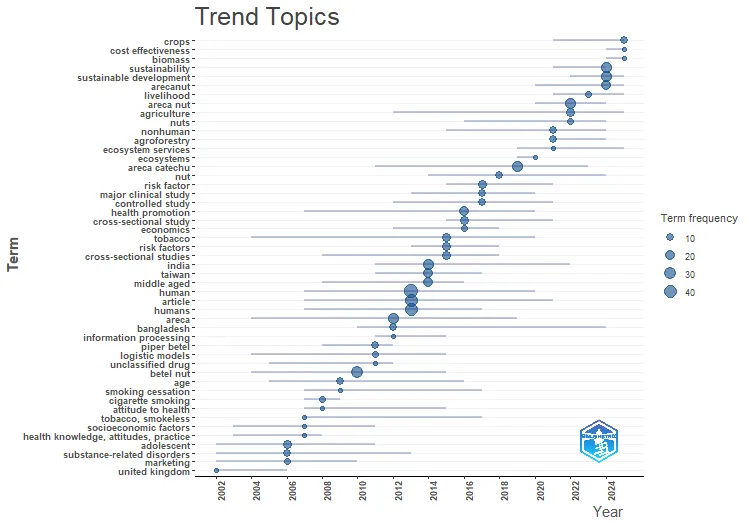
Source: Biblioshiny report. Bubble size represents term frequency; horizontal lines indicate the topic-year interquartile range.
Figure 4. Trend topics in the arecanut market-related literature
4.5 Decoding the marketing mix from the bibliometric evidence
The 4P synthesis reveals an asymmetric marketing knowledge architecture. Price is one of the clearest explicit market dimensions because forecasting and demand modeling translate directly into decisions about timing, risk, and competitiveness. Sabu and Kumar (2020) demonstrate the visibility of predictive price analytics, while Futrinelsa et al. (2025) extend the economic lens to demand elasticities and global market position. This suggests a move from descriptive price studies toward analytical market intelligence. Place is the most conceptually mature dimension. The literature on traders, marketplaces, middlemen, relational exchange, and cooperative structures shows that arecanut distribution cannot be reduced to channel length or marketing margins. Sharp's work, in particular, demonstrates that intermediaries create market access, information, liquidity, and social coordination (Sharp, 2013, 2016, 2019). For future work, this insight should be connected with modern supply-chain analytics, digital platforms, traceability, and producer organizations. Product is the fastest-expanding dimension. The literature is moving beyond crop output toward differentiated, value-added and residue-derived offerings. Mula et al. (2018) examine value addition and processing economics; Aithal and Dasgupta (2018) focus on the growth challenge of arecanut-derived plates; Chaitra (2024) maps the value chain for biodegradable leaf-sheath plates and bowls; Koeslulat et al. (2024) explicitly address product adaptation; and Dewi et al. (2025) analyze consumer preferences for a coir-fiber product. This body of work is highly consistent with the recent prominence of sustainability, biomass, and cost effectiveness in the trend-topic analysis.
Promotion is the least developed dimension. Brand awareness and market-development concerns appear in isolated case-oriented records, but promotion does not emerge as a major network theme. This absence is theoretically consequential. New value-added products cannot scale through production innovation alone; they require positioning, segmentation, communication, trust formation, and evidence on consumer response. Moreover, promotion of the nut for direct consumption sits within a health-sensitive environment, making responsible communication and regulatory alignment a central rather than peripheral issue. The bibliometric gap therefore points to a distinctive future research domain: responsible promotion that separates claims about traditional consumption, food products, and non-food circular products while examining how risk perceptions affect demand.
|
Dimension |
What the literature currently shows |
Key market-dynamics interface |
Priority research gap |
|
Product |
Processing, product adaptation, leaf-sheath products, coir/fiber applications, circular value addition |
Diversification, quality, product-market fit, willingness to pay |
Segment-specific product design; consumer acceptance; certification; portfolio strategy; whole-palm value capture |
|
Price |
Price forecasting, processing economics, demand elasticity, cost effectiveness |
Volatility, farm-gate realization, export competitiveness, risk |
Real-time price intelligence; causal drivers of volatility; transmission across farm-wholesale-retail/export levels; willingness-to-pay studies |
|
Place |
Traders, middlemen, marketplaces, cooperatives, relational transactions, value chains |
Bargaining power, liquidity, access, transaction costs, coordination |
Digital platforms; traceability; cooperative vs private-channel performance; gendered intermediation; producer share of final value |
|
Promotion |
Sparse brand-awareness and market-development evidence |
Demand creation, risk perception, trust, regulation |
Responsible communication; branding of sustainable products; health-risk framing; digital promotion; message effects on different consumer segments |
|
Cross-cutting emerging themes |
Sustainability, sustainable development, biomass, livelihood, agroforestry, analytics |
Structural transformation of the market system |
Integrate 4Ps with circular economy, farmer livelihoods, digital analytics, export strategy, and responsible consumption |
Source: Authors' integrative synthesis of the Biblioshiny results and verified market-facing studies.
Table 5. Integrated 4P-market dynamics framework and incremental research agenda
5. Discussion
5.1 The field is growing faster than its marketing theory
The central finding is not simply that arecanut scholarship is expanding; it is that the field's market relevance is expanding faster than its explicit marketing theory. More than three-fifths of the corpus has appeared since 2020, but the keyword 'marketing' belongs primarily to an earlier topic period. Recent scholarship instead uses the vocabularies of sustainability, livelihood, biomass, crops, agroforestry, cost effectiveness, consumer preference, and analytics. This indicates a conceptual lag: researchers are studying market-shaping phenomena without consistently integrating them into a common marketing architecture.
This lag creates both a weakness and an opportunity. It is a weakness because the field can become a collection of disconnected technical advances - a better fiber, a new biodegradable product, a more accurate price model, or a richer account of trader behavior - without explaining how these advances jointly create value for farmers, intermediaries, firms, consumers, and communities. It is an opportunity because arecanut provides a setting in which marketing theory can be extended into an agricultural market system characterized by informality, cultural embeddedness, sustainability pressures, and competing consumption narratives.
5.2 The incremental contribution: from 4Ps to an integrated arecanut market system
The first incremental contribution is the identification of an uneven 4P structure. Price and place are comparatively established because agricultural economics and economic anthropology have long studied prices, traders, marketplaces, intermediaries, and institutions. Product is now catching up rapidly because circular-economy and sustainability research has expanded the range of marketable outputs. Promotion remains the missing piece. This diagnosis differs from a conventional review that would simply list themes; it evaluates the field in terms of managerial completeness and reveals where future marketing scholarship can add disproportionate value.
The second contribution is the recognition that the 'product' in arecanut marketing is becoming a portfolio rather than a single commodity. Leaf sheath, husk, coir, fiber, biomass, and processed outputs create multiple downstream markets. Once this transition is recognized, questions of segmentation, brand architecture, channel choice, quality assurance, consumer preference, and pricing can no longer be treated independently. The marketing system becomes a portfolio-allocation problem in which different parts of the crop may enter food, household, packaging, industrial, agricultural, or environmental markets with distinct customers and regulatory conditions.
The third contribution is the integration of responsible consumption into market analysis. The strong health-consumption clusters in the co-word network are not merely irrelevant noise. They show that the demand side of arecanut is structurally entangled with health behavior, risk perception, and public policy. For direct-consumption products, marketing decisions therefore operate within a legitimacy and responsibility constraint. For non-consumption value-added products, by contrast, the same crop can be repositioned around biodegradability, waste utilization, local livelihoods, or renewable materials. Future scholarship should examine how these contrasting narratives influence brand meaning, stakeholder acceptance, and channel strategy.
The fourth contribution concerns data and digitalization. The citation prominence of price forecasting suggests that market intelligence is a high-value research direction (Sabu & Kumar, 2020). Yet forecasting should be connected to decision systems: when should farmers sell, how should cooperatives manage inventories, how do price signals travel across markets, and can mobile platforms improve bargaining power? Similarly, demand elasticity and consumer preference models should feed directly into export and product-development strategy (Dewi et al., 2025; Futrinelsa et al., 2025). This moves the literature from prediction toward actionable marketing analytics.
5.3 Implications for scholars, practitioners, and policy
For scholars, the results suggest that future studies should be designed around cross-level mechanisms rather than isolated variables. A useful study might connect farm-level quality and sustainability practices to product differentiation, channel selection, price premiums, and farmer income. Another might test whether traceability or eco-labeling changes willingness to pay for leaf-sheath products while measuring how much of the premium reaches producers. Such designs would connect marketing outcomes to agricultural and livelihood consequences.
For cooperatives, processors, and entrepreneurs, the findings imply that value addition requires simultaneous attention to product-market fit, cost structure, distribution, and credible communication. The newest residue-based products are unlikely to scale only because they are biodegradable. They must outperform or meaningfully differentiate themselves from substitutes on convenience, quality, aesthetics, price, availability, and verified sustainability attributes. Market-development research should therefore move from technical feasibility to adoption and repeat-purchase behavior.
For policy makers, the results highlight three priorities. First, market infrastructure should improve transparency and farmer access to timely price information. Second, support for value-added enterprises should include market research, standards, certification, and channel development rather than focusing only on production technology. Third, policies affecting direct arecanut consumption should recognize the interaction between demand, livelihoods, public-health objectives, and communication practices. The objective is not to collapse these concerns into a single policy goal but to make trade-offs explicit and evidence based.
6. Future Research Agenda
The next phase of arecanut marketing research should prioritize research designs that integrate at least two levels of the market system. Six directions appear especially promising:
A further methodological priority is stronger corpus discipline. Because arecanut is studied in medicine, public health, ethnobotany, agriculture, materials science, and commerce, broad search strings can retrieve records that are only indirectly connected to marketing. Future bibliometric studies should report both a broad market-system corpus and a manually screened core marketing corpus, ideally with transparent inclusion decisions and inter-rater agreement. This would preserve interdisciplinary discovery while improving construct validity.
7. Limitations
This study has four limitations. First, it relies on Scopus and therefore reflects the database's coverage, indexing decisions, and citation counts. Relevant local-language journals, theses, reports, cooperative publications, and policy documents may be underrepresented. Second, the 2026 publication count is incomplete because the search was conducted in August. Third, the search deliberately used a broad market-related vocabulary, and the resulting corpus remains multidisciplinary despite exclusion of several medical and toxicological terms. The presence of health and materials clusters is analytically informative but also means that the corpus should not be interpreted as 224 conventional marketing papers. Fourth, bibliometric co-occurrence measures identify structural association rather than causal relationships or substantive quality. The interpretive 4P synthesis therefore complements, rather than replaces, close reading and future systematic review.
CONCLUSION
This study decodes four decades of arecanut market-related scholarship and shows a field in transition. Publication activity has accelerated sharply, with 62.5% of the corpus appearing from 2020 onward. Yet the strongest recent themes are not explicitly labeled marketing. They are sustainability, sustainable development, livelihood, agroforestry, biomass, cost effectiveness, consumer preference, and analytics. The field's central challenge is therefore integration.
The bibliometric evidence supports a clear interpretation of the marketing mix. Price research is moving toward forecasting and demand analytics; place research has a deep foundation in traders, middlemen, marketplaces, and relational exchange; product research is expanding quickly through processing, adaptation, and circular value addition; promotion remains markedly underdeveloped. The most important incremental contribution is to connect these uneven 4P streams with wider market dynamics - farmer livelihoods, cooperative and informal institutions, responsible consumption, sustainability, and digital market intelligence. Doing so can shift arecanut research from fragmented studies of a crop and its by-products toward a coherent theory and evidence base for sustainable market-system development.
Data Availability and Transparency Statement
The analysis is based on Scopus bibliographic records and the Biblioshiny/Bibliometrix report supplied for this study. The complete search logic, search date, corpus size, and analytical procedures are reported in the manuscript to support reproducibility. Redistribution of raw Scopus records may be subject to Scopus licensing conditions.
Conflict of Interest
The authors declare that they have no known competing financial interests or personal relationships that could have influenced the work reported in this study.
Declaration of Generative AI and AI-Assisted Technologies
Generative artificial intelligence tools were used to assist with language refinement, organization, and editorial improvement of the manuscript. The authors critically reviewed, verified, and revised the generated material and take full responsibility for the accuracy, interpretation, originality, citations, and final content of the manuscript.
Informed Consent
Not applicable. The study did not involve human participants or the collection of primary data.
REFERENCES

Raghavendra Prasad N.¹*, Savitha V.², Decoding Arecanut Marketing: A Bibliometric Analysis Of Marketing Mix, Market Dynamics, And Emerging Themes, Int. J. Sci. R. Tech., 2026, 3 (9), 163-177. https://doi.org/10.5281/zenodo.22329655
 10.5281/zenodo.22329655