

We use cookies to ensure our website works properly and to personalise your experience. Cookies policy
MSPM’s Shri Shivaji Institute of Engineering and Management Studies Basmat Road, Parbhani – 431401, Maharashtra, India
Engineering colleges across India face a critical challenge, with approximately 28% of enrolled students failing to complete their degrees on time. In regions like Vidarbha, Maharashtra, this rate is exacerbated by localized financial stress, first-generation academic backgrounds, and constrained support systems. Traditional College Management Systems (CMS) are strictly reactive, flagging academic distress only after semester results are declared—months too late for meaningful intervention. Furthermore, standard institutional data tracking suffers from critical gaps: paper registers yield zero analytical insights , and standard RFID-based attendance logging is highly vulnerable to rampant proxy attendance, where cards are passed between peers. Consequently, key behavioral indicators from attendance, laboratory engagement, and continuous assessments (CA) are never correlated, leaving both faculty and at-risk students unaware of structural failure trajectories until they become irreversible. The system establishes a dual-capture attendance node at the classroom door using a Raspberry Pi Zero W integrated with an RC522 RFID reader and a Pi Camera. When a student taps an RFID card, the system reads the roll number and instantly triggers a face capture within one second. Using an OpenCV preprocessing pipeline and a local face_recognition (dlib) and DeepFace framework, the live face embedding is compared against a pre-enrolled 128-dimensional mathematical vector using a Cosine Similarity threshold of 0.6. Verified logs are saved as PRESENT_VERIFIED to a local SQLite database via MQTT over Wi-Fi , while mismatches blink a red hardware LED and dispatch real-time proxy alerts to faculty via WhatsApp. The system effectively maps directly onto the Dr. Babasaheb Ambedkar Technological University (BATU) Semester VI B.E. CSE curriculum, demonstrating immediate academic and institutional validation through a scheduled two-week live classroom pilot. Beyond its primary deployment as an internal early-warning dashboard with automated Twilio SMS and WhatsApp alerts , EduSense establishes the foundation for a scalable EdTech SaaS enterprise viable for India’s 10,000+ engineering colleges. Future iterations will expand this framework by replacing weekly snapshot ensembles with Long Short-Term Memory (LSTM) recurrent networks to capture gradual temporal disengagement, and incorporating federated learning paradigms to securely scale model training across multiple institutions simultaneously without consolidating raw student data.
EduSense is an IoT-enabled, AI-powered early academic risk detection system tailored for engineering colleges in India. It proactively monitors student engagement metrics to predict academic failure up to six weeks before it becomes irreversible.
Engineering colleges face a persistent crisis where approximately 28% of enrolled students do not complete their degree on time (AICTE, 2023). This issue is particularly pronounced in regions like Vidarbha, Maharashtra, due to localized financial stress, first-generation student backgrounds, and limited academic support systems.
1.1. Key Gaps in Existing College Management Systems
Existing legacy systems operate strictly reactively, flagging student failure only after semester results are declared. The proposal identifies six critical gaps:
1.2. System Architecture & Core Modules
The proposed system upgrades traditional infrastructure into a proxy-resistant biometric system by stacking a dual-capture attendance mechanism into a six-layer machine learning pipeline.
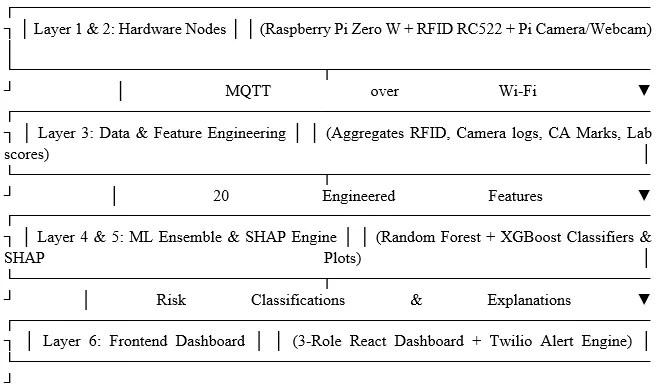
1.3. Detailed Layer Breakdown
2.Camera, Face Recognition, & Verification Workflow
This module serves as the primary upgrade to eliminate proxy attendance with zero structural friction for honest students.
2.1. Step-by-Step Verification Protocol
2.2 Component Stack & Estimated Hardware Budget
The hardware is designed for extreme cost efficiency, relying heavily on existing lab resources:
|
Component |
Recommended Model |
Purpose |
Estimated Cost |
|
Camera |
Pi Camera v2 / v3 or Logitech C270 |
Primary face capture |
₹700 – ₹1,200 |
|
Processors |
Raspberry Pi Zero W |
Central processing node (or borrow from IoT lab) |
Institutional Lab Resource |
|
Card Reader |
RC522 Reader Module + 10 Cards |
Contactless ID tokens |
Included in node |
|
Indicators |
5mm Red & Green LEDs |
Visual feedback for verification status |
₹40 |
|
Enclosure |
Acrylic Mount |
Fixed positioning on door frame (3D printed/DIY) |
₹150 |
|
Total Out-of-Pocket Hardware Budget |
|
|
₹2,370 (if not using lab stock) |
3.Feature Engineering: 20 Behavioral Risk Signals
EduSense relies on a comprehensive, multimodal feature set updated weekly. The integration of the camera adds two predictive parameters that identify disengagement before marks drop:
3.1. Machine Learning Model Training Plan
The system targets performance benchmarks of Precision >90%, Recall >88%, F1 Score >89%, and ROC-AUC >0.92.
Implementation Methodology
3.2. Syllabus Alignment (BATU Semester VI B.E. CSE)
The architecture map validates practical application by directly supporting five courses in the active university curriculum:
3.3. Privacy, Security, & Ethical Safeguards
To comply with India’s Personal Data Protection Bill (PDPB) guidelines for handling biometric records, the system enforces a strict privacy framework:
4. Implementation Timeline & Team Responsibilities
The project is structured as a 12-Week Development Cycle split among four team members:
4.1. 12-Week Phase Milestones
4.2. Team Role Matrix
4.3. Research, Startup, & Commercial Potential
The proposal outlines concrete steps for both academic publication and commercialization as an EdTech SaaS product.
Research Contributions & Publication Venues
The team intends to publish a paper titled: "EduSense: A Real-Time IoT-Augmented Explainable Ensemble Learning Framework with Face-Verified Attendance for Early Academic Risk Detection in Engineering Education". Key publishable novelties include streaming real-time hardware data feeds, introducing anti-proxy camera verification features, and utilizing SHAP for educational model interpretability.
Target venues include IRJET/IJERT (Month 4), IEEE ICCCA 2026 (Months 4-5), IEEE Access (Months 5-6), or Computers & Education (Elsevier) Commercialization & Scaling Roadmap
The team outlines a 5-year rollout strategy leveraging available seed capital like the Startup India Seed Fund (₹20L), AICTE Idea Lab, MeitY Startup Hub, and the BATU Incubation Centre:
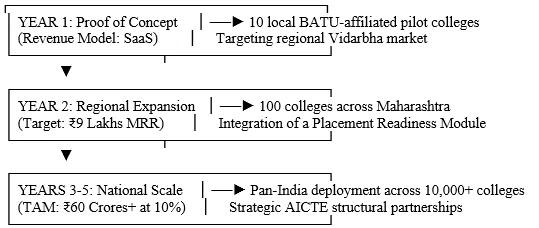
CONCLUSION
The EduSense framework transitions educational infrastructure from a reactive, post-facto evaluation model to a proactive, early-warning paradigm tailored for Indian engineering colleges. By addressing the critical structural limitations of legacy systems—namely, undetected temporal student disengagement and vulnerable paper-register or card-only attendance logs—this project implements a secure, six-layer predictive pipeline. The operational marriage of a low-cost IoT edge device with computer vision models establishes a dual-capture attendance mechanism that mitigates the prevalence of proxy card-tapping. Simultaneously, transforming raw academic inputs, laboratory submissions, and attendance slopes into 20 multi-modal behavioral risk signals enables high-accuracy classification through an optimized Random Forest and XGBoost ensemble.
Future iterations of the system will look beyond static snapshot classification by implementing Long Short-Term Memory (LSTM) recurrent networks to analyze sequential, time-series shifts in student disengagement across multiple semesters. To scale the platform into a national enterprise without compromising institutional boundaries, future research will explore federated learning architectures. This approach will allow multi-institutional collaborative model training without combining raw, sensitive localized student datasets. Ultimately, EduSense demonstrates that fusing affordable IoT equipment with advanced, explainable artificial intelligence provides a scalable path to stabilizing engineering student retention, mitigating backlogs, and improving long-term graduation rates
REFERENCES






Pranita G. Bais, Syed Asif Syed Gaffar*, Arpita Mukund Jondhale, Gayatri Shriram Bharose, Vinod K. Pawar, Anand K. Pathrikar, EduSense - A Real-Time IoT-Augmented Explainable Ensemble Learning Framework with Face-Verified Attendance for Early Academic Risk Detection in Engineering Education, Int. J. Sci. R. Tech., 2026, 3 (9), 710-716. https://doi.org/10.5281/zenodo.23115562
 10.5281/zenodo.23115562