

We use cookies to ensure our website works properly and to personalise your experience. Cookies policy
1Department of Business Administration & Management, Hussaini Adamu Federal Polytechnic, Kazaure, Jigawa State. Nigeria
2Centre for Entrepreneurship and Skills Development, Hussaini Adamu Federal Polytechnic, Kazaure, Jigawa State. Nigeria
This research study empirically investigated the effect of organisational justice on employee work engagement in the tertiary institutions in North-West Nigeria. Its specific objectives were to examine the effect of distributive, procedural and interactional justice on employee work engagement in the tertiary institutions North-West Nigeria. To achieve these objectives, the study adopted the cross sectional survey research design. It specifically made use of data collected from four hundred and one (401) staff of the tertiary institutions in North-West Nigeria. Data collected were analysed with descriptive and Ordinary Least Square regression. The findings of the study revealed that organisational justice has significant effect on employee work engagement in the tertiary institutions in North-West Nigeria. It was also revealed that each of the dimensions of organisational justice: distributive, procedural and interactional justice, positively and significantly affect employee work engagement in tertiary institutions of North-West Nigeria. From these findings, the study recommended that managements of the tertiary institutions in North-West Nigeria should increase their efforts in rewarding employees according to their workload, work completed, work contributed, relevant skills and educations acquired, increase effort in promoting those policies or procedures; provide employees with accurate, timely and adequate information to perform their job and ensure all employees are treated with politeness, dignity, kindness, consideration.
1.1 Background of the Study
Employee engagement is considered a highly central topic in management, attracting attention from both researchers and professionals alike (Saks 2022). Employee engagement, traditionally situated in the realm of human resource management, is now expanding into broader organizational contexts due to its beneficial effects in terms of various aspects, such as business, service, and operational effectiveness (Turner 2020). Engaged employees demonstrate strong commitment to their organization, showing no intention to leave while actively pursuing self-improvement, taking initiative, innovating, and maintaining high accuracy in their work (Schaufeli 2021).
Employee work engagement is a factor critical to organizations performance in today’s cutthroat environment. Organizational justice and awareness are linked to improving employee engagement, according to studies on good organization performance. There is a direct correlation between staff engagement and those variables, although few researchers have discovered it. Increased focus and an unbiased awareness of current occurrences, including emotional, mental, and bodily sensations, characterize the flexible state of self-awareness (Jain et al., 2023).
In today's fast-paced and competitive business environment, organizations are constantly seeking ways to improve employee performance, productivity, and job satisfaction. One crucial aspect that has gained significant attention in recent years is organizational justice. Organizational justice refers to the perceived fairness and equity in the workplace, encompassing distributive, procedural, and interactional justice (Colquitt, 2001). Organizational justice has three primary components: procedural, distributive, and interactive justice (Mengstie, 2020). Procedural justice refers to the fairness of decision-making processes, while distributive justice pertains to the allocation of resources and outcomes (Colquitt, 2001). Interactive justice involves the quality of treatment individuals receive during the implementation of procedures.
Employees feel obligated to engage themselves in role and extra role performance when they perceive justice in an organization (Eder & Eisenberger, 2015). However, most organizations in Nigeria do not promote fairness in dealing with employees even when they are the most critical resource in the organization whose actions and inactions determine the success of the organization (Oge, Ifeanyi & Charles-Gozie, 2015). According to Oge et al (2015) injustice in Nigeria workplace has been increasing at an alarming rate. It is reflected in reward distribution, interpersonal treatment and even in the policies and procedure developed by some organizations. In most cases these policies and procedures are unclear, or immeasurable to those who design them. The unfair and deplorable working conditions employees experience result in tardiness, strikes, workplace assault, extensive absenteeism, sabotage (Efanga & Akpan, 2015). These have also negatively affected psyche and morale of most Nigerian employees; making them unable to deliver on their job description (Igbinomwanhia & Akinmayowa, 2013). Perceived injustice occasioned by unresponsiveness to workers plight, wage increment and better-working conditions, regular promotion and employers’ unwillingness to fulfil contractual obligation with employees have made most
Nigerian workers unenthusiastic in performing their duties (Amazue, Nwatu, Ome, & Uzuegbu, 2016). This has created the impression that Nigerian employees are not engaged when in actual fact it is the perceived unfairness in workplace that make workers dissatisfied and thus lack of lack of work engagement (Karatepe, 2011).
Employee work engagement, on the other hand, is a critical outcome that organizations strive to achieve, as it is linked to improved job performance, reduced turnover, and enhanced overall well-being (Bakker & Demerouti, 2008). Work engagement is characterized by vigour, dedication, and absorption, and is considered a key driver of organizational success.
The importance of organizational justice and employee work engagement cannot be overstated. Research has shown that when employees perceive their organization as just and fair, they are more likely to experience increased job satisfaction, organizational commitment, and work engagement (Colquitt, 2001; Ehrhardt & Ragins, 2019). Conversely, when employees perceive their organization as unjust and unfair, they are more likely to experience decreased job satisfaction, organizational commitment, and work engagement (Colquitt, 2001; Ehrhardt & Ragins, 2019).
1.2 Statement of Problem
Organizations strive to enhance employee work engagement as a critical driver of productivity, job satisfaction, and organizational success. However, disparities in perceptions of fairness and equity collectively termed organizational justice can significantly impact employees' motivation and engagement levels. Despite the growing body of research on these topics, there is limited understanding of how specific dimensions of organizational justice (distributive, procedural, and interactional) influence employee work engagement in diverse organizational settings. This gap in knowledge presents a challenge for organizations seeking to foster a fair work environment while maintaining high levels of employee engagement. Addressing this issue is essential for designing targeted strategies that promote both justice and engagement within the workforce. Specifically, in Nigeria it is essential to investigate how organizational justice affects employee work engagement, because the topic is very much less studied in Nigeria as this can provide valuable insights for government and organizations alike to improve employee motivation, retention, and overall performance.
1.3 Research Questions
Based on the research problem, the following research questions are proposed:
1. To what extent does distributive justice effect employee work engagement?
2. To what extent does procedural justice effect employee work engagement?
3. To what extent does interactional justice effect employee work engagement?
1.4 Objectives of the study
The main objective of this study is to examine the effect of organizational justice on employee work engagement of tertiary institutions in Nigeria.
The objectives of this study are:
1. To investigate the impact of distributive justice on employee work engagement.
2. To investigate the impact of procedural justice on employee work engagement.
3. To investigate the impact of interactional justice on employee work engagement
1.5 Research hypothesis
To achieve the objectives of the study, alternative hypotheses were formulated as follows:
H01 Distributive justice has no effect on employee work engagement
H02 Procedural justice has no effect on employee work engagement
H03 Interactional justice has no effect on employee work engagement
1.6 Significance of the Study
This study aims to contribute to the existing literature on organizational justice and employee work engagement by providing insights into the relationship between these two constructs. The findings of this study can help organizations develop strategies to improve employee work engagement, reduce turnover, and enhance overall performance.
This study holds vital importance for both academic and practical purposes. Understanding the influence of organizational justice dimensions; distributive, procedural, and interactional on employee work engagement addresses a critical gap in existing research. By unravelling these dynamics, the study contributes to the broader field of organizational behaviour, offering theoretical advancements in understanding the interconnectedness of justice perceptions and work engagement.
For organizations, the study provides actionable insights to develop policies and practices that foster fairness and equity in the workplace. By promoting organizational justice, employers can enhance employee motivation and engagement, resulting in higher productivity, improved job satisfaction, and overall organizational success. Furthermore, this research has the potential to help organizations navigate diverse workforce settings, tailoring their strategies to meet unique challenges while maintaining a fair and engaging work environment.
The significance of this study can be seen from several perspectives:
- Theoretical significance: This study contributes to the understanding of the relationship between organizational justice and employee work engagement, which is a critical aspect of organizational behaviour.
- Practical significance: The findings of this study can provide valuable insights for organizations to improve employee motivation, retention, and overall performance.
- Methodological significance: This study employs a quantitative approach, which provides a rigorous and systematic method for examining the relationship between organizational justice and employee work engagement.
1.7 Scope of the Study
This study will focus on the relationship between organizational justice and employee work engagement in the context of tertiary institutions in North-west Nigeria. The study is to be conducted using Hussaini Adamu Federal Polytechnic Kazaure, Kano state Polytechnic as well as Sa’adatu Rimi College of Education, Kano. The study will use a quantitative approach, collecting data through surveys from employees in selected tertiary institution.
CHAPTER TWO
LITERATURE REVIEW
2.1 Introduction
In this chapter, attempt is made to conceptually and thematically review some concepts and relevant works done by scholars and other researchers related to organizational and employee work engagement
Organizational Justice
2.2 Employee Work Engagement
Employee work engagement refers to a positive, fulfilling, work-related state of mind that is characterized by vigour, dedication, and absorption (Schaufeli & Bakker, 2004). Work engagement is critical for organizations, as it is linked to improved job performance, reduced turnover, and enhanced overall well-being (Bakker & Demerouti, 2008).
Employee engagement is associated with a positive and constructive state of mind concerning work, which contributes to the overall development of the organization. It is an indication of the positive attitude that workers bring to their tasks (Saks 2022). Engaged employees can invest their best efforts into their work when they are dedicated and committed to this work (Van Tuin et al. 2021). Employee engagement is a significant force in an organization that reflects the degree of staff attitudes toward their work, particularly their dedication and proficiency in communicating with the organization. Generally, engagement is concerned with the level and quality of job performance. Additionally, engaged employees are significantly less inclined to depart from the organization (Malik and Garg 2020).
2.3 Organizational justice
Organizational justice is a critical factor influencing employees' perceptions of their workplace. It encompasses three primary dimensions: procedural justice, distributive justice, and interactive justice (Ahmed & Faeq, 2020). Procedural justice refers to the fairness and transparency of decision-making processes, while distributive justice pertains to the allocation of resources, rewards, and outcomes (Colquitt, 2001). Interactive justice involves the quality of treatment individuals receive during the implementation of procedures.
2.4 Distributive justice
Distributive justice is a concept that is rooted in the exchange principle and equity theory (Lambert, 2003; Cook & Hegvedt, 1983) and is assumed to be related to individuals’ ‘‘ends’’ (Sweeney & McFarlin, 1997). This concept focuses on individuals' perceived fairness in the distribution of organizational outcomes (Colquitt et al., 2001; Forsyth, 2006). In essence, distributive justice involves employees comparing their outcomes with those of others, which can trigger emotions such as anger, frustration, and resentment when unfairness is perceived (Yean & Yusof, 2016; Farmer, Beehr & Love, 2003).
Research has shown that employees who perceive unfairness are more likely to experience psychological pressure and engage in aggressive workplace behaviours (Loi, Yang & Diefendorff, 2009; Judge, Scott, & Ilies, 2006). This highlights the importance of distributive justice in maintaining a positive work environment. When employees perceive that they are being treated fairly, they are more likely to trust their organization and exhibit positive job attitudes (Lin et al., 2007).
2.5 Procedural Justice
Procedural justice pertains to the fairness of decision-making processes within organizations, encompassing the mechanisms, methods, and processes utilized to make decisions (O'Callaghan, 2024). Researchers have emphasized the importance of procedural justice due to the limitations of the distributive justice concept. Notably, the absence of procedural justice can lead to increased employee turnover, as employees are more likely to quit their jobs in such circumstances (O'Callaghan, 2024). This highlights the significance of procedural justice in maintaining a stable workforce.
2.6 Interactional Justice
Interactional justice, a related concept, refers to the fair and respectful treatment of individuals within an organization, particularly in interactions with leaders (Colquitt, 2001; Cropanzano & Molina, 2015). Inclusive leadership fosters an environment characterized by openness, information sharing, and encouragement of communication and expression (Linag, Xiyuan, & Fawang, 2020). Research suggests that benevolent leadership, ethical leadership, and servant leadership are associated with interactional justice, which positively influences employees' job satisfaction and performance (Wu et al 2012; Mashi, 2018).
2.6 Relationship between O J and Employee Work Engagement
Research has shown that organizational justice is positively related to employee work engagement (Colquitt, 2001; Ehrhardt & Ragins, 2019). Specifically, distributive justice, procedural justice, and interactional justice have been found to predict employee work engagement (Liao & Rupp, 2005; Masterson et al., 2000). John O. O & Evans O.E (2019) conducted a study on Influence of Organizational Justice on Employee Engagement in Tertiary Institutions in Edo State, Nigeria, the study adopted the cross sectional survey research design. It specifically made use of data collected from four hundred and one (401) staff of the tertiary institutions in Edo State. Data collected were analysed with descriptive and Ordinary Least Square regression. The study revealed that organisational justice has significant influence on employee engagement in the tertiary institutions in Edo State. It also revealed that each of the dimensions of organisational justice: distributional, procedural and interactional positively and significantly influenced employee engagement in the tertiary institutions in Edo State.
According to Oge et al (2015) injustice in Nigeria workplace has been increasing at an alarming rate. It is reflected in reward distribution, interpersonal treatment and even in the policies and procedure developed by some organizations. In most cases these policies and procedures are unclear, or immeasurable to those who design them.
Çetinel, E., (2023). Conducted a study to find an answer to the question of whether organizational justice is an effective factor on work engagement in the context of Türkiye. Within the scope of the research, data were collected from 399 academics working in state and foundation universities in Türkiye and these data were analyzed. As a result of the analyses, it was understood that organizational justice perception positively affects work engagement with all its sub-dimensions, but this effect is at a low level. However, fairness in most organizations in Nigeria is far from reality as Monanu, Okoli, & Adibe (2015) indicated that most organization does not promote fairness in dealing with employee even when employees are a most critical resource in an organization whose actions and inactions determine the success of an organization.
Distributive justice’s impact on employee engagement:
Employee impression of justice is known as distributive justice. When reviewing the outcomes of choices about evaluations of progress, compensation, rewards, and praise, staff members must believe they have received a fair proportion of the assets of the company. By opposing organizational outcomes (such as wages, advancements, civil rights, punishments, incentives, tangible assets, and infrastructure) with outcomes achieved by other people as a point of guidance, employees will develop a sense of equitable distribution based on their job inputs (learning, expertise, abilities, time, energy, mental assets, and effectiveness). Employee behaviour, which in turn affects employee engagement, is eventually affected by all of these emotions (Mulang, 2022). Employees who see equity in distribution as highly valued in their firms are also more likely to feel obligated to play fair roles, contributing more via increased job engagement.
The term “procedural justice” describes how staff members see the logic of the rules, procedures, and guidelines that a firm uses to make decisions. It has to do with the degree of hierarchy whereby administrators or representatives share decisions by protocols and fairly inform staff members (Dong, et al. 2020). Social exchange theories, which claim that connections develop gradually into confidence, loyalty, and devotion provided parties abide by particular exchange norms, are used to explain the influence of procedural equity on worker engagement. Fair decisions may spark bonds of friendship among staff members inside a company, which in turn can generate good vibes and excitement and, eventually, high levels of job engagement. According to the study premise, procedural fairness significantly and favourably affects employee engagement at work.
Interactional justice impact on employee engagement:
When details about company decisions and the mind-sets and habits that workers describe are provided, it is said to be equitable in the eyes of staff members. This is known as interactional justice. Workers look for justice in their dealings with management; when executives and employees are treating each other fairly, workers feel good about their jobs and are more engaged in their duties. Fair relationships between staff members and managers are promoted by interactional justice, which also gives staff members a feeling of pride in their work and a feeling of connection. Greater involvement results from this happy emotion encouraging workers to become more interested in their job. Interactional justice produces a favourable and noteworthy impact on job engagement, according to the study concept.
2.7 Theoretical Frameworks
Several theoretical frameworks can explain the relationship between organizational justice and employee work engagement, including. The present study is grounded on the social exchange theory
Social Exchange Theory and Extrinsic Motivation
Blau (1964) provided a foundation for understanding how social exchange relationships can promote employees to behave in a way that is favourable to their organizations and supervisors. According to Blau's formulation, social exchange relationships are sustained and developed by the expectation of reciprocity. In other words, organizations or supervisors initiate favourable treatment of their employees, expecting that employees will reciprocate by exhibiting positive job attitudes.
Two frequently cited examples of favourable treatment are perceived organizational support (POS) and leader-member exchange (LMX). Engaging in social exchange relationships creates a feeling of obligations on the part of individual employees. This sense of obligation plays a key role in eliciting positive attitudes from employees. Research by Roch et al (2019) found that the sense of obligation to reciprocate is the primary driver behind a healthy exchange relationship between employees and their employers.
2.8 Research Framework
Researchers use conceptual framework to demonstrate and explain the relationship between the variables used in a study. The independent variables in this study are distributive justice and procedural justice and interactional justice, while the dependent variable is employee work engagement.
Organizational Justice
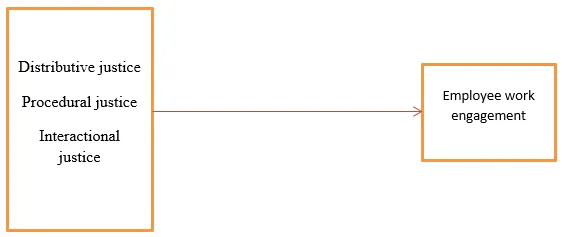
Developed by the researcher
CHAPTER THREE
RESEARCH METHODOLOGY
3.1 Introduction
This chapter describes the method to be adopted in carrying out the study. It presents research design, population of the study, sample size and sampling technique, and instruments of data collection. Other aspects presented in the section are the validation and reliability of the instrument and the method of data analysis and presentation.
3.2 Research Design
This study employs a quantitative research approach, specifically a cross sectional survey design, to investigate the relationship between organizational justice and employee work engagement in the selected tertiary institutions in North-West Nigeria.
3.3 Population of the Study
The whole group of people, objects, events or things that a researcher has interest in investigating is referred to as the population (Sekaran & Bourgie, 2010). While the target population is total collection of elements about which the researcher wishes to make some inferences (Okiro & Ndungu, 2013). The population of this study consist of all the staff of Hussaini Adamu Federal Polytechnic Kazaure, Jigawa state, Kano state Polytechnic, and Sa’adatu Rimi College of Education, Kano.
|
S/N |
INSTITUTION |
POPULATION |
SAMPLE SIZE |
|
1 |
Hussaini Adamu Federal Polytechnic |
1205 |
291 |
|
2 |
Kanom State Polytechnic |
2500 |
333 |
|
3 |
Sa’adatu Rimi College of Education Kano |
2050 |
323 |
|
|
Total |
5755 |
947 |
Table 1
3.4 Sample Size and Sampling Technique
The sample size of the study consists of 291 staff from Hussaini Adamu Federal Polytechnic Kazaure, and 333 staff from Kano state Polytechnic and 323 staff from Sa’adatu Rimi College of education Kano. The sample size was arrived at using Krejcie & Morgan formular (1970). The sampling method will depend on the research design chosen. For a quantitative approach, a random or stratified sampling method may be used to select a representative sample of employees from different departments and levels of the organization; this study will use a random sampling method.
3.5 Method of Data Collection
This study employed a quantitative approach with a correlational non-experimental design. This approach enables the application of statistical analyses to explore connections between variables, evaluating the magnitude and direction of relationships (Rubin & Babbie, 2016). Data will be collected primarily through questionnaire that will be administered to respondents. The questionnaire was developed based on a comprehensive literature review, incorporating valid and frequently used measures.
3.6 Method of Data Analysis
The analysis of the collected data will be done with the help of SPSS v. 21 and descriptive and ordinary Least Square regression. The reliability and validity of the measurement items were validated by confirmatory factor analysis (CFA) and reliability analysis (Cronbach’s alpha). The average variance extracted (AVE) plus composite reliability (CR) were computed for the validation of the convergent validity. Discriminant validity on the basis of Fornell–Larcker criterion and Heterotrait–Monotrait ratio (HTMT) was also studied.
The validity of questionnaire content was verified by the expert opinions of four seasoned HR practitioners to ascertain if the questionnaire items actually measured what they ought to measure. In terms of reliability thirty copies of the questionnaire were administered to different cadres in the three institutions in North-west Nigeria. The data generated were analysed and used in assessing the reliability of the research instruments. Cronbach’s alpha was used to test and detect the reliability of the instrument by calculating the internal consistency of each scale.
Table 2 shows the reliability of the questionnaires. The reliability of the items is discussed below.
|
S/N |
Questionnaire items |
Cronbach’s Alpha Value |
Number of items |
|
1 |
Employee work engagement |
0.896 |
17 |
|
2 |
Distributive Justice |
0.852 |
6 |
|
3 |
Procedural Justice |
0.811 |
6 |
|
4 |
Interactional Justice |
0.901 |
12 |
Source; SPSS output 2026
Table 2 Reliability Test
The value of Cronbach’s coefficient alpha of the employee engagement and dimensions of organisational justice ranging from low 0.811 to a high 0.901 are within the acceptable values of alpha, ranging from 0.70 to 0.95, the criterion suggested by Nunnally (1978) and are therefore considered good indicators of the reliability of the instrument.
One thousand (1000) copies of questionnaire were administered with the aid of research assistants. Of the one thousand questionnaire administered, four hundred and one (401) of them were found usable. Specifically, we successfully surveyed 235 staff in Kano State Polytechnic, Kano, 101 staff in Sa’adatu Rimi College of Education, Kano, 65 staff in Hussaini Adamu Federal Polytechnic, Kazaure,
The data collected from the respondents were analysed using correlation and regression analysis. SPSS v. 21 was the statistical package used in the analysis. Bivariate Pearson correlation coefficients were conducted on the data for all the variables in the study.
Table 3 shows the Pearson correlation coefficients among research variables. Bryman and Cramer (1997) posit that the Pearson’s correlation coefficient (r) should not exceed 0.80; otherwise the independent variables that show a relationship in excess of .80 may be suspected of having multicollinearity. However, we observed from table 5 that none of the correlation coefficients is up to .80, thus ruling out any form of multi-collinearity in the model
|
|
EME |
DISTRIBUTE |
PROCEDURE |
INTERACT |
|
EME Pearson Correlation Sig. (2-tailed) N |
1
401 |
.678** .000 401 |
.673** .000 401 |
.216** .000 401 |
|
DIST. Pearson correlation Sig. (2-tailed) N |
.678** .000 401 |
1
401 |
.224** .000 401 |
.071** .159 401 |
|
PROC. Pearson correlation Sig. (2-tailed) N |
.673** .000 401 |
.224** .000 401 |
1
401 |
.172** .001 401 |
|
INTER Pearson correlation Sig. (2-tailed) N |
.216 .000 401 |
.071 .159 401 |
.172** .001 401 |
1
401 |
**. Correlation is significant at the 0.01 level (2-tailed).
Source: Researcher’s fieldwork (2026)
Table 3 : Pearson correlation coefficients among research variables
Table 3 shows that employee engagement is positively and significantly related to all the dimensions of organisational justice namely distributive justice (r=.678**, p=000<0.05), procedural justice (r=.673**, p=000<0.05), and interactional Justice (r=.216**, p=000<0.05).
Regression Analysis Results
|
Model |
Unstandardized coefficients |
Standardized coefficients |
Test statistic |
P value |
|
|
B |
Std. Error |
||||
|
1 (constant) DISTRIBUTE PROCEDURE INTERACT |
.626 .364 .353 .075 |
.084 .017 .017 .022 |
.552 .534 .085 |
7.408 21.530 20.571 3.352 |
.000 .000 .000 .001 |
|
D.W |
R Square |
Adjusted R Square |
Overall std. Error |
F |
Sig. |
|
1.999 |
.752 |
.750 |
.19810 |
401.794 |
.000a |
Table 4: Regression Analysis Results
The regression results also show that organisational justice constructs: distributional, procedural and interactional when grouped together has Fstatistic of 401.794 at Prob (F-statistic) value of 0.00000. This means that, overall there exist statistical significant relationships between organisational justice and employees work engagement in tertiary institutions in North-west Nigeria at 5% level of significance.
There is also a highly statistical significant relationship between distributional justice (t= 21.530; p=0000<0.05), procedural justice (t=20.571; p=0000<0.05), and interactional justice (t=3.352; p=001<0.05) and employee engagement in tertiary institutions in North-West Nigeria. The results showed that such relationship is positive, suggesting that all the dimensions of organisational justice have positive impact on employee engagement.
Discussion of Findings
The results reveal that distributive justice has a significant and positive effect on employee work engagement in North-West Nigeria. This aligns with Gupta and Kumar (2012), who reported that distributive justice strongly influences employee engagement within Indian organizations and MNC subsidiaries. It also supports Strom (2014), who found that both procedural and distributive justice were positively linked to work engagement when transactional leadership was low, based on data from 348 U.S. employees. Similarly, Özlem, Özgür & Meltem (2017) found a significant positive relationship between distributive justice and work engagement among healthcare workers in a Turkish state hospital, the results further agree with Ghosh, Rai and Sinha (2017), who reported that distributive justice significantly enhances both job engagement and organizational engagement among 284 bank employees in India. However, the findings differ from Amazue, Nwatu, Ome and Uzuegbu (2016), who found that distributive justice did not predict work alienation — the opposite of dedication and absorption — among academic and non-academic staff at the University of Nigeria. They also contradict Arif and Ibrahim (2015), whose study of 218 employees in a Middle Eastern airline showed that while distributive justice improved leader-member relations, it did not directly predict work engagement, with LMX fully mediating the link between interactional justice and engagement.
For procedural justice, the study shows it also significantly and positively influences employee engagement in tertiary institutions in North-West Nigeria. This is consistent with Karatepe (2011), who found procedural justice significantly predicted work engagement among full-time frontline hotel employees in Abuja, Nigeria. It also supports Gupta and Kumar (2012) in the Indian context, and Özlem, Özgür and Meltem (2017) in Turkey, where procedural justice was significantly linked to work engagement. The results further align with Ghosh, Rai and Sinha (2017) on procedural justice’s positive impact on job and organizational engagement among Indian bank staff. Nonetheless, they contrast with Amazue et al. (2016), who found no predictive effect of procedural justice on work alienation, and with He, Zhu and Zheng (2016), whose UK study showed procedural justice influenced engagement only indirectly through organizational and moral identity.
Regarding interactional justice, the findings indicate it significantly and positively affects employee work engagement in tertiary institutions in North-West Nigeria. This supports Gupta and Kumar (2012) in India, Özlem, Özgür and Meltem (2017) among Turkish healthcare workers, and Ghosh, Rai and Sinha (2017) among Indian bank employees, all of whom reported positive links between interactional justice and engagement. The results also mirror Igbinomwanhia and Akinmayowa (2014), who found interactional justice significantly predicts citizenship behaviour, and Ucho and Atime (2013) and Balogun, Ojedokun and Owoade (2016), who linked it to OCB dimensions. Furthermore, they align with evidence tying interactional justice to related outcomes such as OCB among teachers in Akwa Ibom (Efanga & Akpan, 2015), psychological well-being in Osun State local government (Ajala & Bolarinwa, 2015), employee satisfaction in Port Harcourt banks (Okocha & Anyanwu, 2016), organizational commitment in Ibadan manufacturing firms (Ajala, 2015), and job performance among South-South university lecturers (Efanga, Aniedi & Gomiluk, 2015).
Policy Implications of the study:
Ensure fair reward distribution
Management of tertiary institutions in North-West Nigeria should strengthen and uphold fairness in how employee rewards are allocated. This means recognizing staff based on their effort, contributions, job needs, level of responsibility, skills, qualifications, and the training they have completed.
Ensure fairness in work procedures and promotions
Management should also promote equity in the processes used for task execution and career advancement. This can be achieved by implementing policies that guarantee timely promotions, applying workplace rules consistently for all staff, and avoiding overly rigid procedures. Employees should also be given avenues to express concerns, appeal decisions, or challenge outcomes.
Promote fairness in workplace interactions and communication
Institutions should continue to uphold interactional and informational justice. Supervisors must provide staff with accurate, timely, and sufficient information to carry out their duties. They should also clearly explain roles and responsibilities and confirm that employees understand them. In addition, employees should receive constructive feedback on decisions and their implementation, as well as fair consideration and responses when they request more details about a decision. To strengthen interactional justice, supervisors should avoid personal bias in assigning work, uphold ethical and professional conduct, avoid inappropriate remarks, and treat all employees with respect, courtesy, kindness, and honesty.
SPONSORSHIP
Tertiary Education Trust Fund (TETFUND).
REFERENCES


Yakubu Shaibu1*, Nuradeen Abdullahi Yusuf2, Effect Of Organizational Justice On Employee Work Engagement In North-West Tertiary Institutions Of Nigeria, Int. J. Sci. R. Tech., 2026, 3 (7), 743-755. https://doi.org/10.5281/zenodo.21493966
 10.5281/zenodo.21493966