

We use cookies to ensure our website works properly and to personalise your experience. Cookies policy
1BBA-Accounting and Finance Symbiosis School for Online and Digital Learning
2Supervisor Symbiosis School for Online and Digital Learning
This study investigates how managers' emotional intelligence contributes to the enhancement of organizational health and the wellbeing of employees. Emotional intelligence has become a more and more important leadership trait, impacting on relationships, employee motivation and the effectiveness of an organization. The study used a quantitative research design and employed a structured questionnaire based on five point Likert scale. Data were collected using an online survey system from 90 workers and managers. The results indicate that the managers with high emotional intelligence make a significant contribution to positive relationships, motivation of employees and less conflict in organizations. Furthermore, the findings suggest that emotional intelligence is an important factor in fostering organizational well-being through better communication, better teamwork, better problem-solving skills, better feedback acceptance and higher work efficiency. The study indicates that emotional intelligence is not just a personal attribute but a tool which can be used strategically in organizations to improve leadership performance and foster positive organizational culture. The results indicated that there is a need for organizations to incorporate the development of emotional intelligence as an integral part of leadership development to enhance individual performance and organization health.
The role of emotional intelligence (EI) in the context of organizational and management studies is of great importance in the light of its influence on the effectiveness of leadership and the manner in which the relationship between employees and employers works. (Salovey & Mayer, 1990) Defined EI as the ability to monitor one’s own and others’ emotions and use this information to guide thinking and actions. The idea was later extended to the idea of perceiving, understanding and regulating emotions to support emotional and intellectual development (Salovey P. , Mayer, Caruso, & Yoo, 2008). The definitions consider EI as a set of abilities that are fundamental to effective functioning in an organization.
Emotional intelligence is seen as a key competency of leadership in management settings. Those who display high EI skills are more effective in communicating, empathy, decision making and employee engagement. Of particular importance is that empathy has been identified as one of the most important skills of a leader and emotionally intelligent leaders demonstrated greater performance in coaching and managing others (Landry, 2019). Organizational health is described as the organization’s capacity to unite in a shared vision, deliver that vision effectively and continuously adapt as a way to maintain its performance over time (Feder, 2024). A healthy organization is one in which positive working environments and good employee wellbeing, trust and collaboration are evident. Past research has demonstrated that emotional intelligence is positively correlated with organizational citizenship behavior, job satisfaction and organizational commitment and negatively correlated with job stress (Mokhtar, Sauid, Mustakim, & Krishnan, 2024). However, far too many organizations are plagued by poor work climate because managers lack emotional awareness and emotional regulation abilities. Furthermore, little research has specifically focused on the influence of managers' emotional intelligence on the health of an organization as a whole.
Hence the aim of this study is examining the role of managers' emotional intelligence in enhancing organizational health, and giving some guidelines for managers that they can use in order to make their organization healthy. This study aims to build upon the current body of research on emotional intelligence, as well as offer practical recommendations to managers who are concerned with creating a more healthy and sustainable organization by examining how emotionally intelligent managerial practices can impact the organizational environment and employee experience. Despite increasing attention to emotional intelligence in leadership research, many organizations continue to struggle with unhealthy work environments characterized by high stress levels, low employee engagement, weak trust, and ineffective communication. Limited emotional awareness, empathy and emotional regulation skills are often associated with these challenges at the manager level. Although the role of emotional intelligence in the effectiveness of leadership and in the individual employee's job performance has been pointed to in previous studies, little attention has been given to the understanding of the role of emotional intelligence of the manager in the health of the organization as a whole. This lack of effective research and investigation results in a lack of theory and practice in emotionally intelligent management as stakeholders for improving healthy organizations. This is why there is a lack of theory and practice in emotionally intelligent management in the promotion of healthy organizations. This study aims to investigate the effect of managers' emotional intelligence on the enhancement of organizational health. Specifically, the study attempts to investigate the relationship between the behaviors of managers on the dimensions of emotional intelligence and the organizational environment, the employees' well-being and organizational functioning.
Research hypotheses
H1: Managers’ emotional intelligence has a significant positive effect on organizational health.
H1a: Managers’ emotional intelligence positively influences employee relationships and workplace support.
H1b: Managers’ emotional intelligence positively influences communication and teamwork in organizations.
H1c: Managers’ emotional intelligence positively influences organizational efficiency and problem-solving.
Literature Review
Emotional intelligence (EI) has become an essential concept in leadership and organizational behavior. It is the capacity to perceive, understand, manage and regulate emotions in oneself and others (Mayer, Salovey, & Caruso, 2004). Over the past two decades, researchers have worked on its relevance for better leadership performance, employee performance and organizational outcomes.
The most popular model of emotional intelligence was put forward by (Cherniss, Goleman, Emmerling, Cowan, & Adler, 1998), who lists five elements: self-awareness, self-regulation, motivation, empathy, and social skills. Self-awareness allows leaders to identify their emotions and how they impact their actions and choices. Self-regulation helps leaders regulate their impulsive responses and keep their emotions in check, while navigating conflict situations at work. Motivation is an internal drive to attain goals and keep performance at a high level. Empathy helps leaders grasp what motivates employees on the emotional level, and social skills are needed to communicate, work together and manage relationships. According to research, emotionally intelligent leaders have been found to have a greater impact on the creation of a positive workplace communication. Communication is an essential key element to a healthy organization as it helps to foster clarity, trust and understanding within the organization, with employees (Carmeli, 2003). EI leaders also show active listening and empathy, as well as being open, which helps streamline information sharing and avoid misunderstandings in the workplace.
Emotional intelligence has a strong impact on teamwork and cooperation. Researches showed that the leaders who have good emotional competencies develop supportive team climate, promote teamwork and improve team cohesiveness (Wong & Law, 2002). Leaders use emotional intelligence to help control group dynamics and to address interpersonal conflicts positively. Problem solving and creative thinking is another factor of organizational health that impacts by emotional intelligence. Emotionally intelligent leaders can more successfully manage stress and keep their minds flexible, increasing their ability to think creatively and make sound judgments (Ashkanasy & Daus, 2005). It is also important to note that the acceptance of feedback is another aspect that is very closely tied to emotional intelligence. A leader that is both emotionally aware and self-regulated is more open to feedback and able to foster an environment of continuous improvement (Bar-On, 2006). Such leaders promote psychological safety, which allows employees to express ideas and feedback without fear. Another key area of organizational health related to emotional intelligence is listening skills. Through effective listening, the understanding will be better, relationship will be better, and workplace conflicts will be reduced. Emotional intelligence improves leaders' skills in listening and responding to their employees' concerns.
Finally, emotional intelligence adds to an organization's efficiency by enhancing organization and time management. More successful leaders are able to manage and regulate their emotions and manage stress, which allows them to prioritize tasks, maintain productivity, and complete organizational goals on time (Cherniss, Goleman, Emmerling, Cowan, & Adler, 1998). Overall, the literature shows that emotional intelligence is central to the development of effective leadership and healthy organizations, and it can be seen in better communication, working in teams, problem-solving, responsiveness to feedback, listening, and operational efficiency.
RESEARCH METHODOLOGY
The quantitative research methodology was used in this study to investigate the role of managers' emotional intelligence in enhancing the health of organizations. In the field of organizational studies, quantitative research techniques are commonly employed to quantify perceptions and statistically examine the relationship between the variables (Creswell, 2014). The study employed descriptive and correlational research design. The descriptive component was designed to gain insight into how employees perceive emotional intelligence of their managers and the correlational component was designed to explore the relationship between EI and organizational health outcomes. The target population included employees and managers of different organizations. Convenience sampling was employed as there were accessibility issues, and 90 valid responses were received. Structured questionnaire was used to collect the data, which was done via Google Forms. Logistical challenges and restricted access to organizations made online data collection the option. The questionnaire was divided into two parts: demographic data and statements on Likert scales of emotional intelligence and organizational health of the managers. The measurement instrument consisted of 12 items measured on a five-point Likert scale (strongly disagree, disagree, neutral, agree, and strongly agree). These items have been created using theories of emotional intelligence that have been established, such as (Goleman, Working with Emotional Intelligence, 1998) which states that the ability to awareness, empathy, motivation, and social skills are the key skills in the leadership competence.
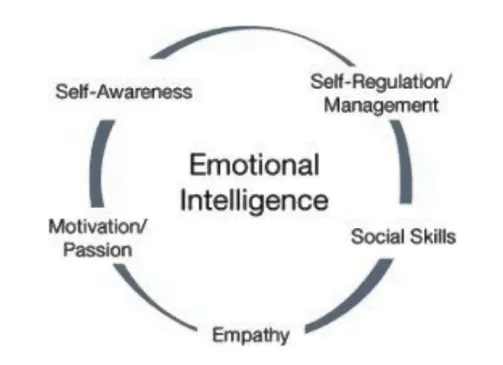
Figure 1: Emotional Intelligence Cycle
The study used Microsoft Excel software to analyze the data. The descriptive statistics like frequency, percentage, mean and standard deviation were employed to describe the respondents' perception and to test the relationship among the study variables. The study was voluntary and confidentiality and anonymity was respected to the respondents. All collected data was used only for academic research.
Data Analysis:
Descriptive Statistic:
1. Demographic Characteristics of Respondents
A total of 90 respondents participated in this study. Demographic details offer a general overview of the background characteristics of the participants, such as their gender, age, organizational function and work experience.
1.1 Gender Distribution
The results showed that the majority (62.22%, n=56) of the respondents represents male category, and the females (37.78%, n=34). It shows that the male participants were more prevalent in the organizations that participated in this study.
Table 1: Gender distribution
| Gender | Frequency | Percentage | |
|---|---|---|---|
| Male | 56 | 62.22 | |
| Female | 34 | 37.78 | |
| Total | 90 | 100% |
1.2 Age Distribution
Regarding age, the respondents were mostly young, with over half of them aged between 20 and 25 years (53.33%, n = 48). The second highest number of participants were 25 to 30 years (23.33%, n = 21). The 30-35 year age group and the 35-40 year age group had smaller percentages of 10% and 10% respectively. There were only 3 who were older than 40 years, representing 3.33% of the respondents. Overall, the results indicate that the sample in the study was largely made up of young professionals.
Table 2: Age distribution
| Age | Frequency | Percentage | |
|---|---|---|---|
| 20-25 | 48 | 53.33 | |
| 25-30 | 21 | 23.33 | |
| 30-35 | 9 | 10.00 | |
| 35-40 | 9 | 10.00 | |
| Older | 3 | 3.33 | |
| Total | 90 | 100% |
1.3 Organizational Position
Majority of the respondents were employees (78.89%) with 21.11% (n = 19) being employers or managerial staff. This suggests that the views captured in this research are more representative of those of employees than of organization leaders.
Table 3: Position distribution
| Position | Frequency | Percentage | |
|---|---|---|---|
| Employer | 19 | 21.11 | |
| Employee | 71 | 78.89 | |
| Total | 90 | 100% |
1.4 Work Experience
When it comes to years of experience, a majority of respondents (63.33%, n = 57) had 1 to 5 years of experience, indicating that they are relatively new to the workforce. Smaller numbers of respondents had 5-10 years of experience (17.78%) and 10-15 years of experience (14.44%). Just 4.44% of the participants had a work experience exceeding 15 years. Overall, these results suggest that the sample of the study was made up of mainly young and early career employees.
Table 4: Work experience
| Year | Frequency | Percentage | |
|---|---|---|---|
| 1_5 | 57 | 63.33 | |
| 5_10 | 16 | 17.78 | |
| 10_15 | 13 | 14.44 | |
| More | 4 | 4.44 | |
| Total | 90 | 100% |
2. Impact of Managers’ Emotional Intelligence on Employees
The results of this study indicates that overall respondents have positive attitude about the role of managers' emotional intelligence in employee. The scores in each of the six items varied from 3.88 to 4.18, with most measuring strong agreement that the managers' emotional intelligence has a positive effect on the different workplace outcomes. In particular, there was a significant level of consensus among respondents that “Managers' emotional intelligence motivates employees to perform better” received the highest mean score (M = 4.18, SD = 0.978). A high level of agreement among participants is also reflected in this relatively low standard deviation. Likewise, respondents expressed high levels of agreement about the positive impact that emotionally intelligent managers have on collaboration and trust within their companies (M = 4.09, SD = 1.128) and on trust between employees and management (M = 4.09, SD = 1.148). The findings here indicate that EI is an important factor in establishing trust-based relationships at work. Moreover, it was agreed that emotionally intelligent managers foster better work relationships (M = 4.04, SD = 1.121) and support employee's feelings (M = 4.06, SD = 1.064). The results suggest that emotional intelligence has a strong link to the creation of a supportive and positive work atmosphere. The lowest mean score in this section was on the item “My workplace has fewer conflicts” (M = 3.88, SD = 1.079). This is still a level of agreement, but indicates that respondents also think that conflict reduction is a slightly less direct indicator of the impact of managers' emotional intelligence.
Table 5: Statistical evidence
| Impact of Managers' EI on Employees | |||||||
|---|---|---|---|---|---|---|---|
| 1. Managers with high EI create better workplace relationships. | 2. Managers’ EI enhances collaboration and trust in the organization. | 3. Managers’ EI helps employees feel supported. | 4. Managers’ EI reduces workplace conflicts. | 5. Managers’ EI motivates employees to perform better. | 6. Managers’ EI increases trust between employees and management. | ||
| No | Valid | 90 | 90 | 90 | 90 | 90 | 90 |
| Missing | 0 | 0 | 0 | 0 | 0 | 0 | |
| Mean | 4.04 | 4.09 | 4.06 | 3.88 | 4.18 | 4.09 | |
| Median | 4.00 | 4.00 | 4.00 | 4.00 | 4.00 | 4.00 | |
| Mode | 4 | 5 | 5 | 4 | 4 | 5 | |
| SD | 1.121 | 1.128 | 1.064 | 1.079 | 0.978 | 1.148 | |
[Figure - see the formatted PDF]
Figure 2: Perceived Impact of Managers' EI on Employees
Overall, The results obtained in Part 1 confirm that the emotional intelligence of managers is a key factor in achieving positive results in employee-related aspects, specifically in the improvement of employee motivation, trust, collaboration and relationships at the workplace.
Organizational Health:
The organizational health results also show a very positive perception of the role of managers' emotional intelligence. The mean values for this section ranged from 3.93 to 4.17 indicating that participants in general agreed that emotional intelligence plays a significant part in improving the health of an organization. The statement ‘Emotional intelligence of managers improves organization and timely completion of tasks' received the highest average score (M = 4.17, SD = 1.094). This finding indicates that emotional intelligence is viewed as a crucial aspect of productivity and task management in organizations. Likewise, respondents were very positive about emotional intelligence for problem solving and innovation (M = 4.09, SD = 1.088) and teamwork and cooperation (M = 4.08, SD = 1.144). The findings emphasize the significance of emotional intelligence in developing an organization's collaborative and innovative culture. Additionally, the respondents were supportive of the importance of emotional intelligence in enhancing listening and understanding of employees (M = 4.00, SD = 1.151) and also in enhancing employees' acceptance of feedback (M = 3.96, SD = 1.111). These results show that emotionally intelligent leadership helps to increase the level of openness and interpersonal communication in the workplace. Strengthening communication in the workplace (M = 3.93, SD = 1.188) was the lowest mean score in this section. This indicates that the respondents view communication improvement as somewhat less affected by emotional intelligence than other organizational factors, but still in the agreement range.
Table 6: Organizational Health
| Organizational Health | |||||||
|---|---|---|---|---|---|---|---|
| Statistic | |||||||
| 7. Emotional intelligence of managers strengthens communication in the workplace. | 8. Emotional intelligence of managers improves teamwork and cooperation. | 9. Emotional intelligence of managers encourages problem solving and innovation. | 10. Emotional intelligence of managers promotes acceptance of feedback. | 11. Emotional intelligence of managers improves listening and understanding among employees. | 12. Emotional intelligence of managers enhances organization and timely completion of tasks. | ||
| No | Valid | 90 | 90 | 90 | 90 | 90 | 90 |
| Missing | 0 | 0 | 0 | 0 | 0 | 0 | |
| Mean | 3.93 | 4.08 | 4.09 | 3.96 | 4.00 | 4.17 | |
| Median | 4.00 | 4.00 | 4.00 | 4.00 | 4.00 | 4.00 | |
| Mode | 4 | 5 | 5 | 5 | 5 | 5 | |
| Std. Deviation | 1.188 | 1.144 | 1.088 | 1.111 | 1.151 | 1.094 | |
[Figure - see the formatted PDF]
Figure 3: Perceived Organizational health
Overall, the findings of Part 2 support the idea that emotional intelligence (EQ) of managers has a significant impact on the health of the organization, especially in terms of team collaboration, innovation, production efficiency, and communication in the workplace.
Discussion of Findings
The results of this research suggest that the emotional intelligence of managers is an important factor in enhancing employee performance and organizational well-being. High mean scores for most of the items on the Likert scales indicate that the general opinion of the respondents is that emotionally intelligent managers are more effective in creating a positive work environment. The findings in the first section indicated that the emotional intelligence of managers is a significant factor in motivating their employees, fostering trust and maintaining good relationships at work. The highest mean score was found for the statement regarding the employees' performance motivation, suggesting that respondents have positive views on the relationship between being emotionally intelligent managers and employee's work engagement. The results are consistent with the study of emotionally intelligent leaders by (Goleman, Emotional intelligence: Why it can matter more than IQ, 1995) who stated that emotionally intelligent leaders are more capable of inspiring and motivating their employees through emotional sensitivities, emotional management, and effective communication.
Further, the results provide evidence of how emotional intelligence improves team collaboration and trust in organizations. This aligns with previous research that showed that an emotionally intelligent leader creates better interpersonal relationships and teamwork in the workplace (Wong & Law, 2002) emotionally intelligent leader is better able to manage emotions, solve conflicts, and create teamwork in the workplace. The findings also showed that managers' emotional intelligence helps to decrease conflict in the workplace and foster positive work environments. This result aligns with the emotional intelligence theory proposed by (Mayer, Salovey, & Caruso, 2004) that suggests that people with high emotional intelligence have good emotional awareness, empathy and emotional regulation skills, which are important in dealing with interpersonal conflicts. The second part shows that managers' emotional intelligence has a significant positive impact on organizational health, both in terms of communication, teamwork, innovation, and task efficiency. The results parallel those of (Carmeli, 2003) who observed that positive relationships between emotional intelligence and organizational attitudes, job satisfaction and organizational effectiveness. The results of the study indicate that emotional intelligence is not only a personal competency but also an important organizational resource that helps to improve interpersonal relationships in the workplace, employee performance and the functioning of the organization.
Research Gap
Although there has been a growing number of literature on emotional intelligence, there are still several gaps in research. First, previous studies on emotional intelligence have been undertaken largely in Western and developed country contexts, with few studies examining developing or transitional contexts of the organization. This makes it important to look at more empirical research in different cultural and organizational settings. Researchers see cross-contextual studies as being especially important in the exploration of emotional intelligence because of its strong influence by social and cultural factors, as cited in (Bar-On, 2006). Second, the existing literature tends to emphasize the individual-level consequences of emotional intelligence, for example, on employee performance or job satisfaction, rather than take a more comprehensive approach to its organizational-level consequences. (Ashkanasy & Daus, 2005) highlighted the fact that more studies are needed to address the relationship between emotional intelligence and organizational climate and health. Thirdly, the majority of the studies conducted in the past included few students or used only qualitative methods. This is still an area of need for quantitative studies that statistically prove emotional intelligence and organizational outcomes. This study tries to fill these gaps by exploring the influence of managers' EQ on employee outcome and organization health with quantitative survey data.
CONCLUSION
The findings of this study support the fact that emotional intelligence of the managers plays one of the most important roles in determining employee performance and organizational health. High EI managers are better able to establish supportive working environments, build positive relationships with others, and motivate employees. The results indicate that the organizations may view EI as a key leadership skill. Emotional intelligence training programs for managers can help them enhance communication, conflict management and emotional awareness. These efforts can ultimately result in increased organization effectiveness. Moreover, the results suggest that emotionally intelligent leadership is a key factor in ensuring a healthier organizational climate, in which employees trust and cooperate with one another and communicate well. This reinforces the thesis of (Cherniss, Goleman, Emmerling, Cowan, & Adler, 1998) that emotional intelligence is a key aspect of good leadership. Finally, emotional intelligence will be considered as a must-have managerial skill and as a part of leadership development programs, recruitment plans and organizational training policies to enhance the organizational performance and health.
REFERENCES

Sina Marat, Dr. Chaitanya Shinkhede, The Role of Manager’s Emotional Intelligence in Improving Organizational Health, Int. J. Sci. R. Tech., 2026, 3 (10), 520-527. https://doi.org/10.5281/zenodo.23236870
 10.5281/zenodo.23236870