

We use cookies to ensure our website works properly and to personalise your experience. Cookies policy
1F.O.-Operational Executive in Yashoda Super Speciality Hospitals
2MBA Healthcare And Hospital Management Chandigarh University
Total Quality Management has emerged as an important organizational strategy for improving the quality, efficiency, safety, and responsiveness of healthcare services. Hospitals operate within complex environments involving patients, physicians, nurses, pharmacists, administrators, technicians, support personnel, regulatory authorities, and other stakeholders. Consequently, hospital performance depends not only on clinical competence but also on the effectiveness of organizational processes, communication, resource utilization, leadership, information systems, and continuous quality improvement activities. Total Quality Management provides an integrated management philosophy in which quality becomes the responsibility of the entire organization rather than a function limited to a quality department. The approach emphasizes patient centeredness, leadership commitment, employee participation, continuous improvement, process management, evidence based decision making, teamwork, and systematic measurement of performance. This review examines the role of Total Quality Management in improving hospital operational performance and discusses its major principles, strategies, tools, implementation requirements, technological applications, challenges, quality indicators, and evidence from previous studies. Particular attention is given to Plan Do Check Act, Six Sigma, Lean healthcare, Kaizen, Root Cause Analysis, Failure Mode and Effects Analysis, benchmarking, Pareto analysis, cause and effect analysis, and Statistical Process Control. The review also evaluates the contribution of electronic health records, hospital information systems, data analytics, artificial intelligence, telemedicine, and real time performance monitoring to quality improvement. Evidence indicates that appropriately implemented Total Quality Management can contribute to improvements in patient satisfaction, operational efficiency, patient safety, resource utilization, service quality, and organizational performance. However, successful implementation requires sustained leadership, employee involvement, adequate training, organizational readiness, reliable information systems, measurable objectives, and a culture of continuous learning. Total Quality Management should therefore be viewed as a long term organizational strategy that integrates clinical quality with operational excellence and patient centered care.
Hospital operational performance refers to the ability of healthcare organizations to utilize human, financial, technological, physical, and informational resources to deliver safe, effective, timely, efficient, equitable, and patient centered care. Modern hospitals face increasing patient volumes, rising costs, workforce pressures, technological demands, waiting times, medication errors, infections, and resource constraints. The World Health Organization emphasizes that quality healthcare should be effective, safe, people centred, timely, equitable, integrated, and efficient [1,2]. Poor quality can result in preventable harm, resource wastage, reduced patient trust, and economic losses [3,4]. Because clinical and administrative processes are interconnected, operational performance requires a system wide approach. Donabedian's structure, process, and outcome framework provides an important foundation for evaluating healthcare quality [5].
Quality management has evolved from inspection and quality assurance toward continuous, organization wide improvement. Total Quality Management (TQM) emphasizes prevention, process improvement, employee involvement, patient focus, and organizational learning [6,7]. Influenced by Deming, Juran, and Crosby, TQM promotes management responsibility and systematic improvement [8]. In healthcare, TQM integrates quality across clinical, administrative, nursing, diagnostic, pharmaceutical, laboratory, procurement, and support services [9,10]. Leadership, teamwork, training, employee participation, patient focus, process management, and organizational culture are important for successful implementation [11,12]. Evidence suggests that TQM can improve efficiency, safety, patient satisfaction, and overall quality performance [13]. Therefore, this review examines TQM principles, healthcare applications, operational outcomes, improvement tools, digital technologies, implementation challenges, and strategies for sustainable hospital performance.
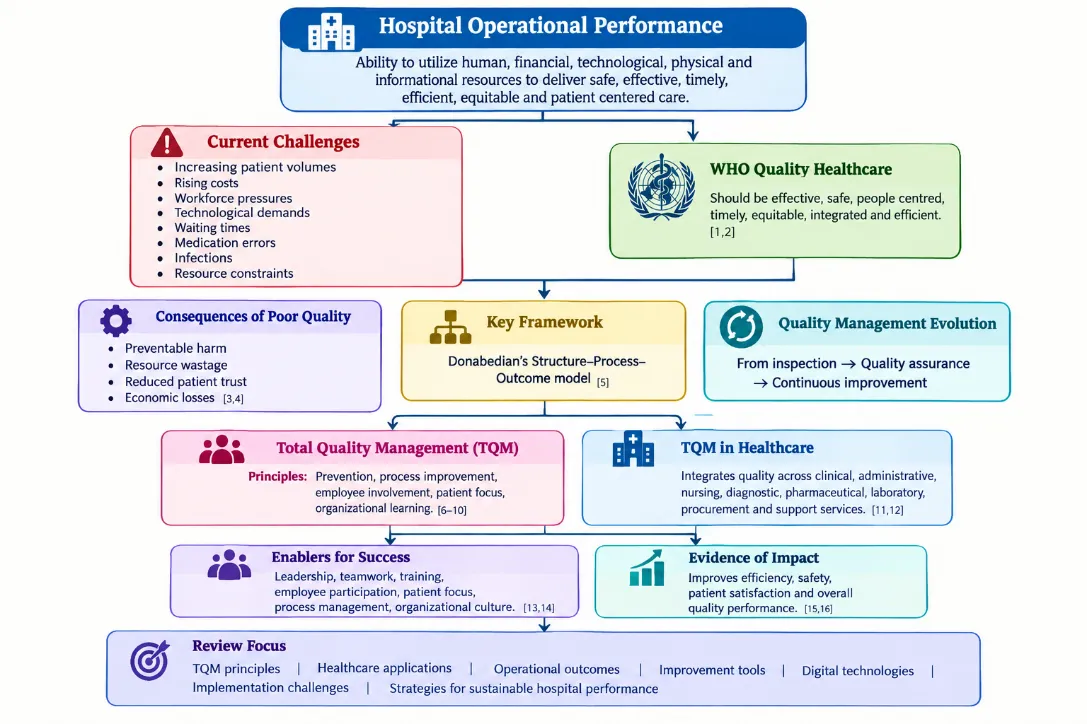
Figure 1: Conceptual framework of hospital operational performance and Total Quality Management (TQM), illustrating the relationship between healthcare challenges, quality frameworks, TQM principles, implementation enablers, and improved operational outcomes.
2. CONCEPT OF TOTAL QUALITY MANAGEMENT
Total Quality Management (TQM) is an organization-wide management philosophy aimed at achieving sustained improvement in performance through the participation of all employees. Unlike conventional quality approaches that assign responsibility to specialized departments, TQM integrates quality into strategic planning, daily operations, human resource management, patient services, and decision making. Its primary objective is to consistently meet patient expectations, improve processes, reduce variation, and minimize preventable waste [14,15]. The foundations of TQM were developed through the contributions of Deming, Juran, and Crosby. Deming emphasized statistical thinking, variation reduction, management responsibility, and continuous improvement; Juran focused on quality planning, control, and improvement; while Crosby emphasized prevention and the principle that quality should be incorporated into processes rather than achieved through final inspection [16,17]. These principles are highly applicable to healthcare because hospitals involve complex processes, multiple stakeholders, resource constraints, and variable outcomes. Core TQM principles include patient focus, leadership commitment, employee involvement, process orientation, continuous improvement, teamwork, communication, and evidence-based decision making. In hospitals, multidisciplinary employee participation enables identification of workflow problems and promotes organizational learning [18]. Strong leadership provides strategic direction, resources, and a culture of improvement [19]. Process mapping and performance monitoring help identify inefficiencies, while quality indicators such as waiting time, medication errors, infections, readmissions, length of stay, patient satisfaction, and resource utilization support data-driven corrective actions [20].
3. TOTAL QUALITY MANAGEMENT IN HEALTHCARE
|
Sr. No. |
Dimension |
Description |
|
1 |
Evolution of TQM in healthcare |
TQM developed in healthcare as hospitals increasingly recognized the need to integrate quality improvement with organizational efficiency. It expanded conventional quality assurance approaches by emphasizing organization wide responsibility, continuous improvement, and systematic management of healthcare processes [21,22]. |
|
2 |
Organization wide quality responsibility |
TQM considers quality to be the responsibility of all organizational members rather than being limited to specialized quality assurance personnel. Clinical, administrative, managerial, and support staff are collectively involved in quality improvement activities [23,24]. |
|
3 |
Continuous quality improvement |
Continuous improvement is a central principle of TQM. Healthcare organizations systematically identify problems, analyze processes, implement corrective measures, and monitor outcomes to achieve sustained improvements in performance and patient care [25,26]. |
|
4 |
Quality improvement techniques |
Healthcare organizations may apply quality circles, statistical quality control, benchmarking, process mapping, and team based improvement approaches to improve both clinical and administrative processes [27,28]. |
|
5 |
Importance in hospital management |
Hospitals involve multiple professional groups, complex workflows, and different organizational priorities. TQM provides a common framework for coordinating these activities toward improved quality, patient outcomes, and organizational performance [29,30]. |
|
6 |
Prevention rather than inspection |
Unlike traditional inspection based approaches that primarily identify defects after they occur, TQM emphasizes preventing errors by improving the processes responsible for producing healthcare outcomes [31,32]. |
|
7 |
Organizational culture |
A supportive organizational culture is essential for successful TQM implementation. Open communication, teamwork, constructive feedback, learning, innovation, accountability, and readiness for change can facilitate quality improvement initiatives [33]. |
Table 01: Key Dimensions of Total Quality Management in Healthcare
4. HOSPITAL OPERATIONAL PERFORMANCE
Hospital operational performance encompasses the efficiency, effectiveness, safety, responsiveness, productivity, and reliability with which hospital resources are converted into healthcare services and outcomes. It includes both clinical and nonclinical dimensions. Donabedian's structure, process, and outcome framework provides a useful foundation for understanding performance because hospital structures influence processes, processes influence outcomes, and outcomes provide feedback regarding the adequacy of structures and processes [34]. Hospital efficiency and productivity are influenced by workforce utilization, equipment availability, bed management, supply chain performance, diagnostic capacity, operating room utilization, pharmacy processes, discharge planning, and administrative workflow. Operational efficiency does not mean simply providing more services at lower cost. Efficient performance requires appropriate use of resources while maintaining safety, effectiveness, and patient centeredness. The concept of healthcare value similarly emphasizes the relationship between outcomes achieved and resources used [35].
5. MAJOR TQM STRATEGIES FOR IMPROVING HOSPITAL PERFORMANCE
Patient centered care is a fundamental component of Total Quality Management (TQM) because hospital services should be designed according to patient needs, expectations, safety, and preferences. Patient centered TQM emphasizes effective communication, reduced waiting times, shared decision making, respect for patient preferences, and systematic use of patient feedback. Evidence indicates that patient experience is associated with clinical effectiveness and patient safety, supporting its integration into overall healthcare quality management [36]. Continuous process improvement involves systematic evaluation of hospital workflows to identify delays, duplication, communication failures, unnecessary documentation, and unclear responsibilities. Process mapping and iterative improvement methods such as the Plan Do Study Act approach can help teams test and implement sustainable changes [37,38]. Standardization through standard operating procedures can reduce unnecessary variation in medication administration, infection prevention, documentation, discharge planning, and other hospital activities. However, standardized processes should allow appropriate professional judgment. Staff training is equally important because employees require practical knowledge of quality improvement tools, patient safety, teamwork, data interpretation, and problem solving. Leadership commitment should be demonstrated through resource allocation, strategic planning, quality meetings, recognition of improvement activities, and transparent communication [39,40]. Quality indicators should be used to evaluate performance through measures such as adverse events, readmissions, waiting time, patient satisfaction, mortality, and cost. Root Cause Analysis and Failure Mode and Effects Analysis further support identification and prevention of system failures [40]. Internal auditing, interdepartmental teamwork, and evidence based decision making strengthen accountability, coordination, and continuous organizational learning, thereby supporting sustained improvements in hospital performance.
6. TQM TOOLS AND TECHNIQUES USED IN HOSPITALS
The Plan Do Check Act cycle provides a structured framework for continuous improvement by enabling hospitals to identify problems, implement planned interventions, evaluate outcomes, and standardize successful changes [41,42]. Six Sigma reduces process variation and defects through the Define, Measure, Analyze, Improve, and Control framework and has been applied to clinical and administrative processes to reduce errors, time, and costs [43,44]. Lean healthcare focuses on eliminating non value adding activities such as waiting, unnecessary movement, duplication, overprocessing, defects, and excess inventory. Lean and Six Sigma are often integrated because Lean improves process flow while Six Sigma addresses variation and defects [45,46]. Kaizen promotes incremental improvement through employee participation and can be applied to admission, dispensing, laboratory, operating room, and discharge workflows [47]. Root Cause Analysis examines underlying system factors following adverse events, whereas Failure Mode and Effects Analysis proactively identifies potential failures before they occur [48]. Benchmarking enables hospitals to compare performance with internal standards, peer organizations, and recognized best practices to identify gaps and establish improvement targets [49]. Pareto analysis helps prioritize major causes responsible for a large proportion of problems, while Fishbone diagrams systematically explore potential causes involving people, methods, equipment, materials, environment, and measurement. Statistical Process Control uses control charts to distinguish normal from unusual variation and monitor indicators such as infection rates, medication errors, waiting times, laboratory turnaround time, and readmissions. Collectively, these tools strengthen evidence based decision making and support continuous quality improvement within TQM [50].
7. IMPACT OF TQM ON HOSPITAL OPERATIONAL PERFORMANCE
Total Quality Management (TQM) can improve hospital operational performance by encouraging systematic examination of processes, identification of bottlenecks, reduction of waste, and continuous monitoring. Process mapping, Lean principles, Six Sigma, standardization, and performance measurement can improve efficiency and quality, although outcomes depend on effective implementation and organizational support [51,52]. Reducing waiting time is an important operational outcome. Hospitals can analyze delays in registration, consultation, diagnosis, pharmacy, admission, and discharge and introduce appointment redesign, workload balancing, electronic registration, standardized pathways, and improved communication to promote timely care [53].TQM also supports patient safety through standardized procedures, improved communication, electronic medication systems, incident reporting, Root Cause Analysis, Failure Mode and Effects Analysis, checklists, and clinical audits. These approaches help identify system weaknesses and reduce medication errors and adverse events [54]. Operational costs can be reduced by minimizing waste, rework, unnecessary testing, preventable complications, excessive inventory, and inefficient staff utilization. Better scheduling, bed management, inventory control, and workforce allocation further improve resource utilization [55]. TQM can enhance patient satisfaction through shorter waiting times, better communication, responsiveness, and patient involvement [56]. Employee participation, training, and teamwork can strengthen engagement and safety culture [57]. Thus, TQM integrates efficiency, safety, cost control, patient satisfaction, and employee engagement to achieve sustainable improvements in overall hospital performance.
8. ROLE OF TECHNOLOGY AND DIGITALIZATION IN TQM
Digital technology has become an important component of contemporary healthcare quality management. Electronic Health Records provide access to patient information, improve documentation, facilitate information sharing, and can support clinical decision making. A systematic review and meta analysis found that appropriately implemented electronic health records were associated with improved documentation efficiency, increased guideline adherence, and reductions in medication errors and adverse drug events, although considerable heterogeneity existed between studies [58]. Hospital information management systems can integrate clinical, administrative, financial, laboratory, pharmacy, radiology, and operational information. Such integration allows managers to monitor performance across departments and identify relationships between operational processes and patient outcomes. Digital systems can also reduce duplication and improve communication when they are designed according to workflow requirements [59].
9. CHALLENGES IN IMPLEMENTING TQM IN HOSPITALS
Resistance to organizational change is one of the most important barriers to TQM implementation. Healthcare professionals may resist new processes if they perceive them as additional administrative burdens, threats to professional autonomy, or management initiatives imposed without adequate consultation. Effective change management therefore requires communication, participation, education, leadership support, and demonstration of practical benefits. Lack of leadership commitment can undermine TQM because improvement initiatives require resources, strategic direction, and organizational authority. Leadership turnover can further disrupt long term quality programs. Research examining healthcare TQM implementation has identified inconsistent management commitment and inadequate leadership as important barriers [60,61]. Financial limitations may restrict investment in information systems, training, quality teams, equipment, staffing, and improvement infrastructure. Hospitals in resource limited settings may therefore need to prioritize low cost interventions such as process standardization, communication improvement, teamwork, and basic performance measurement before implementing expensive technologies.
10. STRATEGIES FOR SUCCESSFUL TQM IMPLEMENTATION
Successful TQM implementation should begin with the establishment of a quality oriented organizational culture. Quality should be incorporated into the hospital mission, strategic planning, departmental objectives, employee evaluation, and leadership responsibilities. Quality should be viewed as an organizational value rather than a temporary project.Strong leadership and management support should be demonstrated through resource allocation, participation in improvement activities, communication of quality objectives, and recognition of successful teams. Leaders should create an environment in which employees can identify problems and propose solutions without fear of inappropriate blame. Leadership development should therefore form an important component of TQM implementation [62]. Employee participation and empowerment should be promoted through multidisciplinary quality teams, suggestion systems, quality circles, safety huddles, and structured improvement projects. Employees should receive access to performance data and should understand how their work contributes to organizational outcomes [63].
11. CONCEPTUAL FRAMEWORK
The conceptual relationship between TQM and hospital operational performance can be represented as a sequential organizational pathway. The first level consists of TQM principles, including leadership commitment, patient focus, employee involvement, continuous improvement, process management, teamwork, organizational learning, and data driven decision making. These principles establish the organizational foundation required for quality improvement [64].The second level involves improvement of hospital processes. When TQM principles are translated into practice, hospitals can standardize procedures, redesign workflows, improve communication, strengthen staff capability, identify risks, monitor performance, and use evidence for decision making. These activities can influence operational processes such as patient registration, consultation, diagnosis, medication management, nursing care, admission, discharge, laboratory services, pharmacy services, and administrative processes.
12. RESEARCH GAPS AND FUTURE PERSPECTIVES
Despite extensive research on Total Quality Management (TQM) in healthcare, important gaps remain. Variation in TQM definitions and measurement approaches limits comparison between studies, highlighting the need for standardized hospital TQM assessment models. Future research should also develop multidimensional performance frameworks incorporating efficiency, safety, patient experience, workforce, clinical outcomes, and financial indicators. Longitudinal studies are required to determine whether improvements achieved through TQM remain sustainable over time, particularly during leadership changes, staff turnover, and resource limitations. Artificial intelligence and healthcare analytics represent emerging opportunities for predicting demand, optimizing staffing, identifying risks, and supporting decision making; however, future research should address safety, privacy, fairness, explainability, cost effectiveness, and staff acceptance [65]. Greater attention is also needed in resource limited healthcare settings to develop affordable and context appropriate TQM strategies. Patient participation should be strengthened through advisory groups, co design, digital feedback, and shared decision making [66,67]. Future studies should further examine the integration of TQM with Lean, Six Sigma, digital transformation, value based healthcare, sustainability, workforce wellbeing, and integrated care to develop comprehensive and sustainable hospital quality management systems [68].
CONCLUSION
Total Quality Management (TQM) provides a comprehensive strategy for improving hospital operational performance by integrating quality into leadership, organizational culture, clinical and administrative processes, workforce management, and patient care. Its principles of patient focus, employee involvement, teamwork, continuous improvement, process orientation, measurement, and evidence based decision making can enhance operational efficiency, resource utilization, patient safety, service quality, and patient satisfaction. Tools such as Plan Do Check Act, Six Sigma, Lean healthcare, Kaizen, Root Cause Analysis, Failure Mode and Effects Analysis, benchmarking, and Statistical Process Control help convert these principles into measurable improvements. Digital technologies, including electronic health records, data analytics, artificial intelligence, telemedicine, and performance dashboards, can further strengthen quality management. However, sustainable TQM depends on committed leadership, supportive organizational culture, trained employees, reliable data, adequate resources, and patient participation. Therefore, hospitals should integrate TQM into strategic management and routine clinical operations rather than treating it merely as an accreditation or administrative requirement.
REFERENCES


Atul Kumar Tripathi1*, Saugata Banerjee2, Total Quality Management As A Strategy For Improving Hospital Operational Performance, Int. J. Sci. R. Tech., 2026, 3 (9), 289-298. https://doi.org/10.5281/zenodo.22753353
 10.5281/zenodo.22753353