

We use cookies to ensure our website works properly and to personalise your experience. Cookies policy
1Institute for Social Transformation, School of Arts and Social Sciences, Tangaza University, Kenya.
2Community Development and Environmental Management, School of Cooperative and Community Development, Cooperative University of Kenya, Kenya.
Despite global efforts to increase female participation, women engineers remain underrepresented in construction, including sustainable building. This study examined the barriers women engineers face in sustainable building construction across project phases in Nairobi City County, Kenya. Using a qualitative case study of La Femme Engineering Services (LFE), a Nairobi construction and consultancy firm, data were gathered from sixteen participants, women engineers in managerial, technical, and financial roles, plus male key informants selected purposively until data saturation. Findings showed that women encounter barriers in 63.6% of their daily work on sustainable building projects, organised into five interrelated themes: lack of role models (31.1%), community and societal norms (20.0%), non-conducive work environments (17.8%), low esteem and underestimation (17.8%), and motherhood (13.3%). Scarcity of female role models was the strongest barrier, reflecting women's underrepresentation and discouraging career ambition, while community attitudes reinforced gendered perceptions of engineering. The study concludes that role-model scarcity, cultural bias, inadequate site infrastructure, esteem issues, and motherhood responsibilities collectively constrain women's involvement, necessitating targeted interventions at both organisational and societal levels.
The construction sector is a vital driver of economic growth, contributing significantly to employment, investment, and GDP (World Bank, 2020). Defined as the planning, designing, financing, building, and management of infrastructure projects, it includes residential, non-residential, and public works, involving multiple stakeholders such as architects, engineers, and contractors [1]. Sustainable building, or green building, refers to creating structures using environmentally responsible and resource-efficient processes across all construction phases: pre-design, design, procurement, construction, and post-construction [2, 3]. Women engineers play an important role by participating in these phases, promoting environmental, economic, and social sustainability [4].
The presence and participation of women engineers in building construction are influenced by several factors that are either enablers in the building construction sector or barriers in the same sector. The latter constitute the focus of this study. Barriers, as defined by Merriam-Webster dictionary, are structures that impede movement. In this study, they refer to the obstacles limiting women's participation in different phases of building construction.
This study examined the barriers faced by women engineers in sustainable building construction, with a particular focus on stages such as pre-design, design, procurement, construction, monitoring, and post-construction, while emphasising their importance in sustainable practices. The study centred on women engineers in Nairobi City County, selected for its status as a construction hub with diverse projects and sustainability needs. Nairobi hosts many professional women engineers and construction firms, such as La Femme Engineering Service Ltd. (LFE), along with organisations such as the Association of Kenya Women in Construction (AKEWIC) and the Institution of Engineers of Kenya (IEK).
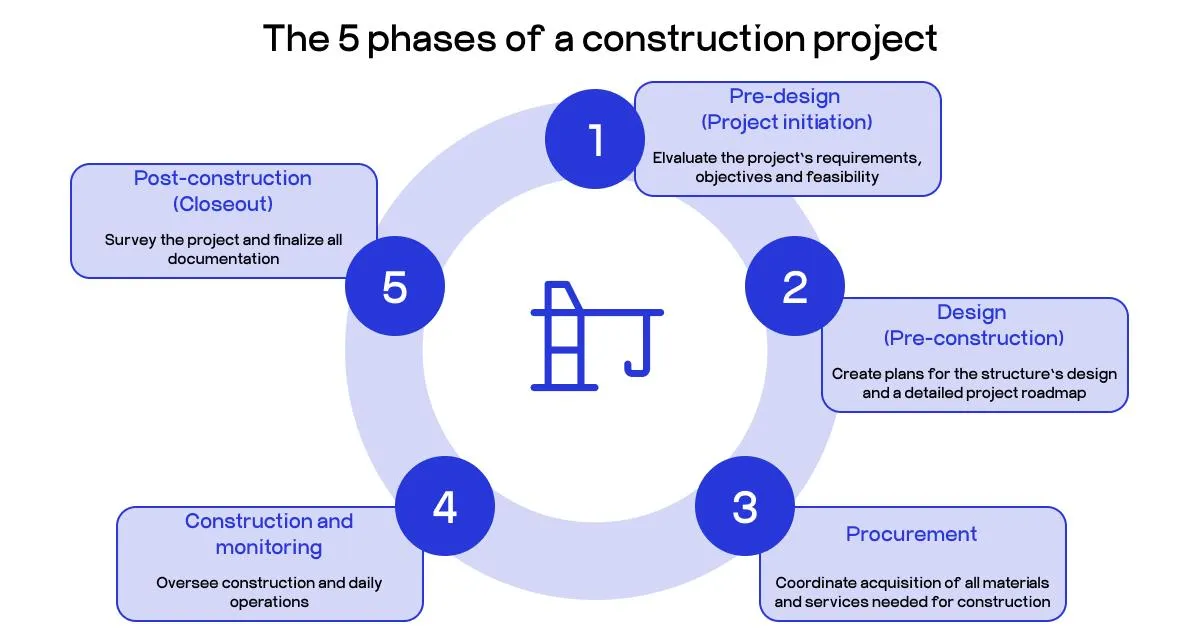
Figure 1: Construction phases
LFE was highlighted for its significant representation of women and commitment to sustainability. Qualitative data were gathered from female engineers and male key informants, all of whom held at least a bachelor's degree.
The challenges discussed in this study include cultural norms, limited access to education and training, work-life balance issues, religious beliefs, personal preferences, societal stereotypes, and instances of workplace harassment [5].
The country's conservative cultural norms and societal factors continue to reinforce stereotypes that portray engineering as a male-dominated profession [6]. Similarly, in the UK, green engineering and other STEM-related fields are commonly associated with men [7]. Gender stereotypes remain deeply embedded in engineering cultures, limiting women's participation and career progression in sustainable building construction despite efforts to reduce such barriers [8].
In addition, the cultural influence is the perception that women are incapable of performing work in male-dominated sectors such as construction [9]. It was the case in the Caribbean, where cultural beliefs restricted women’s involvement in civil engineering by portraying them as unsuitable for physically demanding work. Likewise, women in the Australian construction industry continue to experience socio-cultural barriers and workplace stereotypes that discourage their participation in sustainable building [10, 11].
In Africa, women have traditionally been regarded as primary caregivers responsible for household welfare and family needs [12]. Such socio-cultural expectations, reinforced by patriarchal attitudes, continue to hinder women's participation in engineering and other male-dominated professions [13]. In Ghana, traditional beliefs have prevented women from serving as principal contractors despite their qualifications. As one participant explained: "All my bidding documentation was completed and presented as requested... However, I lost the contract because the custom of the area prevented females from doing men’s jobs" (Dzisi, 2021, p. 6).
Similarly, cultural stereotypes remain significant barriers in Nigeria [14]. In Kenya, women continue to be underrepresented in the construction industry due to traditional divisions of labour, limited training opportunities, and entrenched gender roles that discourage women from pursuing engineering careers [15, 16, 17]. Furthermore, hierarchical cultural structures continue to influence women's roles and responsibilities in society, limiting their participation in civil engineering and sustainable building construction [18].
In the research carried out in the USA by Khilji and Pumroy (2019) and Burrows (2023), it was reported that gender stereotypes undermine recognition and trust in women’s technical abilities, limiting their opportunities in engineering projects [19, 20]. Similarly, in the UK, Naoum et al. (2020) found that although sustainable building construction has traditionally been viewed as requiring physical strength, education, technical skills, and competence are the key requirements for green building projects, yet women are often perceived as lacking these attributes. In Australia, Bridges et al. (2020) found that family expectations and gender socialisation negatively influence women’s engineering education and training. Likewise, Jenkins et al. (2018) argued that some institutions fail to promote women’s career pathways through education and technical skills training.
In Africa, access to engineering education and career advancement continues to be constrained by sexism (UNESCO, 2021), while women remain underrepresented in vocational training [21]. In Kenya, women’s participation in sustainable building construction is strongly influenced by education and competency. Munyoki (2018) observed that female engineers remain inadequately involved in the industry because of insufficient education and technical training.
Earlier investigations have characterised the construction industry as rigorous and demanding, requiring long working hours, heavy workloads, and strict deadlines [22]. Organisations have often prioritised profit over employees’ well-being, contributing to poor work-life balance [23]. In civil engineering, particularly during project supervision, rigid schedules associated with sustainable building projects make it difficult to maintain work-life balance [24]. The demanding nature of construction work also makes it challenging for women to balance professional and family responsibilities [25]. Furthermore, the industry's long-standing reliance on inflexible work schedules and limited workplace flexibility discourages many women from remaining in construction careers [26].
The situation is further compounded by the lack of supportive work-life policies in the construction sector. Many Nigerian construction companies continue to operate under rigid work schedules with minimal flexibility, making it difficult for women to manage both work and domestic responsibilities [27]. Similarly, women pursuing long-term careers in construction often lack access to childcare services, flexible working arrangements, and adequate maternity leave provisions (Munyoki, 2018). While Manivannan et al. (2022), Perera et al. (2022), and Oyewobi et al. (2022) examined workplace inflexibility in different contexts, the present study focused on one constituency in Nairobi County, Kenya.
Personal motivation is a key factor influencing an individual’s commitment, enthusiasm, and dedication towards a chosen profession. Research has shown that women’s careers in building construction are often shaped by personal motivation, beginning from engineering education to professional practice [28]. According to Al Salaheen et al. (2024), women’s interest and passion for civil engineering and related disciplines enhance their contribution to sustainable building construction projects.
However, in Tanzania, women tend to prefer Humanities, Arts, and social sciences over natural sciences, engineering, and technology [29]. Despite achieving similar or better performance than men in STEM examinations, many female students lose interest and do not pursue STEM-related courses at university (Matete, 2022). Similarly, research on women’s aspirations in engineering indicates that careers in building construction are influenced by personal desire to join the industry and acquire relevant skills (Pérez et al., 2020). In Spain, women’s decisions to pursue construction careers are also shaped by cultural norms, gender stereotypes, stress, job burnout, and societal expectations (Pérez et al., 2020).
The aforementioned barriers result in the underrepresentation of women in building construction. Over the last few decades, several initiatives on organisational and governmental levels have been taken to increase the number of women in the building industry; however, women are not as numerous as men in the building construction process [30]. Globally, women engineers encounter a myriad of barriers that hinder their full participation and advancement in building construction (Singh & Peers, 2019).
The current landscape of female engineers in sustainable building construction shows significant progress, yet enduring challenges persist. The participation of women in the construction sector remains inferior to that of their male counterparts due to different barriers they encounter in their daily careers worldwide. The representation of women in construction engineering varies across regions. In Europe, women account for nearly 30% of the workforce in Latvia and Bulgaria, while only 11–12% in Germany and the UK (Singh & Peers, 2019). In the United States, women made up 9.1% of the construction workforce in 2020, reflecting persistent gender disparities despite inclusion efforts [31, 32].
Further, gender segregation remains evident in construction phases [33]. In North America, Canada reports 12% and the US 9% [34, 35], though progress is seen through mentorship, scholarships, and diversity policies [36]. In Latin America, women represent 8–10% in Brazil and Mexico, despite NGO and government initiatives (Karakhan et al., 2021).
In Africa, women make up less than 10% of the construction workforce, influenced by various barriers such as culture, societal expectations, and the perception of the sector. In countries like Nigeria and South Africa, women are still under-represented in various phases of building construction and in different construction companies. Further, researchers identified low participation of women engineers in Kenyan building construction and civil engineering [37].
Consequently, the indicator of the problem is that, despite efforts to increase women’s participation in the sustainable building construction industry, women engineers’ effective participation across different stages of sustainable building construction remains limited. This limited participation results from various factors that negatively influence their contributions and act as barriers. Therefore, understanding the barriers to women engineers in sustainable building construction constitutes a core objective of this study.
This study explored the barriers faced by women engineers in sustainable building construction in Nairobi. The study was conducted in Nairobi City County, selected for its prominence as Kenya's leading urban area and its wide array of construction initiatives. This diverse context enables a comprehensive analysis of the factors that affect the role of women engineers in promoting sustainable building in Nairobi, with a specific emphasis on La Femme Engineering Services (LFE). Founded in 2006 by Engineer Jane Mutulili, LFE is the central focus of this research. It is a well-established construction and consultancy firm located at the Allamano Centre.
This research employed a qualitative case study methodology focusing on women engineers in managerial, technical, and financial sectors in Nairobi. It also included male key informants with significant expertise in construction. Through purposive sampling, a total of sixteen (16) participants were selected until data saturation was achieved.
The researcher labelled the data based on the main objective: women engineers’ barriers in sustainable building construction. This designated objective was recognised as a category from which numerous aspects surfaced as significant themes, illustrating various dimensions from the participants. Furthermore, to delve deeper into the perspectives that elucidate the themes, each theme was segmented into sub-themes (Figure 2). The results showed that all women encounter 63.6% of barriers in their daily work on sustainable building construction, at different scales
Theme: Barriers
The interaction with the participants in the head office in Westland and on the site of Zimmerman revealed different barriers. Figure 2 shows the proportion of each barrier. The Lack of role models (31.1%) and the Community (20.0%) 0 found to be the two first crucial barriers that women engineers encounter in sustainable building construction. Then both the environment not conducive and Under esteem (17.8%) affect them at the same rate. Lastly, Motherhood prevents women at a rate of 13.3%.
The engagement with participants at the head office in Westland and the Zimmerman site uncovered various obstacles. These results align with those presented in Table 2 in the following sections. Similarly, Figure 1 illustrates the distribution of each barrier. The absence of role models (31.1%) and community support (20.0%) emerged as the two primary obstacles faced by women engineers in sustainable building construction. Additionally, both an unfavourable environment and underestimation (17.8%) impact them equally. Finally, motherhood acts as a barrier for women at a rate of 13.3%.
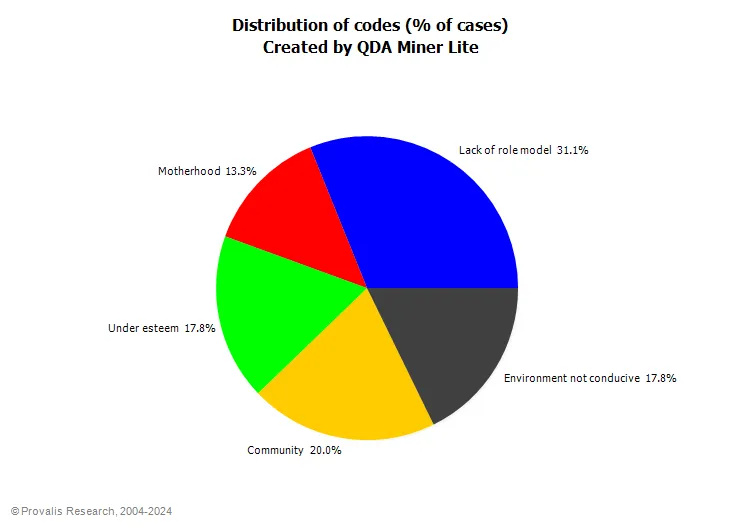
Figure 2: women' s barriers
Sub-Theme 1: Lack of Role Model
This study identified that women were underrepresented in the construction industry. This led to a scarcity of role models in the sector. The findings indicated that the lack of role models accounts for 31.1% of responses (14 cases, 87.5% of the participants) as a barrier to women engineers' contribution to sustainable building construction, making it the highest barrier that discouraged women engineers. The shortage of senior women engineers in the construction industry led many aspiring and early-career women engineers to lack the practical guidance necessary to envision long-term success. For example, participants A3 and A6 explained that Women are intimidated by the high ratio of men in their areas of assignment, which contributed to women not coming out with confidence in their ideas.
Although there is a high number of women engineers in LFE, the researcher observed that few had advanced experience. This situation often led women engineers to limited ambition or discouragement, or withdrawal from their engineering profession. Emphasising the discouragement, KIF4 stated:
One of the barriers is that the construction industry has been male-dominated throughout the ages because there are some works that I would say require muscles. So, you find that women engineers are not able to do it. For example, in the road construction industry, you do not find female engineers mainly working in those remote areas and those areas with extreme climate conditions. You find that most of the female engineers would prefer not to take civil engineering but electrical or chemical engineering, which would make them work in an in-house kind of setup (KIM3).
Sub-Theme 2: Community
Culturally, the construction industry has been reserved for men. People from different communities overlook women in the industry. In the case of this study, a considerable portion of responses, 20.0% (9 cases, 56.2 % of participants, n=16), pointed out the community factor as a key barrier to women engineers. In the context of this study, the community factor reflected how societal norms, cultural expectations, traditional perceptions and limited communal support inhibit women's participation in engineering roles. In many cases, communities uphold gendered perceptions of career suitability, dissuading women from entering or advancing in the construction field.
According to participant A3, cultural perception and expectation suffocate the potential contribution of women engineers. This affects the retention of women in technical roles. This was confirmed by the participant. For her, society often fails to consider women capable because it clings to traditional perceptions and rigid culture that have long dictated who is deemed worthy assigning roles based on gender, age, and social status. As a result, many women are overlooked not because they lack talent but because they do not fit in the culture or tradition of that community.
Another respondent, A8, responded affirming community as an important barrier in these words: The situation that makes my career hard is when I am sent to work with people who do not believe that women are solution-givers. A community that overlooks women. This stressed the need for broader awareness and acceptance of women in engineering. She added, Women encounter several barriers, but the most significant is from the community; people believe that engineering is for men, not for women.
Sub-Theme 3: Environment Not Conducive
The sub-theme of environment not conducive represented 17.8% of responses (8 cases, 50.0 % of participants, n=16) as a barrier that women engineers faced in the construction industry highlighted a systemic challenge within workplaces, especially the worksites that hinder women’s full participation as confirmed these included unsafe or unwelcoming job sites, uncomfortable equipment, and decent facilities available at the construction site as it was observation at the Zimmerman site project where women did not have private toilet or changing room but the shared one with men.
Aligned with this perspective, participant A2 expressed that when you go to the sites, when you are managing a site, I think the facilities that are there do not really cover women. So, you might find there is a provision of changing rooms for men but not for women. When you are starting, there is no provision for women, so you have to set it up as you go into the project.
She (A2) added outlining the lack of basic facilities on-site, saying that even the washroom utilities and sanitary utilities are mostly geared towards men and not women. So those are the challenges of being in the field. Likewise, A4 clarified how difficult the site work is for women engineers with these words: During female periods, for example, do you skip going to the site? Do you skip site meetings? Do you skip site inspections? Do you … because there are no facilities for you to be on site? Likewise, participant four (KIF4) concurred with this and confirmed it, emphasising the discomfort of some sites, saying that in hardship areas, sites are not conducive for the woman.
Sub-Theme 4: Low Esteem
Women have long been overlooked. Gender-based division of labour often impacts them in the construction industry. The sub-theme related to esteem made up 17.8% of responses regarding barriers women face in sustainable building construction (8 cases, 50.0% of respondents, n=16). This highlights the undervaluing of women's skills and contributions within engineering teams and project environments. Women frequently need to work harder to prove their competence or earn equal respect. Respondent A4 concluded that you are being looked down upon because you are a woman, you go to a site, and somebody refers to you as that woman, not as a senior engineer. When you are in a city, and you are a senior, most people decide to talk to you not because you are contributing as an engineer but because you are contributing as a woman.
Additionally, this was backed up by the experience of the participant (KIF1 and KIF3), who shared: There was a time I had been sent by the owner of the company to check the dumping level, and the people on site were mixed (ladies and gents). And none of them thought I had been sent to inspect the work that they were doing. They thought that I had just come to take notes as the secretary of the company because I was a lady.
Sub-Theme 5: Motherhood
Based on the findings in Figure 2 showed that 13.3% of the responses cited motherhood as a barrier. This result presented a unique challenge as it intersected with demanding job schedules, a lack of maternity support, and work-life balance pressures. These challenges led to career interruptions or limitations in project involvement for women engineers. The construction sector’s inflexible timelines and travel demand often conflict with caregiving responsibilities. Participant A4 supported this in these words:
It is very difficult for mothers because sometimes you have to decide what to give. For example, if you are a mother and you have a site far away, do you go to that site, do you leave your family, or do you stay with your family? Also, what I realised in my leadership positions is that we lose a lot of young women in their careers when they start becoming mothers and wives. Because it is a very delicate act of balance, A4. More so, female engineers face the challenge of work-life balance with their families. They face difficulty in managing site work with parenting. The participant A5 explained:
When some women have children and start their families, they are burdened with the responsibility of taking care of the family and along the way, they are forced to give up their career to become mothers, and they stay at home, which is quite unfortunate because it is a loss of somebody's identity. This burden requires that the woman take time off from their career, either for pregnancy or for childbearing or for other responsibilities that are required for the family (A5).
The participant KIF3 concluded that even when you are an engineer entrusted with a big office. When you go home, you still have to become the mother that they want.
In summary, female engineers face many barriers, including the Lack of role models (31.1%) and the Community (20.0%). Then, both the environment not conducive and Under esteem (17.8%) affect them at the same rate. Lastly, Motherhood prevents women at a rate of 13.3%.
Regarding the barriers, the most significant barrier identified for women engineers in sustainable building construction was the lack of role models, accounting for 31.1% of the responses. Women suffer from being underrepresented in building construction. This aligned with findings from Ikiao (2019), which revealed that women engineers in Kenya perceive a lack of female representation in construction as a primary restriction to entering the industry. This study indicated that the scarcity of female mentors and role models contributed to low confidence among women, thereby limiting their participation in the construction sector.
Community-related barriers, which accounted for 20.0%, also significantly impact women's participation in sustainable building construction. This finding aligned strongly with those of Ikiao in 2019 in Kenya that social-cultural and social attitudes factors affected the participation of women in building, as indicated by 76.5% of respondents.
The research carried out in the Asia-Pacific Economic Cooperation (APEC) region highlighted similar findings that societal norms and cultural expectations in APEC often dissuade women from pursuing careers in construction, viewing such roles as inappropriate for women [38]. Likewise, research by Aneke et al. (2017) in South Africa and Amunga & Musasia (2021) in Kenya emphasised that traditional beliefs and negative social attitudes contribute to the low enrollment of women in construction-related educational programs. However, the study on Enhancing Sustainable Housing Through Women’s Cultural Skills, Experiences, and Knowledge demonstrated that cultural knowledge enabled Masai women to contribute to sustainable building construction [39]. African contexts, proactive community engagement and the promotion of female-led construction projects have begun to challenge these stereotypes, indicating that community perceptions evolve positively.
Environmental factors, including non-conducive work environments (17.8%) hindered women's progress in the field. Burrows (May 2023) identified issues such as harassment, discrimination, and lack of supportive infrastructure as prevalent challenges in the construction industry. Additionally, the findings of the research on an exploration of workplace attraction and retention factors for women in construction by Baker et al. (2023) revealed that unsupportive work environments and a lack of a safe environment led to feelings of isolation and hindered career advancement. Furthermore, the environment not conducive aligned with the findings that although the office environment seemed to be friendly for women engineers, physical sites were found not to be accommodating for women engineers (Baker et al., 2023).
When it comes to low self-esteem, women engineers reported feeling undervalued and excluded from key decision-making roles because of gender based perception. These results corroborated those of the study that aimed at examining gender stereotypes and their impact on women’s career progressions from a managerial perspective, conducted in India (Tabassum & Nayak, 2021). Motherhood as a barrier, though less frequently quantified in African literature, was revealed to be a crucial barrier as it affected work-life balance and reduced the earnings of women engineers. For instance, ‘‘Women with children earn less than men with children or women without children. As women’s wages tend to decrease by 4% with each child that she has, men’s wages tend to increase by 6% when they become parents (Madison, 2022, Pg 16).’’ In addition, women engineers experience problems related to the short time of maternity leave due to the inflexibility of the work site environment [40].
CONCLUSION
Despite global and local initiatives to increase female participation, cultural stereotypes, limited educational and training opportunities, work‑life balance challenges, and lack of mentorship continue to restrict women engineers’ involvement in sustainable building construction in Nairobi. Multiple inter‑related barriers like role‑model scarcity, cultural bias, inadequate site infrastructure, esteem issues, and motherhood responsibilities collectively limit women engineers’ involvement in sustainable construction, necessitating targeted interventions at both organisational and societal levels.
Disclosure of conflict of interest
No conflict of interest to be disclosed.
Ethical approval
The researcher adhered to ethical standards by prioritising participants' safety both during and after the study. Participants were informed about the study's nature, and the importance of maintaining the confidentiality of the collected information was emphasised.
Recommendation
Given that the lack of role models and unsupportive community environments were significant barriers, future research could examine the sociocultural dynamics and perceptions surrounding gender roles in engineering using mixed methods (qualitative and quantitative). This would help unpack how community attitudes, organisational culture, and gender norms shape the lived experiences of women engineers.
In addition, future research should evaluate the effectiveness of current policy frameworks, such as the implementation of the two-thirds gender rule and equal opportunity measures, by investigating whether such policies have led to measurable improvements in workplace equity, safety, and inclusivity across multiple engineering firms. Such studies would provide empirical evidence to inform more gender-responsive policies and institutional practices in the engineering and construction sectors in Kenya and beyond.
REFERENCES


Muhindo Mulango Roger1*, Steve Ouma Akoth1, Evans Gacheru Kimani2, Exploring Women Engineers’ Barriers In Sustainable Building Construction In Nairobi City County, Kenya, Int. J. Sci. R. Tech., 2026, 3 (8), 1044-1054. https://doi.org/10.5281/zenodo.22206534
 10.5281/zenodo.22206534