

We use cookies to ensure our website works properly and to personalise your experience. Cookies policy
Rohilkhand College of Nursing, Bareilly, (U.P.)
Women experience various turning points in their life cycle, which may be developmental or transitional. Midlife is one such transitional period which brings about important changes in women. Menopause is an unavoidable change in reproductive life cycle, that every women experience in her middle age and beyond. [2]Objectives:- To assess the knowledge regarding menopausal health among women.To assess the effectiveness of the structured teaching programme on knowledge regarding menopausal health among women. To find the association between pre-test knowledge score on knowledge regarding menopausal health among women with their selected demographic variables. Materials and Method:- This study was conducted at Paharganj, Bareilly. A total of 60 mother were selected using a purposive sampling technique. Data were collected using a validated self-structured questionnaire comprising 30 questions covering socio-demographics. Data was analyzed by using descriptive and inferential statistics. Ethical clearance and informed consent were obtained. Results:-Age showed significant association with chi square value18.51, education showed significant association with chi square value 11.019 and previous knowledge showed significant association with chi square value 5.594 as Research hypothesis (H2) is accepted. The post test score (18.42) is higher than pre test score (13.88) the mean difference between pre test and post test is 4.54 and t-test is 6.26 as H1 is accepted at p value 0.01. people had inadequate to moderate knowledge but after STP knowledge was somewhat increase. Conclusion:- result shows low to moderate knowledge need to conduct more studies on menopausal health among women. Need to provide health education.
In literature women is quoted as “Kshamaya Dharithri”, who plays versatile role in the entire life span. She undergoes significant changes in life, when her reproductive years end and her body and psyche experience a host of physical and emotional changes, starting from the age of fourty-five. [1]
Women experience various turning points in their life cycle, which may be developmental or transitional. Midlife is one such transitional period which brings about important changes in women. One of those important changes that occur in this stage of life is menopause. Menopause is an unavoidable change in reproductive life cycle, that every women experience in her middle age and beyond. [2]
The word “menopause” literally means the end of monthly cycles from the Greek word ‘pausis’ meaning ‘to stop’ and ‘meno’ meaning ‘month’ because the word “menopause” was created to describe this change in human females where the end of fertility is traditionally indicated by the permanent stopping of monthly menstruation or menses. WHO defined menopause as the permanent cessation of menstruation due to loss of ovarian follicular activity. It is the period of transition between the two phases of women’s life from reproductive to non reproductive years which is characterized by cessation of menstruation and loss of reproduction ability and aging. Menopause brings about many physical, physiological, psychological and social changes in a women’s life and this worsens health related quality of life. [3]
In India, the number of menopausal women is steadily increasing due to improved life expectancy and declining fertility rates. Many Indian women experience menopause with limited information and minimal support from healthcare systems. Socio-cultural factors, gender roles, and prioritization of family responsibilities often lead women to neglect their own health needs. This highlights the urgent need for targeted educational interventions that address menopausal health problems in a culturally sensitive and accessible manner. [4]
NEED FOR STUDY
In the developed world, it is estimated that there are over 200 million post-menopausal women worldwide and 40 million in India. The average age of Indian menopausal women is47.5 years. [11] In rural Uttar Pradesh, approximately 55.6% to 84.4% of women are menopausal women. [12] Many women in the developing countries do not know that they can age gracefully, as they are unaware of the dangers that the menopause can cause to their lives. Most of them suffer in silence not bringing to notice their symptoms. [12]
International Osteoporosis Foundation (2013) The menopausal women to affect osteoporosis from 80% in 2014 and 74% in 2015. The age of women 45-60 years suffer from osteoporosis. 80% disease was reported in 2015. According to World Health Organization (WHO), medical studies show that osteoporosis is the second global health problem in work. India is one of the largest affected country expert groups in India at approximately 26 million in 2013 with the numbers projected to increase to 36 million by 2015. [13] During the menopausal transition there are certain issues that may have urgent priority. Therefore, certain remedial measures regarding the confrontation of these problems are necessary. It is found that 3.1% of Indian women in the age 30-40 years attain menopause. The figure goes up to 8% for the age group of 35-39. The incidence soars after the age of 40 years. There is a demand for menopausal health in Indian scenario due to increasing life expectancy and increase in number of menopausal women who live one third of their life in this hormone deficient state. The goal of the Indian Menopause Society is to enhance awareness about menopause and aging through the public health and educational activities. [14]
Therefore, this study is essential to assess the effectiveness of a structured teaching program on knowledge regarding menopausal health problems among menopausal women in selected community areas. The findings will contribute to nursing research, support evidence-based practice, and promote holistic care and healthy aging among menopausal women [24,25].
OBJECTIVE:
HYPOTHESES
Hâ‚: There will be a significant difference between pre-test and post-test level of knowledge scores regarding menopausal health among women after the structured teaching program.
Hâ‚‚: There will be a significant association between pre-test level of knowledge scores and selected demographic variables such as age, education, occupation, and income.
MATERIALS & METHODS:
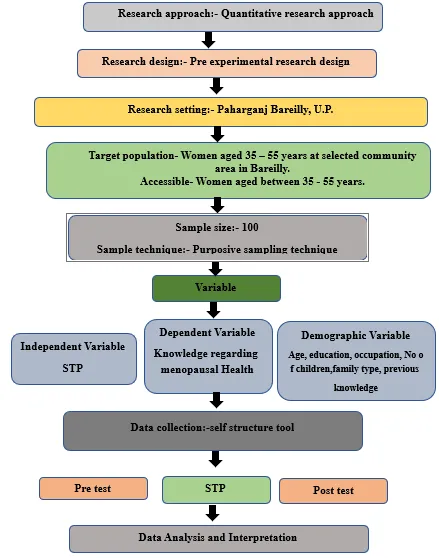
ANALYSIS AND INTERPRETATION:
|
DEMOGRAPHIC VARIABLES |
TOTAL FREQUENCY |
PERCENTAGE (%) |
|
AGE |
||
|
23 |
23% |
|
48 |
48% |
|
29 |
29% |
|
0 |
0% |
|
RELIGION |
||
|
62 |
62% |
|
38 |
38% |
|
0 |
0% |
|
0 |
0% |
|
EDUCATION STATUS OF MOTHER |
||
|
59 |
59% |
|
18 |
18% |
|
14 |
14% |
|
9 |
9% |
|
OCCUPATION OF MOTHER |
||
|
82 |
82% |
|
18 |
18% |
|
NUMBER OF CHILDREN |
||
|
23 |
23% |
|
16 |
16% |
|
35 |
35% |
|
26 |
26% |
|
DIETRY HABIT |
||
|
62 |
62% |
|
38 |
38% |
|
TYPE OF FAMILY |
||
|
26 |
26% |
|
46 |
46% |
|
28 |
28% |
|
MARITAL STATUS |
||
|
0 |
0% |
|
86 |
86% |
|
0 |
0% |
|
14 |
14% |
|
PREVIOUS KNOWLEDGE ABOUT MENOPAUSAL HEALTH |
||
|
Yes |
22 |
22% |
|
No |
78 |
78% |
Section A:- Frequency wise distribution of demographic performa. n=100
|
Test |
Mean |
S D |
Mena difference |
T value |
|
Pre test |
13.88 |
5.81 |
4.54 |
6.26 |
|
Post test |
18.42 |
4.30 |
Significant at p value 0.01 as H1 is accepted.
Section B: Comparison of pre test and post test knowledge regarding Menopause among women
|
Demographic variables |
Adequate |
Moderate |
Inadequate |
Total |
Chi square |
p value |
|
AGE |
||||||
|
0 |
18 |
5 |
23 |
18.516 |
significant At p<0.05 |
|
0 |
28 |
20 |
48 |
||
|
0 |
6 |
23 |
29 |
||
|
0 |
0 |
0 |
0 |
||
|
RELIGION |
||||||
|
0 |
28 |
34 |
62 |
0.962 |
Not significant At p<0.05 |
|
0 |
21 |
17 |
38 |
||
|
0 |
0 |
0 |
0 |
||
|
0 |
0 |
0 |
0 |
||
|
EDUCATION STATUS OF MOTHER |
||||||
|
0 |
12 |
47 |
59 |
11.019 |
significant At p<0.05 |
|
0 |
4 |
14 |
18 |
||
|
0 |
8 |
6 |
14 |
||
|
0 |
5 |
4 |
9 |
||
|
OCCUPATION OF MOTHER |
||||||
|
0 |
49 |
33 |
82 |
0.108 |
Not significant At p<0.05 |
|
0 |
10 |
8 |
18 |
||
|
NUMBER OF CHILDREN |
||||||
|
0 |
12 |
11 |
23 |
3.486 |
Not significant At p<0.05 |
|
0 |
8 |
8 |
16 |
||
|
0 |
12 |
23 |
35 |
||
|
0 |
8 |
18 |
26 |
||
|
DIETRY HABIT |
||||||
|
0 |
28 |
34 |
62 |
0.962 |
Not significant At p<0.05 |
|
0 |
21 |
17 |
38 |
||
|
TYPE OF FAMILY |
||||||
|
0 |
10 |
16 |
26 |
0.238 |
Not significant At p<0.05 |
|
0 |
16 |
30 |
46 |
||
|
0 |
9 |
19 |
28 |
||
|
MARITAL STATUS |
||||||
|
0 |
0 |
0 |
0 |
0.139 |
Not significant At p<0.05 |
|
0 |
35 |
51 |
86 |
||
|
0 |
0 |
0 |
0 |
||
|
0 |
6 |
8 |
14 |
||
|
PREVIOUS KNOWLEDGE ABOUT MENOPAUSAL HEALTH |
||||||
|
0 |
18 |
4 |
22 |
5.594 |
significant At p<0.05 |
|
0 |
42 |
36 |
78 |
||
* significant at 0.05
Section C: Association Between Level of Knowledge to their Demographic Variables
The distribution of knowledge scores varied significantly across several demographic factors in the study population. Age showed significant association with chi square value18.51, education showed significant association with chi square value 11.019 and previous knowledge showed significant association with chi square value 5.594 as Research hypothesis (H2) is accepted.
REFERENCES






Abhinay Ranjan Mehta*, Aman Kumar, Aashish Pathak, Akash Kumar, Priyanka A. Masih, Ravishankar Pal, Effectiveness Of Structured Teaching Programme On Knowledge Regarding Menopausal Health Among Women At Selected Community Area Of Bareilly, Uttar Pradesh, Int. J. Sci. R. Tech., 2026, 3 (10), 408-414. https://doi.org/10.5281/zenodo.23164014
 10.5281/zenodo.23164014