

We use cookies to ensure our website works properly and to personalise your experience. Cookies policy
Department of Biotechnology, Deogiri College (Autonomous), Chh. Sambhajinagar, MS., India- 431005.
The increasing demand for food production and the environmental impact of excessive chemical fertilizer use call for the development of sustainable agricultural alternatives. Among plant growth–promoting rhizobacteria (PGPR), Rhizobium plays an important role in improving soil fertility through biological nitrogen fixation and multiple plant growth–promoting activities. However, the inconsistent performance of commercial inoculants under varying agro-climatic conditions highlights the need to identify efficient indigenous strains adapted to local soils. In this study, nodulated root samples from major leguminous crops including pigeon pea, black gram, cowpea, peanut, and mung bean were used for the isolation and characterization of indigenous Rhizobium strains. The isolates were cultured on yeast extract mannitol agar and evaluated through microscopic, biochemical, and metabolic analyses to identify multi-spectrum strains possessing traits such as PO? and K solubilization, phytohormone production like IAA and cytokinin, and nutrient mobilization. Selected isolates showed compatibility with native soil microbiota and significantly enhanced nodulation, plant growth, biomass accumulation, and overall vigor in Fenugreek under controlled pot conditions, both individually and as microbial consortia. Changes in plant protein expression patterns further indicated enhanced metabolic activity following microbial inoculation. The findings demonstrate the ecological and agronomic potential of indigenous Rhizobium strains as effective biofertilizers capable of reducing dependence on synthetic fertilizers while improving crop productivity and soil health. These results support the use of region-specific microbial resources for environmentally sustainable agricultural practices.
Modern agriculture faces the dual challenge of increasing food production for a rapidly growing global population while minimizing environmental degradation. Although synthetic chemical fertilizers substantially improved crop productivity during the Green Revolution, their excessive and prolonged use has resulted in serious ecological and health concerns, including soil degradation, groundwater contamination, nutrient imbalance, and greenhouse gas emissions (Tilman et al., 2002; Savci, 2012). Nitrous oxide (Nâ‚‚O), a major byproduct of nitrogen fertilizer application, possesses a global warming potential nearly 300 times greater than carbon dioxide (Galloway et al., 2008; Snyder et al., 2009). Furthermore, nitrate leaching into drinking water has been associated with methemoglobinemia (“blue baby syndrome”) and elevated cancer risks in adults (Camargo and Alonso, 2006; Ward et al., 2018). With global fertilizer consumption projected to exceed 205 million tonnes by 2025 (FAO, 2019), the development of sustainable and environmentally compatible agricultural alternatives has become imperative.
Among the promising alternatives, plant growth-promoting rhizobacteria (PGPR) have gained considerable attention due to their ability to enhance plant productivity while reducing dependency on chemical fertilizers (Vessey, 2003; Backer et al., 2018). Within this group, Rhizobium species represent one of the most extensively studied and agriculturally important symbiotic bacteria. These Gram-negative, motile microorganisms establish symbiotic associations with leguminous plants through the formation of specialized root nodules, where atmospheric nitrogen (N₂) is converted into plant-available ammonia (NH₃) via biological nitrogen fixation (BNF) mediated by the nod, nif, and fix gene clusters (Oldroyd et al., 2011; Masson-Boivin and Sachs, 2018). This natural process significantly reduces the requirement for synthetic nitrogen fertilizers while improving soil fertility and ecosystem sustainability.
Beyond nitrogen fixation, Rhizobium exhibits multiple plant growth-promoting traits that contribute to enhanced crop productivity and soil health. These bacteria facilitate nutrient mobilization through POâ‚„ and K solubilization, synthesize phytohormones such as indole-3-acetic acid (IAA), cytokinins, and gibberellins, and improve plant tolerance against abiotic stresses including drought and salinity (Richardson et al., 2009; Sharma et al., 2013; Egamberdieva et al., 2017). Additionally, the production of compounds such as lumichrome, riboflavin, siderophores, and extracellular enzymes contributes to improved nutrient acquisition, organic matter decomposition, and maintenance of a balanced rhizospheric microbial community (Dakora, 2003; Ahmad et al., 2008; Glick, 2012).
Commercial Rhizobium-based biofertilizers often show inconsistent performance in the field because non-native strains may not adapt well to local soil and environmental conditions (Malusá et al., 2012; Bashan et al., 2014). In comparison, indigenous Rhizobium strains are naturally suited to their native environment and usually perform better in terms of survival, root colonization, and nodulation efficiency. This makes them valuable candidates for developing effective region-specific biofertilizers (Thrall et al., 2007; Zhang et al., 2020).
This study focused on isolating and characterizing indigenous multi-spectrum Rhizobium strains from five leguminous crops. The isolates were examined for their biochemical traits, compatibility with beneficial soil microorganisms, and ability to promote plant growth under controlled pot conditions. The study highlights their potential as sustainable and locally adapted biofertilizers for improving crop growth and soil health.
Sample Collection and Surface Sterilization:
Healthy root nodules were collected from five leguminous crops, namely Arachis hypogaea (groundnut), Vigna mungo (black gram), Vigna unguiculata (cowpea), Vigna radiata (green gram), and Cajanus cajan (pigeon pea), grown in agricultural fields at Bilda village, Tal. Phulambri, Dist. Chhatrapati Sambhajinagar, MS., India (20.0458562°N, 75.4015061°E). The nodules were separated aseptically, surface sterilized using standard procedures. (Vincent, 1970).
Cultural, Microscopic, Growth, and Biochemical Characterization of Rhizobium Isolates:
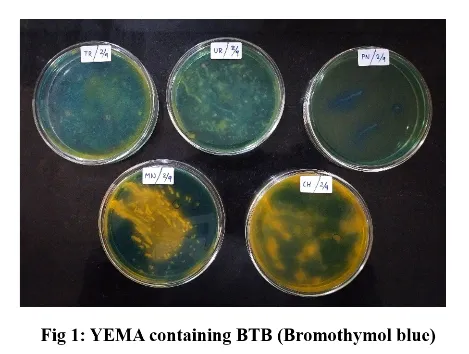
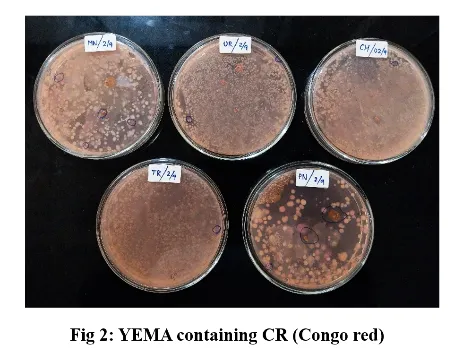
Preliminary characterization of the isolates was performed on Yeast Extract Mannitol Agar (YEMA) supplemented with Congo red (CR) and Bromothymol blue (BTB) following incubation at 28±2°C for 48–72 h. Colony morphology, dye absorption, and colour changes were recorded for identification of typical Rhizobium colonies (Purwaningsih et al., 2021). Microscopic characterization was carried out using Gram staining (Gram, 1884).
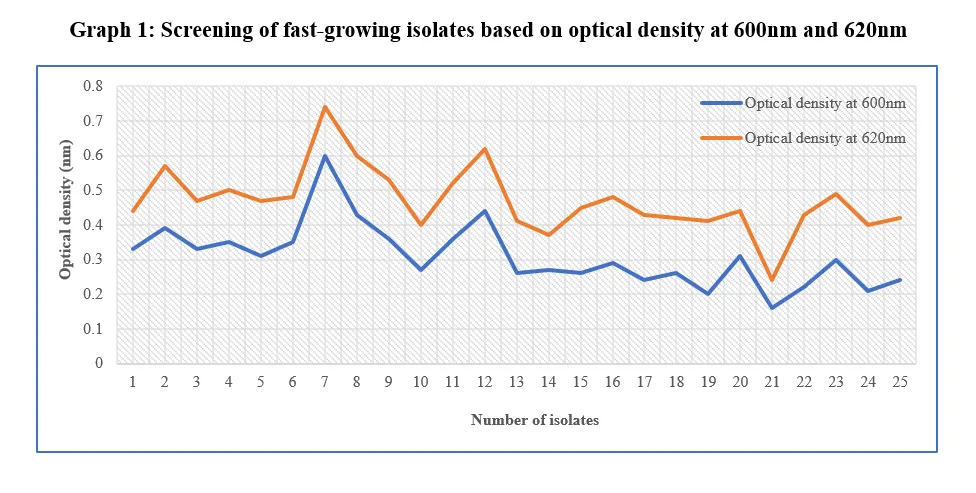
Growth characteristics were evaluated in Yeast Extract Mannitol (YEM) broth by measuring optical density (OD₆₀₀ and OD₆₂₀) and pH changes. Fast-growing isolates were selected for further studies (Somasegaran et al., 1994; Vincent et al., 1970).
Biochemical characterization included carbohydrate utilization, substrate degradation, enzymatic assays, and plant growth–promoting traits. Tests such as TSI, sugar fermentation, starch hydrolysis, citrate utilization, catalase, oxidase, gelatinase, lipase, urease, lysine decarboxylase, phosphate solubilization, IAA production, ammonia production and IMViC were performed using standard protocols (Hajna, 1945; Pikovskaya, 1948; Cappuccino and Sherman, 2014, Møller 1955, Sierra 1957). Results were interpreted based on colour changes, clear zones, gas production, and other visible reactions.
DNA Isolation of Selected Rhizobium Isolates:
Genomic DNA was isolated from selected fast-growing Rhizobium isolates using standard extraction and purification procedures. DNA quality and quantity were assessed by agarose gel electrophoresis and spectrophotometric analysis. The purified DNA was further used for PCR amplification and molecular characterization (Sambrook and Russell, 2001; Ausubel et al., 1995).
Microbial Compatibility Assay:
The compatibility of selected Rhizobium isolates with common soil microorganisms was tested using the cross-streak method on nutrient agar plates. Microorganisms including Escherichia coli, Azotobacter, Pseudomonas, Aspergillus niger, and Aspergillus flavus were grown alongside the Rhizobium cultures to observe compatible or inhibitory interactions (Granada Agudelo et al., 2023).
Pot Assay for Evaluation of Plant Growth Promotion and Nodulation:
A pot assay was performed to evaluate the plant growth–promoting and nodulation ability of selected Rhizobium isolates using fenugreek (Trigonella foenum-graecum) seeds. Sterilized soil was filled in pots, and healthy seeds were sown under aseptic conditions. The experimental setup included an uninoculated control, individual treatments with isolates RHZ7 and RHZ20, and a consortium of RHZ2, RHZ7, RHZ12, RHZ20, and RHZ23 grown in Yeast Extract Mannitol (YEM) broth. The respective inocula were applied to the pots, which were maintained under regular watering conditions. Plant growth parameters and nodulation were periodically observed and recorded in all treatments (Vincent et al., 1970; Somasegaran et al., 1994).
Protein Profiling of Fenugreek Leaves using SDS-PAGE:
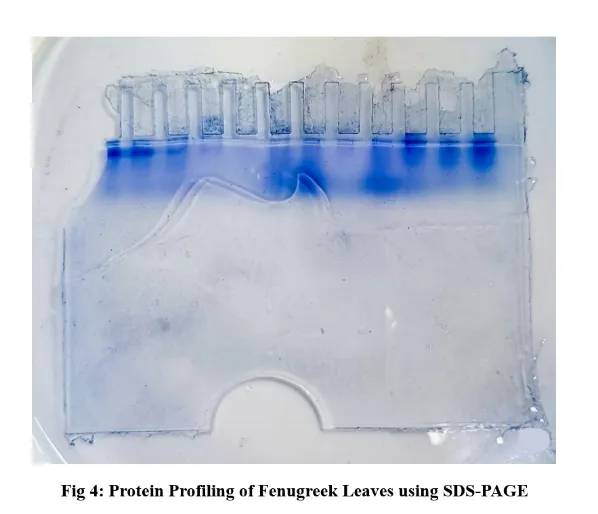
Protein profiling of fenugreek leaves from control and Rhizobium-treated plants was performed using SDS-PAGE following the method of Laemmli (1970). Leaf proteins were extracted, centrifuged, and equal quantities of protein samples were denatured and loaded onto SDS-PAGE gel. Following electrophoresis, gels were stained with Coomassie Brilliant Blue to visualize protein bands. Banding patterns of treated and control samples were compared using a protein marker to assess variations in protein expression.
Cultural and Microscopic Characterization:
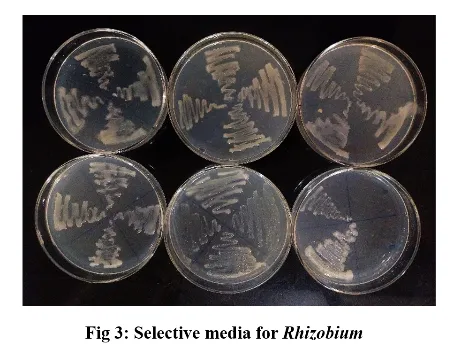
Distinct Rhizobium colonies on YEMA look as if circular, smooth, translucent, and mucoid after incubation. Poor Congo red absorption and the blue-to-yellow colour change on Bromothymol blue medium indicated typical Rhizobium characteristics and acid production. Gram staining showed Gram-negative, rod-shaped cells occurring singly or in small groups, confirming the purity and identity of the isolates.
Screening of Fast-Growing Isolates:
A total of 25 isolates were screened for growth in YEM broth. Variations in optical density and pH (5.0–6.6) were observed among the isolates, showing differences in growth and metabolism. Based on better growth rate, turbidity, and pH changes, five fast-growing isolates—RHZ2, RHZ7, RHZ12, RHZ20, and RHZ23 were selected for further studies.
Biochemical Characterization:
Biochemical characterization showed that the selected Rhizobium isolates possessed diverse metabolic and enzymatic activities. All selected isolates showed positive glucose utilization and no isolate showed gas production on TSI agar. All isolates also exhibited starch hydrolysis, indicated by a clear zone around the colonies on starch agar. IMViC analysis showed variable results for the Indole, MR, and VP tests, which may indicate the occurrence of horizontal gene transfer, whereas all isolates showed positive citrate utilization. All isolates exhibited prominent catalase, oxidase, and urease activities. Gelatinase activity was observed in 10% of the isolates and may be associated with plasmid-mediated gene transfer. All isolates demonstrated significant phosphate-solubilizing activity on Pikovskaya’s medium. Among them, isolates RHZ12 and RHZ23 showed the most promising performance in all the above-mentioned characterization tests. Lipase and lysine decarboxylase tests were negative for all isolates. Acid and gas production from glucose, lactose, and mannitol fermentation was observed in isolates RHZ12 and RHZ23.
DNA Isolation of Selected Rhizobium Isolates:
Genomic and plasmid DNA were successfully isolated from the selected isolates. Agarose gel electrophoresis revealed distinct DNA bands with minimal smearing, indicating the good quality and integrity of the extracted genomic DNA. The isolated DNA was suitable for downstream molecular applications such as species identification and genetic analysis of the isolates. The presence of smaller plasmid DNA bands provided evidence of plasmid carriage and may suggest the occurrence of horizontal gene transfer.
Microbial Compatibility Assay:
The selected Rhizobium isolates showed good compatibility with common soil microorganisms in the cross-streak assay. No inhibitory interactions were observed with Escherichia coli, Azotobacter, Pseudomonas, Aspergillus niger, and Aspergillus flavus, indicating that the isolates can coexist with native soil microflora without affecting their growth (Granada Agudelo et al., 2023; Bashan et al., 2014).
Pot Assay for Evaluation of Plant Growth Promotion and Nodulation:
The pot assay showed visible improvement in the growth and nodulation of fenugreek plants following Rhizobium inoculation compared to the uninoculated control. Isolates RHZ7 and RHZ20 promoted better seed germination, increased shoot and root growth, and higher biomass. Among all treatments, the consortium of RHZ2, RHZ7, RHZ12, RHZ20, and RHZ23 produced the best results, with healthier plant growth and a higher number of well-developed pink nodules, indicating effective nitrogen fixation. Overall, the consortium demonstrated better plant growth–promoting potential than the individual isolates, supporting its possible use as an efficient biofertilizer.
Protein Profiling of Fenugreek Leaves using SDS-PAGE:
SDS-PAGE analysis of fenugreek leaf proteins revealed clear bands mainly in the ~15–75 kDa range. Differences in band intensity between control and Rhizobium-treated plants indicated altered protein expression due to bacterial inoculation. Prominent bands around ~50–55 kDa and ~15–20 kDa likely corresponded to RuBisCO subunits, while other bands represented metabolic and stress-related proteins. Overall, the results suggest that Rhizobium inoculation enhanced protein expression and plant metabolic activity in fenugreek (Laemmli, 1970; Jorrín-Novo et al., 2015).
CONCLUSION
This study demonstrates that indigenous Rhizobium isolates possess strong potential as sustainable biofertilizers. The selected strains enhanced plant growth, root development, and nodulation in Fenugreek, while also showing compatibility with native soil microflora. These conclusions support their possible use as eco-friendly alternatives to chemical fertilizers for improving soil fertility and crop productivity while maintain soil microbial peace.
Further research involving molecular identification, field trials, and formulation development will help establish efficient, region-specific biofertilizers for sustainable agricultural applications.
REFERENCES





Yogini A. Ranade*, Shrirang V. Dhakne, Nikhil M. Dahatonde, Rutuparna S. Deshpande, Nikhil G. Kokate, Harnessing Native Synergy: Screening And Evaluation Of Multi-Spectrum Indigenous Rhizobium Strains For Sustainable Agriculture, Int. J. Sci. R. Tech., 2026, 3 (6), 1180-1186. https://doi.org/10.5281/zenodo.20773646
 10.5281/zenodo.20773646