

We use cookies to ensure our website works properly and to personalise your experience. Cookies policy
1Department : Pharmacology, Viswanadha institute of Pharmaceutical sciences, Visakhapatnam.
2Department : Pharmaceutical Analysis, Viswanadha institute of Pharmaceutical sciences, Visakhapatnam.
The present study investigates the impact of different sources of water and the calcium channel blocker verapamil on seed germination and stem length. The experiment aimed to determine how varying water quality and the presence of verapamil influence early plant growth. Seeds were irrigated using four water sources—tap water, distilled water, rainwater, and river water—with and without the addition of verapamil at a fixed concentration. Germination percentage, germination rate, and stem length were recorded over a fixed period. Results indicated that water quality significantly affected both germination and stem elongation, with distilled and rainwater promoting the highest germination percentages and longest stems. The inclusion of verapamil generally reduced both germination rate and stem length across all water treatments, suggesting that calcium channel inhibition interferes with cellular processes essential for seed germination and growth. Overall, the study highlights the importance of water composition and ion transport regulation in early plant development.
Seed germination is a critical stage in the life cycle of plants, marking the beginning of growth and development that determines subsequent yield and productivity. The success and rate of germination are influenced by both internal factors, such as genetic makeup and hormonal regulation, and external factors, including water quality, temperature, and chemical exposure. Among these, water plays a fundamental role, as it initiates the metabolic processes required for embryo activation, enzyme synthesis, and cell expansion.
Different sources of water—such as tap water, distilled water, rainwater, and wastewater—differ in their chemical composition, pH, salinity, and presence of minerals or contaminants. These variations can significantly influence seed germination and early seedling growth. For instance, water with high salinity or heavy metal content can inhibit germination and reduce stem elongation, whereas pure or mineral-balanced water may promote healthier growth.
Verapamil, a calcium channel blocker commonly used in medical treatments for cardiovascular conditions, has also been studied for its physiological effects on plants. Calcium ions play a crucial role in cell wall stability, membrane permeability, and signal transduction during germination and growth. By interfering with calcium transport, verapamil may alter these processes, potentially affecting germination rate and stem elongation.
Investigating the combined effects of different water sources and verapamil on seed germination and stem length provides insight into how environmental and chemical factors interact to influence plant growth. Such studies can contribute to understanding plant stress physiology and may have implications for agricultural practices, environmental pollution monitoring, and the selection of appropriate irrigation sources.
MATERIALS:
Glass jars, mesh, labels, green gram, fenugreek, waters (Alkaline water, distilled water,groundwater,Industrialwater,Lemonwater,Mineralwater,Seawater&Tapwater),Spatula.
APPARATUS:AnalyticalBalance&Measuringscale.
DRUG:Verapamil (Calciumchannelblocker).
METHODS:
STEP-1:
EXPERIMENT-1
Seeds are rinsed in water. The split or otherwise obviously damaged seeds are discarded. The best sprouting resulted seeds are purchased which are specially labeled for sprouting, which are usually tested to guarantee a good germination rate. At the very least, organic seeds are purchased. Many organic seeds sold for consumption are specially treated not to sprout. The multiple samples of water were collected from different resources i.e. alkaline water, distilled water, groundwater, Industrial water, Lemon water, Mineral water, Salt water &Tap water and labeled them.
STEP-2:
5gm of seeds were accurately weighed and placed in previously weighed 100 ml of each labeled water sample jars
STEP-3:The jars were set upright and experimental waters were filled and left a side to soak for a period of 24hours.The sprouting lid which is a hollow ring plastic-mesh, is placed to the mouth Of the glass jars in away if the jars are tilted the un sprouted seeds will not pass through the size of the mesh
STEP-4:
On the 2nd day, the jars were placed in such a way which allows the excess water to drain out of the jar, and the jars were placed in such a way to circulate the air freely, for the sprouting.
STEP-5:
On the3rd day the sprouting of seeds were observed and measured with the help of a measuring scale of randomly selected sprouting seeds of each labeled jar are noted, the same type of waters were sprinkled on to the sprouting jars to promote growth.
STEP-6:
Every day we have taken 10 sprouts from each jar & growth was measured and average was taken, other 2 consecutive day the procedure was repeated.
STEP-7:
3days measured results were tabulated & the graph was drawn using Multiple samples of water on X axis and Growth on Y axis.
The above procedure was followed for green gram and fenugreek sprouting in multiple samples of water i.e, (Alkaline water, distilled water, ground water, Industrial water, Lemon water, Mineral water, Sea water & Tap water).
EXPERIMENT-2
The combination of lemon juice (Resembles Acidic PH water) and Sea water (Resembles Basic PH water) with ground water by above mentioned procedure for Fenugreek and Green gram seeds
Table 3: Combination of Lemon Juice & Ground Water
A) Combination of Lemon Juice and Ground water
| LEMON JUICE(ml) | GROUND WATER(ml) |
|---|---|
| 90 | 10 |
| 80 | 20 |
| 70 | 30 |
| 50 | 50 |
| 70 | 30 |
| 80 | 20 |
| 90 | 10 |
Table 4: Combination of Seawater & Ground Water
A) Combination of Sea water and Ground water
| SEAWATER(ml) | GROUNDWATER(ml) |
|---|---|
| 90 | 10 |
| 80 | 20 |
| 70 | 30 |
| 50 | 50 |
| 70 | 30 |
| 80 | 20 |
| 90 | 10 |
The stem length was measured for 3 consecutive days and the results were tabulated & graph was plotted using combination ratios on X axis and Growth on Y axis
EXPERIMENT-3
Sprouting using drug verapamil
Now let us know how the growth of seeds were done using green gram and fenugreek seeds.
A) RESULTS OF GROWTH OF FENU GREEK SEEDS IN MULTIPLE SAMPLES OF WATER
Table 5: Results of Growth Fenugreek Seeds in Multiple Water Samples
| Samples of water | Average of 10 observations on each day | Average growth in 3 days cm | ||
|---|---|---|---|---|
| Day-1 | Day-2 | Day-3 | ||
| Alkaline water | 0.11 | 1.86 | 2.19 | 1.38 |
| Distilled water | 0.10 | 1.75 | 2.36 | 1.40 |
| Ground water | 1.58 | 2.84 | 4.44 | 2.95 |
| Industrial water | 0.34 | 0.92 | 1.49 | 1.75 |
| Lemon juice | _ | _ | _ | _ |
| Mineral water |
1.27 | 1.93 | 2.47 | 1.34 |
| Pond water | 1.39 | 2.21 | 3.93 | 2.51 |
| Seawater | _ | _ | _ | _ |
| Tap water | 1.25 | 2.25 | 3.75 | 2.50 |
MULTIPLEWATERSAMPLES
A) RESULTS OF GROWTH OF GREEN GRAM SEEDS IN MULTIPLE WATER SAMPLES
Table 6: Results of Growth of Green Gram Seeds in Multiple Water Samples
| Samples of water | Average of 10 observations on each day | Average growth in 3 days Cm | ||
|---|---|---|---|---|
| Day-1 | Day-2 | Day-3 | ||
| Alkaline water | 1.2 | 1.74 | 2.28 | 1.74 |
| Distilled water | 1.23 | 2.31 | 2.5 | 2.01 |
| Ground water |
1.23 | 2.7 | 4.25 | 2.71 |
| Industrial water | 1.23 | 1.81 | 2.15 | 1.73 |
| Lemon juice | _ | _ | _ | _ |
| Mineral water | 1.17 | 2.16 | 2.22 | 1.85 |
| Pond water | 1.12 | 1.74 | 2.66 | 1.84 |
| Seawater | _ | _ | _ | _ |
| Tap water | 1.07 | 1.97 | 2.56 | 1.86 |
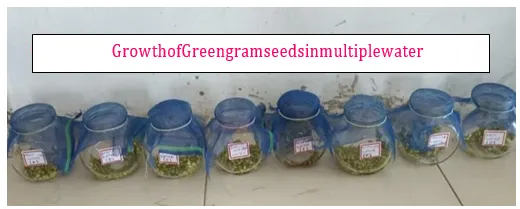
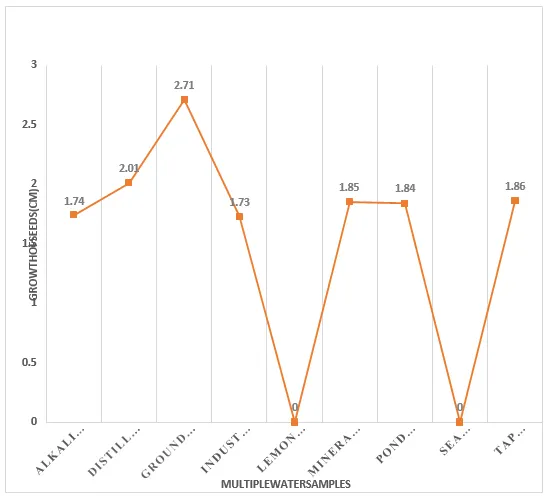
GRAPH-1 GROWTH OF GREEN GRAMSEEDS IN MULTIPLE WATER SAMPLES
B) GROWTH OF FENUGREEK SEEDS IN COMBINATION TO SEA WATER & GROUND WATER
Table 7: Growth of Fenugreek Seeds in Combination to Sea Water and Ground Water
| RATIOS OF SEA:GROUND WATER WATER(ml) |
Average of 10 observations on each day | Average growth in 3 days Cm | ||
|---|---|---|---|---|
| DAY-1 | DAY-2 | DAY-3 | ||
| 90:10 | - | - | - | - |
| 80:20 | - | - | - | - |
| 70:30 | - | - | - | - |
| 50:50 | 0.62 | - | - | 0.62 |
| 30:70 | 1.22 | 1.72 | 2.35 | 1.76 |
| 20:80 | 1.38 | 2.56 | 3.01 | 2.31 |
| 10:90 | 1.56 | 2.61 | 3.03 | 2.4 |
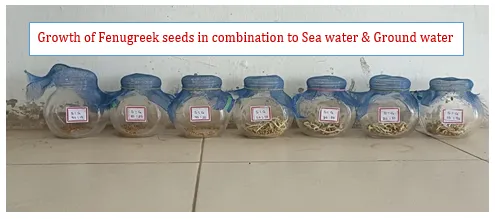
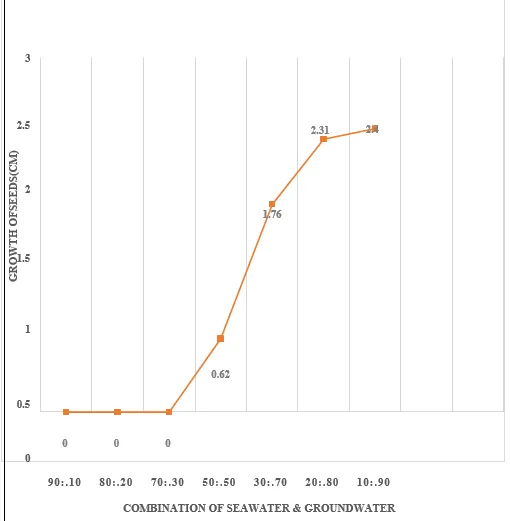
Graph: 3 Growth of Fenugreek Seeds in Combination to Seawater & Ground Water
C) RESULTS OF DILUTION CONCENTRATIONS OF SEAWATER & GROUND WATER USING GREEN GRAM
Table 8: Results of Dilution Concentrations of Seawater and Groundwater Using Green Gram
| RATIOSOF | Average of 10 observations on each day | Average growth in | ||
|---|---|---|---|---|
| SEA : GROUND WATERWATER(ml) | DAY-1 | DAY-2 | DAY-3 | 3days(Cm) |
| 90:10 | - | - | - | - |
| 80:20 | - | - | - | - |
| 70:30 | - | - | - | - |
| 50:50 | 0.18 | - | - | 0.18 |
| 30:70 | 1.14 | 1.82 | 2.21 | 1.39 |
| 20:80 | 1.41 | 2.54 | 3.21 | 2.38 |
| 10:90 | 1.57 | 2.54 | 3.45 | 2.52 |
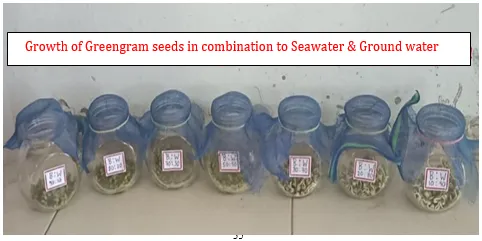
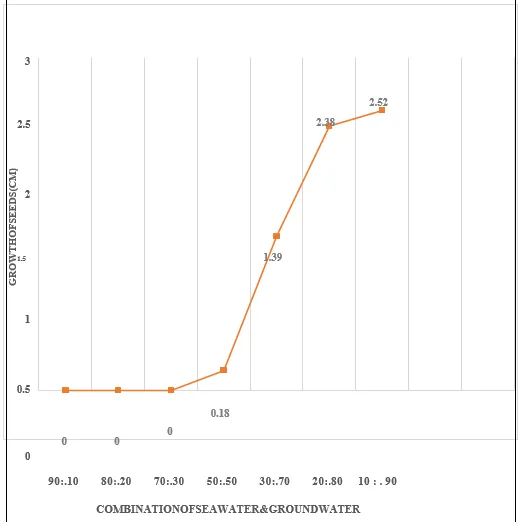
Graph: 4 Growth of Greengram Seeds in Combination to Seawater & Ground Water
D) GROWTH OF FENUGREEK SEEDS IN COMBINATION TO LEMON JUICE & GROUND WATER
Table 9: Growth of Fenugreek Seeds in Combination to Lemon Juice and Ground Water
| RATIOS OF LEMON:GROUND JUICE WATER(ml) | Average of 10 observations on each day | Average growth in3 days (Cm) | ||
|---|---|---|---|---|
| DAY-1 | DAY-2 | DAY-3 | ||
| 90:10 | - | - | - | - |
| 80:20 | - | - | - | - |
| 70:30 | - | - | - | - |
| 50:50 | - | - | - | - |
| 30:70 | 0.5 | 0.7 | 0.9 | 1.5 |
| 20:80 | 1.3 | 1.5 | 1.8 | 3.4 |
| 10:90 | 2.4 | 2.6 | 2.8 | 5.93 |
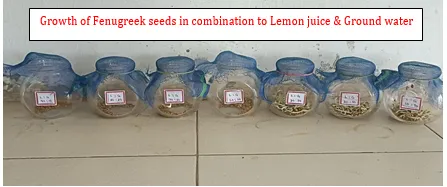
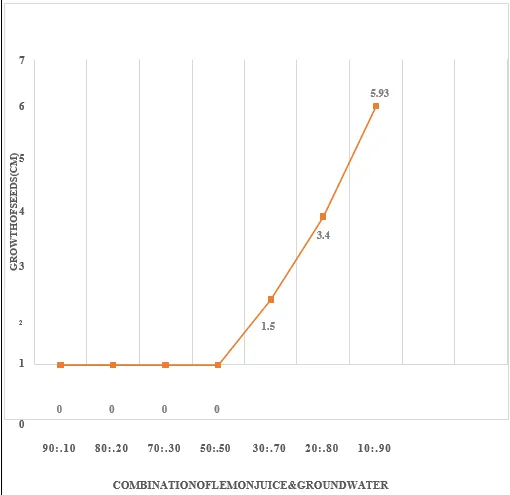
Graph: 5Growth of Fenugreek Seeds in Combination to Lemon Juice & Ground Water
E) GROWTH OF GREEN GRAM SEEDS IN COMBINATION TO LEMONJUICE & GROUND WATER
Table 10: Growth of Green Gram Seeds in Combination to Lemon Juice &Ground Water
| RATIOS OF | Averageof10observationsoneach day | Average growth | ||
|---|---|---|---|---|
| LEMON:GROUND JUICE WATER(ml) | DAY-1 | DAY-2 | DAY-3 | in3 days(Cm) |
| 90:10 | - | - | - | - |
| 80:20 | - | - | - | - |
| 70:30 | - | - | - | - |
| 50:50 | - | - | - | - |
| 30:70 | 0.4 | 0.5 | 0.8 | 1.16 |
| 20:80 | 1.2 | 1.4 | 1.9 | 3.2 |
| 10:90 | 2.4 | 2.5 | 2.7 | 5.8 |
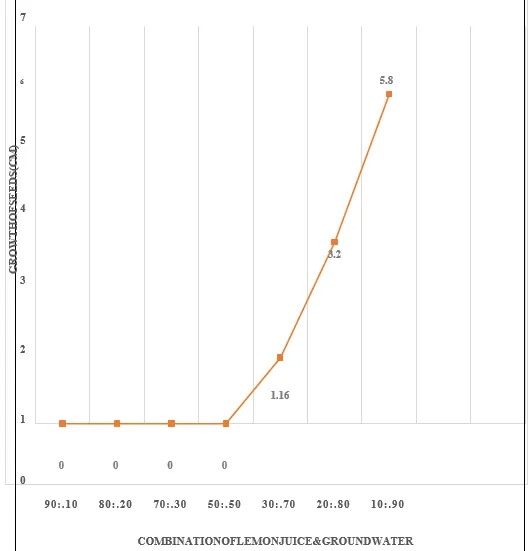
Graph: 6 Growthofgreengramseedsincombinationtolemon Juice & Ground Water
F) GROWTH IS FENUGREEKSEEDS WITH DRUG IN MULTIPLESAMPLES OF WATER
Table 11: Growth of Fenugreek Seeds with Drug Verapamil in Multiple Water Samples
| Samples of water | Average of 10 observations on each day | Average growth in 3 days (Cm) | ||
|---|---|---|---|---|
| Day-1 | Day-2 | Day-3 | ||
| Alkaline water | 3.5 | 6.92 | 10 | 13.7 |
| Distilled water | 2.5 | 4.6 | 7.3 | 4.8 |
| Ground water | 2.8 | 3.5 | 8 | 4.7 |
| Industrial water |
2.3 | 4 | 6.3 | 8.4 |
| Mineral water | 3 | 5 | 9 | 11 |
| Pond water | 2 | 4.5 | 9.5 | 9.66 |
| Tap water | 2.8 | 3.1 | 5 | 7.56 |
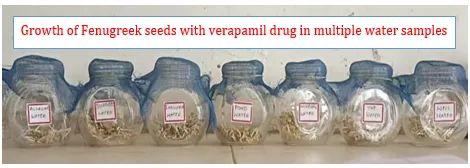
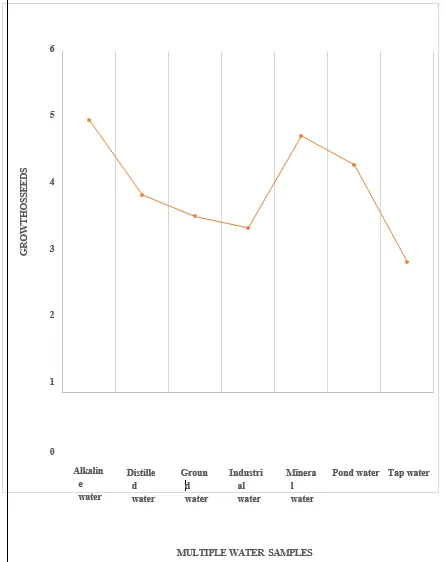
GRAPH7GROWTHOFFENUGREEKSEEDS INMULTIPLEWATER SAMPLES WITH VERAPAMIL DRUG
Table 12: Results of Drug Verapamil in Multiple Samples of Water Using Green Gram.
| Samples of water | Average of 10 observations on each day | Average growth in 3 days (Cm) | ||
|---|---|---|---|---|
| Day-1 | Day-2 | Day-3 | ||
| Alkaline Water | 2.13 | 4.92 | 7.08 | 4.71 |
| Distilled Water |
1.63 | 3.32 | 5.54 | 3.49 |
| Ground Water | 1.39 | 2.98 | 4.37 | 2.98 |
| Industrial Water | 1.68 | 2.37 | 4.5 | 2.85 |
| Mineral Water | 2.01 | 3.18 | 6.8 | 4.5 |
| Pond Water | 1.62 | 2.28 | 7.17 | 3.99 |
| Tap Water |
1.79 | 2.37 | 2.76 | 2.27 |
G) RESULTS OF DRUG IN MULTIPLE WATER SAMPLES USING GREEN GRAM
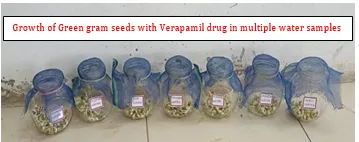
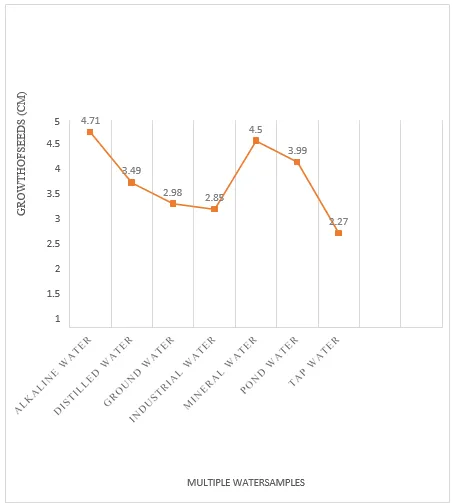
Graph: 8 Growth of Greengram Seeds Multiple Water Samples with Verapamil
SUMMARY & CONCLUSION
The growth of fenugreek and green gram seeds were observed in multiple samples of water (Alkaline water, Distilled water, Ground water, Industrial water, Lemon juice, Mineral water, Pond water, Salt water & Tap water).
REFERENCES

R. Indu, M. Swapna, Dr. M. Savitri, Impact of Different Sources of Water and Verapamil on Seed Germination & Stem Length, Int. J. Sci. R. Tech., 2026, 3 (11), 221-233. https://doi.org/10.5281/zenodo.23943760
 10.5281/zenodo.23943760