

We use cookies to ensure our website works properly and to personalise your experience. Cookies policy
Assistant Professor (Mass Communication & Journalism), IIC Convenor, Dr. C. V. Raman University, Khandwa
Artificial Intelligence (AI) is emerging as a transformative influence in organizational communication and public relations (PR), offering innovative tools to meet the increasingly complex and swift demands of these fields. In organizational landscapes, AI enhances internal communication through various automated solutions such as chatbots, virtual assistants, and systems for data-driven feedback analysis. This integration facilitates timely and consistent dissemination of information among employees, effectively bridging communication gaps and minimizing misunderstandings within the workplace. Moreover, AI empowers organizations to analyze communication trends, allowing them to foresee potential concerns, thereby enriching decision-making processes and fostering a well-informed workforce. In the domain of public relations, AI significantly augments strategic communication efforts through capabilities like real-time media monitoring, sentiment analysis, and predictive analytics. These technological advancements enable PR professionals to gain insights into public sentiment, manage brand reputation vigilantly, and react swiftly to emerging issues or crises. AI also enhances the capacity for personalized communication, allowing organizations to customize their messaging in accordance with audience preferences and behavioral patterns, which in turn strengthens engagement and builds trust. Nevertheless, the escalating dependence on AI underscores the imperative for transparency, ethical considerations, and human oversight. While AI technologies enhance operational efficiency, accuracy, and outreach, maintaining responsible usage is crucial to uphold credibility and foster public trust. In summary, AI is pivotal in advancing organizational communication and public relations, rendering processes more dynamic, data-informed, and strategically effective.

Communication is essential for the functioning of organizations, providing clarity, coordination, and fostering strong relationships with employees and external stakeholders. The rise of digital technologies has introduced Artificial Intelligence (AI) as a transformative tool in communication practices within organizations and public relations. AI encompasses the capability of machines and software to execute tasks typically requiring human intelligence, such as learning, analysis, decision-making, and language processing. In the realm of communication and PR, AI enhances the speed of information dissemination, facilitates a deeper understanding of audiences, and refines the delivery of messages. This paper examines the significance of AI in organizational communication and public relations, underscoring its advantages, the challenges it presents, and its potential for future development.
2. REVIEW OF LITERATURE
Artificial Intelligence (AI) has emerged as a significant technological development influencing communication practices across organizations and public relations. Scholars have increasingly examined AI as a socio-technological system that reshapes how organizations interact with stakeholders, manage information, and maintain reputation• Buhmann and White (2022) assert that AI represents a structural transformation in public relations, affecting communication management beyond mere automation.
• Key AI technologies, such as machine learning and natural language processing, are reshaping PR functions like media relations, stakeholder engagement, and reputation management.
• Russell and Norvig (2016) describe AI as systems that learn, reason, and solve problems, enhancing decision-making efficiency through large-scale data analysis in organizational communication.
• Diakopoulos (2019) emphasizes the influence of algorithms on public communication and media, affecting agenda-setting and public discourse, thereby playing a significant role in reputation building.
• Huang and Rust (2021) note AI’s strategic value in marketing, where predictive analytics and personalization foster better audience engagement and trust.
• AI-driven insights help organizations anticipate stakeholder needs and develop targeted communication strategies.
• Grunig and Hunt’s (1984) two-way symmetrical communication model gains importance with AI, facilitating continuous feedback and real-time engagement.
• Curtin (2012) discusses the evolution of public relations towards relationship management, with AI enabling proactive crisis monitoring and responses.
with AI enabling proactive crisis monitoring and responses.
Overall, the reviewed literature establishes that AI enhances efficiency, accuracy, and strategic depth in organizational communication and public relations. However, scholars also stress the importance of ethical use, transparency, and human oversight to maintain credibility and trust.
3. OBJECTIVES OF THE STUDY
The main objectives of this study are:
1. Examine the role of AI in organizational communication.
2. Analyze the importance of AI in public relations practices.
3.Understand how AI supports internal and external communication.
4.Study the role of AI in media monitoring, crisis communication, and reputation management.
5. Identify ethical challenges related to the use of AI in communication.
4. Research Questions
5. Research Methodology
This study utilizes qualitative and descriptive research methodologies to investigate the intersection of artificial intelligence (AI), organizational communication, and public relations. Data was gathered from a variety of secondary sources including books, research articles, journals, reports, and online academic resources. The analysis aims to elucidate the prevalent trends, diverse applications, and challenges associated with integrating AI within communication practices.
6. Analysis and Discussion
AI enhances communication efficiency, media monitoring, and crisis preparedness. Data-driven insights enable proactive decision-making and improved stakeholder engagement.
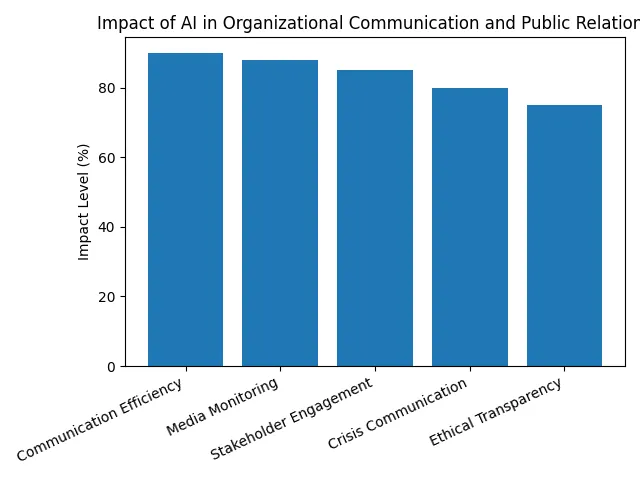
Fig: -1 shows that AI has the highest impact on communication efficiency and media monitoring, followed by stakeholder engagement and crisis communication. Ethical transparency remains critical for sustainable AI adoption.

AI plays an important role in improving internal communication within organizations. Tools such as chatbots, automated emails, and virtual assistants help employees access information quickly and accurately. AI-based systems ensure consistency in communication and reduce human errors.
AI also helps organizations analyze employee feedback, communication patterns, and engagement levels. By studying data, organizations can identify communication gaps, predict employee concerns, and improve workplace transparency. As a result, AI supports better coordination, productivity, and employee satisfaction.
In public relations, AI has become a powerful strategic tool. AI-based media monitoring systems track news coverage, social media conversations, and public sentiment in real time. This helps PR professionals understand public opinion and manage brand reputation effectively.
AI also supports predictive analytics, allowing organizations to anticipate potential crises and respond proactively. Personalized communication powered by AI enables PR practitioners to deliver targeted messages to different audience segments. This increases engagement, trust, and long-term relationships with stakeholders.

Crisis communication requires quick and accurate responses. AI helps organizations detect early warning signals through sentiment analysis and trend monitoring. During crises, AI tools assist in drafting responses, monitoring reactions, and evaluating communication effectiveness.
In reputation management, AI helps organizations track brand perception over time. By analyzing online conversations and feedback, organizations can improve their communication strategies and maintain a positive public image.
Despite its benefits, the use of AI in communication raises ethical concerns. Issues related to data privacy, algorithm bias, transparency, and over-automation cannot be ignored. Excessive dependence on AI may reduce human judgment and emotional understanding in communication.
Therefore, organizations must ensure ethical guidelines, human supervision, and responsible use of AI tools. Maintaining transparency and trust is essential for effective organizational communication and public relations.
7. Findings
The study reveals that:
Ethical use and human oversight are essential for maintaining credibility and trust.
CONCLUSION
Artificial Intelligence (AI) is a vital element in contemporary organizational communication and public relations, offering enhancements in internal communication channels and facilitating strategic public relations initiatives. Its implementation allows organizations to interact with stakeholders more effectively by improving the speed and accuracy of information dissemination and enhancing decision-making processes. However, the role of ethical considerations and the necessity for human oversight cannot be overlooked, as these factors are critical to ensuring that AI is integrated responsibly. In summary, the careful and balanced incorporation of AI into organizational strategies can lead to the development of transparent, responsive, and trustworthy communication frameworks. When applied judiciously, AI holds the potential to significantly influence and improve the landscape of organizational communication and public relations for the better.
REFERENCES

Jyoti Gour Verma*, Importance Of AI In Organizational Communication And Public Relations, Int. J. Sci. R. Tech., 2026, 3 (6), 535-539. https://doi.org/10.5281/zenodo.20576281
 10.5281/zenodo.20576281