

We use cookies to ensure our website works properly and to personalise your experience. Cookies policy
Department of Electronics & Telecommunication Engineering, Tatyasaheb Kore Institute of Engineering & Technology, Warananagar, Kolhapur, Maharashtra, India
Visual impairment continues to be a major challenge worldwide, affecting the mobility, independence, and daily activities of millions of people. Traditional assistive devices such as white canes provide limited information about the surrounding environment and often fail to identify obstacles beyond their physical reach. This paper presents an innovative wearable assistive system called "Embedded Smart Spectacles for Blind People." It uses computer vision, embedded systems, wireless communication, and home automation tech to improve the lives of visually impaired folks. The spectacles have an ESP32-CAM module with an OV2640 camera to snap real-time images of what users see. These get sent to a processing unit where a YOLO-based object detection algorithm figures out nearby objects and obstacles. Then, the system turns this info into speech with a Text-to-Speech engine so users hear what's around them. For added safety, it also has an SMS alert feature to call caregivers or family when help is needed. Furthermore, ESP-NOW wireless communication is employed to establish reliable communication between ESP32 devices for acknowledgment-based home automation control through relay-operated appliances.The developed smart spectacles provide real-time object awareness, voice guidance, emergency communication, and smart home accessibility within a single low-cost wearable platform. Experimental results demonstrate reliable object detection, efficient wireless communication, and practical usability in indoor and outdoor environments. Future enhancements include integrating facial recognition, GPS-based navigation, multilingual voice support, and cloud-based monitoring features to further improve accessibility and user independence.
Visual impairment is a major disability affecting millions of people around the world. It limits their ability to navigate and interact confidently with their surroundings. While various assistive devices, like white canes and guide dogs, are available, they often provide limited information about obstacles, objects, and environmental conditions. This limitation leads to challenges in mobility, safety, communication, and access to everyday services. However, with the rapid growth of embedded systems, artificial intelligence, and wireless communication technologies, we have more opportunities to create smart assistive solutions that promote independence and improve quality of life.
Many visually impaired individuals have the skills and abilities needed to lead independent, productive lives with the right technological support. Unfortunately, affordable and multifunctional assistive devices are often lacking, which restricts their ability to perform daily tasks without help. Modern smart technologies can fill this gap by offering real-time information about the environment, allowing users to engage more effectively with the world around them.
The "Embedded Smart Spectacles for Blind People" is a cool new system to help visually impaired folks move around safer and easier. It has an ESP32-CAM module with an OV2640 camera that snaps real-time images of what's around. These images then get processed by a YOLO-based object detection algorithm which spots objects and obstacles.The system then converts the detected information into speech through a Text-to-Speech engine, giving users immediate audio guidance. Additionally, it includes an SMS alert mechanism for emergency communication and ESP-NOW-based home automation features, allowing users to control household appliances wirelessly.
The goal of the Embedded Smart Spectacles is to provide a cost-effective, portable, intelligent assistive solution that boosts user independence and confidence. Combining object detection, voice feedback, emergency alerts, and home automation in one wearable device, this system aids visually impaired folks in moving around safer and more efficiently. This tech is a big step toward a more inclusive society. It lets visually impaired people join in on education, jobs, and daily tasks with way more independence and dignity.
LITERATURE REVIEW
Researchers have made assistive tech to help visually impaired folks move around easier and feel more independent. Smart glasses, in particular, are pretty cool because they use things like computer vision and audio cues to guide wearers. The glasses spot objects and warn about hazards, giving real-time feedback.Thanks to recent AI and wireless tech advancements, these devices work even better now, letting people navigate safer and do everyday tasks with more confidence.[1]
Many existing smart glasses utilize camera modules and image processing techniques to recognize objects and convert visual information into audio output. Object detection algorithms such as YOLO and OpenCV-based image processing have significantly improved detection accuracy and processing speed. These technologies allow users to receive immediate information about nearby objects and obstacles through speech-based feedback. However, some earlier systems were limited by processing delays, hardware complexity, and high implementation costs.[2]
Researchers also look at how IoT and wireless tech can make assistive devices better. They use things like ESP32-based controllers and mobile communication features to do this. This lets them create real-time monitoring and help with emergencies. Users can now alert caregivers and family in dangerous situations thanks to these systems, making everything safer.[3]
Several studies have focused on developing wearable devices capable of obstacle detection and environmental awareness. While these systems successfully identify nearby obstacles, many of them are unable to provide advanced features such as smart home interaction, reliable wireless control, and acknowledgment-based communication. Consequently, visually impaired users still face challenges in independently controlling household appliances and interacting with smart environments.[4]
DESIGN AND DEVELOPMENT
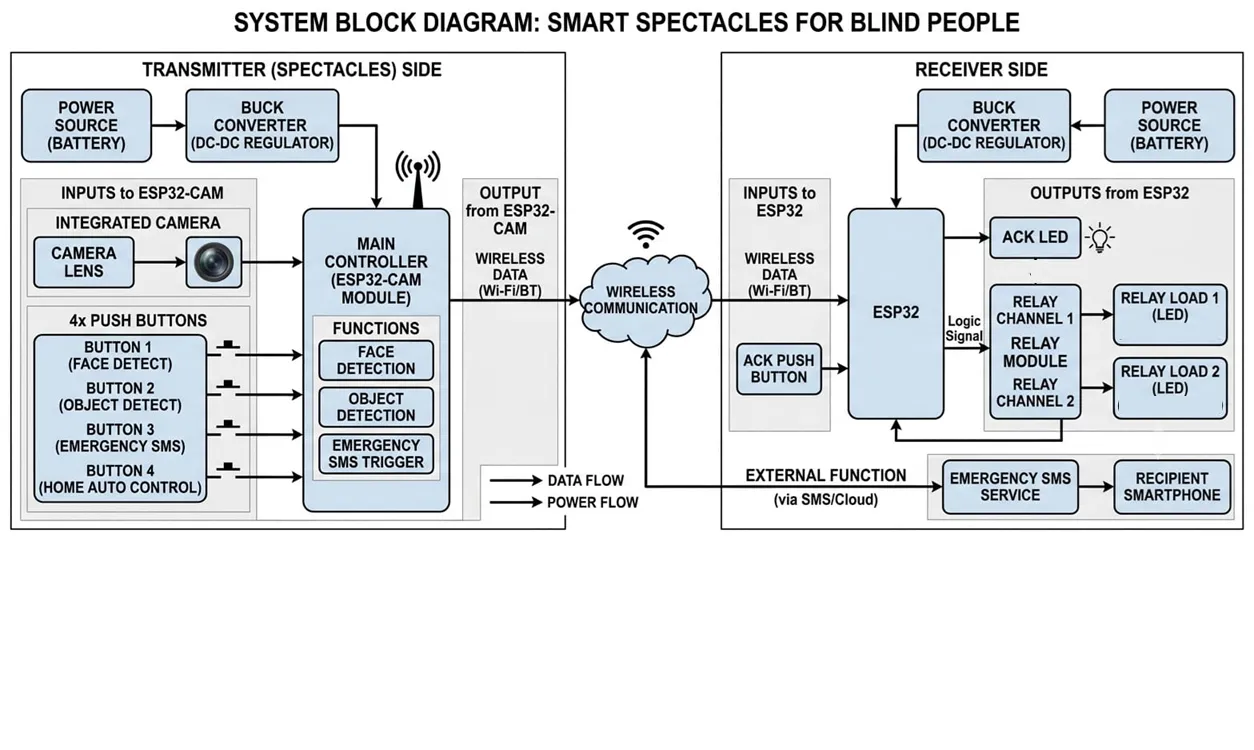
Fig.1:- block diagram of the Embedded smart spectacles for blind people.
Here's the deal with Figure 1 – it shows the block diagram of the new Smart Spectacles for blind folks. This set-up has two parts: the first bit's mounted on the spectacles, and the second is for home automation and giving feedback based on sounds or touches.That top part includes an ESP32-CAM module, an OV2640 camera, buttons, and some battery power stuff like the LM2596 buck converter. On the receiver end, you've got another ESP32 controller, a relay module, buttons, LED lights, and its own power supply too.Now, here’s where things get cool – that camera takes live pics of what's around and sends them to be processed by a computer vision technique using a YOLO-based object detection algorithm. It spots obstacles and lets people know what’s near them.There are special buttons to activate different modes, like object detection or even sending an emergency SMS. And guess what? The ESP32-CAM is in charge, handling all image getting, object recognizing, and wireless communication duties.
After detecting an object, the system turns the info into voice messages via a Text-to-Speech engine and shares it through audio output. If there's an emergency, users can trigger an SMS alert that goes to preset contacts. For wireless communication, the transmitter and receiver ESP32 modules use Wi-Fi or ESP-NOW. Once the receiver ESP32 gets a message, it operates relays to control things like lights and fans, and sends a confirmation signal back. Also, to keep everything running smoothly, an LM2596 buck converter delivers steady voltage regulation.
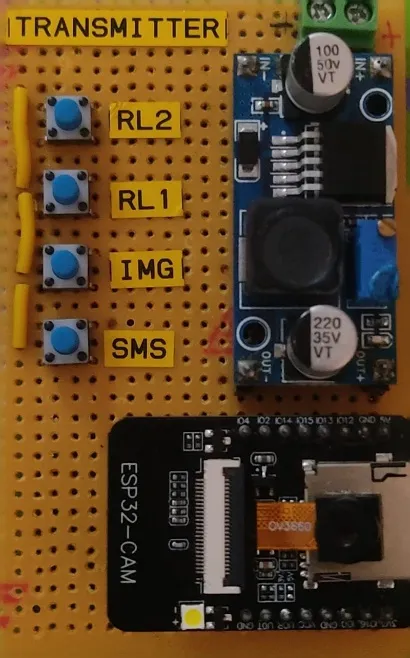
Fig.2:-Primary unit
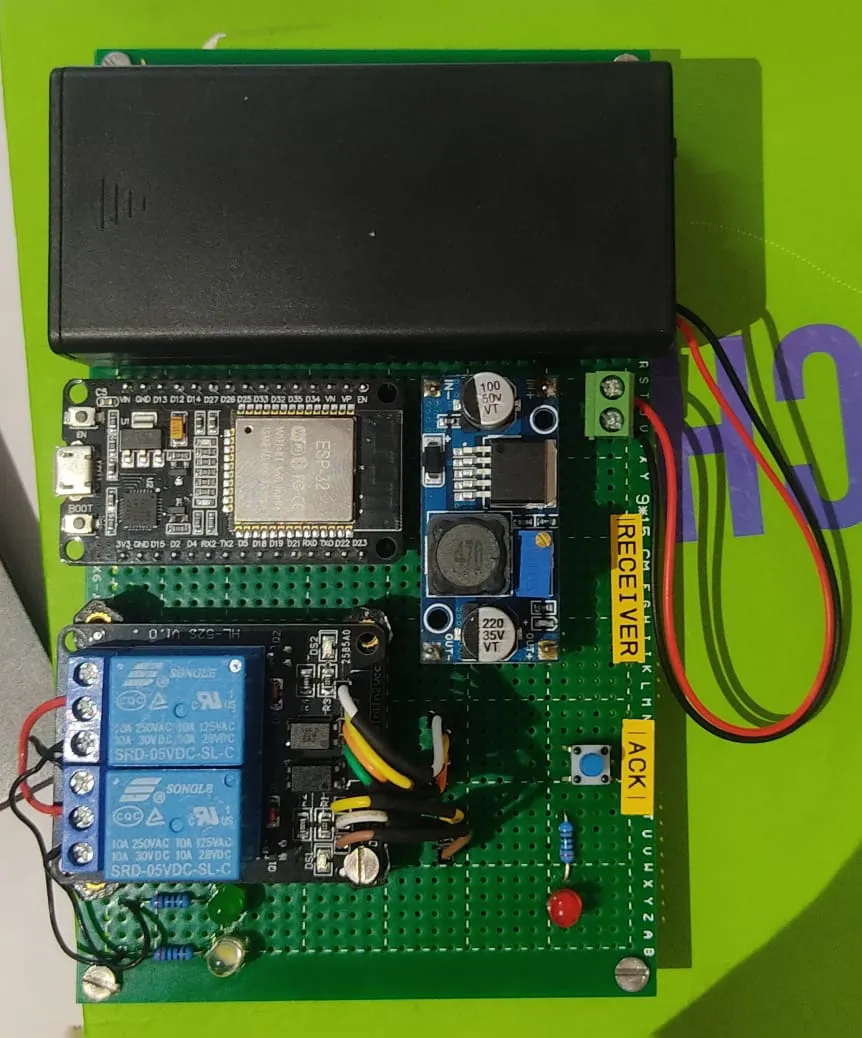
Fig.3:-Secondary unit
WORKING PRINCIPLE
The Embedded Smart Spectacles for Blind People act as a smart, wearable helper. This device mixes up image catching, object finding, wireless talk, emergency alerts, and home control stuff. It's got two parts: the transmitter (that's the smart specs) and the receiver.Inside the smart specs is an ESP32-CAM module paired with an OV2640 camera. Once the gadget is switched on, the camera keeps taking real-time pictures of what's in front of the wearer. These snaps get beamed through Wi-Fi to a computer which then uses a YOLO-based program to figure out what objects are in the images. This setup lets the vision-impaired person know about close obstacles and stuff, making it easier and safer for them to move around..
The smart spectacles also include four push buttons, each assigned to a specific function. The first button activates face detection functionality, while the second button initiates object detection. The third button is used to trigger an emergency SMS alert whenever the user requires immediate assistance. Upon activation, an emergency message is sent to a predefined contact number, allowing caregivers or family members to respond quickly. The fourth button is dedicated to home automation control.
In home automation, the ESP32-CAM sends commands wirelessly using ESP-NOW to another ESP32. This protocol lets the devices communicate directly, fast and efficient, no Wi-Fi router needed. On the receiving end, the ESP32 takes those commands, does its thing, and the relays kick into action, controlling appliances like door lock or fans. The receiver is decked out with all it needs: ESP32 controller, relay module, ACK button, and status LED. When everything goes smoothly and a command is carried out, it sends back an ACK signal to show all systems are go. To top it off, there's an LED that lights up when communication and execution are a success.
A rechargeable battery powers both the transmitter and receiver. LM2596 DC-DC buck converters give stable voltages for the electronics too. These smart glasses combine object detection, emergency comms, and home automation. They boost independence, safety, and ease for folks with vision troubles in their everyday lives.
HARDWARE SPECIFICATIONS
ESP32-CAM Module
The ESP32-CAM is a tiny, affordable development board combining an ESP32 microcontroller with an OV2640 camera sensor. This makes it great for image processing and wireless communication. Thanks to Espressif Systems, it has built-in Wi-Fi and Bluetooth, letting it capture, process, and send images wirelessly all on its own. Because it’s small, consumes little power, and is super capable, it’s popular in surveillance systems, smart devices, IoT stuff, robotics, and assistive tech. This module uses the ESP32-S processor, featuring a dual-core Xtensa LX6 CPU that runs at up to 240 MHz. It's got 520 KB of SRAM and 4 MB of flash memory too, letting it handle image acquisition, wireless stuff, and controls just fine. Plus, it has integrated Wi-Fi (802.11 b/g/n) and Bluetooth v4.2, making reliable wireless connections a breeze. So it’s perfect for real-time data sharing and remote monitoring tasks. The ESP32-CAM has an OV2640 camera sensor, which is a 2-megapixel CMOS thing. It can snap pictures at up to 1600 x 1200 pixels (UXGA). Plus, it handles several image formats like JPEG, RGB565, YUV, and grayscale. It also does JPEG compression on its own, shrinking picture sizes. That way, it sends info quicker wirelessly and uses memory better. This comes in handy when storage and data flow are tight in small systems.
The ESP32-CAM supports a MicroSD card slot too, which lets you store images, videos, and app data externally. Plus, it has UART, SPI, I2C, and PWM interfaces for linking up sensors, displays, relays, andmore peripherals. It runs on 5V and comes with an onboard antenna for wireless communication.
ESP32 MODULE
The ESP32 DevKit V1 (30-Pin) is a powerful development board from Espressif Systems, relying on the ESP32-WROOM-32 module. It rocks a dual-core Xtensa LX6 processor along with built-in Wi-Fi and Bluetooth, making it perfect for IoT, automation, robotics, and other neat projects. This board gets used a lot due to its awesome processing speed, battery-saving features, and how easy it is to program using Arduino IDE or ESP-IDF. Equipped with a dual-core 32-bit processor capable of hitting 240 MHz, it crushes multitasking and real-time jobs. Plus, it has 520 KB SRAM and usually 4 MB of flash memory, letting you smoothly run your code and stash data too. Add in support for Wi-Fi 802.11 b/g/n and Bluetooth v4.2 (both Classic and BLE), and there’s no extra module fuss for wireless connections. Powered at 3.3V, the ESP32 can run via a Micro-USB or an external 5V VIN source. What's more, it offers around 30 GPIO pins with advanced features like PWM, ADC, DAC, SPI, I2C, UART, I2S, and touch sensing. There are 18 ADC channels with 12-bit resolution and 2 DAC channels on this board, so connecting to analog stuff is super simple. The board supports deep sleep operation with extremely low power consumption, making it great for battery-powered stuff. It also boasts hardware encryption, secure communication, and an RTC. Plus, it regulates voltage on board. These features make the ESP32 DevKit V1 one of the most versatile microcontroller platforms for modern embedded systems.
SOFTWARE SPECIFICATION
Yolo Module
YOLOv8s is an advanced real-time object detection algorithm by Ultralytics. It offers a great balance between accuracy and efficiency. This makes it perfect for embedded vision, surveillance, robotics, autonomous systems, and assistive tech.YOLOv8s belongs to the YOLOv8 family and is specifically optimized for applications that require fast object detection while maintaining high accuracy.
The model uses a modern neural network design with an advanced backbone, neck, and anchor-free detection head. Unlike earlier YOLO versions, YOLOv8 simplifies things by improving object localization without anchors, making detection easier and more accurate. The model is capable of detecting multiple objects simultaneously within a single image while maintaining real-time performance.
YOLOv8s works with an input image size of 640x640 pixels, has about 11.2 million parameters, and 28.6 billion FLOPs. On the COCO validation dataset, it scores a mAP of 44.9%, showing a nice balance between speed and accuracy. This makes it great for situations with limited computational power but where reliable object detection is a must. The model uses Python and the Ultralytics framework on PyTorch. It tackles various computer vision tasks such as object detection, image classification, instance segmentation, pose estimation, and object tracking. The framework comes with simple APIs for training, validating, testing, and deploying the model. This makes integrating it into both embedded and AI apps a breeze. In the "Embedded Smart Spectacles for Blind People" project, YOLOv8s does real-time object detection. Images from the ESP32-CAM are sent to the processing system. There, the YOLOv8s model analyzes the images to spot objects and obstacles. The info it detects boosts environmental awareness, helping visually impaired users navigate safely. They picked YOLOv8s for its lightweight design, accurate detection, and efficient real-time performance.
RESULT
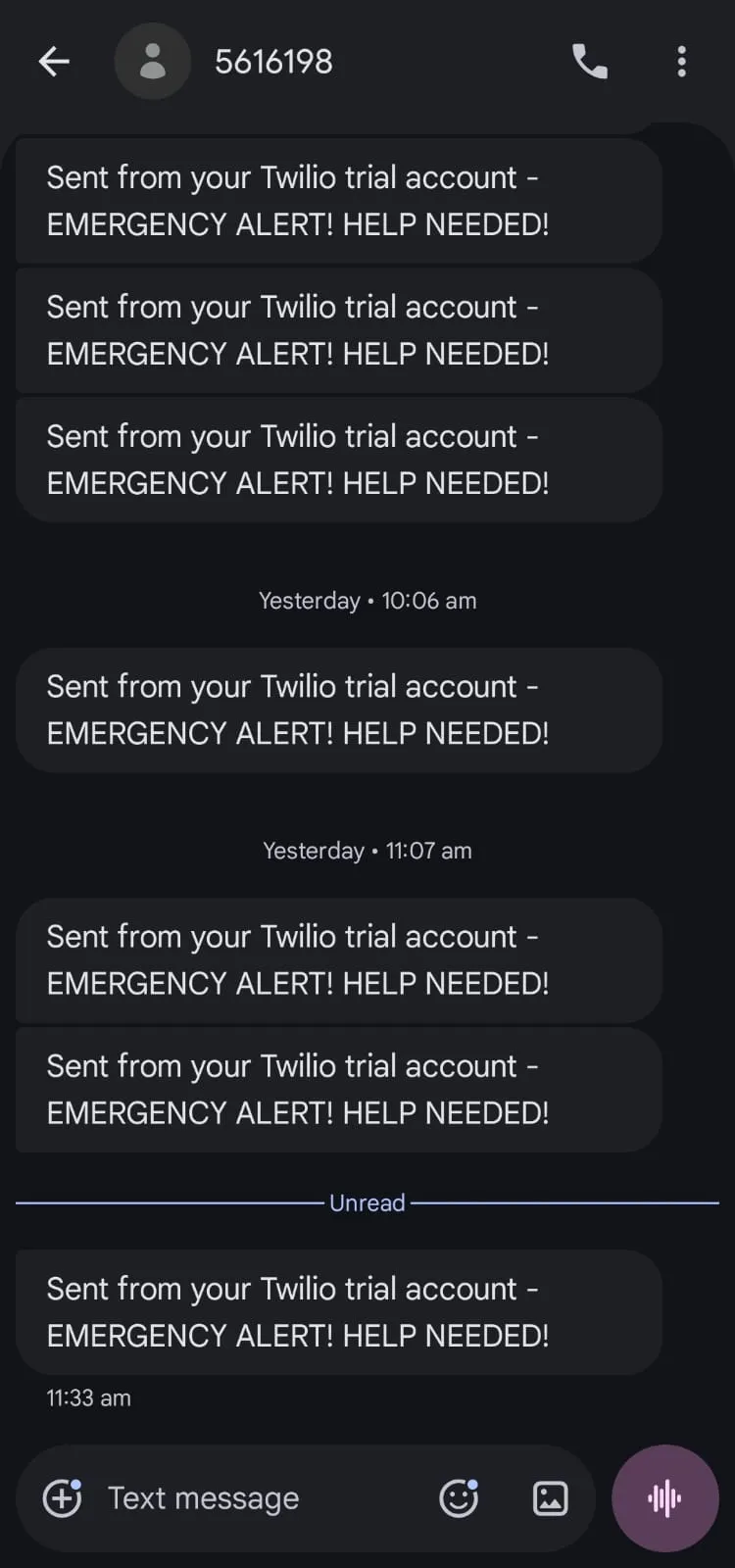
Fig. 4:- SMS based Emergency Help Service
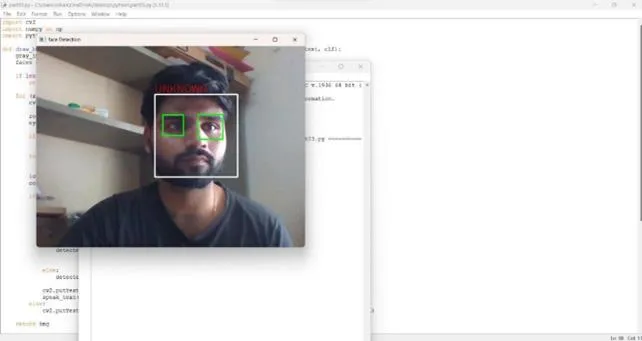
Fig.5:- Image capture
CONCLUSION
Visually impaired individuals frequently encounter significant challenges in getting around, spotting obstacles, and handling everyday tasks on their own. But thanks to big advances in things like embedded systems, wireless communication, and computer vision, we can now make smart assistive devices that boost safety and enhance quality of life. The Embedded Smart Spectacles for Blind People is meant to be an affordable option that helps users understand their surroundings and access key services more independently. By combining computer vision, wireless communication, emergency alerts, and home automation, these specs aim to seriously step up user independence and safety. Tests on the prototype show that this tech is not only effective but also cost-efficient, making it a game-changer for supporting the daily living of visually impaired folks. This promotes both better accessibility and self-reliance for those who need it most.
FUTURE SCOPE
The proposed project makes life easier and safer for visually impaired folks with smart wearable tech. Its current prototype can do real-time object detection, send emergency texts, and control household stuff based on voice commands. It uses things like an ESP32-CAM module, OV2640 camera, ESP32 nodes, and a rechargeable battery.Looking ahead, adding GPS for navigation, facial recognition, and better object detection would be super helpful. Connecting it to a mobile app and the cloud could enhance its features even more.These improvements will make the smart spectacles more intelligent, reliable, and user-friendly, providing greater mobility and convenience for visually impaired users.
REFERENCES


Vipul A. Patil*, Vishwajeet K. Patil, Vishwajeet P. Gujar, C. P. Shinde, Embedded Smart Spectacles For Blind People, Int. J. Sci. R. Tech., 2026, 3 (6), 1-7. https://doi.org/10.5281/zenodo.20638495
 10.5281/zenodo.20638495