

We use cookies to ensure our website works properly and to personalise your experience. Cookies policy
Department of Artificial Intelligence and Machine Learning, Savitribai Phule Pune University, Pune, Maharashtra, India
Artificial Intelligence (AI), Deep Learning, and Computer Vision technologies have signifi- cantly transformed modern intelligent systems by enabling machines to understand, analyze, and process visual information automatically. Modern intelligent applications such as surveil- lance systems, smart city infrastructure, healthcare imaging, industrial monitoring, autonomous systems, and AI-assisted creative platforms require scalable image intelligence frameworks ca- pable of integrating multiple Artificial Intelligence services within one centralized ecosystem. Traditional image intelligence systems mainly focus on isolated functionalities such as im- age enhancement, image restoration, object detection, image classification, surveillance mon- itoring, or AI image generation independently. Although these systems provide efficient solu- tions for specific tasks, they suffer from several limitations including lack of interoperability, deployment complexity, absence of centralized analytics, limited scalability, and inefficient workflow integration. This research proposes AIVERSE, a unified AI-powered image intelligence platform inte- grating computer vision, surveillance analytics, image enhancement, image restoration, object detection, object counting, suspicious activity monitoring, smart reporting, and generative AI functionalities into one scalable architecture. The proposed framework integrates YOLOv8-based real-time object detection, OpenCV- based enhancement operations, Richardson-Lucy image restoration, Stable Diffusion text-to- image generation, and ControlNet sketch-to-image synthesis to provide advanced AI-assisted image processing services. The frontend interface is developed using Next.js and React.js while Flask is used as the backend API framework for communication between frontend modules and AI services. Py- Torch, OpenCV, YOLOv8, and Hugging Face Diffusers are integrated to perform intelligent visual analytics and generative AI operations. Experimental analysis demonstrates that the proposed framework achieves high object de- tection accuracy with improved PSNR and SSIM values compared to traditional image en- hancement approaches. The proposed AIVERSE platform simplifies intelligent workflow man- agement while improving accessibility to advanced AI technologies for surveillance systems, educational research, industrial automation, healthcare imaging, smart city infrastructure, and AI-assisted creative applications.
Artificial Intelligence (AI) and Computer Vision (CV) technologies have become one of the most rapidly growing research domains in modern computing systems. These technologies enable machines to analyze visual information similarly to human perception while improving automation, accuracy, and intelligent decision-making capabilities.
Computer Vision systems are widely used in healthcare imaging, smart surveillance, traffic analysis, industrial automation, retail analytics, autonomous vehicles, and intelligent robotics. Recent advancements in deep learning have significantly improved image understanding capa- bilities through object detection, image segmentation, object tracking, image generation, and intelligent enhancement operations.
Traditional image intelligence systems are generally developed for isolated functionalities. Some systems focus only on object detection while others focus on enhancement, restoration, surveillance analytics, or AI-assisted image generation independently. Such systems often re- quire multiple software tools and lack centralized workflow integration.
Recent developments in Generative AI have introduced advanced image synthesis tech- nologies such as Stable Diffusion and ControlNet capable of generating realistic images from textual prompts and sketches. Similarly, modern object detection algorithms such as YOLOv8 provide highly accurate real-time object localization and recognition capabilities with improved inference speed.
Modern surveillance systems also require intelligent frameworks capable of performing suspicious activity monitoring, object tracking, intelligent analytics, automated reporting, en- hancement operations, and AI-assisted visual understanding simultaneously.
To address these limitations, this research proposes AIVERSE, a unified AI-powered image intelligence platform integrating deep learning, computer vision, surveillance analytics, image restoration, enhancement operations, object detection, and generative AI technologies into one centralized scalable ecosystem.
RESEARCH GAP
Existing image intelligence systems mainly focus on individual AI functionalities such as im- age enhancement, object detection, surveillance analytics, or AI-assisted image generation independently. Most existing frameworks lack centralized integration between multiple AI- powered services.
Current systems suffer from several limitations including:
Therefore, there is a strong requirement for a unified AI-powered intelligent framework capable of integrating multiple deep learning and computer vision services into one scalable ecosystem.
OBJECTIVES
SYSTEM ARCHITECTURE
The proposed AIVERSE platform consists of four major architectural layers including:
The User Interface Layer is developed using Next.js and React.js to provide an interactive and user-friendly frontend environment. Flask APIs are integrated in the Backend Layer for communication between frontend modules and AI services.
The AI Processing Layer integrates multiple deep learning frameworks including YOLOv8, OpenCV, Stable Diffusion, and ControlNet for performing intelligent image processing op- erations. The Storage and Analytics Layer stores processed outputs, analytical reports, and monitoring results for future visualization and reporting.
IMAGE ENHANCEMENT SERVICE
The Image Enhancement Service improves image quality using histogram equalization, CLAHE enhancement, denoising filters, brightness normalization, and sharpening operations. This module improves image visibility and visual clarity for better AI-assisted analytics and surveil- lance monitoring.
OpenCV-based preprocessing operations are integrated to improve low-light images, reduce noise, and optimize image contrast for intelligent processing.
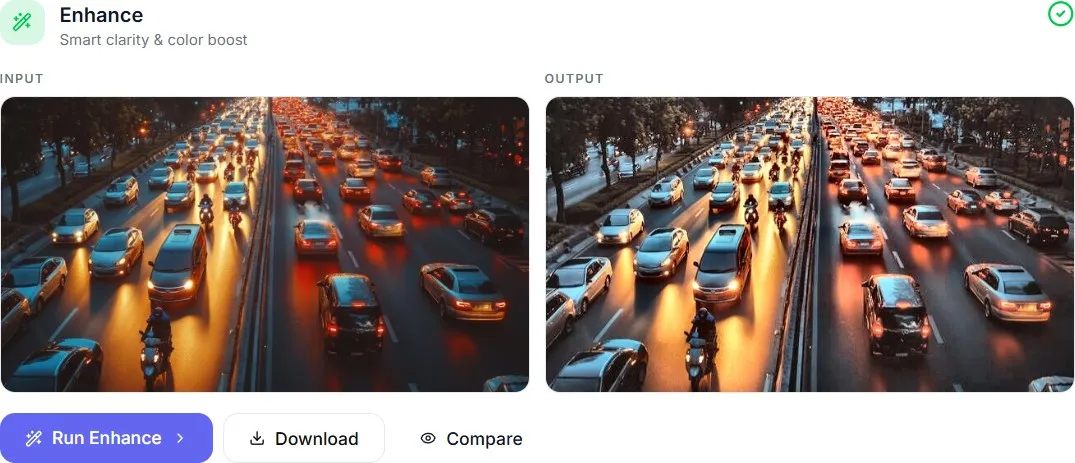
Figure 1: Image Enhancement Service
IMAGE RESTORATION SERVICE
The Image Restoration Service restores blurred and degraded images using Richardson-Lucy Deconvolution combined with intelligent enhancement operations. This module improves im- age sharpness and restores degraded visual information for surveillance and forensic applica- tions.
The restoration pipeline performs blur reduction, denoising, edge sharpening, and structural recovery operations to improve image quality.
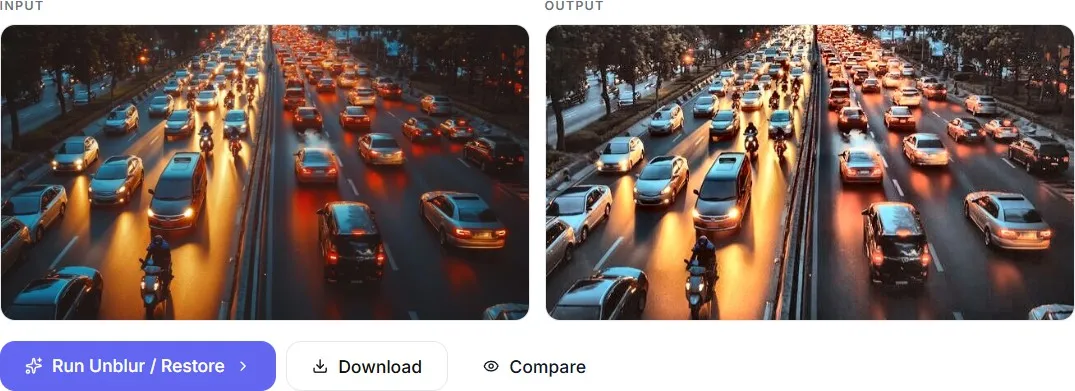
Figure 2: Image Restoration Service
OBJECT DETECTION SERVICE
The Object Detection Service utilizes YOLOv8 for real-time object localization, tracking, and classification. The model identifies multiple objects within surveillance scenes and generates accurate bounding box predictions with high inference speed.
YOLOv8 significantly improves object detection performance while reducing computa- tional overhead compared to traditional CNN-based approaches.
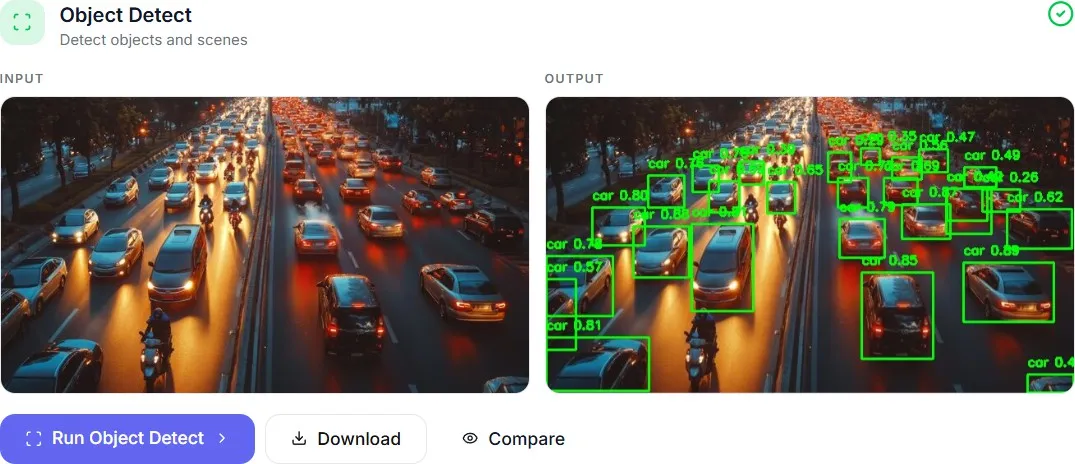
Figure 3: YOLOv8 Object Detection
TEXT TO IMAGE GENERATION
The Text-to-Image Generation Service utilizes Stable Diffusion models to generate realistic AI-generated images from textual prompts. This module enables intelligent image synthesis and AI-assisted creative applications.
ControlNet integration further enables sketch-to-image transformation capabilities by guid- ing image generation through structural conditions.

Figure 4: Text-to-Image Generation using Stable Diffusion
MATHEMATICAL MODEL
The YOLOv8 object detection loss function is represented as:
Loss = Lbox + Lobj + Lcls (1)
Where:
The Peak Signal-to-Noise Ratio (PSNR) used for image quality evaluation is represented as:

The Structural Similarity Index (SSIM) is represented as:

EXPERIMENTAL RESULTS
Experimental evaluation was performed using surveillance datasets, COCO datasets, and AI- generated image samples. The proposed framework demonstrated high object detection accu- racy with improved enhancement and restoration quality.
|
Metric |
Value |
|
Detection Accuracy |
94.2% |
|
Precision |
93.1% |
|
Recall |
92.4% |
|
F1-Score |
92.7% |
|
PSNR Improvement |
31.4 dB |
|
SSIM Improvement |
0.87 |
|
Average Processing Time |
1.8 sec |
Table 1: Experimental Performance Results
APPLICATIONS
The proposed AIVERSE platform can be used in multiple real-world applications including:
FUTURE SCOPE
The proposed system can be further enhanced by integrating edge AI optimization, cloud- based distributed processing, drone surveillance systems, federated learning architectures, and advanced facial recognition technologies.
Future developments may also include mobile application deployment, multilingual AI in- teraction, blockchain-based surveillance security, and real-time anomaly prediction systems.
CONCLUSION
This research presents AIVERSE, a unified AI-powered image intelligence platform integrating deep learning, computer vision, surveillance analytics, image enhancement, image restoration, object detection, suspicious activity monitoring, and generative AI technologies into one scal- able framework.
The proposed architecture successfully combines YOLOv8-based real-time object detec- tion, OpenCV enhancement operations, Stable Diffusion image generation, ControlNet sketch transformation, and intelligent reporting services within a centralized ecosystem.
Experimental observations demonstrate that the proposed framework improves detection accuracy, image quality, processing efficiency, and intelligent workflow automation compared to traditional approaches.
The integration of multiple AI-powered services within one centralized platform signifi- cantly improves accessibility to advanced AI technologies for surveillance systems, industrial automation, educational research, healthcare imaging, traffic monitoring, and AI-assisted creative applications.
REFERENCES



Anurag Dhondge*, Sushant Karle, Rudresh Kankrej, Jayraj Patil, AIVERSE: A Unified AI-Powered Image Intelligence Platform Using Deep Learning, Computer Vision, and Generative AI, Int. J. Sci. R. Tech., 2026, 3 (6), 1228-1233. https://doi.org/10.5281/zenodo.20796266
 10.5281/zenodo.20796266