

We use cookies to ensure our website works properly and to personalise your experience. Cookies policy
Swamy Vivekananda Rural First Grade College, Bangalore University
The key long-term financial safety is returns on investments as more and more women play a role in the security of their households and economies. Using descriptive quantitative design and Jamovi software, this study investigates the relationship between job security and investment designs of 336 working women in Karnataka, and also correlates it with the levels of self-motivation and risk acceptance of the women. The results indicate that job security has a positive effect on investment attitude and the strongest determinant is self-motivation while risk tolerance is also positively related to investment attitude; together, these three variables account for 44.6% of the variance in investment attitude. The model did not present any multi-collinearity issues and results indicate that policy makers, employers and financial educators would welcome employment security, and provide specific financial education and motivation programs to advance women's investment practices.
Women's occupation in paid employment has increased significantly in recent decades and this has helped to strengthen their role in both home and economic affairs. Women's increasing involvement in financial decision-making and gradually controlling their saving and investment process ensures their economic future and economic empowerment in a healthy way. Investment planning has thus become a core element of personal finance with supporting investments like home ownership, education, retirement planning and financial security throughout the life cycle.
Individuals generally have a favorable outlook on long-term financial decisions when their jobs are of good quality and stable. Job security – the belief that one’s job and income are probable to linger in the future – decreases sketchiness about cash flows and allows systematic saving and investment. Women are in a better position to commit funds to a range of investment options where employment is theoretical as stable, ranging from traditional products to market products. Conversely, fear of losing their job or missing out on income can prevent them from investing in assets that will take a longer time to make profit, or assets that involve more risk, and may cause even more conservative short-term investing decisions.
Investment patterns identify how people invest their money across a range of financial products, based on their investment objectives, income, risk tolerance and expectations on future opportunities. These days, working women have a combination of choices like bank deposits, mutual funds, insurance, gold, real estate, and retirement plans; and their acceptance is subjective based on their workplaces, financial knowledge, motivation, and demographic profile and general economic inclinations. Women are involved in various professions and jobs and in different private organizations, education, banking, healthcare, entrepreneurship, self-employment etc. This professional diversity translates into a variety of income security and job security experiences, leading to a range of feelings of confidence when planning, saving and investing for the long-term.
Although women's economic role has been expanding, many are exposed to a variety of silent experiments involving income volatility, access to financial information, and differing appetites for risk and need to make investment decisions due to family commitments. Some of these pressures can be offset by the certainty of employment, as it provides some degree of employment stability and increased sense of security in structured financial planning. In order to increase women's financial flexibility and promote their active investment behaviour, it is important to understand the relationship between job security and these factors. In the face of the evolution of labour markets as a result of technological advancements, economic cycles, restructuring and evolving employment contracts, it is becoming increasingly critical for researchers, policy makers and financial practitioners to examine the relationship between job security and women's investment ranges.
Problem Statement
Women play a significant role in contributing economic development and house hold income, by making informed decisions increasingly important for long term financial security and economic independence. Women’s investment behaviour is influenced by various factors such as employment stability, income security, financial literacy, self- motivation, risk tolerance and prevailing economic conditions. Among these factors job security is particularly important as it can influence financial confidence, investment capacity and willingness to take financial risks. A stable employment may encourage women to allocate their income towards both their short term and long term financial instruments thereby supporting their financial wellbeing and independence.
Although previous studies examined investment behaviour and financial literacy among women limited attention has been given to the influence of job security on women investment patterns across different employment sectors in Karnataka. Women employed in government organizations, private companies and educational institutions, banking, health care, business and other sectors experience various level of job stability which may influence their financial planning and investment decisions. In addition economic uncertainties, organisational changes and evolving labour market conditions may affect women perception on financial security and their confidence in making investment decisions. Therefore understanding the relationship between the job security and women’s investment behaviour across different employment sectors is important for assessing their financial decision making and long term financial security.
There is need to examine the extent to which job security influences the investment behaviour of women and to understand the role of self-motivation and risk tolerance in this relationship. Such an investigation can provide valuable insights to the factors that shape women’s investment decisions and help identifies strategies for enhancing financial awareness, strengthening financial confidence, and promoting long term financial wellbeing among women in Karnataka.
Review of literature
Kalaivani et al. (2025) emphasize the critical role that women entrepreneurs in emerging markets can play in promoting economic growth. It looks at the specific obstacles women encounter such as access to finance, socio-cultural factors and adverse regulatory frameworks. Case studies of women-led businesses that have been successful in innovation, employment generation and sustainable development are presented. The chapter highlights the need for targeted policy measures and incentive packages to enhance interventions in order to boost women entrepreneurship. Furthermore, it explores the overall implications of women's economic empowerment on the development of communities and the stability within the region, and calls for a broader entrepreneurial ecosystem that shifts the focus towards women's engagement and their role in the development of emerging economies. This review highlights the need for focused approach, planning and measures to overcome challenges for women entrepreneurs and unlocking their potential to sustain the economic growth.
Showkat et al. discuss the critical link between digital financial services (DFS), financial literacy and women's economic empowerment in their study from 2025. They discover that financial education has an impact on women to using DFS, which leads to economic empowerment. The study highlights the importance of integrating widely accessible financial education into digital platforms and supports the quantitative approach based on the Technology Acceptance Model (TAM) and Theory of Planned Behavior (TPB). The authors highlight the importance of DFS as an important bridge between financial literacy and empowerment especially in India and urge for more extensive studies to be generalised. Some of the key recommendations include the provisioning of gender sensitive educational materials, enhancing the technology infrastructure and establishing linkages between financial and educational institutions to build a more inclusive financial ecosystem that can enhance women's economic participation.
Cao and Song (2025) delve into the psychological consequences of the potential for AI-based automation on job insecurity by drawing on social information processing and transactional stress theory. A study using longitudinal information across the US General Social Survey (GSS) finds that workers of industries with high levels of automation potential are more likely to be insecure about their jobs. Using longitudinal data from the US General Social Survey (GSS), the study finds that workers in high automation potential industries are more likely to be insecure in their jobs. The study shows, however, that social media activity can help decrease these fears, and that the type of relationship between supervisor and subordinate is less important. Even at this early stage of maturity, the study brings attention to the diversity of industries in adopting AI and the associated psychological impacts. It highlights the human factor of workplace digital transformation and calls for establishing workplaces that are conducive to human well-being to reduce the undesirable impact of automation on people.
The study by Arafat, Turi, and Amir (2025) analyzes the economic and social impacts of IMF conditionality’s in Pakistan, focusing on inflation, unemployment, poverty, GDP growth, and public service expenditures. The research also reveals that, although IMF programs have been effective in stabilizing exchange rates and reducing fiscal deficits, they have also had negative impacts, including a decline in economic growth, inflation, and poverty and unemployment. These contractionary policies and cuts have reduced the public investment in basic services, such as health and education, with a commensurate impact on social vulnerabilities. The study emphasizes the balance between macroeconomic stability and social well-being, and recommends a pro-social policy mix that does not over-invest in structural or social issues at the expense of one another. The research adds to the current debate on the effectiveness of IMF interventions, and will help draw attention to the importance of building strategies with a focus on inclusive growth and societal resilience.
Mehrzad and Rostan (2021) examined job satisfaction among the female employees in the public sector of Afghanistan. They found that with respect to job satisfaction, salary increases and promotion prospects were important while with respect to dissatisfaction, low pay and poor working conditions were important. The research emphasized the need of policy measures based on gender sensitivity and the promotion on merit in the workplace to create an environment that is supportive to the female employees. It emphasises the importance of structural and systemic barriers to improve job satisfaction and gender equality in the public sector.
Walunj (2021) discusses the investment behavior of public sector workers in Pune, particularly their investment strategy and the need for diversification to minimize risk and generate returns. Their knowledge of financial markets and investment opportunities are also reflected in the research, which includes knowledge of safety, liquidity, marketability, tax benefits, and risk. It also highlights how their tax duties impact on their investment habits, and why it is important for salaried people to be financially educated and plan their investments strategically.
The Walunj R. E. (2021) study focuses mainly on the elements affecting the investment choices of the public sector workers. Many studies have pointed out the importance of demographic factors such as age, income stability and employment security for the investment behavior of individuals. Young people are more inclined to put their money into high-risk investments, such as stocks and mutual funds, whereas older workers are more likely to invest in low-risk investments, like pension plans. There are also important gender differences, as women tend to favor traditional investments, and they tend to be more dependent upon their spouses' advice. The significance of financial literacy and technological innovation is also underscored, emphasizing the need for diversification and professional advice to ensure the best investment results. The studies taken together offer a full picture of the dynamic influences that affect the behavior of people in investments within the public sector.
The study by Singh and Kaur (2018) on Investment Behaviour reveals that people prefer to invest in a low-risk investment choice and invest in traditional investment instruments, both in short and medium term periods. Demographic factors, such as age, income and marital status, are important drivers of investment behavior, and younger people and non-financial planning households exhibit different behaviors. There are significant differences between men and women with women often feeling less knowledgeable about money and less secure about their financial future. This makes investors cautious and focus on safety and moderate returns. Due to the variety of factors that affect investment choices across different demographic groups and investment behaviors, financial literacy and financial planning are emphasized.
Kappal and Rastogi (2020) explore the investment decision-making of women entrepreneurs and have found that they are risk averse and cautious in their investments despite being willing to invest in business ventures in a risky manner. This can be explained by short time, lack of knowledge about financial products and many people being influenced by their family's investment habits. The study recommends that women entrepreneurs can be better informed and make more risky investments, by improving their financial literacy and investing time in understanding investment options. It provides investment managers, policy makers, and financial advisors with practical guidance towards creating bespoke investment approaches, training sessions and workshops which can help improve financial literacy and the adoption of financial equality among investors.
The article in the Journal of Financial Planning (2000) provides valuable insights into the financial difficulties that women encounter and the increased need of professional financial planning in today's complex and continually changing economic environment. Women are encouraged to be financially independent along with the men whatever their status and circumstances are. The article, however, highlights that women may face different challenges, including the fact that they are historically dependent on men for their financial needs, they may have less confidence in their financial decision-making abilities than men, and they may fear not being able to afford necessities in the future. Financial stress and lack of financial literacy are both big concerns raised, but not unique to women. The possibility of a woman's concerns of poverty in old age is often realized. The article highlights the importance of financial education, planning, and the involvement of the financial services industry, women's groups, and various other stakeholders in helping women overcome these obstacles and secure their financial futures.
The research serves to illustrate the drawbacks of using mean house prices as indicators of house price changes and the potential for these changes to be distorted over time because of the different characteristics of houses that sold. It proposes that a hedonic price index, which reflects such changes, is a better alternative. The study, based on data from the budget surveys conducted by the Belgian Statistical Institute, shows that the hedonic index for the sales of secondary market houses is always lower than the indices based on the average sales values. This highlights the importance of detailed data on housing features to enable accurate monitoring of prices. The results were consistent with other research on investor attitudes and their investment strategies, including that of Lewellen, Lease, and Schlarbaum (1977) which examined individual investors' investment strategies.
The study underscores the need to be careful when interpreting house price changes based on average sales prices, especially in Belgium, given the differences in properties sold over time in terms of their characteristics. The authors suggest that the hedonic price index is a more accurate way to calculate this price. The research uses budget surveys from the Belgian Statistical Institute that imply that the hedonic index for secondary market house sales is constantly lower than indices based on average sales values, emphasizing the need for complete data on property characteristics in order to be able to assess the market correctly. In a similar vein, Hur (2022) emphasizes the role of contextual factors in influencing work attitudes, through a systematic review and analysis of the relationship between job security and workplace behavior. Both studies highlight how important it is to have detailed data and strong methods to understand complex economic and behavioral phenomena.
Hirshman et al. (2024) investigate the impact of job loss on financial decision-making, particularly in the context of risk-taking behaviors. The study adopts a multi-method approach, integrating survey data, administrative banking data and controlled laboratory experiments, generating correlational and causal evidence. The results provide evidence that losing a job has a significant effect on the likelihood of financial risk taking. Those that have been jobless state that they are more inclined to be taking risks, including buying more lottery tickets. Administrative data also indicate that the spending of other sectors of the economy drops after the loss of jobs, whereas gambling spending does not fall as much. The outcomes of the lab experiments further corroborate these findings and show that in controlled environments, losing a job is associated with increased financial risks. This study reveals that unemployment has a disruptive effect, and that unemployment increases risky financial behaviours, which adds to the knowledge base on the economic and psychological impacts of unemployment.
Research Gap
Existing research has extensively examined women's investment behaviour, financial literacy, risk tolerance, and demographic factors influencing investment decisions. Similarly, numerous studies have investigated the effects of job security on employee satisfaction, organizational commitment, productivity, and psychological well-being. However, there is limited empirical evidence explaining how job security influences the investment patterns of women, particularly within the Karnataka context.
Most previous studies have focused on specific occupational groups or have examined investment behaviour without considering employment stability as a key influencing factor. Furthermore, relatively few studies have analysed the combined influence of job security, self-motivation, and risk tolerance on women's investment behaviour. The interaction of these factors remains insufficiently explored despite their importance in shaping financial planning and investment decisions.
Therefore, this study seeks to bridge this research gap by examining the impact of job security on the investment patterns of women in Karnataka. The study provides empirical evidence on the relationship between employment stability and investment behaviour while considering the role of self-motivation, risk tolerance, and demographic characteristics. The findings are expected to contribute to the existing literature and provide practical insights for promoting informed financial decision-making and women's economic empowerment
Significance of the Study
The present study is significant because it contributes to the understanding of how job security influences the investment patterns of women in Karnataka. As women increasingly participate in diverse occupations and take greater responsibility for financial planning, understanding the factors that shape their investment behaviour has become essential for promoting financial security and economic empowerment. The study provides empirical evidence on the relationship between employment stability, self-motivation, risk tolerance, and investment behaviour, thereby enriching the existing literature in the fields of behavioural finance and personal financial management.
The findings of this study will be useful to policymakers, employers, financial institutions, investment advisors, and financial educators in designing programmes that strengthen employment security, improve financial literacy, and encourage systematic investment practices among women. The results may also assist organizations in developing employee welfare initiatives that enhance financial confidence and support long-term financial planning.
In addition, the study will benefit women investors by increasing awareness of the importance of employment stability and informed investment decision-making. It also serves as a valuable reference for researchers and academicians interested in women's financial behaviour, investment management, and employment-related financial decision-making. By providing evidence from Karnataka, the study contributes to a better understanding of the financial challenges and investment opportunities experienced by women in a rapidly changing economic environment.
Objectives of the Study
Research Questions
Hypotheses
H01: There is no significant relationship between job security and investment behaviour among working women in Karnataka.
H11: There is a significant relationship between job security and investment behaviour among working women in Karnataka.
H02: Self-motivation and risk tolerance do not significantly influence investment behaviour among working women in Karnataka.
H12: Self-motivation and risk tolerance significantly influence investment behaviour among working women in Karnataka.
H03: Job security, self-motivation, and risk tolerance do not have a significant combined influence on investment behaviour among working women in Karnataka.
H13: Job security, self-motivation, and risk tolerance have a significant combined influence on investment behaviour among working women in Karnataka.
H04: Investment behaviour does not differ significantly across selected demographic characteristics of working women in Karnataka.
H14: Investment behaviour differs significantly across selected demographic characteristics of working women in Karnataka.
Research framework:
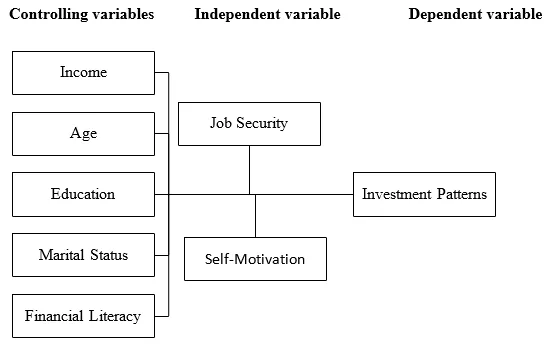
Job Security
One of the most important factors that affect an employee's financial security, psychological health, and long-term planning is the security of the job. It means having a sense of security and stability in one's job and regular income and believing that their job and income will continue into the future. Feelings of job security are associated with fewer financial uncertainties and higher levels of long-term financial commitment among employees (such as investment, retirement planning and saving). On the other hand, job insecurity tends to cause financial worry, disincentive some to invest in risky assets, and encourage greater precautionary saving.
Job insecurity was defined by Greenhalgh and Rosenblatt (1984) as the threat and uncertainty of losing a job. They were the first to propose job security as a psychological construct that impacts on employee attitudes, behaviour and decision making. Later Sverke, Hellgren, and Näswall (2002) stressed that the employees who feel more secure in their jobs have higher levels of organizational commitment, job satisfaction, and financial confidence. A stable job brings greater certainty and happiness to employees and allows them to make better financial choices.
Employment stability, organizational policies, career development opportunities, income security, and workplace support are factors that impact job security. The stable job market offers peace of mind that people have a steady income and can rely on their employment. Income security is the ability of workers to pay their bills, and have extra income to save or invest. Likewise, organizational policies that support them, communication, career development opportunities, and employee welfare programs boost employees' confidence in future employment. All of these make for an ideal setup to plan for the long term and build wealth.
On a behavioural finance level, job security has a huge impact on people's investing patterns, affecting their perception of financial risk and future income stability. A person who has a steady income is more likely to invest in mutual funds, stocks, pension plans and systematic investment plans, because he has more certainty in his income. On the other hand, when people feel unsure about their job, they tend to be more conservative in their investment strategies, investing in low-risk assets like fixed deposits, savings accounts, and gold. Therefore, employment stability is an important determinant of financial behaviour and investment decision making.
Job security cannot be narrowed down to a higher monetary value since it is immensely crucial for women who are increasingly entering the workforce and now taking responsibility for their family's finances. Today's working woman is actively involved in her family's income, wealth building, retirement planning and even education for her children and also assumes personal and family financial responsibilities. A secure position has a positive effect on their economic self-sufficiency, better confidence in their investment planning for the long run and better ability to buffer against economic uncertainties. Moreover, job security allows women to develop a disciplined approach to saving and investing systemically, this contributes to their long run financial well-being.
In relation to Karnataka, the women are working in various fields like Government, Private Industry, Educational Institutions, Banks, Healthcare, Information Technology, Entrepreneurship, and Self-employment. These sectors experience different levels of perceived job security based on employment conditions, organizational policies, career possibilities and economic conditions. Thus, understanding of the impact of job security on investment behaviour of women is critical for financial literacy, economic resilience and encouraging informed investment decisions. Therefore, job security is taken as one of the independent variable which is expected to exert a strong influence on the investment pattern of women in Karnataka in the current study.
Self-Motivation
Self-motivation is a person's internal desire to start, maintain and succeed at a task or behaviour in the absence of external rewards or pressures. It represents a person's commitment to growth, to challenges overcome, and to persisting toward desired outcomes. Self-motivation is also important in the context of financial decision-making, as it can help to motivate individuals to build their financial literacy and make informed investment choices. The more self-driven a person is, the more likely they'll be to make regular financial plans, set long-term financial objectives and invest in appropriate financial products to plan ahead.
Self-motivation is linked to Self-Determination Theory (SDT) by Deci and Ryan (1985) which posits that people are intrinsically motivated to develop and reach their full potential when their needs for autonomy, competence and relatedness are satisfied. This theory proposes that people engage in activities for intrinsically rewarding reasons as their own personal meaning. The financial situation: Women with high intrinsic motivation are more likely to look for financial information, assess investment options, and make financially rational decisions towards their long-term financial goals than those subject to external factors.
Some personal and environmental factors that influence self-motivation are: self-confidence, goal orientation, financial awareness, career aspirations and perceived employment stability. Those with a positive outlook on their job security and income have the tendency to save on a regular basis and invest for the future. A good work place can boost motivation by creating less financial risk and allow persons to concentrate on building wealth and planning for the future. On the other hand, when employment is uncertain, confidence can be lowered, and discouraging people from making long-term investment commitments.
Self-motivation has a positive effect on the investment behaviour from a behavioural finance perspective; it can help the individual to consider financial options carefully, maintain their investment discipline and stick to their financial plans when the market fluctuates. Motivated investors are more likely to diversify their investment portfolio, to keep an eye on investment performance and to seek professional financial advice when needed. They also possess greater financial literacy, reinforcing smart investing and risk management choices.
Self-motivation is crucial for women's empowerment as it enhances their financial independence and fosters their active involvement in investment and wealth creation. Working women are now more and more contributing towards the income of the household, along with professional and family responsibilities. They are able to deal with financial difficulties and adopt disciplined saving habits because they possess strong self-motivation, which also helps them make investment decisions that enable them to achieve their long-term financial goals, including preparing for children's education, owning a home, saving for retirement and saving for emergencies. Women with a strong drive are also more likely to invest in a variety of investment options and are able to cope with economic shifts with more confidence.
Women working in government bodies, private industries, education, banking, health, business, and other sectors are subjected to different employment conditions and financial commitments in the context of Karnataka. Their ability to remain motivated toward achieving financial security significantly influences their investment behaviour. Hence, self-motivation is taken as an important factor for the present study since it can enhance the link between job security and investment patterns by motivating the women to make regular and rational investment choices.
Investment Behavior
The way people invest their money in different investment options to meet their financial goals, taking into account expected returns, risks involved, liquidity needs, and future financial needs. The process of selecting, managing and monitoring investments based on individuals' financial knowledge, earnings, and willingness to take risk, preferences and economic expectations. Investment behaviour is a dynamic phenomenon, which changes with time and is a result of both rational economic factors and psychological factors.
In the traditional finance theory, investors are assumed to carefully think about the risk and return of an investment opportunity and then decide to invest. But, in behavioural finance, there are also cognitive, emotional and social factors that affect the investment choices. The investment behaviour is strongly influenced by the personality traits such as financial literacy, employment stability, motivation, confidence, demographic profile and risk perception. Therefore, investors with the same income level could have their own investment approaches due to their specific situation and attitudes toward financial planning.
The investment behaviour is broadly represented by investment preference, savings behaviour, investment horizon, portfolio diversification, financial planning and the ability for decision making. Investment preference is the choice of investment vehicles like fixed deposits, mutual funds, stocks, bonds, insurance policies, pension plans, gold, real estate and other investment options that is based on their objectives and risk tolerance. The savings behaviour is the consistent decision making process which results in the allocation of income over time for future financial requirements, while the investment horizon is the time period of investment preference among short, medium and long term. The advantage of having a diversified portfolio is that it helps mitigate the investment risk by distributing the investments across different asset classes to maximize the risk and return scenarios.
Factors related to the job are important factors in the investment attitudes. Those who have a regular income and a stable job are more likely to feel that they are earning enough to invest in a long term project. Those who feel confident that they will have employment until they are ready for retirement have a clear motivation to save regularly, to make retirement planning and have a more predictable capacity to invest in a variety of financial products. However, if the job or income is not guaranteed, people might be more likely to invest conservatively, for example, by choosing very liquid and low-risk investments. Therefore, job stability is another important factor affecting investment decision making and savings.
Self-motivation is also one of the big factors affecting the behaviour of investing that motivates investors to set investment goals, develop knowledge of investing, and apply a disciplined approach to investing. Investors with a high motivation to look at their portfolios often, seek professional financial advice, and diversify their investments and are more likely to invest even during a temporary dip in the market. Likewise, those who are better off financially are more likely to think about investing and to make good investments. Individuals' choice of investment instruments depends on their risk tolerance as well. Generally, conservative investors will focus their investment options on fixed deposits, government securities, insurance products and gold, whereas an investor with high-risk tolerance will invest in equity, mutual funds, exchange-traded funds (ETFs), and other market-linked investments.
As women become more and more involved in the family labour force and increasing their participation in the financial management of the household, the behaviour of women investors has become more and more of a focus. Women's financial empowerment has enabled them to play an active role in wealth creation and long term financial planning. However, employment security, family responsibilities, financial literacy, income, education, confidence and financial aspirations are some factors that can influence women's investment fund choices. Women are now more conscious regarding the importance of investing not only for wealth building but also for their children's education, health care, financial freedom and for retirement. So, it was essential to investigate the determinants of women investment behaviour and therefore, it has become one of the important research areas in behavioural finance and personal finance management.
In Karnataka women are found working in various fields like Government Organizations, Private Companies, educational Institutions, health sector, banks, IT Sector, business enterprises and in self-employment. These sectors are diverse in terms of employment outcomes, income stability, employment opportunities and organizational support, which could impact women's financial planning and investment decisions. Economic fragility, inflation, an unstable work market and changing financial products are also factors in investment decisions. This results in women making different investments based on their employment status, financial objectives and perceived financial security.
In the present study, investment behaviour is considered as the dependent variable and thereafter the effect of job security on investment selection of women is explored and explains the influence of self-motivation and risk taking on the investment selection. Identifying these linkages is important as it helps to better comprehend the financial decision-making process of women and to create policies and financial education programmes that foster the adoption of knowledge-driven investment practices and financial health.
Risk Tolerance
Risk tolerance is a person's willingness and capacity to take risks and loss of money to gain higher return on investment. It is among the most significant factors that affect investment behaviour, affecting the choice of investment options, diversification of the portfolio, and long-term financial planning. People have a wide range of attitudes towards financial risk according to their level of income, age, education, levels of financial knowledge, experience of investing, financial stability and personal investment aspirations. Therefore it is important to understand the level of risk appetite of an investor to make investment decisions that are in line with the investor's financial goals and risk carrying capacity.
In behavioural finance, risk tolerance is not only about financial risk capacity, but a psychological response to risk. High-risk investors tend to be more inclined to take on financial assets that are volatile in nature and market-oriented, such as stocks, mutual funds, exchange-traded funds (ETFs) or other growth assets that may yield higher rewards. However, if you have a low risk tolerance, you would prefer to invest in relatively safer options such as a fixed deposit, government bonds, insurance policies, gold, or a savings account where capital preservation outweighs capital growth. Therefore, the risk tolerance concept is closely linked to investment opportunities, investment time horizon, and it also influences the investment portfolio allocation.
A person's risk tolerance is affected by a number of factors. Young investors may be more willing to take investment risk as they have a longer time horizon and have more time to bounce back from market fluctuations. Furthermore, higher education, financial literacy and financial stability of having a regular income and employment boost confidence for taking risks. However, for those who are in financial hardship or who have just lost their job, things can be more serious and they may be less willing to take risks to preserve their financial assets and more conservative in their investment strategies.
One of the factors influencing the investment behaviour of working women is their risk tolerance. Other factors that influence women's investment choices encompass family responsibility, financial responsibilities, financial stability, and future financial objectives. The more financially confident women are, the more apt they are at diversifying their investments across financial products and investing for the long term to accumulate wealth. However, women who feel at ease with their finances may prefer to invest in lower-risk securities that have regular and predictable income streams. This implies that understanding the risk-taking propensity of women is important to account for the differences in investment patterns among women in different employment status.Thus, it is important to recognise risk tolerance in order to understand the difference in investment behaviour among women in different employment situations.
Women are now actively involved in a variety of professions even in Karnataka – Government jobs, private companies, educational institutions, banking, health care, entrepreneurship and self-employment. The different work settings in which they have participated and their feeling for financial security could influence their willingness to make financial risks and investments decisions. Hence, in this study, risk tolerance is regarded as an important predictor of the investment behaviour. But its effect along with job security and self-motivation provides an overall picture of what is influencing the investment pattern of the women in Karnataka.
Research Design
The present study has employed descriptive quantitative research design to study the effect of job security on the investment of women in Karnataka. The primary data was collected by administering a structured questionnaire to 336 working women working in various organizations, like Government, Private, School, Bank, Hospital, Business and other professions in Karnataka. The questionnaire consisted of demographic questions and statements to measure the major constructs of the study such as Job Security, Self-Motivation, Investment Behaviour and Risk Tolerance on a five point Likert scale.
Data collected was coded, cleaned and analysed using Jamovi statistical software. The objectives of the study were achieved by the use of both descriptive and inferential statistics. The data were presented in descriptive statistical form and the reliability of the measurement scales was determined using Cronbach's Alpha test. The relationships among the variables were examined by Pearson correlation analysis, and the effect of the variables, namely job security, self-motivation and risk tolerance on investment behaviour was analyzed by multiple linear regression. Further, to check for the presence of multicollinearity, collinearity diagnostics (Variance Inflation Factor) was conducted and for differences in investment behaviour among demographic groups, One-Way ANOVA was conducted.
Data analysis
The data obtained from 336 female respondents from Karnataka was analysed with Jamovi software package. The objectives of the study and the test of the proposed hypotheses were achieved by both descriptive and inferential statistical techniques. Cronbach's Alpha coefficient was calculated to test the reliability of the measurement scales. Descriptive statistics and the Shapiro–Wilk test were used to examine the characteristics and normality of the data. Pearson's correlation, multiple regression analysis and collinearity diagnostics (VIF) were carried out to check the associations between the various variables and the effect of job security on the investment behaviour of women in Karnataka, while One-Way ANOVA (Welch's test) was used to check the impact of job security on the investment behaviour of women in Karnataka.
|
Demographic Variable |
Category |
Frequency (n) |
Percentage (%) |
|
Age |
Below 25 years |
174 |
51.8 |
|
25–35 years |
36 |
10.7 |
|
|
35–45 years |
90 |
26.8 |
|
|
45–55 years |
28 |
8.3 |
|
|
55 years and above |
8 |
2.4 |
|
|
Total |
336 |
100 |
|
|
Marital Status |
Married |
139 |
41.4 |
|
Unmarried |
189 |
56.3 |
|
|
Widow |
8 |
2.4 |
|
|
Total |
336 |
100 |
|
|
Educational Qualification |
Bachelor's Degree |
232 |
69 |
|
Master's Degree |
92 |
27.4 |
|
|
Doctorate |
8 |
2.4 |
|
|
Professional Qualification |
4 |
1.2 |
|
|
Total |
336 |
100 |
|
|
Job Position |
Clerical |
26 |
7.7 |
|
Academic |
182 |
54.2 |
|
|
management |
128 |
38.1 |
|
|
Total |
336 |
100 |
Source: Computed from primary data.
Table 1. Demographic Profile of Respondents (N = 336)
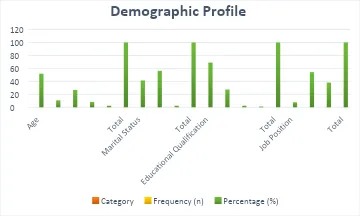
The table and chart above are the demographic profile of the women respondents who took part in the study (N = 336). The majority of the respondents (51.8%) were of the age group 25 years and below followed by 26.8% of 35-45 years of age, which showed that the sample consists mainly of young and middle aged working women. With respect to marriage status 56.3% of the respondents were unmarried, 41.4% were married and 2.4% were widows. The respondents were relatively well educated (69.0% had a bachelor's degree, 27.4% a master's degree). Regarding job position, more than half of the respondents (54.2%) worked at middle-level positions, 38.1% were in senior-level positions and 7.7% were in entry-level positions. The demographic features available in this study suggest that it captures women across a range of educational and working levels making it appropriate for analyzing the effect of job security on investment behavior.
Reliability Analysis
|
Variable |
Cronbach's Alpha |
Interpretation |
|
Job Security |
0.766 |
Good |
|
Self-Motivation |
0.663 |
Acceptable |
|
Investment Behaviour |
0.636 |
Acceptable |
|
Risk Tolerance |
0.601 |
Acceptable |
Source: Computed from primary data.
The internal consistency of the measurement scales was checked using Cronbach's Alpha. The reliability coefficient of the Job Security scale (α = 0.766) is good, while Self-Motivation (α = 0.663), Investment Behaviour (α = 0.636), Relationship Scale (α = 0.684), and Risk Tolerance (α = 0.601) are acceptable. The scales were found to be fairly reliable with all reliability coefficients being greater than 0.60, which makes them appropriate for behavioural research and appropriate for further statistical analysis.
Descriptive statistics
Descriptive statistics provide a simple numerical summary of variables of interest in the study including job security, self-motivation, investment behaviour, and risk tolerance. These tend to describe the average level of each construct and the spread of respondents' answers around the average, such as by using the mean and standard deviation. This preliminary snapshot is used to gauge the overall level of these perceptions and behaviours of working women in Karnataka. It also serves as a helpful basis for later explanations in the paper of correlation and regression analyses.
|
Descriptive |
|||||
|
JS |
SM |
IB |
RS |
RT |
|
|
Mean |
2.05 |
1.98 |
1.88 |
2.03 |
2.26 |
|
Standard deviation |
0.532 |
0.535 |
0.475 |
0.593 |
0.651 |
|
Minimum |
1 |
1 |
1 |
1 |
1.25 |
|
Maximum |
4.13 |
3.33 |
3 |
3.75 |
5 |
|
Skewness |
1 |
0.239 |
-0.0253 |
0.569 |
1.2 |
|
Std. error skewness |
0.133 |
0.133 |
0.133 |
0.133 |
0.133 |
|
Kurtosis |
1.47 |
0.218 |
-0.25 |
0.251 |
2.77 |
|
Std. error kurtosis |
0.265 |
0.265 |
0.265 |
0.265 |
0.265 |
|
Shapiro-Wilk W |
0.916 |
0.934 |
0.946 |
0.939 |
0.901 |
|
Shapiro-Wilk p |
<.001 |
<.001 |
<.001 |
<.001 |
<.001 |
Source: Computed from primary data.
The descriptive statistics reveal that the respondents reported relatively low mean scores for all the study variables, indicating a generally positive perception of job security, self-motivation, investment behaviour, and the relationship between employment stability and financial decision-making. Among all constructs, Risk Tolerance recorded the highest mean (M = 2.26, SD = 0.651), whereas Investment Behaviour showed the lowest mean (M = 1.88, SD = 0.475). The standard deviations indicate moderate variability among respondents. The skewness and kurtosis values suggest that the distributions are moderately skewed but remain within acceptable limits for behavioural research.
Correlation Matrix:
|
Correlation Matrix |
||||||
|
JS |
IB |
RS |
SM |
RT |
||
|
JS |
Pearson's r |
— |
||||
|
df |
— |
|||||
|
p-value |
— |
|||||
|
IB |
Pearson's r |
0.331*** |
— |
|||
|
df |
334 |
— |
||||
|
p-value |
<.001 |
— |
||||
|
RS |
Pearson's r |
0.752*** |
0.420*** |
— |
||
|
df |
334 |
334 |
— |
|||
|
p-value |
<.001 |
<.001 |
— |
|||
|
SM |
Pearson's r |
0.201*** |
0.608*** |
0.059 |
— |
|
|
df |
334 |
334 |
334 |
— |
||
|
p-value |
<.001 |
<.001 |
0.284 |
— |
||
|
RT |
Pearson's r |
0.344*** |
0.281*** |
0.279*** |
0.071 |
— |
|
df |
334 |
334 |
334 |
334 |
— |
|
|
p-value |
<.001 |
<.001 |
<.001 |
0.196 |
— |
|
|
Note. * p < .05, ** p < .01, *** p < .001 |
||||||
Source: Computed from primary data.
Pearson correlation analysis revealed a significant positive relationship between Job Security and Investment Behaviour (r = 0.331, p < 0.001), indicating that higher levels of perceived job security are associated with improved investment behaviour.
The Relationship Scale demonstrated a strong positive association with Job Security (r = 0.752, p < 0.001) and a moderate positive relationship with Investment Behaviour (r = 0.420, p < 0.001). Self-Motivation exhibited a strong positive correlation with Investment Behaviour (r = 0.608, p < 0.001), suggesting that motivated individuals are more likely to engage in systematic investment activities.
Risk Tolerance also showed statistically significant positive relationships with Job Security (r = 0.344, p < 0.001), Investment Behaviour (r = 0.281, p < 0.001), and the Relationship Scale (r = 0.279, p < 0.001). These findings indicate that all major study variables are positively associated, supporting the proposed conceptual framework.
Regression Model
To examine the influence of self-motivation and risk tolerance on investment behaviour among working women in Karnataka.
|
Model Fit Measures |
|
|
Model |
R² |
|
1 |
0.446 |
|
Note. Models estimated using sample size of N=336 |
|
Source: Computed from primary data.
The regression model explained 44.6% of the variation in Investment Behaviour (R² = 0.446). This indicates that Job Security, Self-Motivation, and Risk Tolerance collectively explain a substantial proportion of women's investment behaviour.
|
Model Coefficients - IB |
||||||
|
95% Confidence Interval |
||||||
|
Predictor |
Estimate |
SE |
Lower |
Upper |
t |
p |
|
Intercept |
0.298 |
0.106 |
0.0897
|
0.507 |
2.81 |
0.005 |
|
JS |
0.136 |
0.0396 |
0.0586 |
0.214 |
3.45 |
<.001 |
|
RT |
0.138 |
0.0317 |
0.0753 |
0.2 |
4.34 |
<.001 |
|
SM |
0.5 |
0.037 |
0.4276 |
0.573 |
13.52 |
<.001 |
Source: Computed from primary data.
Self-Motivation emerged as the strongest predictor (β = 0.500, p < 0.001), followed by Risk Tolerance (β = 0.138, p < 0.001) and Job Security (β = 0.136, p < 0.001). These findings demonstrate that women who exhibit higher levels of self-motivation, greater willingness to accept financial risk, and stronger perceptions of job security are more likely to display positive investment behaviour.
Findings
The reliability analysis showed acceptable internal consistency for all scales, with Cronbach’s alpha values between 0.601 and 0.766, confirming the suitability of the instrument. Descriptive statistics indicated generally positive perceptions of job security, self-motivation, investment behaviour, and risk tolerance, with moderate variation across respondents.
Correlation analysis revealed a significant positive relationship between job security and investment behaviour (r = 0.331, p < 0.001), while self-motivation had the strongest association with investment behaviour (r = 0.608, p < 0.001). Risk tolerance was positively linked to both job security and investment behaviour, suggesting that women with higher risk tolerance tend to make more diversified investment decisions.
Multiple regression results showed that job security, self-motivation, and risk tolerance significantly influenced investment behaviour and jointly explained 44.6% of its variance. Self-motivation was the strongest predictor, followed by risk tolerance and job security. Collinearity diagnostics indicated no multicollinearity problems, as all VIF values were within acceptable limits.
Welch’s ANOVA found no statistically significant differences in investment behaviour across marital status (p = 0.074) or job positions. Overall, the results suggest that strengthening women’s employment stability, intrinsic motivation, and confidence in handling financial risk can positively shape their investment behaviour.
Suggestions
Employers should enhance employment stability through clear organisational policies, open communication, and structured career development opportunities, thereby strengthening women employees’ financial confidence and readiness to invest.
Financial institutions and government agencies need to organise regular, gender-sensitive financial literacy and investment awareness programs tailored to working women in diverse sectors, encouraging informed and proactive financial decision-making.
Working women should be supported to adopt systematic investment practices, including formal financial planning, portfolio diversification, and long-term wealth-building strategies aligned with their future goals.
Organisations can introduce workplace financial wellness programmes that offer investment counselling, retirement planning guidance, and personal finance education as part of employee welfare initiatives.
Policymakers should promote measures that advance women’s financial inclusion and facilitate access to a broad range of suitable investment products and services. Future researchers may extend this work by incorporating additional variables such as financial literacy, income level, adoption of digital financial services, and behavioural biases, and by covering wider geographic regions or specific occupational groups.
CONCLUSION
The study examined the impact of job security on the investment behaviour of women in Karnataka by considering the roles of self-motivation and risk tolerance. The findings demonstrate that job security positively influences investment behaviour, while self-motivation emerged as the strongest predictor of women's investment decisions. Risk tolerance also contributed significantly, indicating that women who are more willing to accept financial risk are more likely to participate in investment activities. The regression model explained a substantial proportion of the variation in investment behaviour, confirming that employment-related and psychological factors jointly influence financial decision-making. Overall, the study highlights the importance of promoting employment stability, financial awareness, and self-motivation to strengthen investment behaviour among women in Karnataka and contribute to their long-term financial well-being.
REFERENCES


Manjula N.*, Keerthana, Influence Of Job Security On Investment Patterns Of Working Women In Karnataka, Int. J. Sci. R. Tech., 2026, 3 (9), 746-763. https://doi.org/10.5281/zenodo.23119716
 10.5281/zenodo.23119716