

We use cookies to ensure our website works properly and to personalise your experience. Cookies policy
Department of Chemistry, Gopikabai Sitaram Gawande College, Umarkhed, Dist. Yavatmal – 445206 (M.S.), India
The oxidative dehydrogenation of three 6-chloro-3-(4-methoxybenzoyl)chroman-4-ones [3-II(a–c)] to the corresponding 4H-chromen-4-ones (flavones) [4-II(a–c)] using molecular iodine in refluxing ethanol has been examined in detail. The reaction introduces the C-2=C-3 double bond, converting the non-planar, sp³-hybridised chroman-4-one into a fully conjugated, planar chromone, and proceeds in 60–65% yield within 10 min. The transformation is followed by four independent spectroscopic criteria: (i) the two mutually coupled H-2 and H-3 doublets (J = 11 Hz) of the flavanone disappear completely from the ¹H NMR spectrum, leaving only aromatic protons and the anisoyl methoxy singlet; (ii) the carbonyl stretching frequency rises from 1660–1685 cm?¹ to 1720 cm?¹; (iii) the principal UV band undergoes a bathochromic shift of about 20 nm, consistent with extension of conjugation through the newly formed double bond; and (iv) the molecular ion decreases by exactly two mass units, while the chlorine isotope cluster is preserved. The Shinoda test, positive for the flavanones, becomes negative for the flavones. Elemental analyses agree with the calculated compositions to within 0.05%.
Chroman-4-ones (flavanones) and their derived nitrogen heterocycles are of continuing interest because of their broad biological profile (Harborne & Williams, 2000; Cushnie & Lamb, 2005). The 3-aroylchroman-4-ones used in the present work are readily available from o-hydroxyacetophenones through the Baker–Venkataraman transformation followed by Claisen–Schmidt condensation (Baker, 1933; Mahal & Venkataraman, 1934).
The conversion of a flavanone into the corresponding flavone requires the removal of two hydrogen atoms from C-2 and C-3 and the creation of the C-2=C-3 double bond. Several oxidants have been used for this purpose, but molecular iodine in an alcoholic solvent remains among the most convenient, being cheap, mild and easily removed by washing with thiosulphate (Algar & Flynn, 1934; Oyamada, 1935; Imafuku et al., 1987). Although the reaction is widely used, the individual spectroscopic changes that accompany aromatisation are seldom set out together for a single substrate series. In the present paper we take one reaction — the iodine-mediated dehydrogenation of the 3-(4-methoxybenzoyl)chroman-4-ones [3-II(a–c)] — and follow it by ¹H NMR, IR, UV–Visible and mass spectrometry, so that each of the four independent lines of evidence for the loss of the two sp³ protons can be compared directly.
2. EXPERIMENTAL
2.1 Materials and instrumentation
All chemicals were of analytical reagent grade and solvents were dried and distilled before use (Furniss et al., 1989). Reactions were monitored by TLC on silica gel G with benzene as eluent. Melting points were determined in open capillaries and are uncorrected. UV–Visible spectra were recorded over 200–500 nm, IR spectra as KBr pellets over 4000–400 cm⻹, and ¹H NMR spectra at 300 MHz in CDCl₃ with TMS as internal standard (δ in ppm, J in Hz); mass spectra were obtained by electron impact. Assignments follow standard correlation data (Silverstein et al., 2005; Pavia et al., 2015). The starting chroman-4-ones [3-II(a–c)] were prepared as described previously.
2.2 General procedure
The chroman-4-one [3-II(a–c)] (0.01 mol) and iodine (0.012 mol, 3.05 g) were refluxed in absolute ethanol (30 mL) for 10 min. The cooled mixture was treated with 5% sodium thiosulphate solution to destroy the excess of iodine and then diluted with water. The separated solid was filtered, washed thoroughly with water and crystallised from ethanol to give the flavone as a yellow crystalline solid. The progress of the reaction was conveniently followed by the Shinoda test, which is positive for the starting flavanone and negative for the product.
2.3 Physical and analytical data
[4-II(a)] 6-Chloro-2-(4-chlorophenyl)-3-(4-methoxybenzoyl)-4H-chromen-4-one. From [3-II(a)] (0.01 mol, 4.27 g) and Iâ‚‚ (0.012 mol). Yellow solid; m.p. 185 °C; yield 65%. Shinoda test negative. Anal. Calcd for C₂₃Hâ‚â‚„Clâ‚‚Oâ‚„ (425): C, 64.96; H, 3.32. Found: C, 64.92; H, 3.34. UV (EtOH) λmax: 338 nm (Band I), 285 nm (Band II). IR (KBr): 3060 (Ar C–H only), 1720 (chromone C=O), 1640 (C=C), 1600, 1510, 1255, 830 cm⻹. ¹H NMR (300 MHz, CDCl₃): δ 3.88 (s, 3H, Ar–OCH₃), 6.98 (d, J = 9 Hz, 2H, AA′BB′), 7.70 (m, 10H, ArH); no aliphatic protons. MS (EI): m/z 424 (Mâº), 426 (M+2), 428 (M+4) — two Cl; 289 (M–135); 135 (base peak, anisoyl cation); 77.
[4-II(b)] 6-Chloro-3-(4-methoxybenzoyl)-2-(p-tolyl)-4H-chromen-4-one. From [3-II(b)] (0.01 mol). Yellow solid; m.p. 192 °C; yield 62%. Shinoda test negative. Anal. Calcd for Câ‚‚â‚„Hâ‚₇ClOâ‚„ (405): C, 71.20; H, 4.23. Found: C, 71.15; H, 4.25. UV: 340, 287 nm. IR: 1720, 1640, 1510, 1255, 815 cm⻹. ¹H NMR: δ 2.40 (s, 3H, p-tolyl CH₃), 3.88 (s, 3H, anisoyl OCH₃), 6.98 (d, J = 9 Hz, 2H), 7.65 (m, 9H). MS: m/z 404 (Mâº), 406 (M+2, one Cl); 269 (M–135); 135 (base).
[4-II(c)] 6-Chloro-3-(4-methoxybenzoyl)-2-phenyl-4H-chromen-4-one. From [3-II(c)] (0.01 mol). Yellow solid; m.p. 188 °C; yield 60%. Shinoda test negative. Anal. Calcd for C₂₃Hâ‚â‚…ClOâ‚„ (390.5): C, 70.69; H, 3.87. Found: C, 70.64; H, 3.89. UV: 336, 283 nm. IR: 1720, 1640, 1510, 1255, 760 cm⻹. ¹H NMR: δ 3.87 (s, 3H, OCH₃), 6.97 (d, 2H), 7.70 (m, 10H). MS: m/z 390 (Mâº), 392 (M+2); 255 (M–135); 135 (base).
3. RESULTS AND DISCUSSION
3.1 The reaction
Treatment of the flavanones [3-II(a–c)] with a slight excess of iodine in refluxing ethanol effects clean dehydrogenation within 10 min, giving the flavones [4-II(a–c)] in 60–65% isolated yield. Iodine acts as a mild two-electron oxidant, abstracting the hydrogen atoms at C-2 and C-3 and generating the C-2=C-3 double bond; the hydrogen iodide formed is removed on work-up with thiosulphate. The simplest chemical indication that the reaction has gone to completion is the Shinoda test, which depends on the reducible sp³ C-2–C-3 unit and is therefore positive for the flavanone and negative for the flavone. The melting points rise sharply on aromatisation (for example, 162 → 185 °C for the (a) pair), as expected for the more planar, better-packing chromone. Found and calculated elemental compositions agree to within 0.05% (Figure 5).
3.2 ¹H NMR evidence for aromatisation
The most direct evidence for the reaction is furnished by the ¹H NMR spectra (Figure 1). The starting flavanone [3-II(a)] shows the two mutually coupled methine doublets of H-2 (δ 5.42) and H-3 (δ 5.98) with J = 11 Hz, the magnitude of the coupling establishing a trans-diaxial relationship between the two sp³ protons. In the product these signals have disappeared completely: the region between δ 5 and δ 6 is empty, and the only non-aromatic resonance remaining is the anisoyl methoxy singlet at δ 3.88. Since dehydrogenation is precisely the removal of these two protons, their complete absence is an unambiguous criterion for the success of the reaction, and integration confirms that the aromatic region has gained no protons in the process. The methoxy singlet and the AA′BB′ doublet of the anisoyl ring at δ 6.98 (J = 9 Hz) are retained unchanged, showing that the aroyl substituent is untouched by the oxidant.
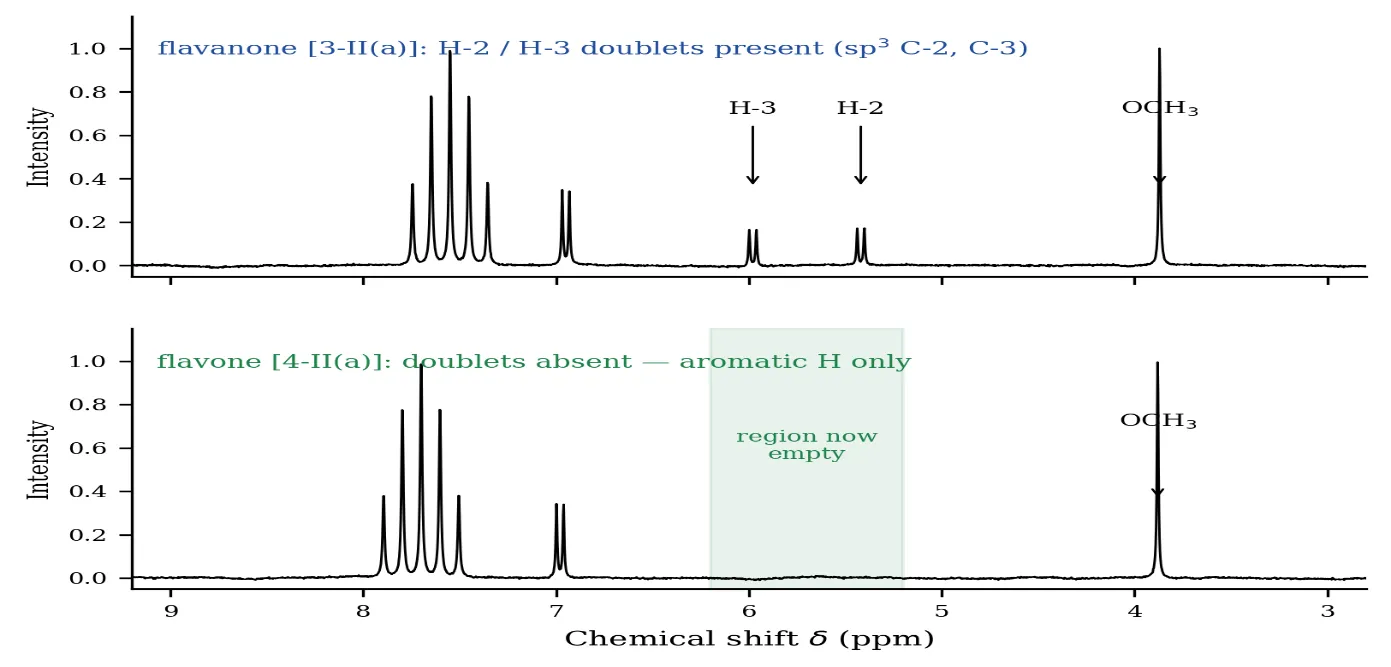
Figure 1. ¹H NMR spectra (300 MHz, CDCl₃) of the flavanone [3-II(a)] and the flavone [4-II(a)]. The H-2 and H-3 doublets (J = 11 Hz) are removed by dehydrogenation, leaving the shaded region empty; the anisoyl OCH₃ singlet is retained.
3.3 Infrared spectra
Aromatisation also produces a characteristic change in the carbonyl region (Figure 2). In the flavanone the C-4 carbonyl absorbs at 1660–1685 cm⻹. In the flavone this band moves to 1720 cm⻹, and a new band appears at 1640 cm⻹ due to the C-2=C-3 double bond of the γ-pyrone ring. In addition, the aliphatic C–H stretching absorption of the sp³ C-2–H and C-3–H is lost, leaving only aromatic C–H at 3060 cm⻹ — an independent confirmation that no sp³ methine protons remain. The bands characteristic of the anisoyl group (1510 and 1255 cm⻹) are unaffected.
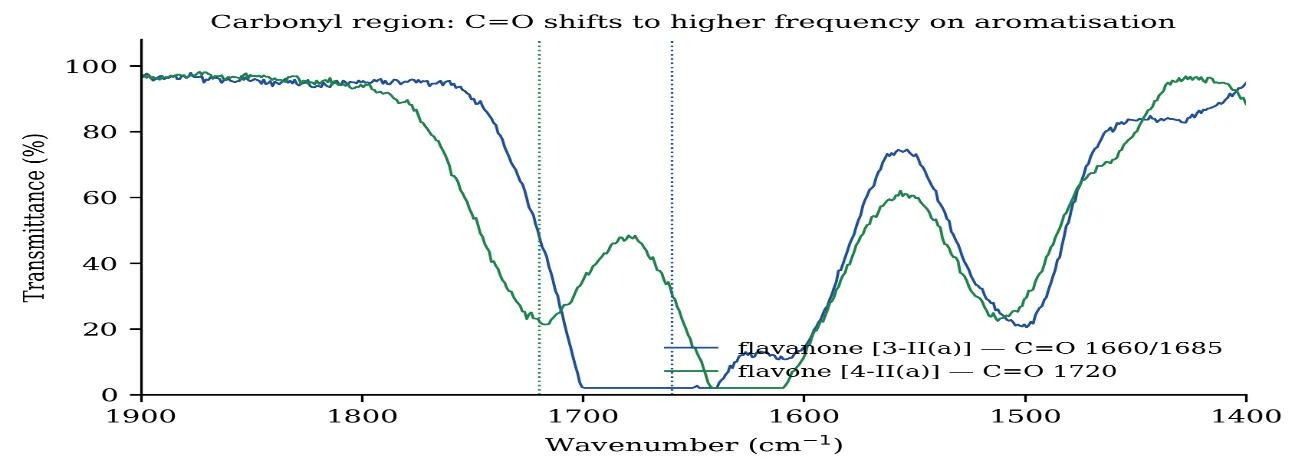
Figure 2. Carbonyl region of the IR spectra of [3-II(a)] and [4-II(a)]. The C=O band rises from 1660 to 1720 cm⻹ on formation of the chromone.
3.4 Electronic spectra
The creation of the C-2=C-3 double bond places the C-2 aryl ring, the newly formed olefinic bond and the C-4 carbonyl in a single conjugated array — the cinnamoyl chromophore of the flavone. The principal absorption band therefore moves to longer wavelength, from 318 nm in the flavanone to 338 nm in the flavone, a bathochromic shift of about 20 nm which is reproduced closely in all three pairs (Figures 3 and 5). Band II likewise shifts, from 265 to 285 nm. The direction and magnitude of these displacements are exactly what extended conjugation predicts, and they provide a convenient way of following the reaction spectrophotometrically.
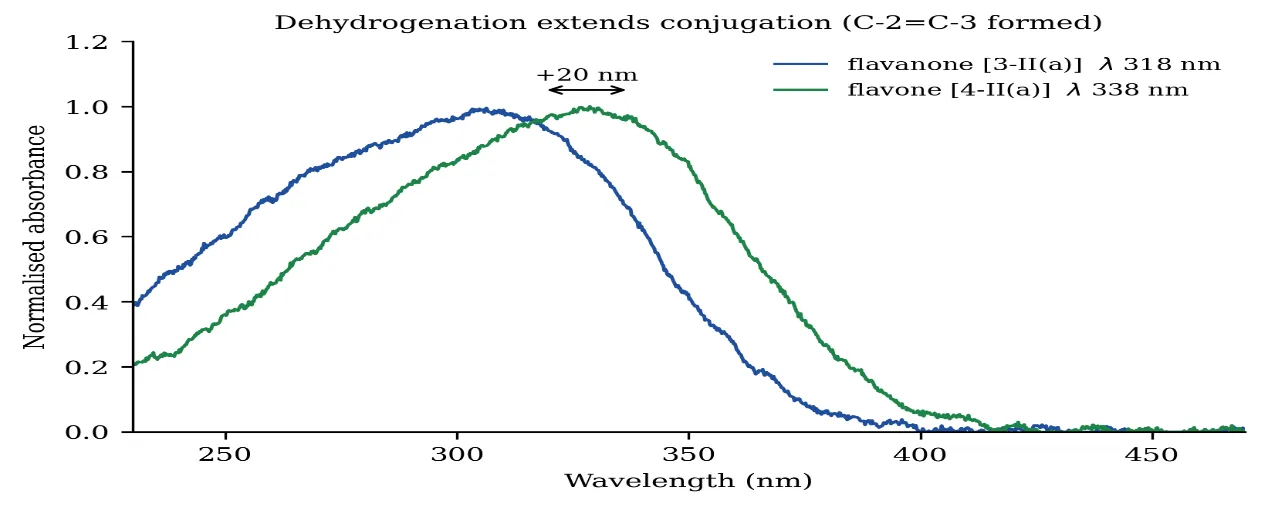
Figure 3. UV–Visible spectra of [3-II(a)] and [4-II(a)] in ethanol. Formation of the C-2=C-3 double bond extends conjugation and shifts the principal band by about 20 nm.
3.5 Mass spectra
The mass spectra (Figure 4) confirm the loss of exactly two hydrogen atoms. The molecular ion of the flavanone at m/z 426 is replaced by an ion at m/z 424 in the flavone, a decrease of two mass units and no more. The two-chlorine isotope cluster (M, M+2, M+4, approximately 9:6:1) is preserved, showing that neither chlorine is lost under the oxidising conditions. The anisoyl cation at m/z 135 remains the base peak in both spectra, and the complementary fragment (M − 135) shifts by the same two units, all of which is consistent with a reaction confined entirely to the C-2–C-3 bond of the pyranone ring.
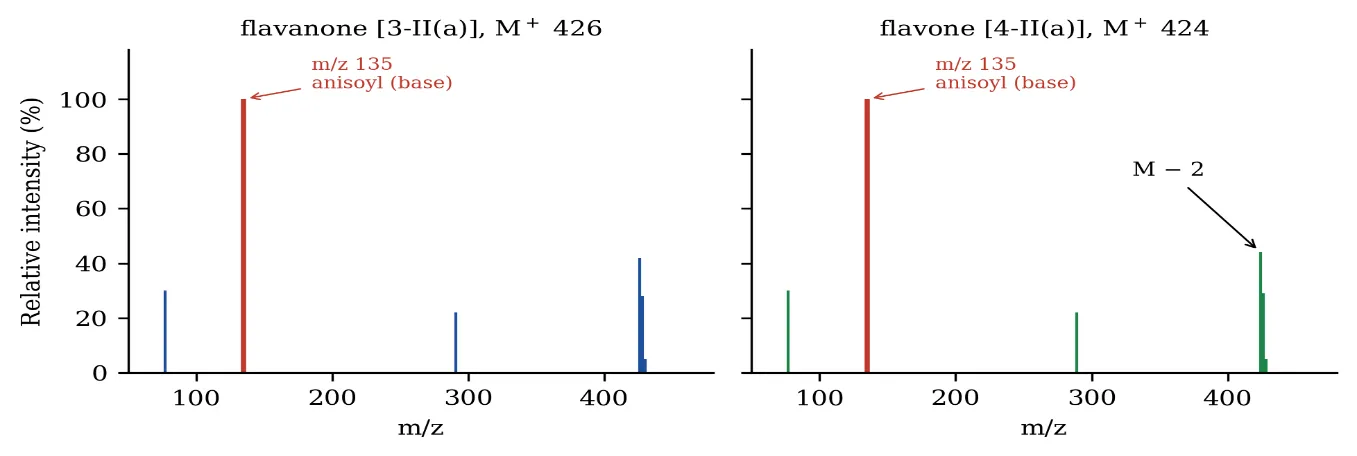
Figure 4. EI mass spectra of [3-II(a)] and [4-II(a)]. The molecular ion falls by exactly two mass units while the two-chlorine isotope cluster and the anisoyl base peak (m/z 135) are retained.
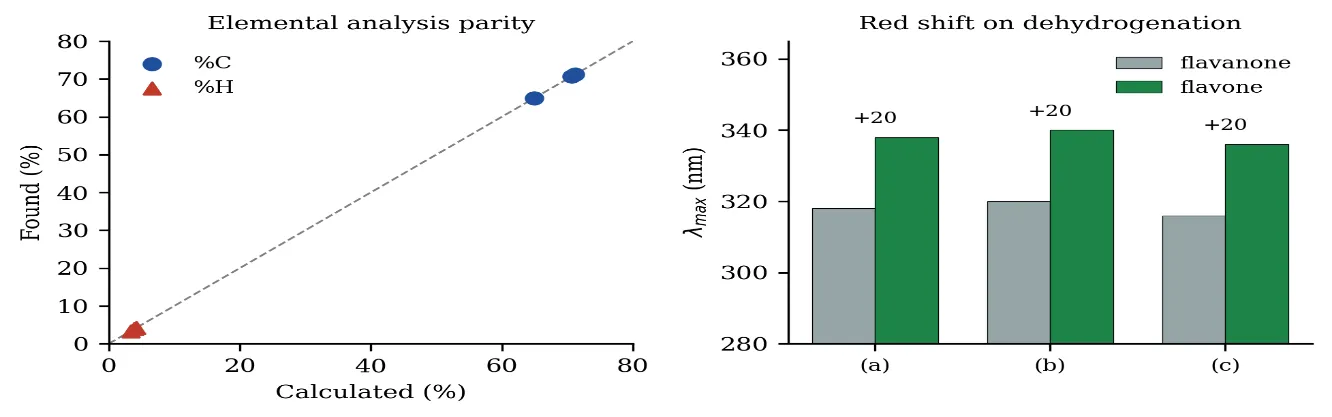
Figure 5. (Left) Parity plot of found versus calculated elemental composition for the three flavones. (Right) The bathochromic shift of the principal band on dehydrogenation, reproduced across all three substrate pairs.
CONCLUSION
Iodine in refluxing ethanol effects the clean dehydrogenation of 3-(4-methoxybenzoyl)chroman-4-ones to the corresponding 4H-chromen-4-ones in 60–65% yield within 10 min. Four independent spectroscopic criteria establish the transformation and agree with one another: the complete disappearance of the H-2 and H-3 doublets from the ¹H NMR spectrum, the rise of the carbonyl stretching frequency from 1660 to 1720 cm⻹ with the appearance of the C-2=C-3 band at 1640 cm⻹, a bathochromic shift of about 20 nm in the principal UV band, and a decrease of exactly two mass units in the molecular ion with retention of the chlorine isotope cluster. The Shinoda test provides a simple chemical check on completion. The anisoyl group survives the oxidation unchanged, as shown by the retention of the methoxy singlet, the 1510 cm⻹ band and the m/z 135 base peak.
REFERENCES

Arati A. Narwade, Suresh P. Rathod*, Iodine-Mediated Oxidative Dehydrogenation Of 3-(4-Methoxybenzoyl)Chroman-4-Ones To 4H-Chromen-4-Ones: A Spectroscopic Study Of The Aromatisation Step, Int. J. Sci. R. Tech., 2026, 3 (8), 181-185. https://doi.org/10.5281/zenodo.21806010
 10.5281/zenodo.21806010