

We use cookies to ensure our website works properly and to personalise your experience. Cookies policy
1Little Flower College of Nursing, Monvila, TVPM
2Shree Devi College of Nursing, Mangalore, Karnataka
Incidence of Cellulitis of the lower limb is on increase with increasing number of hospitalisations. A history of previous episode of Cellulitis is a strong risk factor in case of repeated event of Cellulitis in the same limb. Supportive interventions along with effective education of the persons with cellulitis of the lower limb can go long way to effective prognosis and prevention of recurrence. Knowledge regarding risk factors for recurrence are effective in reducing the rate of recurrence. They provide the basis for various educational programs for the patient as well as for those in health care delivery in different settings. Aim: Evaluate the effectiveness of Computer Assisted patient Education on knowledge about prevention of recurrence of Lower limb Cellulitis. Materials and methods: A quasi- experimental one group pre-test post-test design was adopted for the study .Sample consisted of 32 patients hospitalised with recurrence of Lower limb Cellulitis. Structured knowledge questionnaire was used for data collection before and after computer assisted teaching programme to assess the level of knowledge about prevention of recurrence of Lower Limb Cellulitis. Result: Among the participants, 10 (32%) had an average level of knowledge, while 22 (68%) had a poor level of knowledge regarding lower limb cellulitis and its prevention. None of the participants demonstrated a good level of knowledge. The mean pre-test knowledge score was 9.30 ± 4.80. Seven days after the Computer-Assisted Patient Teaching (CAPT) intervention, the mean post-test knowledge score increased to 18.60 ± 3.00. The paired t-test revealed a statistically significant increase in the post-test knowledge scores compared with the pre-test scores (t = 19.97, p < 0.01) Conclusion : Patients with Lower limb Cellulitis should be made aware of risk of recurrence, factors involved and the preventive measures through good quality patient education to help prevent recurrence and to improve quality of life of the patients.
Lower limb Cellulitis is a bacterial skin infection with frequent relapses and debilitation. It is an infection with lymphatic involvement manifesting varying severity, high incidence and rate of recurrence. Although moderate episodes of cellulitis can easily be treated in the outpatient setting, more serious cases of cellulitis are on the rise, necessitating hospitalisation, especially in the elderly and those with predisposing factors or comorbidities which results in a decrease in income and economic production, aggravating the poverty cycle.
Several risk factors have been identified for etiology of Cellulitis. Among them, the most common risk factors are local trauma to the limb affected, local oedema, venous insufficiency both superficial and deep, precedent radiation therapy and a past surgical history. (Collazos et al., 2018). In addition ethnicity, environmental risk factors like exposure to flood water, diabetes, drinking and smoking are also identified.
Patients with non-necrotizing acute Cellulitis in many cases have a tendency to reccur at the same site. Obesity and previous surgical history of the affected extremity were identified as risk factors in patients with repeated Cellulitis. Patients with a previous history and recurrence had a long febrile period and hospital stay and increased Leukocyte count and CRP than those with first episode. Understanding of factors of recurrence and influence the clinical use of antibiotics and non-pharmacological measures in treatment and prevention of Cellulitis. (Karpelin et. al., 2010)
Among various risk factors identified for recurrence of Lower limb Cellulitis Lymphoedema is an important risk factor. With repeated episodes of cellulitis lymphatic system of the lower extremities get damaged resulting in lymphoedema .( (Inghammar, 2014, Adimoolam et al., 2018). Cellulitis cannot be prevented always but the risk of developing cellulitis can be minimized. A common cause of Cellulitis is an injury or an abrasion resulting from finger nails, leading to entry of pathogenic agent in to the body. Regular hand washing to remove germs and bacteria, proper toe nail care (trimming and cleaning), and excellent hygiene (daily showering and wearing clean clothes) can all assist to limit the chance of bacteria entering the skin. It is possible to avoid activities that raise the risk of cuts and grazes. Wearing protective gear when playing or working outside, applying sunscreen to minimise sunburn, limiting contact with unknown animals, avoiding bug bites, and applying insect repellent lotion, among other things, may be beneficial. To avoid cracks that allow bacteria to enter the skin, keep the skin hydrated. Immunocompromised patients, diabetics, and people with inadequate circulation in the extremities are also at risk. Lymphoma promotes the growth of pathogenic microorganisms and inhibits blood circulation, resulting in increased pressure due to fluid retention. Preventing lymphoedema is critical for treating and decreasing a cellulitic episode. It points out the need to develop a campaign to increase the level of knowledge about preventive measures of recurrence. A study done with the objective of determining the risk factor of recurrence of lower limb cellulitis identified that over weight (OR, 5.8;95%CI,2.43-4.11),Occupation(OR,4.5;95%CI,1.0519.34),lymphedema (OR,6.91;95%CI,2.85-16.74), level of knowledge on prevention of recurrence (OR,4.13;95% CI, 1.66-10.29) were independent predictors of recurrence of Lower limb Cellulitis. (Rani Catherine , Darling Bibiyana, 2023).
Patient’s capability to restore health or prevent recurrence looks to be influenced by their awareness of the condition. A sense of uncertainty regarding awareness and understanding of Cellulitis was reported by the samples in a cross sectional survey done in England, the participants expressed that they received a clear diagnosis, yet many reported negative, including delayed diagnosis. Many of them felt that they were not told about the causes or treatment or avoidance of further episode of Cellulitis. The findings suggest patient’s need for basic information including their disease condition and how to handle an acute occurrence of Lower limb cellulitis (Teasdale, 2019). Lack of knowledge regarding the risk factors of recurrence has to be addressed with appropriate education strategies to prevent more and more persons incur repeated episodes of lower limb cellulitis . Awareness of risk factors of repeated episodes of Cellulitis need to be created among the patients through appropriate measures about ongoing management and prevention.
2. METHODOLOGY:
A quasi- experimental one group pre-test post-test design was adopted to assess the effectiveness of a computer assisted patient education on prevention of recurrence of Lower limb Cellulitis. Purposive sampling technique was used to select the samples to measure the effectiveness of a planned Computer assisted patient education programme CAPT on the level of knowledge regarding prevention of its recurrence. Researcher selected 32 samples that came to the hospital as inpatients or outpatients with a repeated events of Lower limb Cellulitis. A predetermined knowledge questionnaire was used to collect data regarding knowledge of the samples regarding prevention of lower limb cellulitis. A computer assisted education regarding preventive measure of recurrence was provided to samples. After seven days of the educational intervention, post-test was given to the samples using the same knowledge questionnaire.
3. RESULT:
3.1 Level of Knowledge about prevention of recurrence of Cellulitis
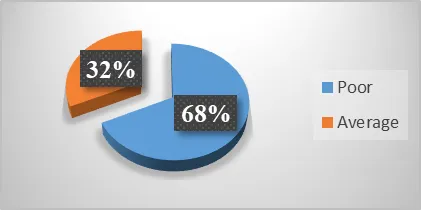
Among the samples, 10(32%) had average degree of knowledge, 22 (68%) had poor degree of knowledge. Not one of the samples had good degree of knowledge. About prevention of recurrence of Lower limb Cellulitis.
3.2 Effectiveness of a Computer Assisted Patient Education on knowledge about prevention on Recurrence of Lower limb Cellulitis
N=32
|
Knowledge |
Mean |
SD |
N |
Mean Difference |
Paired t |
p |
|
Pre test |
9.3 |
4.8 |
32 |
9.2 |
19.97 |
p<0.01 |
|
Post test |
18.6 |
3.0 |
32 |
Before the intervention, the mean knowledge score of the 32 patients was 9.30 ± 4.80. Seven days after the Computer-Assisted Patient Teaching (CAPT) intervention, the mean knowledge score increased to 18.60. The paired t-test demonstrated that the increase in knowledge scores following the intervention was statistically significant at the 0.01 level (p < 0.01).
3.3 Effectiveness of a Computer Assisted Patient Education on dimensions of knowledge about prevention on recurrence of Lower limb Cellulitis.
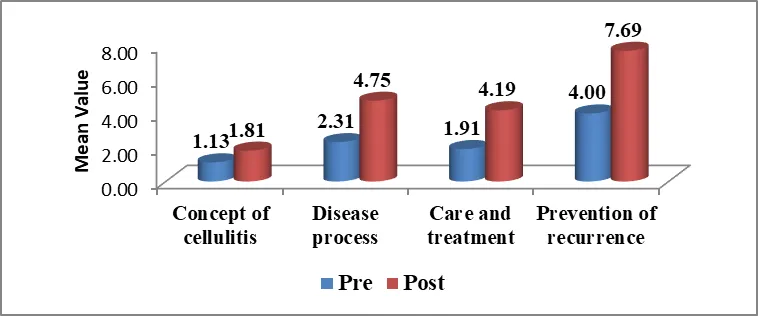
Before the intervention, the mean knowledge score of the 32 patients regarding the concept of cellulitis was 1.13 ± 0.61. Seven days after the Computer-Assisted Patient Teaching (CAPT) intervention, the mean score increased to 1.81. The improvement was statistically significant (t = 6.03, p < 0.01).
Similarly, the mean knowledge score related to the disease process of lower limb cellulitis increased from 2.31 ± 1.45 before the intervention to 4.75 after seven days. The observed increase was statistically significant (t = 10.87, p < 0.01).
With respect to care and treatment of lower limb cellulitis, the mean pre-test knowledge score was 1.91 ± 1.47, which increased to 4.19 following the intervention. This improvement was also statistically significant (t = 10.77, p < 0.01).
The mean knowledge score on prevention of recurrence improved from 4.00 ± 2.44 before the intervention to 7.69 seven days after the intervention. The paired t-test demonstrated a highly statistically significant improvement (t = 11.56, p < 0.01).
Overall, the paired t-test findings indicate that the increase in knowledge scores across all domains following the Computer-Assisted Patient Teaching (CAPT) programme was statistically significant at the 0.01 level (p < 0.01). These findings suggest that the Computer-Assisted Patient Teaching programme was effective in enhancing patients' knowledge regarding the concept, disease process, care and treatment, and prevention of recurrence of lower limb cellulitis.
4. DISCUSSION
Recurrence of Cellulitis of Lower limb can be limited only by self- care management of the risk factors which contributes to its recurrence. Early identification of onset of an episode of Lower limb Cellulitis and initiation of antibiotic therapy is of great importance to prevent complications associated with it such as lymphoedema that incline a person to recurrence of another episode. Personal awareness about the disease, pathogenesis, risk factors, treatment modalities and preventive measures are necessary to appraise it effectively in the self - management of prevention of recurrence. In the present study, analysis of knowledge score of the patients showed that 32% patients possessed average degree of knowledge, and 68% poor degree of knowledge and none of the samples possessed good degree of knowledge. The patients who suffer from Lower limb Cellulitis were not familiar with Cellulitis, its causes and the preventive measures of recurrence.
The finding of the study is supported by a study done in Australia that explored patient experiences regarding Cellulitis and treatment, that patient information about health and communication was poor. Patients were unknowing what they are able to do, to inhibit recurrence (Carter, Kilburn & Featherstone, 2007). Similarly in a study done in England, a sense of uncertainty regarding awareness and understanding of Cellulitis was reported by the samples. Some of the participants expressed that they received a clear diagnosis, yet many reported negative including delayed diagnosis. Many of them felt that they weren’t provided knowledge on reasons of Cellulitis or management or avoidance (Teasdale, 2019). Knowledge about disease and preventive measures is a considerable factor in disease management. Study findings imply the health personnel to understand patient’s educational needs and to identify measures to improve their level of knowledge for better adherence to treatment and preventive measures.
In the present study pretest knowledge score about prevention of recurrence compared with posttest knowledge score after the administration of intervention, a Computer Assisted Education. The paired t test (p<0.01) demonstrated an increase in knowledge score as a result of the Computer Assisted Education at 0.01 level of significance. Thus, it could be inferential that Computer Assisted Education is effective in enhancing the knowledge about prevention on recurrence of Lower limb Cellulitis.
Various educational strategies have been tested for its effectiveness in terms of acquisition of knowledge, reduced anxiety levels, self-care enhancement etc. The use of technology conveys health information in a better way to improve patient’s knowledge and reviewed literature supports computer-based patient education, as more beneficial comparing with traditional instruction. A study done in a University in Pennsylvania, reviewed the materials catalogued in MEDLINE or CINAHL and disseminated in peer-evaluated journals from 1971 to 1998, pertinent to the utilisation of Computer Technology in patient instruction, identifies Computer-based Education as an impressive strategy for conveying knowledge and developing skill of patients in comparison with other educational interventions (Lewis, 1999).
Patient education has unique role to maximise the effectiveness of patient care in any health care setting. Patient education promote increased adherence to medications and self-care management. When a person with Lower limb Cellulitis is aware of risk of recurrence and the means implied for prevention of recurrence, it is more likely that they utilize the health information and the goal of prevention of recurrence is better achieved.
CONCLUSION
Patient education has unique role to maximise the effectiveness of patient care in any health care setting. Patient education promote increased adherence to medications and self-care management. When a person with Lower limb Cellulitis is aware of risk of recurrence and the means implied for prevention of recurrence, it is more likely that they utilize the health information and the goal of prevention of recurrence is better achieved.
REFERENCES


Rani Catherine K. V.1*, Darling B. Bibiyana2, Knowledge For Prevention: Effectiveness Of A Computer-Assisted Education Programme On Lower Limb Cellulitis Recurrence, Int. J. Sci. R. Tech., 2026, 3 (7), 172-176. https://doi.org/10.5281/zenodo.21261496
 10.5281/zenodo.21261496