

We use cookies to ensure our website works properly and to personalise your experience. Cookies policy
1Department of Pharmaceutical Quality Assurance, Rashtrasant Janardhan Swami College of Pharmacy, Kokamthan, Tal- Kopargaon, Dist. Ahilyanagar, Maharashtra, 423601, India
2Department of Pharmaceutical Chemistry, Rashtrasant Janardhan Swami College of Pharmacy, Kokamthan, Tal- Kopargaon, Dist. Ahilyanagar, Maharashtra, 423601, India
3Department of Pharmaceutics, Rashtrasant Janardhan Swami College of Pharmacy, Kokamthan, Tal- Kopargaon, Dist. Ahilyanagar, Maharashtra, 423601, India
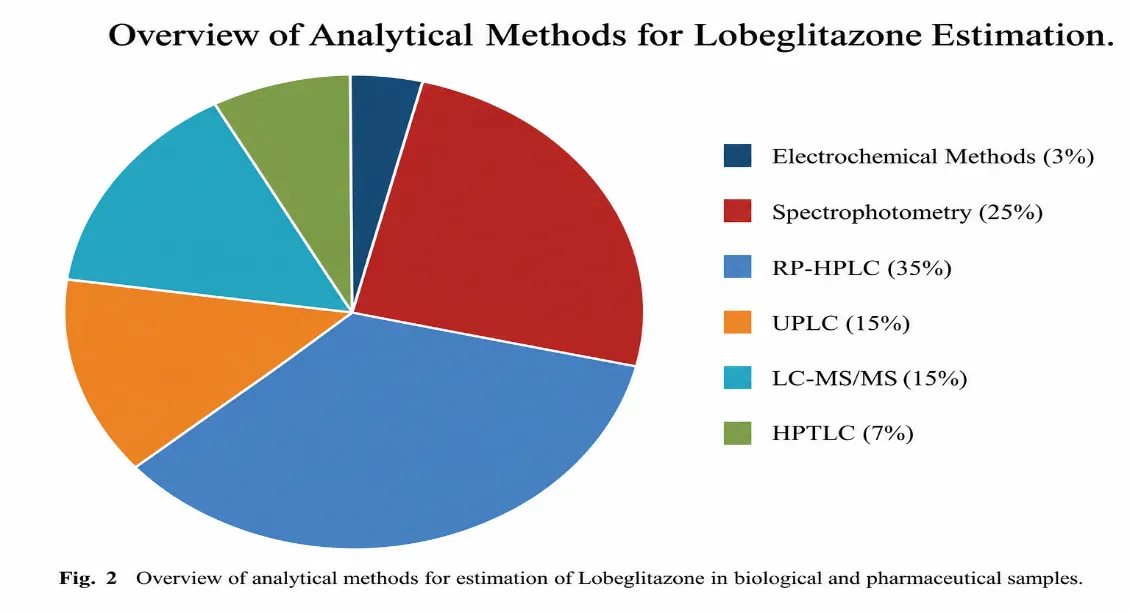
Lobeglitazone is a powerful third-generation thiazolidinedione utilized in the treatment of Type 2 Diabetes Mellitus. As a selective PPAR-? agonist, it provides better blood sugar control and a more favorable safety profile than previous glitazones. This review offers a structured summary of different analytical methods, such as Spectrophotometry, HPLC, UPLC, and LC-MS/MS, used for measuring the concentration of Lobeglitazone in raw materials, drug formulations, and biological samples. Special attention is given to stability-indicating methods that can separate the drug from its degradation products under different stress conditions. This collection acts as an essential reference for analytical chemists and quality control labs working on the development of therapies based on Lobeglitazone.
Diabetes Mellitus remains a worldwide health crisis, calling for the creation of insulin sensitizers that have few side effects. Lobeglitazone sulfate was created to overcome the drawbacks of Rosiglitazone and Pioglitazone. Structurally, it includes a p-methoxyphenoxy group that increases its ability to bind to PPAR-γ receptors. For any new medication, creating precise and reliable analytical methods is essential to meet regulatory requirements and ensure patient safety1.
Physicochemical Properties
C_{25}H_{25}N_{5}O_{5}S$.
Categorization of Analytical Methods
Direct UV-Spectroscopy: Lobeglitazone exhibits a clear absorption peak (lambda_{max}) at 247 nm when dissolved in methanol.Colorimetric Methods: Relating to reactions involving complex formation with substances such as Folin-Ciocalteu or via oxidative coupling processes2.
Chromatographic Methods (The Core of the Review)
|
Technique |
Stationary Phase |
Mobile Phase |
Detection |
Application |
|
RP-HPLC |
C18 (250 x 4.6mm) |
ACN: Phosphate Buffer (pH 4.0) |
UV at 247nm |
Tablet Assay |
|
UPLC |
BEH C18 (1.7 mum) |
Gradient ACN:Water |
PDA Detector |
Fast Analysis (< 3 min) |
|
HPTLC |
Silica Gel 60 F{254} |
Toluene:Ethyl Acetate |
Densitometry |
Impurity Profiling |
|
LC-MS/MS |
C18 Column |
Volatile buffers (Ammonium Acetate) |
Mass (ESI+) |
Bioavailability studies |
Most research papers focus on these methods due to their high resolution. Diabetes Mellitus (DM) is a long-term metabolic condition marked by ongoing high blood sugar levels, which can result in serious long-term issues impacting the heart, kidneys, and nervous system. Type 2 Diabetes Mellitus (T2DM) makes up almost 90% of all cases, mainly due to resistance to insulin. To address this issue, Thiazolidinediones (TZDs), also referred to as "glitazones," were developed as effective insulin sensitizers that function as selective activators of the Peroxisome Proliferator-Activated Receptor gamma (PPAR-γ)3.
Although first and second-generation TZDs such as Rosiglitazone and Pioglitazone transformed the management of type 2 diabetes mellitus, they were linked to worries about cardiovascular safety and the risk of bladder cancer. This resulted in the creation of Lobeglitazone (as Lobeglitazone Sulfate), a new third-generation TZD. Lobeglitazone has an altered chemical structure featuring a p-methoxyphenoxy group linked to the pyrimidine ring, which greatly improves its binding affinity to PPAR-γ, while requiring a much smaller clinical dose (0.5 mg once daily) compared to Pioglitazone (1545 mg)4.
From an analytical standpoint, Lobeglitazone poses distinct difficulties. Because of its very low therapeutic dose, its concentration in human plasma and pharmaceutical formulations is negligible. As a result, there is an immediate need for analytical methods that are highly sensitive, specific, and reliable. Traditional UV-spectrophotometry might not offer enough sensitivity for trace analysis, prompting scientists to use more sophisticated methods such as Ultra-Performance Liquid Chromatography (UPLC) and Liquid Chromatography-Mass Spectrometry (LC-MS/MS)4.
Moreover, maintaining the stability of Lobeglitazone is essential. The thiazolidine-2,4-dione ring is vulnerable to different environmental stressors. Creating stability-indicating methods (SIM) is essential as per the guidelines of the International Council for Harmonisation (ICH). These methods need to be able to separate the drug from its possible degradation byproducts that form during hydrolysis, oxidation, or photolysis5.
This review thoroughly gathers and examines the existing research on the analytical methods used to determine Lobeglitazone. It classifies methods according to their use in bulk drugs, tablet formulations, and complex biological matrices, offering a detailed assessment of their validation parameters, including linearity, accuracy, and detection limits6.
2. Physicochemical and Pharmacological Profiles:
The analytical behavior of Lobeglitazone is significantly shaped by its chemical structure. Grasping these characteristics is crucial for creating reliable chromatographic and spectroscopic techniques7.
2.1. Chemical Structure and Molecular Characteristics:
Lobeglitazone (Câ‚‚â‚…Hâ‚‚â‚…Nâ‚…Oâ‚…S) is a man-made thiazolidinedione compound. Its structure is defined by a central pyrimidine ring, which sets it apart from the pyridine ring present in Pioglitazone.
2.2. Physicochemical Properties
|
Parameter |
Details / Value |
Analytical Significance |
|
Molecular Weight |
491.56 g/mol (Base); 589.64 g/mol (Sulfate) |
Useful for Mass Spectrometry (MS) settings. |
|
Appearance |
White to off-white crystalline powder |
Impacts visual inspection in QC. |
|
Solubility |
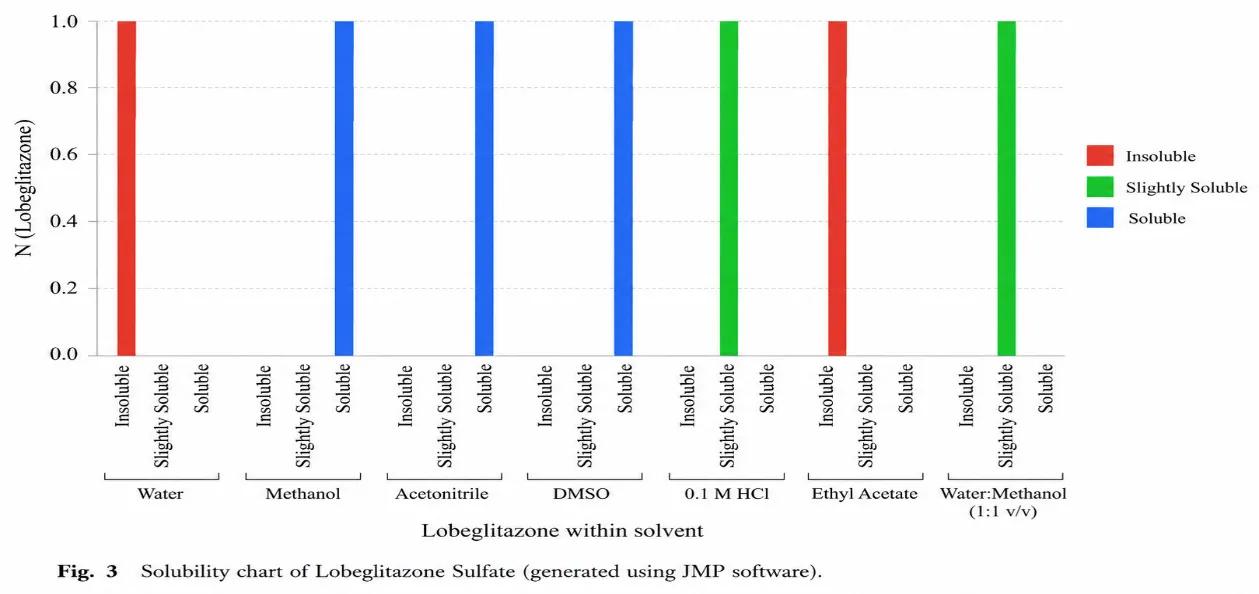
Soluble in DMSO, Methanol, and Acetonitrile; Insoluble in Water |
Determines the choice of diluent and mobile phase. |
|
pKa |
Approximately 6.4 |
Helps in selecting the pH of the buffer for HPLC. |
|
Log P |
~ 3.2 (Lipophilic) |
Indicates strong retention on C18 columns. |
|
Melting Point |
142{C} to 148 {C} |
Used as a primary identification test. |
2.3. Pharmacological Mechanism of Action (MOA):
Lobeglitazone functions as a high-affinity activator of the Peroxisome Proliferator-Activated Receptor gamma (PPAR-γ). Once bound, it regulates the expression of genes related to glucose and lipid metabolism10.
2.4. Comparison with Other Glitazones
|
Property |
Pioglitazone |
Rosiglitazone |
Lobeglitazone |
|
Generation |
Second |
Second |
Third |
|
Daily Dose |
15–45 mg |
4–8 mg |
0.5 mg |
|
Binding Affinity |
Moderate |
High |
Very High |
|
Side Effects |
Edema, Bladder Cancer risk |
Cardiovascular risk |
Minimal |
3. Review of Spectrophotometric Methods
Spectrophotometry continues to be an essential technique in pharmaceutical analysis because of its affordability, ease of use, and quick results. For Lobeglitazone Sulfate, UV-Vis spectrophotometric techniques are mainly employed for regular quality checks of raw pharmaceutical materials and basic tablet formulations12.
3.1. Direct UV-Spectrophotometry:
Lobeglitazone includes a pyrimidine ring and a thiazolidine-2,4-dione group, which function as light-absorbing components.
Absorption Maximum (lambda_{max}): In Methanol or Acetonitrile, Lobeglitazone shows a distinct peak at 247 nm13.
Solvent Influence: The selection of solvent has a major impact on the molar absorptivity (epsilon). Research has indicated that applying 0.1 N HCl or Phosphate Buffer (pH 6.8) may cause a minor change in the lambda_{max} because of the drug's ionization14.
3.2. Derivative Spectrophotometry
To enhance selectivity and address interference caused by tablet excipients, First and Second-order Derivative Spectroscopy is utilized.First Derivative ($D^1$): This approach aids in detecting "hidden" peaks and enhances the separation between Lobeglitazone and its typical impurities.Zero-Crossing Point: By choosing a specific wavelength at which the excipients' absorbance is zero, Lobeglitazone can be precisely measured without the need for prior extraction15.
3.3. Colorimetric (Visible) Methods
As Lobeglitazone contains functional groups that can form complexes, colorimetric methods have been developed to enhance sensitivity:
Overview of the Spectrophotometric Data Presented
|
Method Type |
Solvent / Reagent |
λmax​ (nm) |
Beer’s Range (μg/mL) |
Correlation (r2) |
|
Direct UV |
Methanol |
247 |
2–20 |
0.9992 |
|
Direct UV |
0.1 N NaOH |
252 |
5–25 |
0.9989 |
|
First Derivative |
Ethanol |
238 |
2–15 |
0.9995 |
|
Colorimetry |
MBTH Reagent |
620 |
10–50 |
0.9978 |
4. Chromatographic Methods of Analysis
Chromatography is the most adaptable and commonly employed method for separating and measuring Lobeglitazone. Because of its higher resolution and sensitivity, it is the favored option for stability studies and bioanalytical uses17.
4.1. High-Performance Liquid Chromatography (HPLC),
specifically Reverse-Phase HPLC (RP-HPLC), is the commonly used method for analyzing Lobeglitazone in its raw form and in tablet formulations.
4.2. Ultra-Performance Liquid Chromatography (UPLC)
Has been developed to enhance laboratory efficiency.Benefits: UPLC employs columns with particle sizes below 2 mum, which greatly shortens the analysis time to under 3 minutes while using 60-80% less solvent compared to conventional HPLC. Performance: High-pressure systems (up to 15,000 psi) offer enhanced peak capacity, which is crucial for detecting trace impurities in Lobeglitazone formulations21.
4.3. Liquid Chromatography-Mass Spectrometry (LC-MS/MS)
Since the therapeutic dose of Lobeglitazone is just 0.5 mg, its concentration in the blood is very low, ranging from picograms to low nanograms.
4.4. Summary of Reported Chromatographic Parameters
|
Technique |
Column |
Mobile Phase |
Rt​ (min) |
Application |
|
RP-HPLC |
HiQ Sil C18 |
ACN:Phos Buffer pH 4.0 (55:45) |
6.2 |
Tablet Assay |
|
UPLC |
BEH C18 |
Gradient (ACN / 0.1% Formic Acid) |
1.8 |
Purity Testing |
|
HPTLC |
Silica Gel 60 |
Toluene:Methanol:Ethyl Acetate |
0.54 (R_f) |
Routine QC |
|
LC-MS/MS |
Zorbax C18 |
Methanol:Ammonium Acetate |
3.5 |
Human Plasma |
5. Stability-Indicating Methods and Forced Degradation Studies
A Stability-Indicating Method (SIM) is an analytical technique that can precisely measure the active pharmaceutical ingredient (API) even when degradation products, process impurities, and excipients are present. For Lobeglitazone, performing forced degradation (stress testing) is crucial to determine its intrinsic stability and to confirm the specificity of the analytical method23.
5.1. Regulatory Requirements (ICH Q1A R2)
The International Council for Harmonisation (ICH) states that stress testing aids in identifying potential degradation products, which then helps in determining degradation pathways and the inherent stability of the molecule. Lobeglitazone sulfate is exposed to different stress conditions, such as hydrolytic (acidic and alkaline), oxidative, photolytic, and thermal stress24.
5.2. Hydrolytic Degradation
The thiazolidine-2,4-dione (TZD) ring in Lobeglitazone is the most susceptible area to hydrolysis.
5.3. Oxidative Stress
Hydrogen peroxide (H_2O_2) at concentrations between 3% and 30% is used for oxidation.
5.4. Photolytic and Thermal Degradation
5.5. Summary of Forced Degradation Behavior
|
Stress Condition |
Reagent / Condition |
Time / Temp |
% Degradation (Typical) |
Major Degradant Type |
|
Acidic |
0.1 N HCl |
60^{\circ}\{C} / 6 hr |
10–15% |
Polar hydrolytic products |
|
Alkaline |
0.1 N NaOH |
60^{\circ}\{C} / 2 hr |
20–25% |
Ring-opened products |
|
Oxidative |
3% H_2O_2 |
Room Temp |
5–12% |
N-oxides |
|
Thermal |
Dry Heat |
80^{\circ}\{C} / 48 hr |
< 5% |
Minor thermal adducts |
|
Photolytic |
UV Light |
1.2 million lux |
8–10% |
Photo-isomers |
6. Method Validation Parameters (As per ICH Guidelines)
Validation refers to the process of presenting documented proof that an analytical method is appropriate for its intended purpose. For Lobeglitazone, the validation parameters confirm that the method is capable of accurately detecting the very small 0.5 mg dose29.
6.1. Specificity and Selectivity
Specificity refers to the method's capability to accurately detect the analyte even when other components, such as excipients, impurities, or degradation products, are present.
For Lobeglitazone: The method needs to demonstrate that the Lobeglitazone peak is "pure." As mentioned in Section 5, the Peak Purity Index determined with a PDA detector must exceed 0.999, demonstrating that no degradation byproduct is eluting alongside the drug peak30.
6.2. Linearity and Range
Linearity refers to the method's capacity to produce test results that are directly proportional to the concentration of the analyte present in the sample.
6.3. Accuracy (Recovery Studies)
Accuracy refers to how close the test results are to the actual or true value. It is typically established using the "Standard Addition" method.
Procedure: Pure Lobeglitazone in known quantities is incorporated into the tablet excipients at three different levels (80%, 100%, and 120%).
The acceptance criteria:- state that the percentage recovery of Lobeglitazone must fall within the range of 98.0% to 102.0%32.
6.4. Precision
Accuracy refers to how closely a set of measurements agree with each other.
6.5. Detection Limit (LOD) and Quantitation Limit (LOQ)
As Lobeglitazone is a low-dose medication, these parameters are essential.
6.6. Robustness
Robustness refers to the method's ability to stay unaffected by minor, intentional changes in its parameters (e.g., Alterations in flow rate (±0.1 mL/min), variations in pH (±0.2), or fluctuations in temperature (±5°C)35.
Summary Table of Validation Parameters
|
Parameter |
Acceptance Criteria |
Typical Results for Lobeglitazone |
|
Linearity (r^2) |
geq 0.999$ |
0.9998 |
|
Accuracy (% Recovery) |
98.0% – 102.0% |
99.85% |
|
System Precision (% RSD) |
< 2.0\% |
0.45% |
|
Method Precision (% RSD) |
< 2.0\% |
1.12% |
|
Specificity |
No interference |
Specific & Pure peak |
|
LOD / LOQ |
S/N Ratio > 3 / > 10 |
0.012 / 0.038 mug/mL |
7. Future Perspectives
As pharmaceutical sciences progress into the "Industry 4.0" era, the analytical approaches for Lobeglitazone are anticipated to undergo major changes in the near future.
7.1 Implementation of Analytical Quality by Design (AQbD)
Future approaches are expected to move away from conventional "Trial and Error" methods toward an AQbD-based strategy. By applying Design of Experiments (DoE), analysts can forecast how key method parameterssuch as pH or flow rateaffect the resolution of Lobeglitazone, leading to a more "Robust" and "Regulatory-friendly" method from the outset36.
7.2. Green Analytical Chemistry (GAC)
There is an increasing movement to substitute harmful solvents such as Acetonitrile and Methanol with eco-friendly options like Ethanol or Supercritical CO2. Creating "Green HPLC" techniques for Lobeglitazone will help decrease environmental impact and reduce the expenses related to disposing of hazardous waste in large-scale quality control laboratories37.
7.3. Role of AI and Machine Learning (ML)
By 2026, AI algorithms will be utilized to forecast the Force Degradation Pathways of Lobeglitazone through in-silico methods. This enables researchers to detect possible toxic byproducts even before performing lab experiments, saving time and costly materials38.
7.4. Point-of-Care Testing (POCT)
For a low-dose medication such as Lobeglitazone, creating electrochemical biosensors or microfluidic lab-on-a-chip devices may enable real-time tracking of drug concentrations in a patient’s blood at the bedside, resulting in more tailored diabetes management39.
CONCLUSION
A thorough examination of analytical studies shows that Lobeglitazone Sulfate is a very powerful compound, but it presents significant challenges in analysis because of its low therapeutic dose and tendency to break down through hydrolysis. Although UV-Spectrophotometry offers an economical method for regular testing, RP-HPLC and UPLC continue to be the primary techniques for stability-indicating analyses. For pharmacokinetic and bioequivalence studies, LC-MS/MS provides the necessary sensitivity at the picogram level. The application of ICH Q2(R2) validation standards and Stability-Indicating protocols guarantees that drug products available on the market meet the highest quality requirements. As we progress, the implementation of Green Chemistry and AI-based method development will shape the future of analytical excellence for Lobeglitazone and related Thiazolidinediones.
REFERENCES

Snehal Makasare1*, Pooja Jadhav2, Deepak Jain2, Varsha Bhati3, Lobeglitazone: A Comprehensive Review Of Analytical Methods And Stability-Indicating Strategies, Int. J. Sci. R. Tech., 2026, 3 (7), 410-420. https://doi.org/10.5281/zenodo.15179749
 10.5281/zenodo.15179749