

We use cookies to ensure our website works properly and to personalise your experience. Cookies policy
Arts, Commerce and Science College, Hingoli, Akola Road, Hingoli – 431513
A single symmetry assumption — that the Universe looks the same in every direction and from every location, on sufficiently large scales — is enough to turn Einstein's ten coupled field equations into two ordinary differential equations for a single unknown, the cosmic scale factor. That reduction is the mathematical backbone of relativistic cosmology, and it has proved remarkably durable: it correctly predicts the thermal history of the Universe, the pattern of the cosmic microwave background, and the large-scale distribution of galaxies. This paper works through that reduction explicitly, then turns to three fronts where the idealized picture is currently being pushed and tested: model-independent frameworks for testing whether general relativity itself, rather than merely its matter content, is the correct description of gravity at cosmic scales; the Einstein–Cartan extension that allows spacetime torsion sourced by the intrinsic spin of matter; and fully non-linear numerical-relativity treatments of a Universe that is, in reality, inhomogeneous below the largest scales. A simple numerical solution of the Friedmann equations is used to illustrate how the scale factor grows differently depending on which component — radiation, matter, or a cosmological constant — dominates the energy budget.
Newtonian gravity treats space as a fixed, unchanging stage on which matter moves. General relativity denies that space is fixed at all: the metric tensor g_μν, which encodes distances and angles throughout spacetime, is itself a dynamical field, sourced by whatever energy and momentum are present, according to the Einstein field equations. Applying this framework to the Universe as a single physical system is the task of relativistic cosmology.
Taken at face value, the Einstein equations are a formidable system of ten coupled, non-linear partial differential equations, intractable in general. Cosmology becomes solvable only because of an additional physical assumption — the cosmological principle — that on scales large enough to average over individual galaxies and clusters, the Universe is homogeneous and isotropic. This one assumption is enough to fix the geometry uniquely, up to a single time-dependent function, and to reduce the field equations to a tractable pair of ordinary differential equations. That reduction, and what it has been used to test and extend, is the subject of this paper.
Section 2 carries out the reduction explicitly. Section 3 discusses the ongoing program of testing general relativity itself at cosmological scales, rather than assuming it and fitting only the matter content. Section 4 turns to Einstein–Cartan cosmology, where intrinsic spin sources spacetime torsion. Section 5 discusses what happens once the assumption of exact homogeneity is relaxed and the full, non-linear equations are solved numerically. Section 6 concludes.
2. From Symmetry to Two Equations
2.1 The metric fixed by symmetry
Demanding homogeneity and isotropy leaves exactly one family of metrics consistent with the symmetry, first written down by Friedmann (1922), Lemaître (1927), Robertson (1935), and Walker (1937), given in Eq. (1):
ds² = −dt² + a(t)² [ dr²/(1−kr²) + r²(dθ² + sin²θ dφ²) ] (1)
with k = +1, 0, or −1 fixing the spatial geometry as closed, flat, or open, and a(t), the scale factor, carrying the entirety of the model's dynamics.
2.2 What the field equations become
Einstein's equations, Eq. (2),
R_μν − ½ R g_μν + Λ g_μν = 8πG T_μν (2)
relate spacetime curvature (left side) to the energy-momentum content (right side, modeled cosmologically as a perfect fluid). Substituting the FLRW metric collapses this tensor equation into the Friedmann equations, Eq. (3),
H² = (Ä/a)² = (8πG/3)ρ − k/a² + Λ/3 , á¸/a = −(4πG/3)(ρ+3p) + Λ/3 (3)
together with an energy conservation equation ρ̇ + 3H(ρ+p) = 0 that follows automatically from the Bianchi identities. Given an equation of state p = p(ρ), these equations determine a(t) completely. Different equations of state — p = ρ/3 for radiation, p = 0 for pressureless matter, p = −ρ for a cosmological constant — give qualitatively different growth laws for the scale factor, plotted in Figure 1.
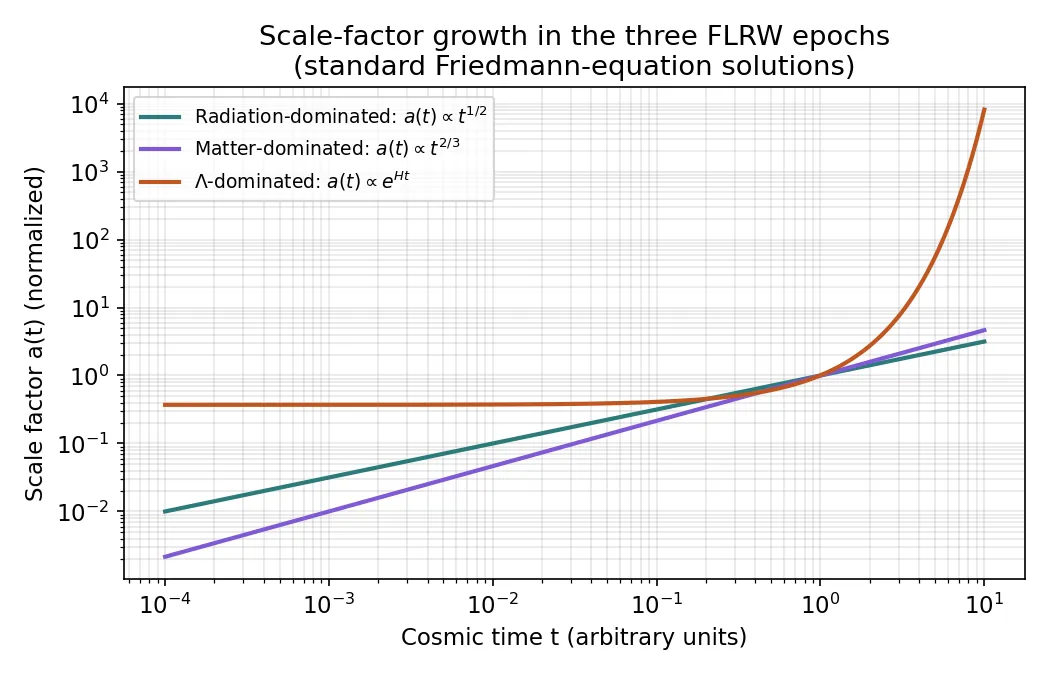
Figure 1. Scale-factor growth in each dominant epoch: a ∝ t¹⁄² (radiation), a ∝ t²⁄³ (matter), a ∝ e^{Ht} (Λ-domination) — standard solutions of the Friedmann equations for each equation of state.
3. Is General Relativity Itself Correct at Cosmic Scales?
The observed acceleration of cosmic expansion can be attributed either to an unknown energy component acting within standard GR, or to a breakdown of GR itself at the largest scales. Distinguishing between these possibilities has become its own precision-cosmology subfield. Ishak (2019), in a widely used Living Reviews synthesis, lays out the toolkit: cosmological probes sensitive to the growth of structure (redshift-space distortions, weak lensing, the integrated Sachs–Wolfe effect, cluster counts) are combined with parameterized, model-independent deviations from GR — for instance, an effective “gravitational slip” between the two metric potentials that GR predicts should be equal — to place data-driven bounds on departures from standard gravity.
The same review catalogues specific alternatives motivated by the acceleration and dark-matter puzzles — scalar-tensor gravity, f(R) gravity, and relativistic completions of Modified Newtonian Dynamics — along with the screening mechanisms that let such theories mimic GR in the Solar System while diverging from it cosmologically. A striking recent constraint noted by Ishak: the 2017 binary neutron star merger, by confirming gravitational waves travel at the speed of light to extraordinary precision, eliminated an entire class of previously viable modified-gravity dark energy models in a single stroke. Bull et al. (2016) complement this with a broader inventory of ΛCDM's open problems — the Hubble tension, the S₈ clustering-amplitude tension, small-scale structure anomalies — concluding that no single modification of GR, or of the matter sector, currently resolves all of them at once.
4. When Spacetime Itself Can Spin: Einstein–Cartan Cosmology
The derivation in Section 2 assumes a torsion-free connection, standard in general relativity. Einstein–Cartan theory drops that assumption, allowing torsion sourced by the intrinsic spin of matter alongside the usual curvature sourced by energy-momentum. Luz and Lemos (2023) work out the general 1+3 threading decomposition needed to handle any metric-compatible affine connection in four dimensions, then specialize to cosmological solutions with a spinning perfect fluid.
The result is subtle: the metric can still take FLRW form even with torsion present, but the Weyl curvature tensor — identically zero in ordinary FLRW spacetime — need not vanish once torsion is switched on. Luz and Lemos trace this back to a coupling between torsion and the Weyl tensor that, mathematically, forbids a closed (k = +1) spatial geometry altogether: spinning-matter Einstein–Cartan cosmologies can only be flat or open.
5. Beyond the Idealization: Inhomogeneous and Numerical Cosmology
Section 2's derivation assumes exact homogeneity, but the real Universe is homogeneous only in a statistical sense on very large scales, and strongly inhomogeneous at the scale of galaxies and clusters. Buchert and Räsänen (2012) ask whether this small-scale structure could “back-react” on the large-scale expansion in a way that mimics dark energy without requiring any new energy component. Spatially averaging the Einstein equations, they show the averaged system picks up extra source terms — a kinematical backreaction term and an averaged intrinsic curvature term — that are simply absent from the exact FLRW equations.
Whether this backreaction is actually large in the real Universe cannot be settled by averaging alone, which motivates direct numerical solution of the full, non-linear Einstein equations on genuinely inhomogeneous matter. Giblin, Mertens, and Starkman (2016) do exactly this, quantifying how much local expansion rates in a numerically simulated, statistically homogeneous but locally clumpy universe deviate from the FLRW prediction — a direct, non-perturbative check on how far Section 2's idealization can be trusted once real structure is present. More recent numerical-relativity codes push this further, coupling smoothed-particle hydrodynamics to full general relativity to follow density perturbations through shell-crossing and into the early stages of dark matter halo formation.
CONCLUSION
The reduction of ten coupled Einstein equations to two ordinary differential equations for a single scale factor, achieved simply by assuming cosmic homogeneity and isotropy, remains one of the most productive simplifications in theoretical physics: it underlies essentially every quantitative prediction of modern cosmology. Yet three active research fronts — model-independent tests of GR itself, Einstein–Cartan extensions incorporating intrinsic spin, and fully non-linear numerical treatments of realistic inhomogeneity — are each, in their own way, probing where this idealization might break down. As the next generation of surveys sharpens the data available on all three fronts, the question of whether standard general relativity, applied to a homogeneous background, remains an adequate description of the Universe at the largest scales should move from open conjecture to settled measurement.
REFERENCES

Khushal P. Rathod*, Mathematical Foundations Of Relativistic Cosmology, Int. J. Sci. R. Tech., 2026, 3 (7), 472-475. https://doi.org/10.5281/zenodo.21408273
 10.5281/zenodo.21408273