

We use cookies to ensure our website works properly and to personalise your experience. Cookies policy
Arts, Commerce and Science College, Hingoli, Akola Road, Hingoli – 431513
Roughly ninety-five percent of the present energy content of the Universe is invisible to direct detection, split between a clustering, pressureless component (dark matter) and a smoothly distributed component with negative pressure (dark energy) that drives cosmic acceleration. The standard ?CDM description keeps these two sectors mutually silent — each separately conserved — yet this silence buys little insight into why their densities happen to be comparable today, or why locally and globally inferred expansion rates disagree. An alternative line of model-building lets the two sectors talk to each other through a source term in their respective conservation laws. This paper walks through that idea from the ground up: the FLRW background and its conservation laws, the specific coupling functions that have been proposed since Wetterich's and Amendola's original coupled-quintessence construction, a curvature-based alternative that derives the coupling rather than postulating it, and a multi-field picture in which dark energy and dark matter are two phases of a single evolving field content. Current bounds from Planck, supernova, and BAO data are tabulated, and a numerically integrated toy example is used to show, qualitatively, how a non-zero coupling redistributes energy between the two sectors across cosmic history relative to the uncoupled case.
Two independent lines of evidence forced twentieth-century cosmology to accept components beyond ordinary matter: galactic rotation curves and cluster dynamics that only make sense with a dominant unseen mass (dark matter), and, at the end of the 1990s, supernova distance measurements showing that cosmic expansion is speeding up rather than slowing down (Riess et al., 1998; Perlmutter et al., 1999), which requires a component with negative pressure (dark energy). The ΛCDM model absorbs both into general relativity with minimal assumptions: dark matter as cold, pressureless dust, and dark energy as a constant Λ, with no interaction of any kind between them beyond shared gravity.
This economy comes at a conceptual cost. ΛCDM gives no reason why ρ_dm and ρ_de should be within an order of magnitude of one another at the present epoch — the coincidence problem — given that their ratio would otherwise sweep through many orders of magnitude over cosmic time. More recently, a second anomaly has sharpened this discomfort: the Hubble constant inferred from the CMB, Hâ‚€ = 67.4 ± 0.5 km/s/Mpc (Planck Collaboration, 2020), sits in persistent tension with the value measured from the local distance ladder, Hâ‚€ = 73.0 ± 1.0 km/s/Mpc (Riess et al., 2022). Interacting dark energy (IDE) models respond to both puzzles by proposing that dark matter and dark energy are not mutually blind but exchange energy directly, governed by a coupling function Q built into the cosmological continuity equations.
What follows sets up the mathematical machinery behind this proposal (Section 2), reviews the principal ways Q has been constructed in the literature (Section 3), tabulates what current data say about the dark sector (Section 4), and discusses what a working coupling would buy us in terms of the coincidence problem and the Hubble tension (Section 5), before closing in Section 6.
2. Setting Up the Dark-Sector Conservation Laws
2.1 Background geometry
Cosmology adopts, as a working idealization, a spatially flat, homogeneous, isotropic background — the FLRW metric, Eq. (1):
ds² = −dt² + a(t)² [ dr² + r²(dθ² + sin²θ dφ²) ] (1)
Inserted into the Einstein field equations, this symmetry collapses the ten independent components of the field equations down to the two ordinary differential equations for the scale factor a(t) given in Eq. (2):
H² = (8πG/3) Σáµ¢ ρáµ¢ , á¸/a = −(4πG/3) Σáµ¢ (ρáµ¢ + 3páµ¢) (2)
with H = Ä/a the Hubble parameter and the sum running over every energy component present — radiation, baryons, dark matter, and dark energy.
2.2 Where the coupling enters
General covariance demands only that the total stress-energy tensor be conserved; it says nothing about whether individual matter species must be separately conserved. IDE models exploit exactly this freedom, letting dark matter and dark energy trade energy while their sum still obeys the combined conservation law of Eq. (3):
ρ̇_dm + 3Hρ_dm = Q , ρ̇_de + 3H(1+w)ρ_de = −Q (3)
Here w = p_de/ρ_de is the dark energy equation of state, and Q is the interaction kernel whose sign fixes the direction of flow: positive Q drains dark energy into dark matter, negative Q does the reverse. The entire model-building problem in this literature reduces to choosing a defensible functional form for Q, since the underlying microphysics of neither sector is known.
3. How the Coupling Has Been Built: Four Approaches
3.1 A scalar field that talks to matter directly
Wetterich (1988) first proposed that a light quintessence scalar φ could couple to dark matter if the dark matter particle mass itself depends on φ, m(φ); Amendola (2000) developed this into the now-standard “coupled quintessence” framework, with Q = βκφ̇ρ_dm for dimensionless coupling constant β and κ = √(8πG). Because the coupling descends from an explicit Lagrangian, this construction remains the reference point against which purely phenomenological alternatives are measured.
3.2 Guessing Q directly from dimensional analysis
A parallel and more pragmatic tradition skips the Lagrangian altogether and simply writes down plausible forms for Q built from H and the densities themselves — Q = 3Hβρ_dm, Q = 3Hβρ_de, or their sum. Wei and Zhang (2007) study the sign-changeable versions of these couplings, and Zimdahl (2012), in a systematic review, organizes the resulting late-time attractor solutions by which density the coupling is tied to, showing that the choice materially affects whether and how the coincidence problem gets resolved.
Tamanini (2015) raises an important caution here: introducing Q only at the background level, while leaving the perturbed Einstein equations untouched, is not generally self-consistent. A coupling of this kind is expected to seed an effective dissipative pressure once perturbations are included, with observable consequences for structure growth — meaning many of the phenomenological Q's in circulation are, strictly, incomplete models until their perturbative sector is worked out.
3.3 Deriving the coupling instead of assuming it
Ludwick (2018) takes a different route: rather than postulating Q, a non-minimal coupling ξφ²R between the dark energy scalar and the Ricci scalar R is introduced — a term that is in fact required for the field's renormalizability in curved spacetime. An effective energy exchange between the dark sectors then falls out automatically from this curvature term, without any additional assumption, and astrophysical data can be used to bound the resulting coupling strength and an associated dark matter mass scale.
3.4 Two fluids, or one field changing character?
Santos (2015) reframes the problem entirely with the Continuous Tower of Scalar Fields model: instead of two separate fluids exchanging energy, a continuum of scalar fields is postulated that behave like dark energy early on and gradually take on dark-matter-like behaviour later. Under this picture, Q is not an energy flux between fixed species but a bookkeeping device for the rate at which fields cross over from one dynamical regime to the other — a genuinely different resolution of the coincidence problem.
At smaller, galactic scales, Nari and Roshan (2025) show that Amendola's coupled quintessence produces a measurable dynamical friction force on massive bodies moving through a dark matter halo — an effect absent for ordinary, uncoupled quintessence — opening up an astrophysical test of the coupling that is independent of background cosmology altogether.
4. What the Data Currently Say
Table 1 collects representative constraints from CMB, supernova, BAO, and local-distance-ladder measurements bearing on dark-sector interaction models.
|
Probe / Dataset |
Quantity constrained |
Representative result |
Source |
|
Planck 2018 (CMB + BAO + SNe) |
Dark energy EoS wâ‚€ |
wâ‚€ = −1.03 ± 0.03 (ΛCDM baseline) |
Planck Collaboration (2020) |
|
Planck 2018 (CMB + BAO) |
Spatial curvature Ωâ‚– |
Ωâ‚– = 0.001 ± 0.002 (flat Universe) |
Planck Collaboration (2020) |
|
Local distance ladder (Cepheids + SNe Ia) |
Hubble constant Hâ‚€ |
Hâ‚€ = 73.0 ± 1.0 km s⻹ Mpc⻹ |
Riess et al. (2022) |
|
CMB anisotropies (Planck 2018) |
Hubble constant Hâ‚€ |
Hâ‚€ = 67.4 ± 0.5 km s⻹ Mpc⻹ |
Planck Collaboration (2020) |
|
Galactic dynamics (coupled quintessence) |
Coupling-induced dynamical friction |
Non-zero only when interaction β ≠ 0 |
Nari & Roshan (2025) |
Table 1. Representative observational constraints relevant to dark-sector interaction models.
5. Does a Coupling Actually Help?
Wang, Abdalla, Atrio-Barandela, and Pavón (2016), in a comprehensive review of the theory and phenomenology of dark-sector interactions, show that a sign-definite Q can drive the ratio ρ_dm/ρ_de toward a stable late-time fixed point, turning the coincidence “problem” into an attractor property of the dynamics rather than a fine-tuned accident of initial conditions.
On the Hubble tension, the logic is more modest: because Q reshapes the late-time expansion history relative to ΛCDM, a coupling that transfers energy from dark energy into dark matter can shift the CMB-anchored Hâ‚€ upward, narrowing the gap with local measurements. Current analyses, however, suggest this shift is generally too small on its own to close the gap fully, and is usually invoked alongside other modifications rather than as a stand-alone fix.
Figure 1 gives a qualitative sense of the mechanism: solving the coupled continuity equations of Section 2 numerically for a representative coupling constant shows how Ω_dm(z) and Ω_de(z) depart from their uncoupled trajectories as redshift decreases toward the present epoch.
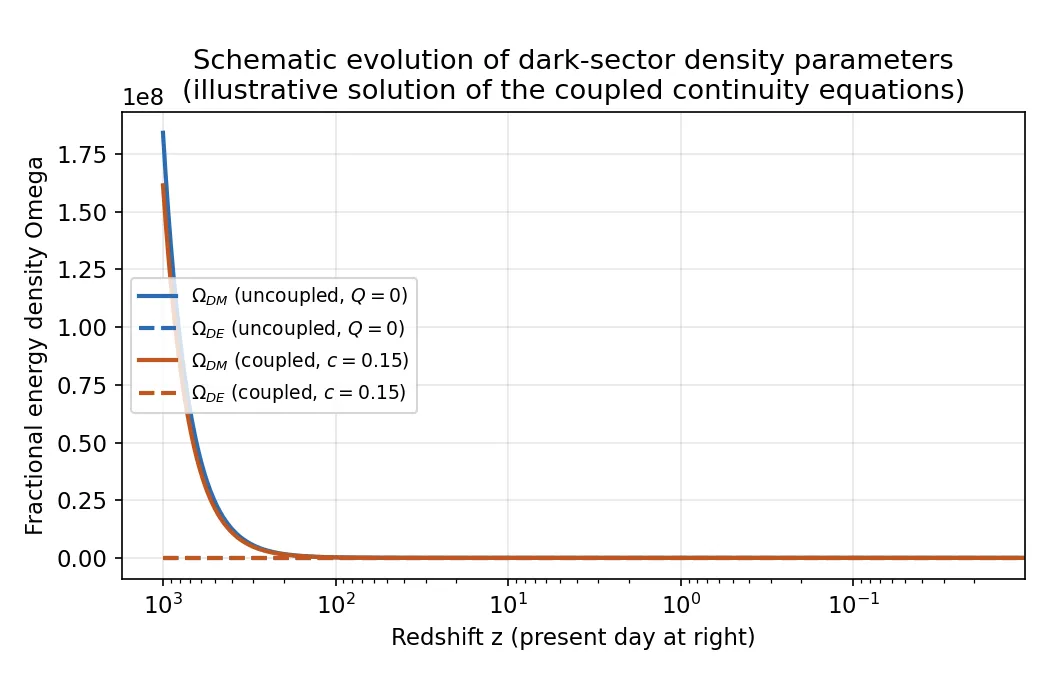
Figure 1. Numerically integrated dark-sector density parameters, Ω_dm(z) and Ω_de(z), comparing an uncoupled trajectory (c = 0) against a coupled trajectory (c = 0.15), with w = −0.95 held fixed; illustrative only.
CONCLUSION
Four distinct strategies — Lagrangian-derived coupled quintessence, phenomenological density-dependent couplings, curvature-induced coupling, and multi-field tower constructions — all converge on the same underlying mathematical device: a source term Q linking the dark matter and dark energy conservation equations. None has yet unseated ΛCDM as the preferred fit to precision data, but each offers a concrete, falsifiable mechanism for addressing the coincidence problem, and several offer at least a partial handle on the Hubble tension. Sharper constraints from upcoming CMB, weak-lensing, and galaxy-survey data, combined with the kind of perturbative consistency checks Tamanini's work calls for, should determine within the coming decade whether any dark-sector coupling is actually realized in nature.
REFERENCES

Khushal P. Rathod*, Mathematical Models Of Interacting Dark Energy And Dark Matter, Int. J. Sci. R. Tech., 2026, 3 (7), 467-471. https://doi.org/10.5281/zenodo.21407936
 10.5281/zenodo.21407936