

We use cookies to ensure our website works properly and to personalise your experience. Cookies policy
Department of Electrical and Electronics Engineering, K. Ramakrishnan College of Technology, Tiruchirappalli, Tamil Nadu.-621112
Continuous monitoring of bladder filling and urine output is an important part of nursing care for elderly, bedridden, post-operative and intensive-care patients, especially those who cannot feel or report that the bladder is full. In present practice, nursing staff inspect the urinary collection bag at intervals, and patients who cannot empty the bladder naturally depend on indwelling catheters, which are uncomfortable and are associated with catheter-associated urinary tract infection. Delayed emptying of the bag or the bladder can lead to overflow, over-distension, pain and further complications, while clinical ultrasound bladder scanners are costly and usually give only a spot reading. This paper presents the design of a low-cost embedded system that performs two related functions: detection of the fill level of a urinary collection bag using an IR or ultrasonic level sensor, and non-invasive detection of bladder fullness using an ultrasonic sensor (HC-SR04) held over the lower abdomen by a belt. Both units are built around an Arduino Uno microcontroller, which triggers the sensor, converts the echo time into distance, expresses the result as a percentage level and compares it with preset limits. The level is shown on a 16×2 LCD, a green, yellow and red LED set indicates Low, Medium and High status, and a buzzer sounds when the High threshold is crossed. An optional GSM, Wi-Fi or Bluetooth module forwards an SMS or app notification to the nurse or caretaker, so that the patient can be monitored remotely in real time. The response recorded over a 120-minute period shows the monitored bladder pressure rising steadily and the alert signal switching on when the preset threshold is crossed. The prototype emphasises simplicity, portability, low cost and ease of installation, and it forms a practical basis for monitoring in hospitals, care homes and home care. A medical-grade ultrasound transducer, per-patient calibration, wireless data logging and clinical validation are identified as the next steps.
The urinary bladder is a hollow muscular organ that stores the urine produced by the kidneys until it is passed out of the body. In a healthy adult, stretch receptors in the bladder wall signal the brain as the bladder fills, and this sensation of fullness prompts voiding. In many patients, however, this feedback is absent or unreliable. Patients with spinal cord injury, neurogenic bladder, stroke or dementia, patients who are sedated or recovering from anaesthesia, and bedridden elderly persons may be unable to sense or report that the bladder is full. Over-distension of the bladder can cause pain, urinary retention, back-pressure on the kidneys and urinary tract infection, so timely emptying is essential.
When the bladder cannot be emptied naturally, an indwelling urinary catheter drains the urine continuously into a collection bag. The bag has to be emptied before it becomes completely full; otherwise the drainage may be obstructed and the connection is put under strain. Nursing staff normally check the bag by eye at intervals, which is time-consuming and easy to miss in wards with a high patient-to-nurse ratio and in home care. Prolonged catheterisation is itself a recognised cause of catheter-associated urinary tract infection (CAUTI), and international guidelines stress limiting both the use and the duration of urinary catheters [1].
Ultrasound is the established non-invasive method for estimating bladder volume. The accuracy of portable ultrasound scanners in measuring residual urine volume has been studied [2], and wearable ultrasound monitors that follow the filling of the bladder continuously have been developed [3]–[5]. However, commercial scanners are costly, need a trained operator and generally give a spot reading, and recent reviews point out that wearable devices still need further development to improve their precision and to be validated in the patient groups that need them most [6], [7]. At the same time, low-cost microcontrollers and sensors now make it possible to build simple monitors for urine level [8]. Figure. 1 shows the overall block diagram of the proposed systems.
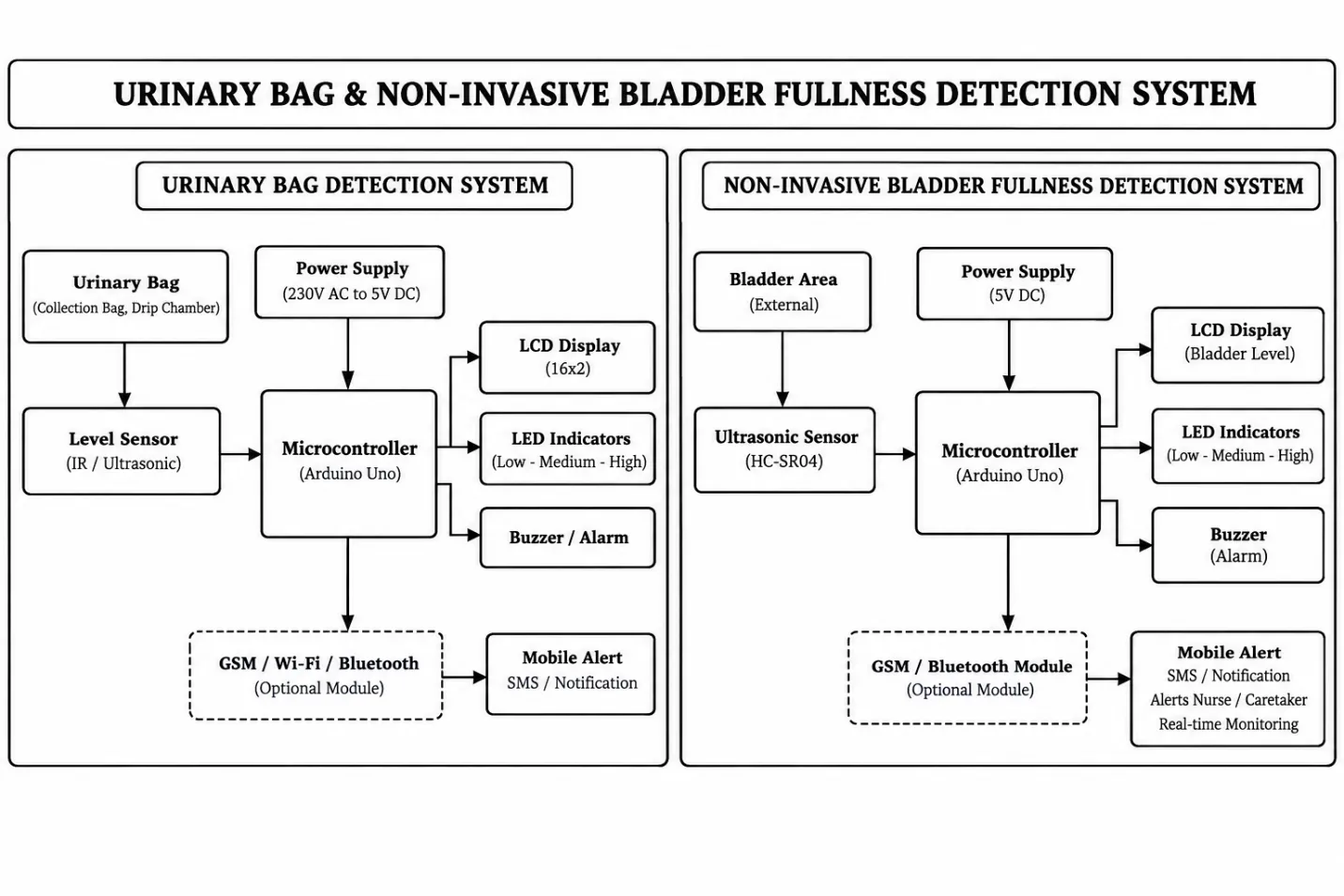
Figure 1: Overall Block Diagram of the Urinary Bag and Non-Invasive Bladder Fullness Detection Systems
The main purpose of the proposed system is to provide an affordable, compact and real-time prototype that warns the caretaker before the urinary bag overflows or the bladder becomes over-distended, without depending on bulky clinical equipment or on repeated visual checks by the nursing staff. The work consists of two complementary units that share one architecture. The Urinary Bag Detection System senses the urine level in the collection bag with an IR or ultrasonic level sensor. The Non-Invasive Bladder Fullness Detection System uses an HC-SR04 ultrasonic sensor, held in a belt over the lower abdomen, to follow the filling of the bladder from outside the body, so that no catheter or skin penetration is needed for this unit.
To give flexible delivery of the information, both units provide a local output and a remote output. A 16×2 LCD powered from a regulated 5 V supply shows the level as a percentage for quick assessment at the bedside, a green, yellow and red LED set indicates the Low, Medium and High ranges, and a buzzer gives an audible alarm when the High range is reached. An optional GSM, Wi-Fi or Bluetooth module sends an SMS or notification to the nurse or caretaker, which allows real-time monitoring from a distance. The design thus shows how an inexpensive microcontroller and ultrasonic or IR sensing can be combined into a practical aid for patient care, home monitoring and educational instrumentation.
There is therefore a need for a compact, low-cost monitor that measures the level automatically, gives immediate local feedback through a display, LEDs and a buzzer, notifies a remote caretaker, and, in the case of the bladder, avoids catheterisation by sensing from outside the body. This study describes the design of such a system around an Arduino Uno microcontroller. Medical-device certification, networking of many patients in a hospital and cloud analytics are beyond the scope of this prototype.
LITERATURE SURVEY:
Kristiansen et al. [3] have designed and evaluated an ultrasound-based bladder volume monitor that used seven phased-array transducers arranged in a circle and sent the data by Bluetooth to a laptop for signal processing and volume estimation. When it was tested on phantoms and on one volunteer, with magnetic resonance imaging as the reference, the monitor gave a mean absolute percentage error of 2.9% and a correlation of R² = 0.99. The work showed that continuous, wearable measurement of bladder volume with ultrasound is feasible. Coombes and Millard [2] investigated the accuracy of portable ultrasound scanners in the measurement of residual urine volume without catheterisation.
Nasrabadi et al. [6] have presented a comprehensive survey of non-invasive wearable bladder volume monitoring systems. The authors classified the methods according to their engineering and medical characteristics, analysed the measurement algorithms, and concluded that wearable devices offer practical benefits but need further development to overcome limits in precision. Hafid et al. [9] have carried out a scoping review of non-invasive technologies for bladder monitoring, concentrating on ultrasound, optical and bioimpedance methods, and also considered wearable devices and external collection systems for people with bladder dysfunction and incontinence.
More recently, Zhang et al. [4] have reported a conformable phased-array ultrasound patch in which multiple phased arrays are embedded in a stretchable substrate. In clinical testing the patch gave bladder volume estimates comparable to standard equipment, with relative errors of 3.2 ± 6.4% when gel was used and 10.8 ± 8.2% without gel, and it removed the need for manual probe handling. Toymus et al. [5] have developed a wearable ultrasonic patch that combines flexible transducers, miniaturised wireless electronics and a mobile application. In tests on healthy volunteers the device measured bladder volumes from 84 to 800 mL with a mean relative error of 11.17%.
Kim and Kim [7] have reviewed wearable ultrasound devices for continuous bladder monitoring in neurourology. They concluded that first-generation devices such as SENS-U show acceptable performance mainly in children with functional voiding dysfunction, with sensitivities of 85–90%, whereas performance in neurogenic bladder populations is a concern: one study with another device (DFree) reported only 46% accuracy and 13% specificity. The review therefore stresses that population-specific validation is needed before such devices can be relied on in patients who require safe catheterisation management.
On the urine-bag side, Hijazi et al. [8] have designed and compared low-cost urine level detection systems for critical patients. Their IoT-based system used an Arduino microcontroller with three sensing methods: a water-level sensor, an ultrasonic distance sensor and a weighing sensor. Each method was evaluated with 110 test recordings; the water-level sensor gave the best result, with 96% accuracy and 98% precision, followed by the weighing sensor with 93% accuracy. Hooton et al. [1] have prepared the international guidelines for the diagnosis, prevention and treatment of catheter-associated urinary tract infection in adults, which form the clinical background for limiting catheter use and for monitoring catheter drainage carefully.
From this survey it is clear that advanced wearable ultrasound patches reach good accuracy but depend on specialised transducers, electronics and clinical validation, whereas low-cost Arduino-based systems have so far concentrated on the urine level in the collection container [8]. The system proposed in this paper brings the two viewpoints together in one simple and inexpensive architecture: the same Arduino-based signal chain monitors the urine bag and, through an external ultrasonic sensor, follows the filling of the bladder, with local alarms and optional mobile alerts.
METHODOLOGY:
The proposed system is a low-cost embedded instrument for real-time sensing, processing, display and alerting of urinary fullness. It is made up of two units, the Urinary Bag Detection System and the Non-Invasive Bladder Fullness Detection System, and both follow the same signal chain: sensor, microcontroller and output devices, as shown in Fig. 1. The sensor measures a level or a distance, the Arduino Uno converts it into a percentage, and the result is shown on the LCD, signalled by the LEDs and the buzzer, and optionally transmitted by a communication module.
The power supply is the first stage of the system. The bag unit is mains-powered: a 230 V AC to 5 V DC adapter supplies the regulated 5 V needed by the electronics, whereas the wearable bladder unit is fed from a 5 V DC supply, which may be a USB adapter or a battery pack. This 5 V supply feeds the Arduino Uno, the sensor, the 16×2 LCD, the LEDs with their series resistors, the buzzer and the communication module.
The Arduino Uno is the central controller of both units. It is based on the ATmega328P microcontroller, works at 5 V and 16 MHz, and offers 14 digital input/output pins and six analog inputs with a 10-bit analog-to-digital converter [11]. It triggers the sensor, reads the echo or level signal, averages several readings to reduce noise, converts the result into a percentage, compares it with the preset limits, and drives the LCD, the LEDs, the buzzer and the communication module.
In the Urinary Bag Detection System, an IR emitter–receiver pair or an ultrasonic sensor is mounted on the collection bag or on its drip chamber. With the IR sensor, the receiver output changes when the urine level crosses the sensor position; with the ultrasonic sensor, the distance from the sensor to the urine surface is measured. The reading is mapped to a percentage of the bag capacity. Collection bags carry a graduated scale (for example from 100 to 2000 mL, as drawn in Fig. 2), and this scale is used to calibrate the percentage.
In the Non-Invasive Bladder Fullness Detection System, the HC-SR04 ultrasonic sensor is fixed in a belt on the lower abdomen over the bladder area, as shown in Fig. 2. The HC-SR04 contains an ultrasonic transmitter and a receiver that work at 40 kHz. A pulse of 10 µs on the trigger pin makes the module send a burst of ultrasound, and the echo pin then stays high for a time equal to the round-trip time of the reflected wave. At 5 V the module has a specified range from about 2 cm to 400 cm [10]. The Arduino calculates the distance from the echo time using
Distance (cm) = [Echo time (µs) × 0.0343] / 2 (1)
where 0.0343 cm/µs is the speed of sound in air at about 20 °C. As the bladder fills, it expands towards the sensor and the measured distance becomes shorter. If dempty and dfull are the reference distances recorded for the empty and the full bladder of a given patient, the fullness is obtained as
Level (%) = [(dempty − d) / (dempty − dfull)] × 100 (2)
Figure 2 shows system connection showing the external ultrasonic sensor over the bladder and the urinary bag
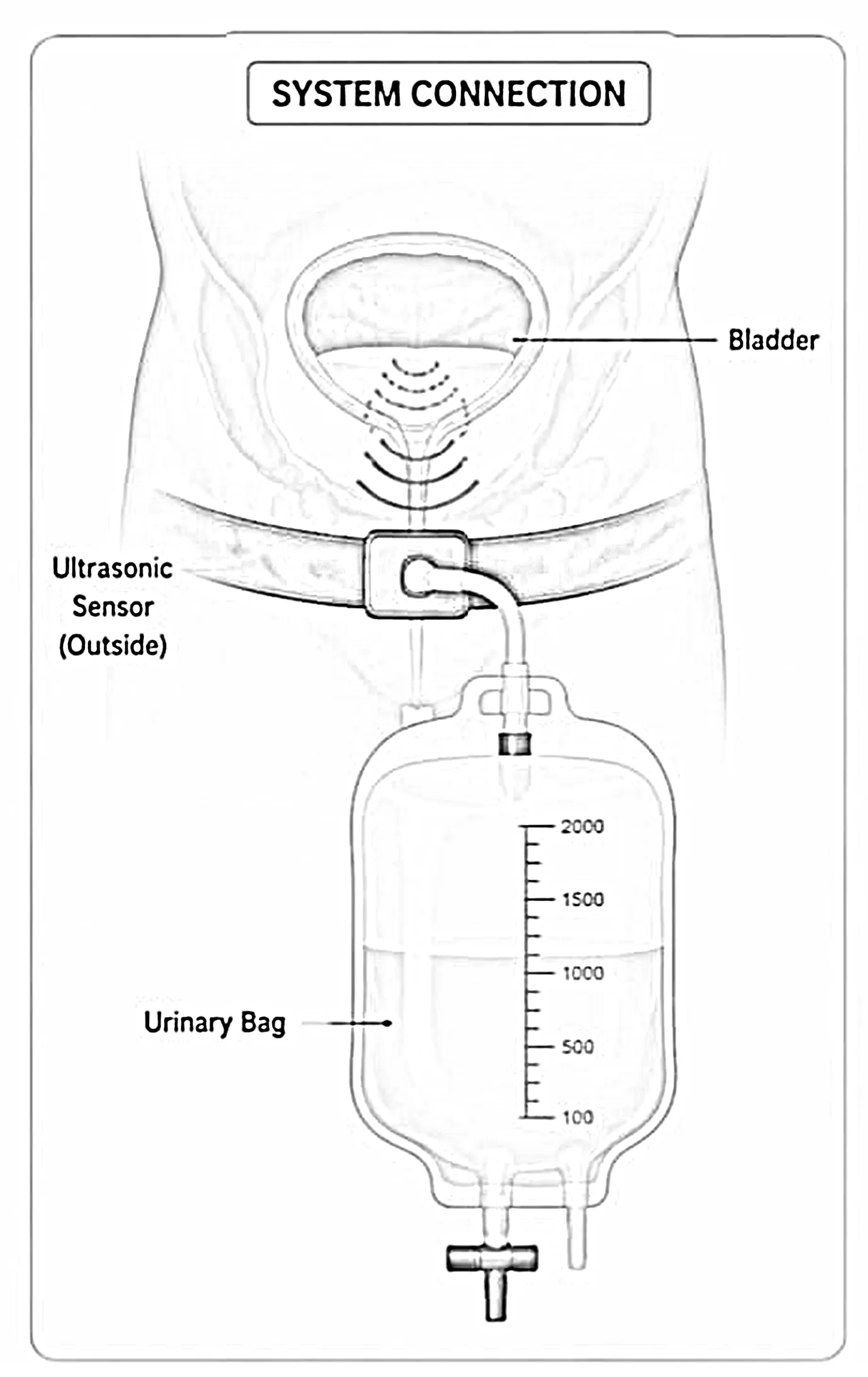
Figure 2: System Connection Showing the External Ultrasonic Sensor over the Bladder and the Urinary Bag
The calculated percentage is compared with the preset limits. In this prototype the Low range is taken as below 40%, the Medium range as 40–70% and the High range as above 70%; these values are examples and can be adjusted in the program. The LCD shows the level as a percentage, for example “URINE BAG LEVEL 75 %” or “BLADDER LEVEL 75 %”. The green LED glows in the Low range, the yellow LED in the Medium range and the red LED in the High range, and the buzzer is switched on when the High range is entered.
An optional communication module extends the alert to a mobile phone. A GSM or Wi-Fi module is used with the bag unit and a GSM or Bluetooth module with the wearable unit. When the High range is reached, the module sends an SMS or an app notification to the nurse or caretaker, so that the bag can be emptied or the patient can be assisted before overflow or over-distension occurs, and the level can also be followed in real time from a distance.
The program runs as a simple loop. At start-up the LCD, the LEDs, the buzzer and the communication module are initialised. The sensor is then triggered and the echo time or level signal is read; several readings are averaged; the distance and then the percentage level are calculated; the limits are compared; the LCD and the LEDs are updated; and, if the level is High, the buzzer is activated and the alert is sent. The loop then repeats. Table 1 compares the two units.
Table 1: Comparison of the Urinary Bag and Non-Invasive Bladder Fullness Detection Systems
| Parameter | Urinary Bag Detection System | Non-Invasive Bladder Fullness Detection System |
|---|---|---|
| Monitoring type | Invasive (bag-based) | Non-invasive (external) |
| Quantity sensed | Urine level (volume collected) in the bag | Bladder filling level |
| Sensor used | IR / ultrasonic (bag level) | Ultrasonic (HC-SR04) |
| Installation | On the urinary collection bag or drip chamber | On the lower abdomen over the bladder area |
| Application | Hospital / care homes | Home / elderly / ICU / bedridden patients |
| Mobile alert module | GSM / Wi-Fi (optional) | GSM / Bluetooth (optional) |
| Local outputs | 16×2 LCD, LEDs, buzzer | 16×2 LCD, LEDs, buzzer |
A practical point must be made about the bladder unit. The HC-SR04 is an air-coupled sensor that works at 40 kHz, so its echo comes from the first surface in front of it, which is the abdominal wall, and not from the bladder wall inside the body. The reading of the prototype therefore follows the combined change in the abdominal surface and the bladder, and it must be calibrated for each patient with the empty and full reference distances. Wearable monitors that image the bladder directly use ultrasound transducers in the megahertz range with an acoustic coupling medium [3]–[5]. For this reason the prototype is intended as an indicator of fullness and a demonstration of the complete signal chain, not as a measurement of volume, and it should be validated against a clinical bladder scanner before any clinical use.
RESULTS AND DISCUSSION:
The response of the monitoring system over a period of 120 minutes is shown in Fig. 3 and Fig. 4. Fig. 3 shows the monitored bladder pressure. It starts at about 4 cmHâ‚‚O and rises to about 7 cmHâ‚‚O in the first 20 minutes, with small fluctuations caused by sensor noise and patient movement, and stays close to this value up to about 40 minutes. It then rises more steeply to about 11–12 cmHâ‚‚O at 65 minutes, remains near 12 cmHâ‚‚O until about 90 minutes, and finally rises quickly to about 17 cmHâ‚‚O at 120 minutes. The threshold for the High range is set at 15 cmHâ‚‚O and is shown by the dashed line in Figure. 3.
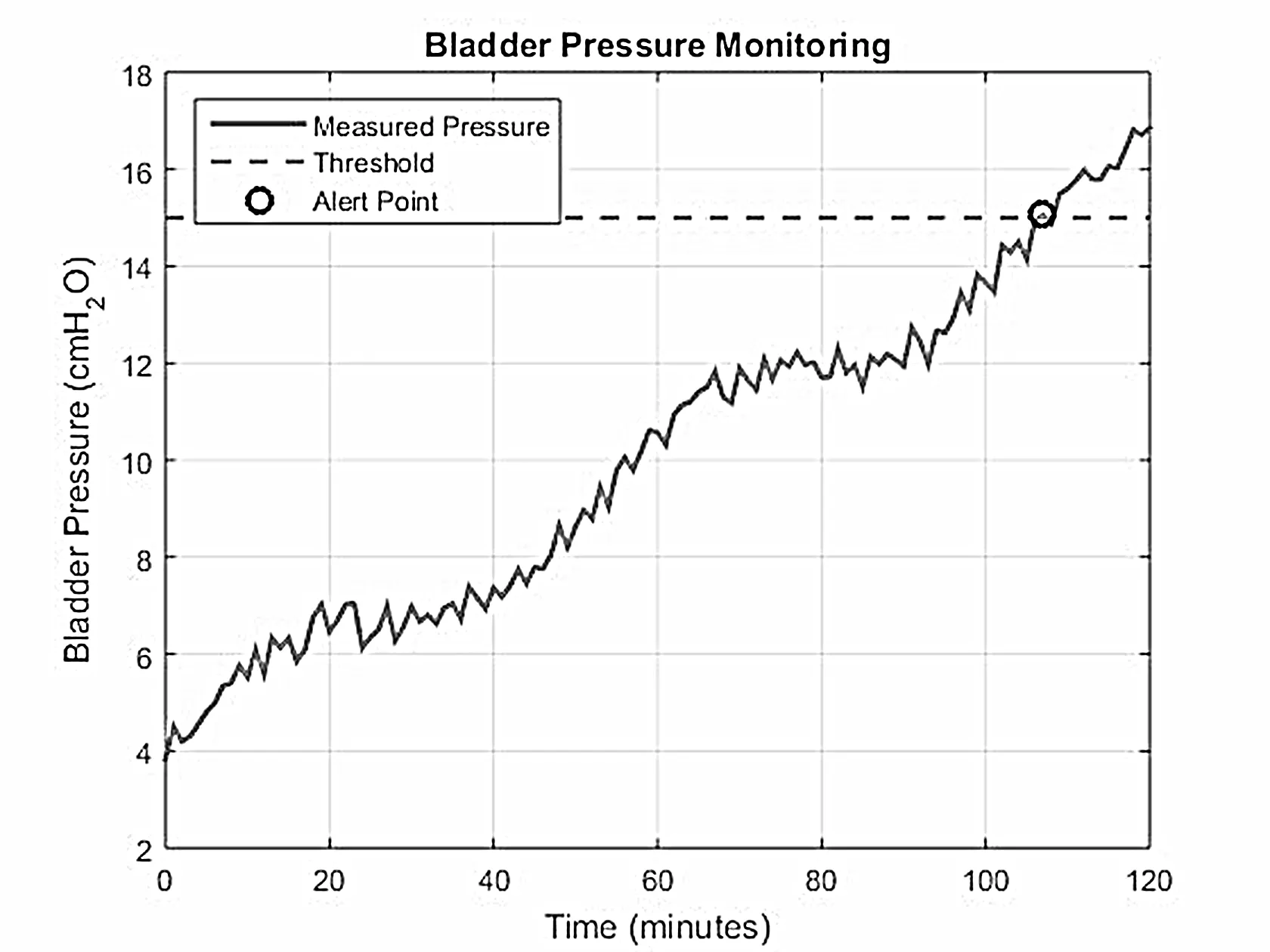
Figure 3: Bladder Pressure Monitoring
The measured pressure crosses the threshold at about 107 minutes, and this point is marked as the alert point in Fig. 3. The signal stays at 0, which means no alert, as long as the pressure is below the threshold, and it changes to 1, which means alert active, when the threshold is crossed. This change is what activates the red LED, the buzzer and the optional mobile notification. Figure. 4 shows the corresponding alert signal.
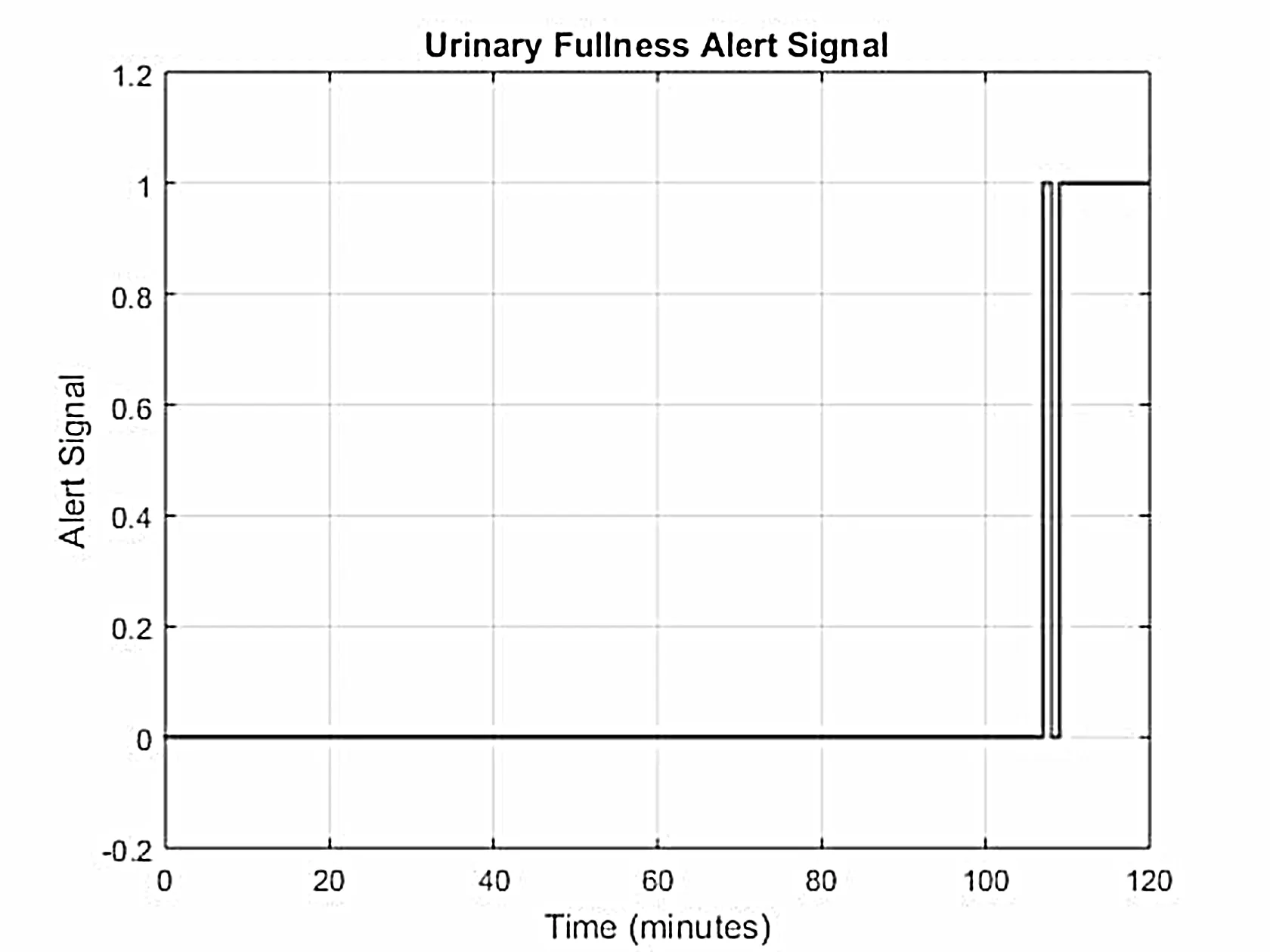
Figure 4: Urinary Fullness Alert Signal
A short on–off pulse can be seen in the alert signal between about 107 and 109 minutes before the signal settles at 1. It is caused by the noisy pressure signal moving up and down around the threshold. In the final system this chattering can be removed by averaging several readings, as already done in the program, or by adding hysteresis, which means using a slightly lower threshold for resetting the alarm than for setting it, so that the alarm does not switch repeatedly.
The results show that the system detects the rising level, raises the alarm at the moment the preset limit is crossed, and holds the alert on afterwards, which gives the caretaker time to act. In practice the same behaviour applies to both units: the bag unit raises the alarm as the bag approaches its capacity, and the bladder unit as the bladder approaches the fullness limit set for the patient. The prototype can be used for the monitoring of catheterised patients in hospital wards and intensive-care units, in care homes, and in the home care of elderly and bedridden patients; for patients with urinary retention or neurogenic bladder who cannot sense fullness, where it may reduce the need for repeated catheterisation; and for remote monitoring by caretakers through SMS or app alerts.
CONCLUSION:
A low-cost, Arduino-based system for urinary bag and non-invasive bladder fullness detection has been presented as a proof of concept. By combining an IR or ultrasonic sensor with a 16×2 LCD, LED indicators, a buzzer and an optional GSM, Wi-Fi or Bluetooth module, the system gives timely local and remote alerts, and the bladder unit does this without any invasive procedure. The response over 120 minutes showed that the alert is raised when the preset threshold is crossed. The prototype can reduce the workload of the nursing staff, avoid overflow of the bag and over-distension of the bladder, and improve patient comfort and hygiene, and it can be used in biomedical instrumentation teaching, in hospital and home-care monitoring, and in portable healthcare technology.
The present design has limits. The accuracy of the bladder unit depends on the placement of the sensor, on the thickness of the abdominal tissue, on body movement and on the calibration for each patient, and the air-coupled HC-SR04 does not image the bladder wall. Future work can therefore include a medical-grade ultrasound transducer with a coupling medium, temperature compensation of the speed of sound, hysteresis in the alarm logic, a rechargeable battery, data logging with a cloud dashboard, a mobile application for monitoring several patients, and clinical validation against a bladder scanner.
REFERENCES


Sanjaykumar R., Rajesh K., Arul Murugan V., Karthikeyan R., Non-Invasive Urinary Bladder and BAG Fullness Detection System, Int. J. Sci. R. Tech., 2026, 3 (10), 735-741. https://doi.org/10.5281/zenodo.23314819
 10.5281/zenodo.23314819