

We use cookies to ensure our website works properly and to personalise your experience. Cookies policy
The Maharaja Sayajirao University of Baroda Vadodara, 390001,India
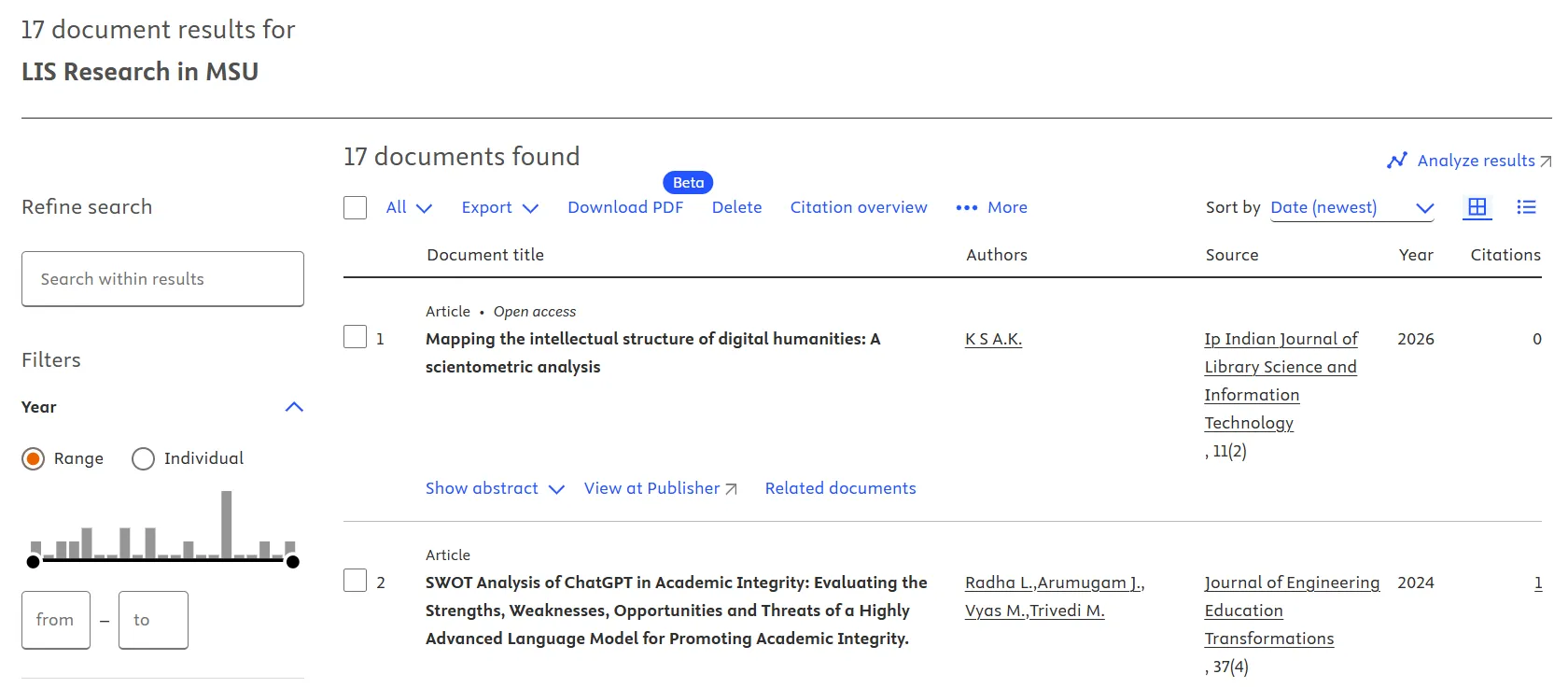
This study attempts to assess the research productivity of the Maharaja Sayajirao University of Baroda (MSU) in the field of Library and Information Science (LIS) through a Scientometric analysis of publications from 2006 to 2026. Scientometric analysis, as a quantitative method for evaluating scholarly communication, provides insights into growth trends, authorship patterns, and the dissemination of research output across journals. The Scopus database, maintained by Elsevier, was selected as the primary source of bibliographic data. A search was conducted using the keywords “Library and Information Science” within the subject affiliation “The Maharaja Sayajirao University of Baroda”. The search was restricted to English-language publications affiliated with India and published between 2006 and 2026. A total of 17 LIS-related research publications published in various library science journals indexed in Scopus were retrieved.
Library and Information Science examines how knowledge is created, shared, and used by scholars and readers. Within this field, Scientometrics is a discipline that studies publications to understand their structure and growth. Techniques such as Scientometrics, Informetrics, and Bibliometrics are applied to analyse both quantitative and qualitative aspects of scholarly output. These methods measure data on published articles over a given period and assess their impact through citation analysis. Scientometrics is the quantitative study of science, analysing research output such as publications and citations using mathematical & statistical methods to understand science's structure, growth, impact, and policies, essentially measuring and mapping scientific activity. It uses bibliometrics to evaluate researchers, institutions, and fields, revealing patterns in scientific communication and development.
According to Wikipedia, Scientometrics is a subfield of Informetrics that studies quantitative aspects of scholarly literature. Scientometrics is the study of measuring and analysing science, technology and innovation. Major research issues include measuring impact, reference sets of articles to investigate the impact of journals and institutes, understanding scientific citations, mapping scientific fields, and producing indicators for use in policy and management contexts. (https://en.wikipedia.org/ wiki/Scientometrics)
The term ‘Scientometrics’ was first coined in Russia by Vassily V. Nalimov in the 1960s. This term has grown in popularity and is used to describe the study of science: growth, structure, interrelationships and productivity. (Hood & Wilson, 2001). Scientometrics is a field that focuses on measuring and studying science, technology and innovation. This study presents research output, citation patterns, and the mapped relationships among documents, journals, and other channels of scholarly communication, with the Institution/research organisations contributing to scientific knowledge. Common research topics include assessing the impact of journals and organisations, analysing how and why researchers cite previous work, mapping the structure of different scientific disciplines, and developing indicators to support research policy, planning, and management decisions.
Scientometrics has strong similarities to fields such as Bibliography and information science, and often overlaps with them in research methods and applications. The rapid development in scientific research and the increasing number of publications have necessitated a more systematic analysis of research output driven by the industrialisation of science. The continued development of computer Technology has further strengthened the process by enabling faster and more accurate data analysis.
In the field of Library and Information Science, many quantitative approaches have been developed to understand and evaluate how knowledge and information are produced, distributed, and used. Over the years, the range of LIS metrics has grown, and the field has evolved from earlier measurement fields such as Librametrics (Rangnathan,1948), Bibliometrics (A. Pritchard, 1969), and Scientometrics to Infometrics (Otto Nacke, 1979), Webometrics (Almind & Ingwersen, 1997), Nettometrics and Cybermetrics (Björneborn& Ingewersen,2004), as well as new, broader fields in digitally focused studies.
The Maharaja Sayajirao University of Baroda (MSU) has an institutional H-index of around 134+, i10-index of 4146+ as reported on their own research profile, though this varies by database and time; overall research profiles on platforms like Scopus, SciSpace, Web of Science, etc. show thousands of authors with many publications, indicating significant research output and citation impact for the university's researchers, with high-level figures like the VC having much higher individual H-indices.(www.msubaroda.ac.in)
This paper conducted a deep analysis of library and information science articles indexed in the Scopus database from 2006 to 2026. The key term used for searches such as “Library Science”, “Information Science”, “Author”, “University Library”, “Virtual Library”, “Electronic Services”, affiliated city “Vadodara” and affiliated university of “ The Maharaja Sayajirao University of Baroda (MSU)” is used for data collection. As a result, 16 articles and 1 conference proceeding were published during the years. Each paper has been published at different times and by different authors, including Joint Authors.
OBJECTIVES OF THE STUDY:
METHODOLOGY:
Scopus and Web of Science are the two most widely used multidisciplinary bibliographic databases for conducting scientometrics analysis. The present study uses the Scopus database to retrieve data. The study used a scientometrics analysis, and the dataset comprises 17 LIS Publications indexed in the Scopus database (http://www.scopus.com). Statistical data downloaded from Scopus and the analytical report, as it is an accessible database and a trusted data source that the majority of researchers have used for Scientometrics studies and scientific research. It provides detailed information such as Year, Author, Source, Subject area, Author rank and types of documents. 17 publications were identified, including 16 articles and 1 conference proceeding paper. The process was completed on October 12th, 2026, and the accurate bibliographic details were also determined. The data were processed through a few steps. The entire dataset was downloaded from the Scopus database as CSV files and converted to MS Excel format for systematic statistical analysis. Each record is checked, examined and tabulated. Charts and graphs for identifying the publication growth. Various qualitative and quantitative indicators were used to analyse the research output, including Total number of Publications (TP), Total number of Citations (TC), Citations Per Paper (CPP), h-index, etc.
REVIEW OF RELATED LITERATURE:
This research examines the long-term growth and development of literature-based discovery (LBD) research. The study uses a scientometric and quantitative approach to analyse publications related to LBD from 1986 to 2020. The results show that 409 publications were identified, spanning three major phases of development: incubation, development, and maturity. The findings also indicate a shift from basic co-occurrence methods to advanced semantic, network-based, and machine-learning approaches, with strong applications in the biomedical domain. In conclusion, the study provides a quantitative overview of the productivity, evolution, and research trends of literature-based discovery. (Kastrin & Hristovski, 2021)
This study examines research trends on emerging contaminants and cancer during 2012–2021. The study uses a scientometric and quantitative approach to analyse publications retrieved from the Web of Science database. The results show that a total of 2,378 publications were produced, with research output increasing steadily over the years. The findings highlight that the United States and China were the most productive countries, and key research themes focused on endocrine-disrupting chemicals, exposure, and cancer risk. In conclusion, the study provides a quantitative overview of publication growth, major contributors, and research hotspots in the field of emerging contaminants and cancer. (Zheng et al., 2022)
The paper ‘A Scientometric Analysis of the Research Output of ICAR-Central Tobacco Research Institute’ examines the research output of the Indian Council of Agricultural Research–Central Tobacco Research Institute (ICAR-CTRI), Rajahmundry. The study uses a scientometric analysis and quantitative approach to analyse publications indexed in the Scopus database from 1951 to March 2025. The results show that a total of 1,632 research articles were published during the study period, with Japan emerging as the most productive contributing country. The findings indicate that Japan is the most prolific publishing country in this domain, followed by the USA and India. Japan's Central Pharmaceutical Research Institute emerged as the leading contributing institution, with 539 documents and 8,675 citations. The journal Agricultural and Biological Chemistry was identified as the most frequently used publication outlet with 431 articles, while The Lancet garnered the highest citation count, totaling 65,744 citations. Future research efforts should aim to bridge the gaps among various institutions under ICAR-CTRI to enhance collaborative outcomes. (Vadhavana& Patel, 2025)
Jayendra Kumar Singh (2014) studied the scientometric pattern of the Indian Journal of Pure and Applied Physics (2006 10). The study presents a Scientometric analysis of 657 papers published in the journal “Indian Journal of Pure and Applied Physics” from 2006 to 2010. The study focuses on various aspects of the journal, such as document types, growth of papers (year-wise), authorship pattern, institutions involved, citation analysis, most prolific authors of the journal, mean page length and number of references. The study also shows that most papers (93.46%) were co-authored, whereas 6.54% were authored by single authors. CSIR topped the institution list. The overall average citation per paper was 1.87, and the overall mean page length across all papers was 5.37. All the studies will be helpful for its further development.
A Scientometric analysis of 829 articles published in the “Indian Journal of Physics” was conducted by Nattar, S., from 2004 to 2008. In his study, he showed that the highest number of papers was co-authored, and that contributions to this journal from India are slightly higher than those from other foreign countries. The study examines the distribution of contributions, authorship patterns, the geographical distribution of contributions, and the number of pages used in each volume. The growth and popularity of this journal are increasing. (Nattar S.,2009)
Mooghali, A. et al. have used bibliographic records from the Social Science Citation Index, Science Citation Index, and Arts & Humanities Citation Index to provide a complete view of the evolution of the field of Scientometric based on literature published from 1980 to 2009. This is a descriptive survey using Scientometric indicators. Findings revealed that, out of 691 articles in the field of Scientometric, 183 (26.48%) were written between 1980 and 2009 by the top ten authors. Some of these articles were produced in collaboration with the authors, and others were by individual authors. Geographical analysis indicated that the field had evolved considerably in different regions of the world. The Hungarian Academy of Science, with 40 records (5.71%), was the most productive institution in the field of Scientometric. Furthermore, chronological analysis revealed that scientific output in the field of Scientometric increased slowly from 1980 to 2009. The overwhelming majority of documents were in English, and the International Journal of Scientometric was the most prolific journal in the field. It has also been declared that 67.87% of the literature was published in the area of Library and Information Science.
The study presents the growth and the contribution of research literature output on cloud computing. The data for the study were obtained from the Web of Science online database, published by the Institute for Scientific Information (ISI), covering 35 years, from 1980 to 2014. The study shows that there was a gradual growth of publications during 2007-2014. The average number of research outputs in cloud computing is 287 articles per year. Authors contributed (90.70 %) of the research articles. The Astronomy & Astrophysics Journal has the highest number of publications, with 372 papers. The USA is the country that contributed the most (2707 articles). Science Technology ranked first with 7128 publications, 129411 citations, and an h-index of 146. (Shipra Gupta & Parameswaran R, 2015).
DATA ANALYSIS AND RESULTS
The publication data were analyzed in line with the objectives framed by the researchers to ascertain the growth and impact of Library and Information Science articles published in the Scopus database at the Maharaja Sayajirao University of Baroda. The results of the analysis are presented in tables and charts as follows.
YEAR-WISE DISTRIBUTION OF LIS PUBLICATIONS
Table 1: Year- Wise Distribution of LIS Publications
| SR. No. | YEAR | Number of Publication | (%)of 17 |
|---|---|---|---|
| 1 | 2026 | 1 | 5.88 |
| 2 | 2024 | 1 | 5.88 |
| 3 | 2021 | 5 | 29.44 |
| 4 | 2018 | 1 | 5.88 |
| 5 | 2015 | 2 | 11.76 |
| 6 | 2013 | 2 | 11.76 |
| 7 | 2010 | 2 | 11.76 |
| 8 | 2009 | 1 | 5.88 |
| 9 | 2008 | 1 | 5.88 |
| 10 | 2006 | 1 | 5.88 |
| Total | Total | 17 | 100 |
[Figure - see the formatted PDF]
Figure 1: Year-wise Publication
Table 1 and Figure 1 reveal the year-wise distribution of publications considered in this study. A total of 17 publications were identified from 2006 to 2026. The highest research output was recorded in 2021, with 5 publications (29.44%), representing the most productive year and accounting for nearly one-third of the total publications. Single publications were published in 2006, 2008, 2009, 2018, 2024, and 2026, each contributing 5.88% of the total output. Moderate research productivity was observed in 2010, 2013, and 2015, with 2 publications (11.76%) in each year. After 2015, the publication trend declined to a single publication in 2018, then rose significantly in 2021. However, this increase was not sustained, with only one publication recorded in each of 2024 and 2026. Overall, the publication pattern demonstrates irregular research productivity, characterized by scattered contributions across most years and a notable peak in 2021. The findings suggest that scholarly output was concentrated in a few specific years rather than showing a consistent upward growth trend over time.
MOST PROLIFIC AUTHOR
Table 2: Author & Co-Author Wise Distribution
| Author Name | Affiliation | Number of Publication | Citation | H-Index |
|---|---|---|---|---|
| Trivedi, M. | The Maharaja Sayajirao University of Baroda | 10 | 66 | 3 |
| Rajaram, S. | The Maharaja Sayajirao University of Baroda | 3 | 5 | 1 |
| Chaudhary, A.S. | Sardar Patel University | 2 | 5 | 1 |
| Dash, R.N. | The Maharaja Sayajirao University of Baroda | 2 | 0 | 0 |
| Joshi, A. | Parul Institute of Medical Science & Research | 2 | 128 | 8 |
| Anilkumar, N. | Physical Research Laboratory | 1 | 25 | 3 |
| Arumugam, J. | PSG College of Technology | 1 | 7 | 2 |
| Bhatt, A. | Gujarat University | 1 | 165 | 7 |
| K S, A.K. | The Maharaja Sayajirao University of Baroda | 1 | 0 | 0 |
| Kamble, S. | The Maharaja Sayajirao University of Baroda | 1 | 1 | 1 |
| Patel, P.V. | Gujarat Technological Institute | 1 | 13 | 1 |
| Pradhan, S. | The Maharaja Sayajirao University of Baroda | 1 | 20 | 1 |
| Radha, L. | Thiagarajar College of Engineering, Madurai | 1 | 1 | 1 |
| Satish Kumar, H.T. | Defence Research and Development Organisation , New Delhi | 1 | 5 | 2 |
| Trivedi, D. | L&T Institute of Project Management, Vadodara, India | 1 | 92 | 5 |
| Vijayakumar, M. | Central University of Rajasthan, Ajmer, India | 1 | 51 | 4 |
| Vyas, M. | Navrachana University, Vadodara, India | 1 | 2 | 1 |
| Total | 31 | - | - | |
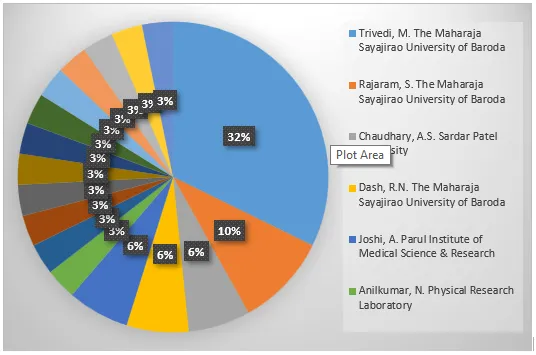
Figure 2: Growth of the Rate of Author Productivity
Table 2 and Figure 2 show the author productivity, citation count, and h-index of authors contributing to the selected publications. The table ranks authors according to their publication output, citation impact, and research influence. A total of 31 author contributions were identified across the 17 publications considered in this study. The table shows that Trivedi, M., is the most productive author, with 10 publications, followed by Rajaram, S., with 3. Chaudhary, A.S., Dash, R.N., and Joshi, A. have each contributed 2 publications. The remaining authors, namely Anilkumar, N., Arumugam, J., Bhatt, A., K S, A.K., Kamble, S., Patel, P.V., Pradhan, S., Radha, L., Satish Kumar, H.T., Trivedi, D., Vijayakumar, M., and Vyas, M., have each contributed one publication. In terms of citation impact, Bhatt, A. received the highest number of citations (165), followed by Joshi, A. (128) and Trivedi, D. (92). Trivedi, M., despite being the most prolific author, received 66 citations, while Vijayakumar, M., accumulated 51 citations. Several authors received relatively fewer citations, and Dash, R.N. and K S, A.K. recorded no citations during the study period.
The table also indicates that Joshi, A., possesses the highest h-index (8) among all authors, demonstrating substantial scholarly impact. This is followed by Bhatt, A., with an h-index of 7, Trivedi, D., with 5, and Vijayakumar, M., with 4. Trivedi, M. achieved an h-index of 3, while other authors recorded h-index values ranging from 0 to 2. Overall, the findings suggest that while Trivedi, M., is the most productive author in terms of publication count, Bhatt, A. and Joshi, A. have achieved greater research impact, as evidenced by higher citation counts and h-index values. This demonstrates that publication productivity and scholarly influence do not necessarily increase proportionately and may vary considerably among authors.
JOURNAL-WISE DISTRIBUTION
Table 3: Journal-wise Distribution
| SR.No. | Journal Name | No of Publications |
% of 17 | HOW TO CITE: Nirali U. Sevak, Mayank Trivedi, Ranjita Niladri Dash, Scientometric Mapping of Library and Information Science Research:, Int. J. Sci. R. Tech., 2026, 3 (11), 297-312. https://doi.org/10.5281/zenodo.23975231 |
|---|---|---|---|---|
| 1 | Library Philosophy and Practice | 8 | 47.05 | 0.4(2020) |
| 2 | DESIDOC Journal of Library and Information Technology | 2 | 11.78 | 1.8(2025) |
| 3 | Journal of Engineering Education Transformations | 1 | 5.88 | 2.0(2025) |
| 4 | Journal of Electronic Resources in Medical Libraries | 1 | 5.88 | 0.9(2025) |
| 5 | Digital Library Perspectives | 1 | 5.88 | 3.8(2025) |
| 6 | IEEE 5th International Symposium on Emerging Trends and Technologies in Libraries and Information Services, ETTLIS 2018 | 1 | 5.88 | - |
| 7 | IP Indian Journal of Library Science and Information Technology | 1 | 5.88 | 0.9(2025) |
| 8 | Serial Reviews | 1 | 5.88 | 1.3(2025) |
| 9 | Annals of Library and Information Studies | 1 | 5.88 | 0.8(2025) |
| Total | 17 | 100 |
[Figure - see the formatted PDF]
Figure: 3 Journals Description
AUTHORSHIP PATTERN AND DEGREE OF COLLABORATION IN LIS PUBLICATIONS
Table 4: Distribution of Authorship Pattern
| Sr.No. | Authorship | Number of Publications | % 17 | Author Count |
|---|---|---|---|---|
| 1 | One Author | 7 | 41.18 | 7*1=7 |
| 2 | Two Author | 7 | 41.18 | 7*2=14 |
| 3 | Three Author | 1 | 5.88 | 1*3=3 |
| 4 | Four Author | 2 | 11.76 | 2*4=8 |
| Total | Total | 17 | 100 | 32 |
| Average authorship per article | Average authorship per article | 1.88 |
The Average number of authors per article is:
=(Total nuber of authors)/(Total number of articles)
Average
Average authorship =(7+14+3+8)/17 = 32/17 = 1.88
[Figure - see the formatted PDF]
Figure 4: Collaborative Authorship
Table 4 and Figure 4 show the distribution of publications according to the number of authors involved in each article. A total of 17 publications were analysed, involving 32 author contributions. The findings reveal varying levels of collaboration among researchers, ranging from single-author to four-author publications. The table indicates that single-author and two-author publications are the most common forms of authorship, each accounting for 7 articles (41.18%). This highlights that both independent research and small-scale collaborative efforts play an equally significant role in the publication output. Together, these two categories constitute 82.36% of the total publications.
Larger collaborative works are comparatively less common. Three-author publications account for only 1 article (5.88%), while four-author publications represent 2 articles (11.76%) of the total output. The relatively low proportion of multi-authored papers suggests that extensive research collaborations are not a dominant feature of the publication pattern.
The total author count across all publications is 32, resulting in an average authorship of 1.88 authors per article. This means that, on average, each publication was produced by approximately two authors. Overall, the data indicate a balanced contribution of both individual and two-author collaborative research, with limited participation of larger research teams. The authorship pattern reflects a moderate level of collaboration, where small research partnerships are more prevalent than extensive multi-author collaborations.
LIST OF PUBLICATIONS CITED IN SCOPUS
Table 5: LIS Publications Indexed in the Scopus Database at MSU.
| Sr. No. | Author Name | Title | Year | Source | Citation |
|---|---|---|---|---|---|
| 1 | K S, A.K. | Mapping the intellectual structure of digital humanities: A scientometric analysis | 2026 | Ip Indian Journal of Library Science and Information Technology | 0 |
| 2 | Radha, L., Arumugam, J., Vyas, M., Trivedi, M. | SWOT Analysis of ChatGPT in Academic Integrity: Evaluating the Strengths, Weaknesses, Opportunities and Threats of a Highly Advanced Language Model for Promoting Academic Integrity. | 2024 | Journal of Engineering Education Transformations | 1 |
| 3 | Dash, R.N., Chaudhary, A.S. | Authorship Pattern and Growth of Scholar Contributions of the M S University of Baroda: Using Scopus Database | 2021 | Library Philosophy and Practice | 0 |
| 4 | Trivedi, D., Bhatt, A., Trivedi, M., Patel, P.V. | Assessment of e-service quality performance of university libraries | 2021 | Digital Library Perspectives | 13 |
| 5 | Kamble, S., Trivedi, M. | Evaluation of Electronic Reference Service for Online Resources: A Case Study of SVKM's NMIMS (Deemed to be University) | 2021 | Library Philosophy and Practice | 1 |
| 6 | Chaudhary, A.S., Dash, R.N. | A Systematic Study of Research Productivity of the Disciplines in Social Sciences and Humanities: The Maharaja Sayajirao University of Baroda. | 2021 | Library Philosophy and Practice | 0 |
| 7 | Vyas, D.M., Trivedi, D.M. | Scholarly Research Trends of State Universities of Gujarat: A bibliometric Study | 2021 | Library Philosophy and Practice | 0 |
| 8 | Vijayakumar, M., Satish Kumar, H.T., Trivedi, M. | A Study on Research Trends in Central Universities of India | 2018 | IEEE 5th International Symposium on Emerging Trends and Technologies in Libraries and Information Services Ettlis 2018 | 3 |
| 9 | Rajaram, S. | Principles for helpful sequence and their relevance in technical writings: A study | 2015 | Annals of Library and Information Studies | 1 |
| 10 | Pradhan, S. | Study of employability and needed skills for LIS graduates | 2015 | Desidoc Journal of Library and Information Technology | 20 |
| 11 | Rajaram, S. | FRBR and Ranganathan's colon book numbers: Exploring a symbiotic relationship | 2013 | Desidoc Journal of Library and Information Technology | 1 |
| 12 | Anilkumar, N., Rajaram, S. | Theses submitted by doctoral students of physical research laboratory, India | 2013 | Serials Review | 3 |
| 13 | Trivedi, M. | Digital libraries: Functionality, usability, and accessibility | 2010 | Library Philosophy and Practice | 33 |
| 14 | Trivedi, M. | Blogging for libraries and librarians | 2010 | Library Philosophy and Practice | 2 |
| 15 | Trivedi, M., Joshi, A. | Use of the internet among health care professionals in a rural medical College in India | 2009 | Journal of Electronic Resources in Medical Libraries | 1 |
| 16 | Trivedi, M., Joshi, A. | Computer and internet use by health care professionals in a rural medical college in India | 2008 | Library Philosophy and Practice | 11 |
| 17 | Trivedi, M. | Health science libraries in the 21st century | 2006 | Library Philosophy and Practice | 1 |
[Figure - see the formatted PDF]
Figure 5: Sum of Citations by Authors
Table 5 and Figure 5 present the list of publications, their authors, publication year, source title, and citation performance. The dataset comprises 17 publications from 2006 to 2026, reflecting two decades of scholarly contributions in Library and Information Science and related interdisciplinary areas. A close examination of the table shows that Trivedi, M., is the most prominent contributor, appearing either as a sole author or co-author in the majority of the publications. This demonstrates the author's central role in the research output and sustained contribution to the field over a long period. The publications cover a wide range of topics, including digital libraries, internet use, bibliometric studies, research productivity, service quality assessment, employability skills, and emerging technologies such as ChatGPT and Digital Humanities. Among all publications, “Digital Libraries: Functionality, Usability, and Accessibility” (2010) by Trivedi, M., is the most highly cited paper, receiving 33 citations. Another influential contribution is “Study of Employability and Needed Skills for LIS Graduates” (2015) by Pradhan, S., which has attracted 20 citations. The paper “Assessment of E-service Quality Performance of University Libraries” (2021) by Trivedi, D., Bhatt, A., Trivedi, M., and Patel, P.V. has received 13 citations, indicating considerable scholarly impact. Similarly, “Computer and Internet Use by Health Care Professionals in a Rural Medical College in India” (2008) has gained 11 citations, reflecting its continued relevance. Several publications have received moderate citation attention, such as “A Study on Research Trends in Central Universities of India” (2018) and “Theses Submitted by Doctoral Students of Physical Research Laboratory, India” (2013) with 3 citations each, while a number of recent publications published in 2021, 2024, and 2026 have received few or no citations so far. This comparatively low citation count may be attributed to their recent publication dates and the shorter time available for citations to accumulate. The publication sources are led by Library Philosophy and Practice, which hosts the majority of the articles, followed by journals such as DESIDOC Journal of Library and Information Technology, Digital Library Perspectives, Annals of Library and Information Studies, and Journal of Electronic Resources in Medical Libraries. The inclusion of conference proceedings and interdisciplinary journals further illustrates the research's diverse dissemination patterns. Overall, the table reflects a combination of single-author and collaborative research efforts, with a strong emphasis on bibliometric studies, digital libraries, scholarly communication, information technology, and research evaluation. The findings highlight the significant contributions of Trivedi, M., and collaborators to the advancement of Library and Information Science research, with a few highly cited publications playing a particularly influential role in shaping scholarly discussions within the field.
RANKING OF AUTHORS
Table 6: Ranking of Authors’ Productivity
| Sr. No. | Name of the Author | Number of Articles Published | Rank |
|---|---|---|---|
| 1 | Trivedi, M. | 10 | 1 |
| 2 | Chaudhary, A.S. | 2 | 2 |
| 3 | Dash, R.N. | 2 | 2 |
| 4 | Joshi, A. | 2 | 2 |
| 5 | Arumugam, J. | 1 | 3 |
| 6 | Bhatt, A. | 1 | 3 |
| 7 | Kamble, S. | 1 | 3 |
| 8 | Patel, P.V. | 1 | 3 |
| 9 | Pradhan, S. | 1 | 3 |
| 10 | Radha, L. | 1 | 3 |
| 11 | Rajaram, S. | 1 | 3 |
| 12 | Satish Kumar, H.T. | 1 | 3 |
| 13 | Trivedi, D. | 1 | 3 |
| 15 | Vijayakumar, M. | 1 | 3 |
| 17 | Vyas, M. | 1 | 3 |
[Figure - see the formatted PDF]
Figure 6: Author Productivity by Number of Publications
Table 6 and Figure 6 present the rankings of authors by publication productivity. The distribution of contributions reveals a highly uneven pattern, with a small number of authors accounting for a substantial share of the research output. Among all contributors, Trivedi, M., stands out as the most productive author, with 10 publications and a first-place ranking. This indicates a dominant role in the publication output and highlights a sustained research contribution over the years. The considerable gap between the first-ranked author and the remaining contributors demonstrates this author’s central influence on the study dataset. Rajaram, S. occupies the second rank with 3 publications, making a notable but substantially smaller contribution compared to Trivedi, M. A third group of moderately productive authors includes Chaudhary, A.S., Dash, R.N., and Joshi, A., each with 2 publications, sharing the third rank. Together, these authors form a middle tier of contributors who have consistently participated in research activities. The remaining 12 authors, namely Anilkumar, N., Arumugam, J., Bhatt, A., K S, A.K., Kamble, S., Patel, P.V., Pradhan, S., Radha, L., Satish Kumar, H.T., Trivedi, D., Vijayakumar, M., and Vyas, M., have each contributed one publication and are placed at the fourth rank. While their individual contributions are limited, collectively they represent a broad base of participation in the research output. Overall, the ranking pattern highlights a highly concentrated authorship structure, where Trivedi, M. serves as the principal contributor, supported by a small group of moderately productive authors and a larger number of occasional contributors. This distribution suggests that the research output is largely driven by a few key researchers, while many authors participate on a limited basis.
TYPES OF PUBLICATIONS:
Table 7: Types of Sources in Which the Researchers Prefer to Publish
| Sr. No. | Name of the Documents | No. of Publications | % of 17 |
|---|---|---|---|
| 1 | Articles | 16 | 94.12 |
| 2 | Conference Proceedings | 1 | 5.88 |
| Total | Total | 17 | 100 |
[Figure - see the formatted PDF]
Figure 7: Types of Sources
Table 7 and Figure 7 reveal that articles were the preferred mode of publication, accounting for 16 out of 17 publications (94.12%). In comparison, only one publication (5.88%) appeared as a conference proceeding, highlighting the dominance of journal articles in the overall research output.
SUBJECT AREA
Table: 8 Documents by Subject
| SUBJECT AREA | Documents | % of 30 |
|---|---|---|
| Social Sciences | 17 | 56.67 |
| Arts and Humanities | 8 | 26.67 |
| Computer Science | 3 | 10 |
| Decision Sciences | 1 | 3.33 |
| Engineering | 1 | 3.33 |
| Total | 30 | 100 |
[Figure - see the formatted PDF]
Figure: 8 Subject Wise Distribution
Table 8 and Figure 8 show the distribution of publications across different subject areas. A total of 30 subject classifications were identified from the 17 publications, reflecting the multidisciplinary nature of the research output. The data reveal that the social sciences account for the largest share, with 17 documents (56.67%) of the total subject classifications. This indicates that more than half of the publications are concentrated within the Social Sciences domain, highlighting its dominant position in the research profile. Arts and Humanities follow with 8 documents (26.67%), demonstrating a substantial contribution and representing more than one-quarter of the total classifications. In contrast, Computer Science contributes 3 documents (10%), indicating a moderate presence within the overall publication output. Decision Sciences and Engineering are minimally represented, with 1 document each (3.33% of the total). Their limited contribution suggests that technical and management-oriented research areas have received comparatively less attention. Overall, the distribution highlights a strong emphasis on Social Sciences and Arts and Humanities, which together account for 83.34% of all subject classifications. The findings suggest that the research output is predominantly focused on traditional Library and Information Science and humanities-related themes, while technical disciplines such as Computer Science, Decision Sciences, and Engineering have a comparatively limited presence.
FINDINGS AND CONCLUSIONS
FINDINGS
The present scientometric study analysed 17 Library and Information Science (LIS) publications affiliated with The Maharaja Sayajirao University of Baroda and indexed in Scopus. The major findings of the study are as follows:
CONCLUSION
This scientometric study systematically examined the publication patterns, authorship characteristics, citation impact, and research productivity of Library and Information Science publications associated with The Maharaja Sayajirao University of Baroda as indexed in the Scopus database. The findings reveal that LIS research output from the university remains modest in quantity but demonstrates meaningful academic contributions through publications in recognised national and international journals.
The study highlights a gradual shift from individual research toward collaborative authorship, reflecting the increasing importance of teamwork and interdisciplinary approaches in scholarly communication. The dominance of journals such as Library Philosophy and Practice, DESIDOC Journal of Library and Information Technology, Digital Library Perspectives, and other reputed LIS journals indicates a strong preference for disseminating research through established scholarly platforms.
The contribution of Trivedi, M., as the most productive author, along with the significant citation impact of authors such as Bhatt, A., Joshi, A., and Trivedi, D., demonstrates that both productivity and research influence have contributed to the visibility of LIS scholarship from the university. Furthermore, the emergence of contemporary topics such as Artificial Intelligence, ChatGPT, Digital Humanities, Digital Libraries, and Research Analytics suggests that researchers are aligning their work with current technological and academic developments.
Overall, the study confirms that Library and Information Science research at The Maharaja Sayajirao University of Baroda has established a meaningful presence in the scholarly landscape. As the discipline continues to evolve through advances in Artificial Intelligence, digital technologies, data analytics, and open knowledge systems, greater opportunities for collaborative and interdisciplinary research are expected. As one of India's prestigious universities, The Maharaja Sayajirao University of Baroda is well-positioned to enhance its research productivity, strengthen national and international collaborations, and make greater contributions to the advancement of Library and Information Science in the future.
REFERENCES

Nirali U. Sevak, Mayank Trivedi, Ranjita Niladri Dash, Scientometric Mapping of Library and Information Science Research:, Int. J. Sci. R. Tech., 2026, 3 (11), 297-312. https://doi.org/10.5281/zenodo.23975231
 10.5281/zenodo.23975231