

We use cookies to ensure our website works properly and to personalise your experience. Cookies policy
Krishnarao Bhegade Institute of Pharmaceutical Education and Research, Talegaon Dabhade, Maharashtra, India.
Stimuli-responsive drug delivery systems (SRDDS) represent an innovative approach to overcome the limitations of conventional drug delivery methods. These systems are designed to release therapeutic agents in response to specific internal or external stimuli, enabling targeted and controlled drug delivery. Internal stimuli such as pH, enzymes, redox potential, and glucose concentration, as well as external stimuli including temperature, light, ultrasound, magnetic fields, electrical signals, and mechanical forces, can trigger drug release. By exploiting the unique physiological conditions of diseased tissues, SRDDS enhance therapeutic efficacy while minimizing systemic toxicity and adverse effects. Recent advances in nanotechnology and biomaterials have accelerated the development of smart polymers, hydrogels, nanoparticles, liposomes, and micelles for stimuli-responsive applications. These systems have demonstrated significant potential in cancer chemotherapy, inflammatory diseases, arthritis, Alzheimer's disease, cardiovascular disorders, diabetes, and tissue engineering. Despite remarkable progress, challenges related to biocompatibility, manufacturing complexity, scalability, and regulatory approval remain. This review discusses the mechanisms, classification, recent developments, therapeutic applications, limitations, and future prospects of stimuli-responsive drug delivery systems.
Conventional drug delivery systems often suffer from several limitations, including poor bioavailability, lack of site specificity, rapid drug degradation, and undesirable side effects. To overcome these challenges, advanced drug delivery approaches have been developed to improve therapeutic efficacy and patient compliance.[1] Among these approaches, stimuli-responsive drug delivery systems (SRDDS), also known as smart drug delivery systems, have emerged as a promising strategy for achieving controlled and targeted drug release.Stimuli-responsive drug delivery systems are designed to respond to specific internal or external stimuli, triggering the release of therapeutic agents at the desired site and time.[2] Internal stimuli include changes in pH, enzyme concentration, redox potential, and glucose levels, whereas external stimuli involve temperature, light, ultrasound, magnetic fields, electrical signals, and mechanical forces. These systems utilize smart polymers, hydrogels, nanoparticles, liposomes, micelles, and other advanced materials capable of undergoing physical or chemical changes in response to environmental variations.[3]
The principle behind SRDDS is based on the unique physiological conditions associated with diseased tissues. For example, tumor tissues exhibit acidic pH, elevated temperature, altered enzyme expression, and abnormal redox conditions compared to healthy tissues. Exploiting these differences allows selective drug release at the target site, thereby enhancing therapeutic effectiveness while minimizing systemic toxicity.[4] Similarly, externally applied stimuli can provide precise spatial and temporal control over drug release, making these systems highly suitable for personalized medicine.Recent advances in nanotechnology, biomaterials science, and pharmaceutical engineering have significantly expanded the applications of stimuli-responsive drug delivery systems.[5] These systems have shown remarkable potential in the treatment of cancer, inflammatory disorders, arthritis, cardiovascular diseases, diabetes, and neurodegenerative disorders such as Alzheimer's disease. Furthermore, their integration with tissue engineering and regenerative medicine has opened new avenues for the development of intelligent therapeutic platforms.[6]
Despite their considerable advantages, challenges related to biocompatibility, scalability, manufacturing complexity, and regulatory approval remain significant obstacles to their widespread clinical implementation.[7] Ongoing research is focused on developing safer, more efficient, and multifunctional delivery systems capable of responding to multiple stimuli simultaneously.[8]This review aims to provide a comprehensive overview of the mechanisms, classification, recent advancements, and therapeutic applications of stimuli-responsive drug delivery systems, while also discussing their limitations and future prospects in modern healthcare
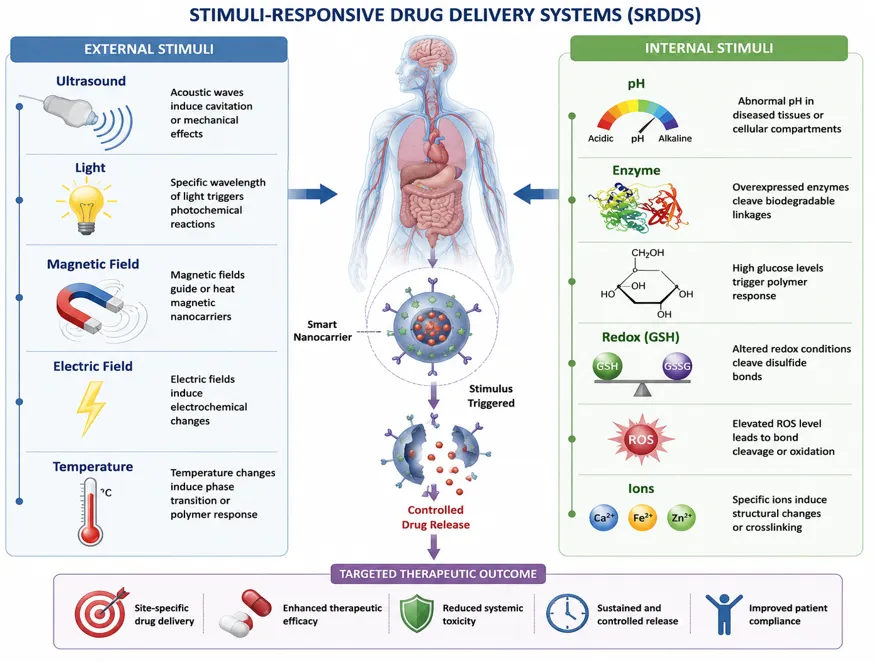
Fig no 1: stimuli-responsive drug delivery systems (SRDDS)
Historical background and its development
The development of drug delivery systems with stimulus-responsive capabilities began in the 1950s through the creation of implantable silicone rubber capsules used for sustained drug release during 1964 [9]. Researchers achieved a fundamental change in the 1970’s through their discovery of controlled macromolecule release from polymeric materials [10]. Acid-sensitive linkages entered the pharmaceutical field through polymer-drug conjugate research during the 1980’s [11].Scientists added temperature-sensitive models to their research by creating poly (N-isopropyl acrylamide) (PNIPAm) hydrogels that had reversible phase characteristics during the 1990s [12]. In the early parts of 2000, scientists achieved advancements in enzyme-responsive and redox-responsive systems [13]. The field of light-responsive materials became significant after photodegradable polymer research began .During the mid-2000’s, scientists developed pH and temperature dual-responsive hydrogels, which represented multi-stimuli responsive systems [14]. Superparamagnetic nanoparticles spurred significant advancement in magnetically triggered delivery systems when they were used for on-demand drug release during 2008 [15]. The 2010s brought rapid growth to commercial translation as ThermoDox® (Temperature-sensitive liposomal Doxorubicin) started its clinical trials.Smart insulin delivery systems that monitor glucose dynamics entered recent healthcare practice [16]. Pharmaceutical nanotechnology researchers develop dual-mechanism advanced delivery systems to precisely focus on biological environments through biomimetic designs that enable accurate delivery methods. The clinical translation process expanded rapidly during the 2010’s when ThermoDox® entered Phase III trials in 2011, and recent technological developments from 2020 to 2024.[17]
Classification of Stimuli-Responsive Drug Delivery Systems [18,19,20]
|
Category |
Subtype |
Mechanism of Drug Release |
Major Applications |
|
Internal Stimuli-Responsive Systems |
pH-Responsive Drug Delivery Systems |
Protonation/deprotonation of polymers, polymer swelling or degradation, drug release triggered by pH changes |
Cancer chemotherapy, oral drug delivery, inflammatory diseases |
|
Enzyme-Responsive Drug Delivery Systems |
Enzyme-mediated cleavage of polymeric carriers, degradation of enzyme-sensitive linkages |
Cancer treatment, inflammatory diseases, tissue regeneration |
|
|
Redox-Responsive Drug Delivery Systems |
Cleavage of disulfide bonds in response to intracellular redox conditions, release of encapsulated drugs |
Intracellular drug delivery, gene therapy, anticancer treatment |
|
|
Glucose-Responsive Drug Delivery Systems |
Glucose oxidase-mediated reactions, polymer swelling in response to glucose concentration |
Diabetes management, insulin delivery |
|
|
External Stimuli-Responsive Systems |
Temperature-Responsive Drug Delivery Systems |
Phase transition above critical temperature, polymer shrinkage or swelling |
Cancer hyperthermia therapy, localized drug delivery |
|
Light-Responsive Drug Delivery Systems |
Photoisomerization, photocleavage, photothermal effects |
Cancer therapy, ophthalmic drug delivery |
|
|
Magnetic-Responsive Drug Delivery Systems |
Magnetic targeting, magnetically induced heating |
Tumor targeting, magnetic hyperthermia |
|
|
Ultrasound-Responsive Drug Delivery Systems |
Cavitation effects, enhanced membrane permeability |
Targeted chemotherapy, gene delivery |
|
|
Electrical-Responsive Drug Delivery Systems |
Electrochemical changes, polymer expansion and contraction |
Implantable devices, neurological treatments |
|
|
Mechanical-Responsive Drug Delivery Systems |
Compression-induced release, stretch-responsive polymers |
Orthopedic implants, tissue engineering |
Table no. 1: Classification of stimuli-responsive drug delivery systems based on internal and external stimuli, their mechanisms of drug release, and therapeutic applications.
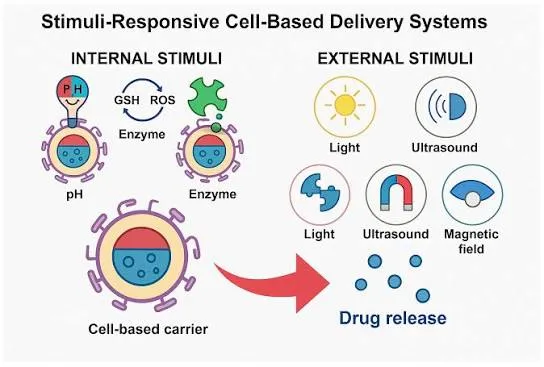
Fig no 2 : Classification of Stimuli-Responsive Drug Delivery Systems
Mechanisms of Stimuli-Triggered Drug Release
Drug release from Stimuli-Responsive Drug Delivery Systems (SRDDS) occurs through various mechanisms in response to specific internal or external triggers. The major mechanisms are the following:
|
Mechanism |
Description |
|
Polymer Swelling |
Stimulus-induced swelling enhances drug diffusion and release. |
|
Polymer Degradation |
Breakdown of polymer matrix releases encapsulated drugs. |
|
Cleavage of Chemical Bonds |
Stimulus-sensitive bonds break, triggering drug release. |
|
Phase Transition |
Structural changes in polymers promote drug release. |
|
Nanocarrier Disassembly |
Nanoparticles disintegrate under specific stimuli, releasing drugs. |
Table no 2 : Mechanisms of Stimuli-Triggered Drug Release[26]
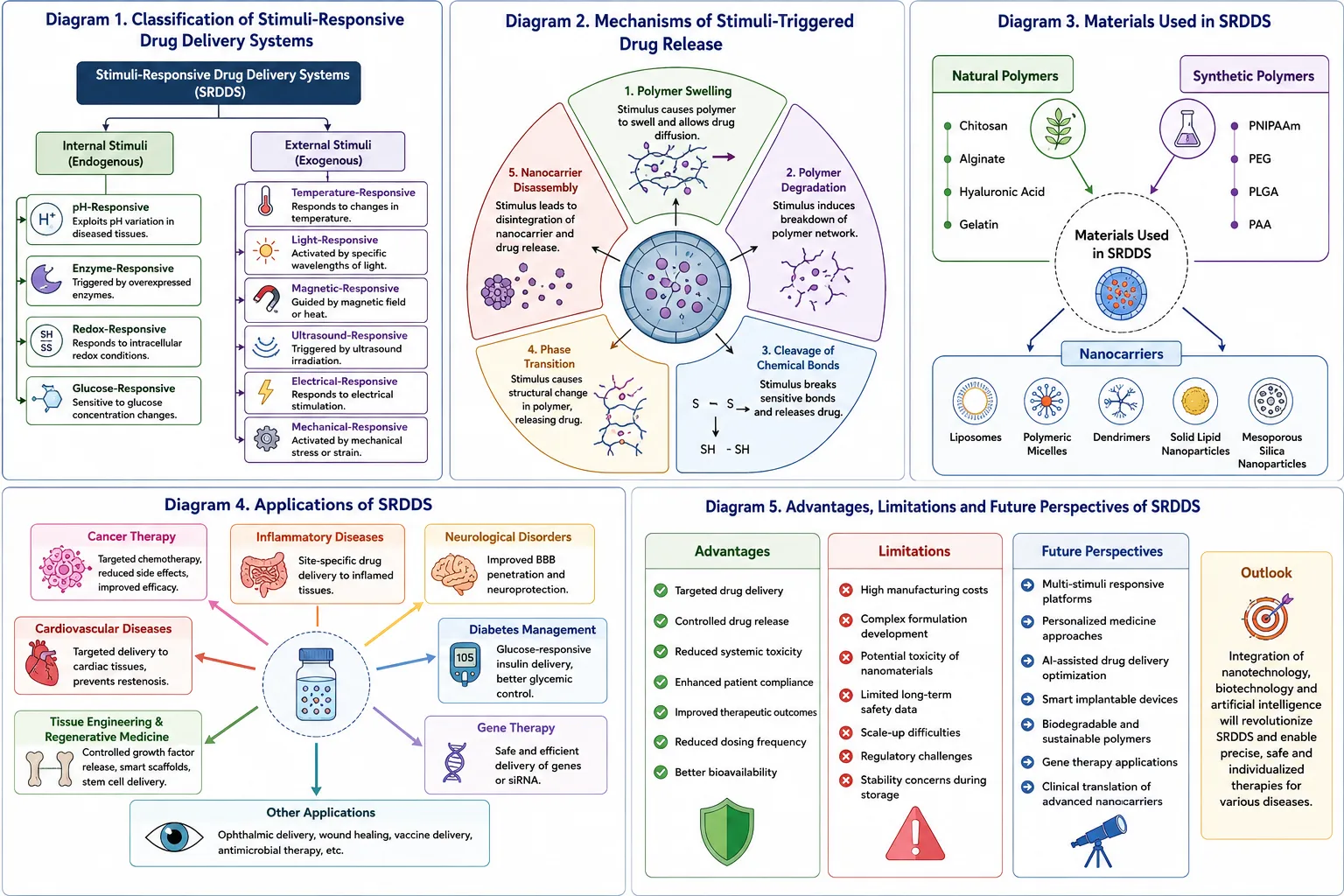
Fig no 3: Mechanisms of Stimuli-Triggered Drug Release
Materials Used in Stimuli-Responsive Drug Delivery Systems
The performance of Stimuli-Responsive Drug Delivery Systems (SRDDS) largely depends on the materials used in their formulation. These materials are selected based on their biocompatibility, biodegradability, responsiveness to specific stimuli, and ability to encapsulate and release therapeutic agents in a controlled manner. The major classes of materials used in SRDDS include natural polymers, synthetic polymers, and nanocarriers.[27]
|
Category |
Material |
Stimuli Responsiveness |
Major Applications |
|
Natural Polymer |
Chitosan |
pH-responsive |
Oral delivery, cancer therapy |
|
Alginate |
pH/Ion-responsive |
Controlled release, tissue engineering |
|
|
Hyaluronic Acid |
Enzyme-responsive |
Cancer targeting, ophthalmic delivery |
|
|
Gelatin |
Enzyme-responsive |
Drug delivery, tissue engineering |
|
|
Synthetic Polymer |
PNIPAAm |
Temperature-responsive |
Hyperthermia therapy, hydrogels |
|
PEG |
Multi-stimuli responsive |
Nanocarriers, protein delivery |
|
|
PLGA |
Degradation-responsive |
Sustained-release formulations |
|
|
PAA |
pH-responsive |
Colon-targeted delivery, hydrogels |
|
|
Nanocarrier |
Liposomes |
pH/Temperature-responsive |
Cancer therapy, vaccines |
|
Polymeric Micelles |
pH/Redox-responsive |
Anticancer drug delivery |
|
|
Dendrimers |
pH/Redox-responsive |
Targeted drug delivery |
|
|
Solid Lipid Nanoparticles |
Temperature-responsive |
Oral and topical delivery |
|
|
Mesoporous Silica Nanoparticles |
pH/Redox-responsive |
Targeted therapy, theranostics |
Table no. 3. Materials Used in Stimuli-Responsive Drug Delivery Systems [28, 29, 30]Bottom of Form
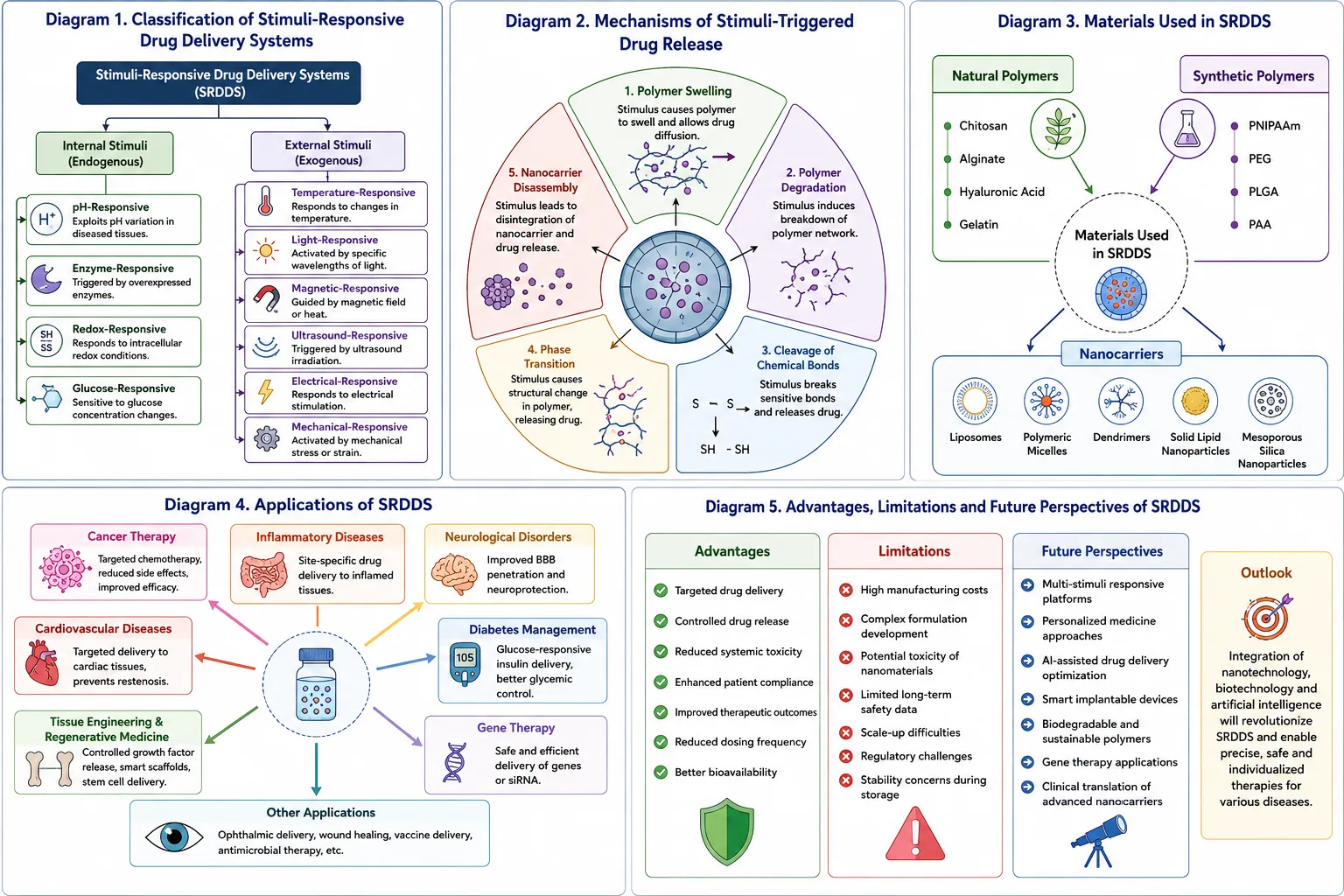
Fig no 4 : Materials Used in Stimuli-Responsive Drug Delivery Systems
Recent Advances in Stimuli-Responsive Drug Delivery Systems
The field of stimuli-responsive drug delivery systems (SRDDS) has witnessed significant advancements in recent years due to progress in nanotechnology, biomaterials, biotechnology, and artificial intelligence. Modern SRDDS are increasingly being designed to provide precise, controlled, and personalized drug delivery while simultaneously improving therapeutic efficacy and minimizing adverse effects. Some of the most notable recent developments are discussed below.[31]
|
Advancement |
Description |
Key Advantages |
Major Applications |
|
Multifunctional Nanoparticles |
Combine therapeutic, targeting, and imaging functions |
Simultaneous diagnosis and treatment, enhanced targeting |
Cancer therapy, personalized medicine |
|
Dual and Multi-Stimuli Responsive Systems |
Respond to multiple stimuli such as pH, temperature, and redox conditions |
Greater control and specificity of drug release |
Cancer therapy, gene delivery |
|
Theranostic Systems |
Integrate diagnosis and therapy in one platform |
Real-time monitoring and personalized treatment |
Cancer, neurological and cardiovascular diseases |
|
AI-Integrated Drug Delivery Systems |
Use artificial intelligence to optimize formulation and drug release |
Predictive drug release and personalized therapy |
Precision medicine, smart drug delivery |
|
CRISPR-Based Responsive Systems |
Deliver gene-editing tools through stimuli-responsive carriers |
Precise gene editing and reduced off-target effects |
Genetic disorders, cancer therapy |
|
Biomimetic Nanocarriers |
Mimic biological membranes and vesicles for drug delivery |
Immune evasion, prolonged circulation, enhanced targeting |
Cancer therapy, immunotherapy, gene delivery |
Table no 4 . Recent Advances in Stimuli-Responsive Drug Delivery Systems[32,33]
Applications in Tissue Engineering and Regenerative Medicine
Stimuli-responsive biomaterials have emerged as promising tools in tissue engineering and regenerative medicine due to their ability to respond dynamically to physiological and environmental cues. These materials can provide controlled and site-specific delivery of growth factors, cytokines, and other bioactive molecules, thereby enhancing tissue repair and regeneration.[33] Smart scaffolds fabricated from stimuli-responsive polymers can mimic the natural extracellular matrix and provide an optimal environment for cell attachment, proliferation, and differentiation.[34] Additionally, these systems have been widely investigated for wound healing applications, where they can release therapeutic agents in response to changes in pH, temperature, or enzyme activity at the injury site. Stimuli-responsive carriers are also employed for stem cell delivery, improving cell survival, retention, and integration within damaged tissues. Overall, these advanced biomaterials contribute to enhanced tissue regeneration, improved cellular growth, and better integration with host tissues, making them highly valuable in regenerative medicine.[35]
Advantages
Stimuli-responsive drug delivery systems offer numerous advantages over conventional drug delivery approaches. Their ability to release drugs selectively at the target site significantly improves therapeutic efficacy while minimizing exposure to healthy tissues. Controlled and sustained drug release reduces fluctuations in drug concentration and helps maintain therapeutic levels for extended periods.[36] As a result, systemic toxicity and adverse side effects are substantially reduced.[37] These systems also improve patient compliance by decreasing the frequency of drug administration and enhancing treatment convenience. Furthermore, targeted delivery enhances drug bioavailability and therapeutic outcomes, making stimuli-responsive systems highly effective for the management of chronic and complex diseases such as cancer, diabetes, and inflammatory disorders.[38]
Limitations
Despite their significant potential, stimuli-responsive drug delivery systems face several challenges that limit their widespread clinical application. The development and manufacturing of these advanced systems often involve complex formulation processes and sophisticated technologies, resulting in high production costs.[39] The potential toxicity and long-term safety of certain nanomaterials remain areas of concern and require extensive investigation. Additionally, large-scale manufacturing and reproducibility of complex nanocarrier systems can be difficult to achieve.[40] Regulatory approval presents another major challenge due to the intricate nature of these formulations and the need for comprehensive safety and efficacy evaluations. Stability during storage and transportation is also a concern, as some stimuli-responsive materials may undergo degradation or lose functionality over time. Addressing these limitations is essential for successful clinical translation and commercialization.[41]
Future Perspectives
The future of stimuli-responsive drug delivery systems is closely linked to advances in nanotechnology, biotechnology, materials science, and artificial intelligence. Emerging research is focused on developing dual- and multi-stimuli-responsive platforms capable of responding to multiple physiological signals simultaneously, thereby improving targeting accuracy and therapeutic control.[42] Personalized medicine approaches are expected to benefit significantly from smart delivery systems tailored to individual patient characteristics and disease profiles. Artificial intelligence and machine learning tools are increasingly being explored to optimize formulation design, predict drug release behavior, and improve treatment outcomes. The development of smart implantable devices capable of on-demand drug release represents another promising area of research.[43] Furthermore, biodegradable and environmentally sustainable polymers are gaining attention as safer alternatives for long-term therapeutic applications. Advances in gene therapy, particularly CRISPR-based technologies, are also expected to drive the development of highly precise and responsive delivery systems. Continued efforts toward the clinical translation of advanced nanocarriers will likely accelerate the adoption of stimuli-responsive drug delivery systems in modern healthcare, ultimately enabling more effective and individualized therapies.[44]
CONCLUSION
Stimuli-responsive drug delivery systems represent a revolutionary advancement in pharmaceutical and biomedical sciences, offering intelligent and controlled approaches for drug administration. By responding selectively to specific internal or external stimuli, these systems enable precise, site-specific drug release, thereby enhancing therapeutic efficacy and minimizing adverse effects. Significant progress in smart polymers, nanotechnology, biomaterials, and nanocarrier design has expanded the applications of these systems in cancer therapy, inflammatory diseases, neurological disorders, cardiovascular conditions, diabetes management, and tissue engineering. Although challenges related to safety, scalability, manufacturing complexity, and regulatory approval remain, ongoing research continues to address these obstacles. The integration of multifunctional nanocarriers, theranostic platforms, artificial intelligence, and personalized medicine strategies is expected to further transform the field. As research and technological innovations continue to advance, stimuli-responsive drug delivery systems are poised to play a crucial role in the future of precision medicine and next-generation healthcare.
REFERENCES

Vaishnavi Gajanan Ahir*, Radhika Jayprakash Khotare, Shweta Dnyandev Birajdar, Dipali Ratnakar Nagre, Kunal Vishnu Ghansawant, Dr. Amol Rakte, Dr. Sanjay Arote, Stimuli-Responsive Drug Delivery Systems: Mechanisms, Recent Advances, and Therapeutic Applications, Int. J. Sci. R. Tech., 2026, 3 (6), 1448-1457. https://doi.org/10.5281/zenodo.20842071
 10.5281/zenodo.20842071