

We use cookies to ensure our website works properly and to personalise your experience. Cookies policy
Lucknow Model College of Pharmacy, Lucknow
Thermosensitive hydrogels have proven to be highly desirable stimuli-responsive biomaterials for sustained and localized delivery of anti-inflammatory drugs. They are unique because they switch from sol to gel at the physiological temperature in vivo, which allows for their minimally invasive injection, extended drug residence at the target site, and controlled drug release, thus delivering more focused therapeutic effect with lower systemic side effects. In the past few years, polymer scientists have made significant progress in the formulation of thermoresponsive hydrogels from natural, synthetic and hybrid polymers that possess enhanced biocompatibility, mechanical properties and controllable gelation properties. They have been highly studied for the delivery of steroidal anti-inflammatory drugs, non-steroidal anti-inflammatory drugs (NSAIDs) and natural bioactive compounds in the treatment of inflammatory diseases such as rheumatoid arthritis, osteoarthritis, ocular inflammation, healing of wounds and periodontal diseases. This review covers the basics of thermoresponsive gelation, formulation approaches, characterization methods and recent developments of the therapeutic use of thermoresponsive hydrogels for the sustained delivery of anti-inflammatory drugs. Moreover, the review covers the challenges that are being addressed in current drug delivery systems such as burst drug release, limited mechanical stability, scalability and regulatory issues, as well as new drug delivery systems such as nanocomposite hydrogels, multifunctional drug delivery systems, and personalized drug delivery platforms. Taken together, thermosensitive hydrogels are a promising platform to enhance local anti-inflammatory therapy and will be utilized in future controlled drug delivery systems.
Inflammation is a complex biological process that serves as a protective mechanism against infection, injury and harmful stimuli to the tissues. Acute inflammation is a vital defense mechanism and tissue repair mechanism, but chronic, uncontrolled inflammation is a key factor in the pathogenesis of many chronic diseases such as inflammatory bowel disease, psoriasis, asthma, neurodegenerative diseases, rheumatoid arthritis and osteoarthritis. Treatment for these conditions often involves using anti-inflammatory drugs including non-steroidal anti-inflammatory drugs (NSAIDs), corticosteroids or disease-modifying anti-rheumatic drugs (DMARDs). However, conventional delivery of these therapeutics is often accompanied with lack of site specificity, high systemic clearance, varying plasma drug levels, frequent dosing and dose dependent side effects, calling for more effective drug delivery systems. Due to their high-water content, biocompatibility and adjustable mechanical properties, as well as the capability to encapsulate a broad spectrum of therapeutic molecules, stimuli-responsive hydrogels have gained interest as biomaterials for localized and controlled drug delivery. Of these, thermosensitive hydrogels are especially promising and exhibit a reversible sol-to-gel transformation at physiological temperature. The unique property is that with minimal invasion the administration of these injectable liquids is transformed into a gel depot at the targeted site, where the drug can be released slowly and locally; and the patients' compliance is better. Recently, there have been a range of advances that have allowed for the creation of natural polymer-based, synthetic polymer-based, and hybrid composite thermoresponsive systems. Poloxamers, poly(N-isopropylacrylamide) (PNIPAM), chitosan, methylcellulose and poly (ethylene glycol)-based copolymers are commonly studied materials, with these materials being able to be synthesized to have desirable gelation temperatures, biodegradability, mechanical properties and drug release profiles. They have shown great promise for sustained delivery of anti-inflammatory drugs via topical, intra-articular, ocular, transdermal and injected routes. In spite of these encouraging results, there are still a number of difficulties that hamper their clinical application. Poor mechanical stability, premature drug release, low drug loading capacity for hydrophobic drugs, drug-gelation variability, lack of easy to sterilize, scale up and regulatory concerns are still significant challenges. Thus, the present studies have been focused on developing multifunctional thermosensitive hydrogels that are more responsive, adhere well to the biological tissues, release the therapeutic agent in an optimized manner, and have better biocompatibility for better therapeutic efficacy with less systemic toxicity. This review aims to give a brief overview of the thermosensitive hydrogels as a sustained delivery system for anti-inflammatory drugs. It covers the basics of thermoresponsive gelation, typical polymers, formulation strategies, some recent applications in therapeutics, current challenges, and future directions for the translation of hydrogel-based drug delivery systems to the clinic.
2. Thermosensitive Hydrogels as Smart Drug Delivery Systems
Thermosensitive hydrogels are one class of stimuli-responsive biomaterials which change its state from sol to gel and vice versa when temperature changes, is important. The hydrogels are in a liquid state at room or refrigerated temperatures, so they can be easily injected or applied to the surface of the body, and immediately turn into a semi-solid gel at a physiological temperature (≈37°C). This temperature-induced gelation allows for local accumulation, a long residence time and a slow release of therapeutic agents, with reduced systemic exposure and side effects. Due to these properties, thermosensitive hydrogels have gained significant interest as drug delivery systems in smart anti-inflammatory therapy, tissue engineering, delivery to the eye, wound healing and regenerative medicine.
2.1 Fundamentals and Mechanism of Thermoresponsive Gelation
Thermoresponsive gelation is controlled by the temperature-dependent reversible change of the polymer–water interaction. The most common biomedical thermosensitive hydrogels have a lower critical solution temperature (LCST), or transition temperature, below which the polymer molecules are in solution and hydrated. With the increase in temperature above the LCST, the hydrogen bonding between polymer molecules and water molecules decreases, and the hydrophobic interaction between polymer chains becomes the major interaction. This leads to the formation of polymer aggregates and micelles, and the creation of a 3D network which traps water molecules and incorporated drugs, creating an in-situ hydrogel. Polymer systems with an upper critical solution temperature (UCST) on the other hand undergo gelation upon cooling, but these are less commonly used in pharmaceutical application.
2.2 Classification of Thermosensitive Hydrogels
Thermosensitive hydrogels can be divided into two types based on the temperature-sensitive properties: LCST-type and UCST-type. These are the most popular and studied LCST hydrogels which gel upon exposure to body temperature, such as poloxamers, PNIPAM, and PLGA–PEG–PLGA copolymers. Contrastingly, UCST hydrogels have opposite properties, being gelled at low temperatures and becoming soluble with increasing temperature. Thermosensitive hydrogels can be classified as natural, synthetic, and hybrid, depending on the type of polymer used. Hybrid hydrogels consist of natural and synthetic polymers which have excellent biocompatibility, biodegradability and drug release properties, while also providing enhanced mechanical strength.
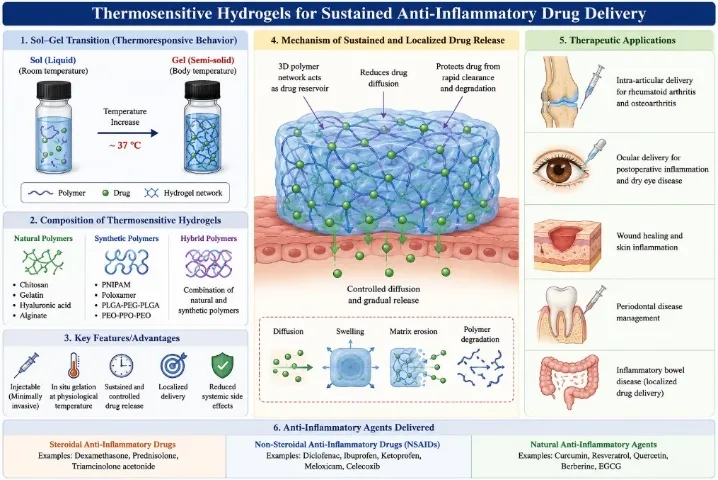
Figure 1. Schematic representation of thermosensitive hydrogels for sustained delivery of anti-inflammatory drugs. The figure shows the temperature induced sol to gel transition of thermosensitive hydrogels: the formulation is liquid at room temperature and turns into a semi-solid gel at higher temperatures, such as body temperature. It underscores the formulation of thermosensitive hydrogels with natural, synthetic and hybrid polymers, their major benefits—injectability, in situ gelation, drug targeting, slow release and decreased side effects on the systemic circulation and the current challenges and research prospects. The central panel presents the structure of the hydrogel network as a drug reservoir, and the significant mechanisms involved in controlled drug release such as diffusion, swelling, matrix erosion, and polymer degradation. The figure also provides a summary of the delivery of steroidal anti-inflammatory drugs, non-steroidal anti-inflammatory drugs (NSAIDs), and natural anti-inflammatory agents and representative therapeutic applications like rheumatoid arthritis, ocular inflammation, wound healing, periodontal disease, and inflammatory bowel disease.
2.3 Natural and Synthetic Thermosensitive Polymers
Chitosan, gelatin, methylcellulose, hydroxypropyl methylcellulose (HPMC), and xyloglucan are some of the natural thermosensitive polymers. The materials are useful because they are biodegradable, biocompatible and non-toxic, but can be further processed by blending and/or chemical modification to increase gel strength and stability. Synthetic thermosensitive polymers like poloxamer 407, poly(N-isopropylacrylamide) (PNIPAM), PEG-based block copolymers and PLGA–PEG–PLGA triblock copolymers have the most advantages in terms of control over the gelation temperature, mechanical properties, and sustained drug release. The use of natural and synthetic polymers has been used widely to formulate the injectable hydrogels with desired physicochemical properties and improved therapeutic efficacy in the delivery of anti-inflammatory drugs.
3. Formulation and Development of Thermosensitive Hydrogels
The critical choice of polymers, excipients and formulation strategies, ensuring the desired gelation temperature, injectability, mechanical properties, biocompatibility and drug loading, is crucial for the successful development of thermosensitive hydrogels. The formulation should continue to be a free-flowing solution during delivery and gel quickly to form a stable depot of the drug at the physiological temperature. Therefore, formulation variables must be optimized to guarantee reproducible performance and therapeutic efficacy.
3.1. Selecting of polymers and excipients.
Physicochemical and drug release properties of thermosensitive hydrogels depend to a large extent on the type of polymer. Predictable thermoresponsive properties and tunable gelation properties make synthetic polymers like poloxamer 407, PNIPAM and PLGA–PEG–PLGA popular. Biocompatible, biodegradable, mucoadhesive polymers, such as chitosan, gelatin, methylcellulose, hyaluronic acid, are often added to improve the properties of biocompatibility, biodegradability, mucoadhesion and tissue compatibility. More and more hybrid formulations of natural and synthetic polymers are being used for improved mechanical strength and extended drug release. Excipients are added to give the formulation optimum performance. The structural integrity is enhanced by cross-linking agents and formulation stability and drug compatibility is enhanced by stabilizers, preservatives, buffering agents and solubilizers. The nanoparticles can also be combined with thermosensitive hydrogels to boost the loading capacity of poorly soluble anti-inflammatory drugs and to decrease the first burst effect.
3.2 Methods of Preparation
The preparation of thermosensitive hydrogels depends on the appropriate polymer system and can be done either by the cold method or by direct dissolution method or by polymerization. The cold method is the most commonly used method for poloxamer-based formulations, in which the polymer is slowly dissolved in cold water (4–8°C) while stirring. The natural polymer-based hydrogels are typically produced by dissolving the individual polymers, then mixing them together at a carefully controlled temperature and pH, before adding the drug. PNIPAM or PEG copolymers are often used to prepare synthetic polymeric hydrogels by free-radical polymerization or block copolymerization. After preparation, the formulations are generally tested for the following properties: gelation temperature, viscosity, injectability, gel strength, swelling behavior, drug loading and in vitro drug release.
3.3 Factors Affecting Sol–Gel Transition and Drug Release
Drug release behavior and sol–gel transition of thermosensitive hydrogels depend on several formulation and environmental factors. One of the most important parameters is polymer concentration; as it increases, gelation time decreases, gel strength increases and drug release time is prolonged. Other factors, such as molecular weight, polymer composition and hydrophilic–hydrophobic balance are also important for the gelation temperature and network formation. In addition to these, external factors like pH, ionic strength, and physiological temperature have an effect on the performance of the hydrogels. Diffusion through the hydrogel matrix is dependent on drug related factors such as molecular weight, aqueous solubility, drug–polymer interaction and loading concentration. Moreover, the cross-linking density, pore size, degradation rate and swelling properties are all interconnected to control the sustained drug release and overall therapeutic efficacy.
4. Characterization and evaluation of thermosensitive Hydrogels
The performance, quality and therapeutic applications of thermosensitive hydrogels must be comprehensively characterized. The key parameters to consider are the gelation properties, the rheological and mechanical properties, the drug loading, the release characteristics, the biocompatibility, and the formulation stability. These properties help determine the suitability of the hydrogel for topical or injectable use and its sustained release of anti-inflammatory compound under physiological conditions.
4.1 Gelation Temperature and Gelation Time
Among the properties of thermosensitive hydrogels, gelation temperature is one of the most important ones, which describes the temperature at which a polymer solution becomes gel. The characteristics of an ideal injectable hydrogel is that it should be in sol at room temperature and gel rapidly at physiological temperature (about 37°C). The gelation time is the time elapsed between dosage and gel formation and should be short enough to prevent leakage, but long enough to be easy to handle. The most common methods for determining these parameters are the tube inversion method, rheological measurements, and vial tilting techniques.
4.2 Rheological and Mechanical Properties
The rheological evaluation gives information concerning the flow behavior, the viscosity, the viscoelasticity and the gel strength of thermosensitive hydrogels. Gelation is usually measured by the storage modulus (G′) and the loss modulus (G″). The mechanical properties (such as compressive strength, elasticity and adhesiveness) play a role in the stability of the hydrogel at the place of application and in the resistance of the physiological stress. Rheological and mechanical properties play an important role in retaining the structural integrity and providing long-term drug release.
4.3 Drug Loading and Encapsulation Efficiency
The drug loading capacity and the drug encapsulation efficiency are important factors that influence the therapeutic behavior of hydrogel formulations. These parameters are dependent on polymer composition, the solubility of the drug, preparation method, and interactions between the drug and the polymer. The drug loading is the percentage of drug added to the hydrogel matrix and the encapsulation efficiency is the percentage of the drug that is retained in the system. Most of these parameters are usually calculated by validated analytical methods based on UV–Visible spectrophotometry or HPLC after the extraction of the encapsulated drug.
4.4 In Vitro Drug Release and Release Kinetics
The sustained release performance of thermosensitive hydrogels under simulated physiological conditions is assessed in vitro by drug release studies. Dialysis membrane techniques, Franz diffusion cells or dissolution apparatus in suitable buffer media at 37°C are both commonly used for the study of drug release. The release profile is further characterized with kinetic models like zero order, first order, Higuchi, Hixson–Crowell and Korsmeyer–Peppas models for understanding the mechanism of release. In most thermosensitive systems, the release of drugs is achieved by means of a controlled diffusion and the progressive degradation of the hydrogel, which leads to a sustained release of the drug.
4.5 Biocompatibility and Stability
Thermosensitive hydrogels must be biocompatible before they can be used in the clinic. Standard in vitro/in vivo techniques are used to evaluate cytotoxicity, cell viability, hemocompatibility and inflammatory response to ensure the safety of the polymeric system. To evaluate changes in appearance, pH, viscosity, gelation temperature, drug content and release characteristics over time stability studies are performed under recommended storage condition. Physicochemical stability is important for ensuring consistencies in therapeutic performance and successful pharmaceutical development.
5. Thermosensitive Hydrogels for Sustained Anti-Inflammatory Drug Delivery
In recent years, thermosensitive hydrogels have become effective carriers for the local and sustained delivery of anti-inflammatory drugs. They can be related in situ at physiological temperature, resulting in sustained drug delivery at the target site, reduced systemic drug exposure, and decreased dosing frequency. Intra-articular, ocular, dermal, periodontal and injectable delivery of these hydrogels have been widely studied for the treatment of inflammatory diseases. Thermosensitive hydrogels have sustained release properties which enhance therapeutic efficiency and reduces the adverse effects associated with the drug.
5.1 Delivery of Steroidal Anti-Inflammatory Drugs
Prolonged local therapy has been successfully made possible with the use of thermosensitive hydrogel containing steroidal anti-inflammatory drugs like dexamethasone, prednisolone or triamcinolone acetonide. Intravenous thermoresponsive hydrogels offer prolonged corticosteroid release spanning up to days or weeks, with a controlled level of drug in the inflamed area and decreased systemic toxicity. Such preparations have shown successful results in the management of ocular inflammation, rheumatoid arthritis, postoperative inflammation and musculoskeletal inflammation and have helped in improving the drug residence time and thus decrease the frequency of administration.
5.2 Delivery of Non-Steroidal Anti-Inflammatory Drugs (NSAIDs)
In addition, thermosensitive hydrogels have been widely investigated for the sustained release of NSAIDs such as diclofenac sodium, ibuprofen, ketoprofen, meloxicam and celecoxib. Drug encapsulation in thermoresponsive polymeric matrices allows a controlled release, enhances the bioavailability at the site of application and reduces gastrointestinal and systemic side effects that occur during oral administration. Injectable, topical and intra-articular administration of these formulations has demonstrated great promise for the treatment of osteoarthritis, postsurgical pain and local inflammatory diseases.
5.3 Delivery of Natural Anti-Inflammatory Agents
Natural bioactive compounds have become more relevant due to their anti-inflammatory, antioxidant and good safety parameters. The use of thermosensitive hydrogels for the delivery of phytonutrients like curcumin, resveratrol, quercetin, berberine and epigallocatechin gallate (EGCG) has been studied. They are poorly soluble in water and low in bioavailability which can be overcome by incorporation into a thermoresponsive hydrogel, giving the added advantage of drug stability, local retention, and controlled release. Such systems have been shown to increase the effectiveness of treatment in wound healing, arthritis, periodontal inflammation, and dermal inflammatory disorders.
5.4 Mechanisms of Sustained and Localized Drug Release
The release of the drug from the thermosensitive hydrogels is mainly controlled by diffusion, polymer swelling, matrix erosion, and polymer degradation mechanisms. After administration, the hydrogel will create a three-dimensional network that will act as a reservoir for the drug, which will help to reduce the diffusion of the encapsulated molecules into the surrounding tissues. The release profile depends on polymer composition, degree of cross linking, pore size, rate of degradation of the hydrogel and interactions between the drug and the polymer. They are biodegradable thermosensitive hydrogels that release the drug over extended time periods and to a specific site, while achieving a therapeutic level at the target site, with reduced systemic levels.
6. Recent Advances and Therapeutic Applications
Biodegradable thermosensitive hydrogels have been developed in the recent years to enhance the properties of gelation, mechanical stability, drug loading capacity and controlled release. These hydrogels have been significantly improved by the incorporation of nanotechnology, bioactive polymers, and multifunctional delivery systems, leading to an improved therapeutic potential. The nanoparticles, liposomes, micelles, and nanocrystals that have been encapsulated in thermosensitive hydrogels have been shown to have higher encapsulation efficiency, low burst release, better drug stability and longer therapeutic effect. These hybrid systems have proven to be more effective than the conventional hydrogels, especially in treating inflammatory diseases at a local level.
Intra-articular delivery of drugs for RA and OA by injectable thermosensitive hydrogels has received a great deal of attention. These formulations are designed to release anti-inflammatory drugs over a long period of time, to remain in the joint cavity and to decrease the need for intra-articular injections. Likewise, thermoresponsive hydrogels have been found to be useful for intraocular drug delivery, extending the precorneal residence time and enhancing the bioavailability of cortico- and NSAID-s for the treatment of postoperative inflammation and dry eye disease.
Thermosensitive hydrogels can be used as multifunctional dressings for wound healing and as skin tissue repair, with the ability to maintain a moist environment, and provide sustained release of anti-inflammatory, antimicrobial and antioxidant agents. Newer formulations with naturally derived bioactive ingredients or nanoparticles have shown superior wound healing properties, including faster healing, decreased inflammation, and improved tissue regeneration. Their injectability and conformability also help to treat irregular surfaces of wounds.
Thermosensitive hydrogels have also been studied in the field of periodontal disease, inflammatory bowel disease, post-surgical treatment, and in localized cancer therapy to release drugs when needed, increasing the effectiveness of treatment while reducing systemic side effects. New studies focus on creating multifunctional stimuli-responsive nanoparticles, peptides, growth factors and biological therapeutics embedded in hydrogels. The next generation systems are supposed to give accurate, personalized, and persistent therapy for various inflammatory diseases.
7. Challenges and Limitations
Although great strides have been made in the development of the thermosensitive hydrogels, yet there are many problems that prevent their wide clinical translation. The poor mechanical properties of many hydrogel systems, especially those made from natural polymers, is one of the major drawbacks. The weak structural integrity can lead to degradation at a site other than the target, loss of drug from the target site and variable release in physiological conditions.
Another challenge is to get precise control over the sol–gel transition. The gelation temperature and gelation time may vary with the concentration and molecular weight of the polymer, the degree of acidity or alkalinity (pH), the ionic strength, and physiological conditions, resulting in various unpredictable in vivo performances. Some formulations have an undesirable initial burst release that can shorten the sustained drug release and make local and systemic adverse effects more likely.
Also, the efficient incorporation of the hydrophobic anti-inflammatory drugs is difficult due to their poor water solubility and lack of compatibility in the hydrogel matrix. While it has been possible to enhance drug loading in nanocarriers and polymeric modifications, high efficiency and controlled release remain a challenge in formulation. Moreover, the chemical structure, gelation and stability of the drug could be influenced by the sterilization process (such as autoclaving or gamma irradiation) and the choice of such process should be carefully considered.
Translational issues include large-scale manufacturing, batch-to-batch reproducibility, long-term storage stability, and regulatory approval. The physicochemical properties and therapeutic activity of the hydrogel formulations can be affected by the difference between the laboratory and the industrial scale production. Furthermore, there are still not many pre-clinical safety tests and clinical studies that are well-designed for the use of many thermosensitive hydrogel systems used for anti-inflammatory drug delivery. To ensure their successful commercialization, advanced polymer engineering, standardized manufacturing processes and thorough clinical assessment will be essential in addressing these challenges.
8. Future Perspectives
Future research of thermosensitive hydrogels will hopefully seek to develop multifunctional hydrogels with the ability to deliver accurate, controlled and individualised anti-inflammatory treatment. More recent developments in polymer chemistry are enabling the creation of hydrogels with better mechanical properties, with a controllable gelation temperature, increased biodegradability and specific drug release. The ability to deliver the drug at the correct location and at the appropriate time by incorporating smart polymers that detect multiple physiological signals (temperature, pH, enzymes, reactive oxygen species, etc.) could further enhance the therapeutic precision and release the drug at the correct site and time.
Nanotechnology is expected to become a more prominent component in the future's generation of thermos-sensitive hydrogels. Drug loading or incorporation into hydrogel matrices containing nanoparticles, liposomes, polymeric micelles, nanocrystals and EVs can provide increased drug loading, increase the stability of poorly water-soluble anti-inflammatory agents, reduce the burst release and extend therapeutic efficacy. Such hybrid systems also enable the co-delivery of various therapeutic agents, such as anti-inflammatory drugs, antioxidants, growth factors and nucleic acid-based therapeutics, that can provide beneficial synergistic effects in treatment.
The clinical applications of thermosensitive hydrogels are expected to be expanded with the recent advances of personalized medicine, 3D bioprinting and tissue engineering. Injectable, customizable hydrogels with optimized Physico-chemical characteristics could be used in regenerative medicine, wound healing and inflammatory diseases. Furthermore, the application of artificial intelligence (AI) and computational modeling to optimize polymer selection, formulation design, and prediction of drug release behavior is becoming more common to shorten the formulation development process and decrease the number of experiments needed.
Despite all the above, standardized manufacturing process, scalable manufacturing process, extensive safety evaluation and robust clinical trial design will be essential for successful clinical translation. To create safe, effective and commercially viable thermosensitive hydrogel systems for sustained anti-inflammatory drug delivery, there will be the need for continued interdisciplinary collaboration between material scientists, pharmaceutical researchers, clinicians and regulatory agencies.
CONCLUSION
Thermosensitive hydrogels are a new class of "smart" drug delivery systems which have shown great potential for sustained and targeted delivery of anti-inflammatory agents. Due to their special temperature-sensitive sol–gel phase transition, they can be administered with minimal invasiveness, have a long drug retention time, allow for controlled drug release and lower systemic toxicity, which increases the therapeutic efficacy and patient acceptance. Due to developments in polymer engineering and formulation strategies, they have found use in the delivery of a variety of steroidal drugs, NSAIDs and natural bioactive compounds for treatment of various inflammatory disorders.
The recent advancement and the integration of nanotechnology, hybrid polymeric systems and multifunctional carriers have further improved the physicochemical characteristics and therapeutic efficacy of thermosensitive hydrogels. However, issues of mechanical stability, rapid drug release, reproducible gelation characteristics, manufacturing on a large scale and regulatory clearance remain as obstacles to their broad clinical use. Optimized formulation design and standardized production processes will play an important role in translating laboratory research into clinical practice and will be critical to address these issues.
In general, thermosensitive hydrogels are highly versatile and promising carriers for the delivery of anti-inflammatory drugs for long periods. In the years to come, new technologies in biomaterials, personalized medicine and intelligent drug delivery are anticipated to speed the process of creating innovative thermoresponsive hydrogel systems that are clinically applicable and safer and more efficient.
REFERENCES



Aditi Rajpoot, Shashank Tiwari*, Sadhana Singh, Thermosensitive Hydrogels For Sustained Delivery Of Anti-Inflammatory Drugs: Recent Advances, Challenges, And Future Perspectives, Int. J. Sci. R. Tech., 2026, 3 (8), 99-108. https://doi.org/10.5281/zenodo.21774167
 10.5281/zenodo.21774167