

We use cookies to ensure our website works properly and to personalise your experience. Cookies policy
MABD Institute of Pharmaceutical Education and Research , Yeola Nashik, (MS), India.
Gout, a common inflammatory arthritis caused by monosodium urate crystal deposition in joint and cartilage. Non-steroidal anti-inflammatory drugs (NSAIDs), particularly ibuprofen & Dexketoprofen, this drug has first-line therapy for the gout and arthritis using to their potent analgesic and anti-inflammatory activity. However, conventional immediate-release tablet shows high plasma fluctuation, first pass metabolism, short half-life, high protein binding this all factor show. For avoid these factor prepare Sustained-release (SR) drug delivery systems to offer a reducing drug tolerability, concentrations over extended periods, reducing dosing frequency, and minimizing peak-related adverse effects. This Review whole studied that Analysis of a formulation strategies for development sustained release ibuprofen tablet also including microencapsulation, coated pellets, osmotic pump sysytems, matrix Tablet and tablet hydrogel based carrier. Emphasis is placed on the role of rate-controlling polymers (e.g., hydroxypropyl methylcellulose, ethyl cellulose, Eudragit, and biodegradable polyesters) in modulating drug-release kinetics, along with mechanistic evaluation using established release models (zero-order, first-order, Higuchi, and Korsmeyer–Peppas). In in vitro design mostly focus on dissolution Study i.e. dissolution rate, which type of apparatus used etc. In-vitro dissolution profiles and available in-vivo pharmacokinetic data are critically compared to assess the correlation between formulation design and clinical performance. Furthermore, the clinical use of sustained ibuprofen release — including improved analgesic duration, reduced gastric irritation, and enhanced activity against gout, reduce Pain — are discussed alongside existing formulation methods, strategies and factors. Collectively, this review highlights the potential of sustained-release ibuprofen systems as a clinically relevant advancement over conventional formulations, and identifies key research gaps, existing method, clinical safety & efficacy and Warring about to new ibuprofen sustained release formulation.
Oral admiration is the most common route of drug delivery due to its Safety, easy take, cost-effectiveness, and high patient adherence. For last few years, modified-release (MR) oral dosage forms, including, extended-release (ER), sustained-release (SR), and controlled-release (CR) systems, have Novel drug delivery system had developed. [1] inflammatory arthritis has different types also including gout. Gout is a complex and common form of inflammatory arthritis developed by long-term asymptomatic hyperuricemia, formed by chronic deposition of monosodium urate (MSU) crystals.2 Clinical data indicates that MSU crystal deposition includes tophaceous deposits of MSU crystals in the joints and skin, chronic joint injury, and acute episodes of extreme pain and inflammation affecting peripheral joints, most frequently the first metatarsophalangeal (MTP) joint. In addition to describing trends in the incidence and prevalence of gout, recent epidemiological research has improved our knowledge of the risk factors for the disease's development and the effects of co-morbid conditions on cardiovascular morbidity and mortality.3
Sustained release drug selection criteria –
| Selection criteria | Ideal Drug Characteristics |
|---|---|
| Dose | Low |
| Hali –life | 2-4 hr |
| Solubility | Moderate |
| Stability or GI tract | Stable |
| Absorption window | Broad |
| Pharmacological Action | Suitable for prolonged release |
| Bioavailability | good |
| Safety | Low toxic |
Table no. 1 selection criteria for sustained-release NSAIDs.17
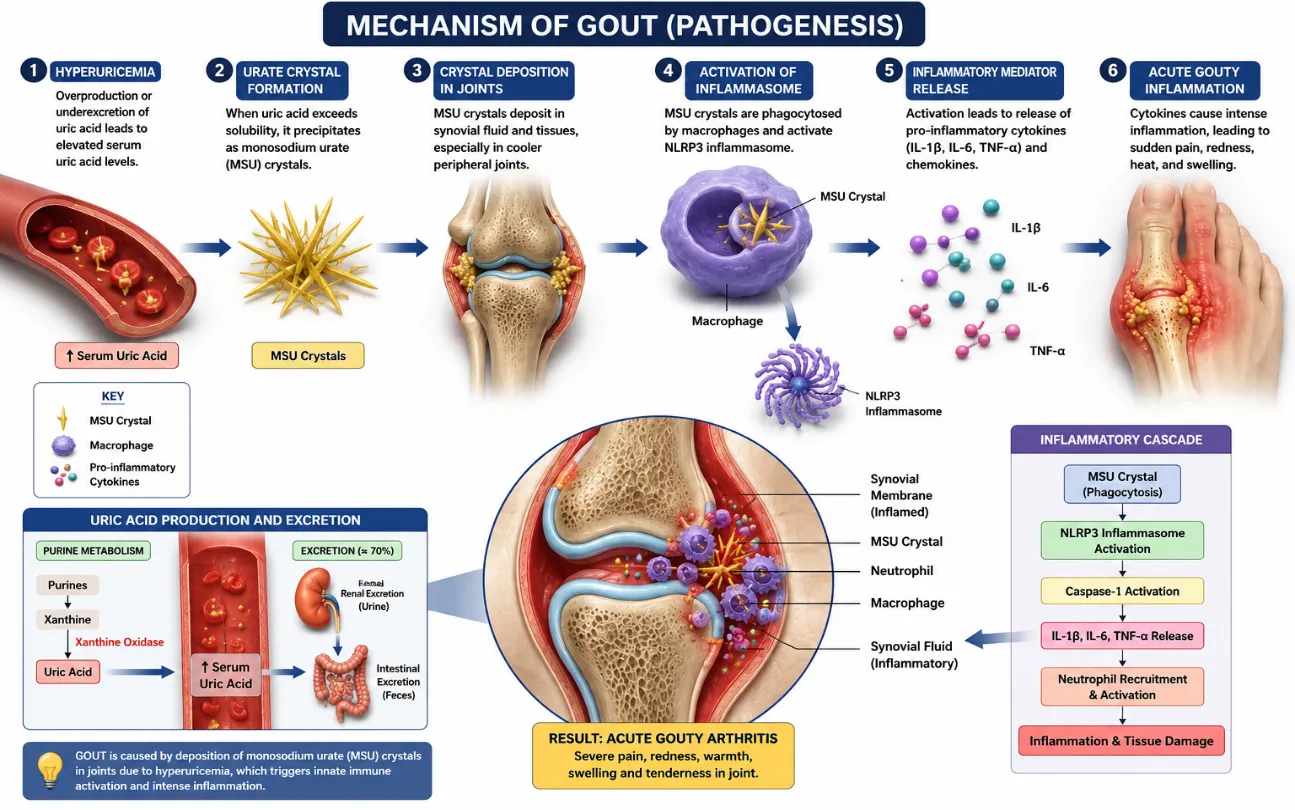
Figure 01: Mechanism of Gout68
Mechanism –
Busso N. et.al was studied that leucocytes are most studied cell in gouty inflammation. When MSU crystals are added to neutrophils, the cells die and lysosomal and cytoplasmic enzymes are released. According to in vitro research, the addition of natural crystals to neutrophil preparations caused the lysosomal membranes to rupture, causing the leakage of lysosomal contents. When crystals are coated with immunoglobulin, this mechanism of cell killing seems to be stopped, yet lysosomal enzyme release still occurs. The efficacy of colchicine, a strong inhibitor of neutrophil lysosomes and cell migration, further supports the significance of neutrophils in the acute response.4 the pathophysiology of gout is significantly influenced by innate immune pathways, particularly the activation of the NLRP3 inflammasome, which releases pro-inflammatory cytokines including IL-1β. Numerous intracellular and extracellular receptors and enzymes interact with environmental factors that affect the inflammatory state to orchestrate this pro-inflammatory cascade.5
Sustained release formulation for Gout management –
Et.al Yang Y Described that Low-dose sustained-release colchicine administered locally will significantly improve drug safety thanks to the sustained release effect of the microneedle preparation material, chitosan (CTS). At the same time, uricase stability and enzyme activity retention would be significantly enhanced due to the sustained release effect of microneedles and the protective effect of liposomes and microneedles on proteins.6 et.wl peng Z Evaluate that traditional drug delivery systems (TDDSs)—mostly oral tablets and intravenous injections—fail to address localized MSU crystal deposition or provide sustained drug release 7 Microsphere/liposome systems: PLGA- or lipid-encapsulated uricase formulations achieve weeks-to-months sustained release, reducing injection frequency and improving adherence in chronic regimens8 Long-acting formulations of therapeutic agents have been used to improve adherence and prevent issues such as missing doses or treatment fatigue to prescribed medication in a number of different fields such as contraception, male hypogonadism, and schizophrenia, with demonstrable success. nanoparticles (MNPs) to achieve the sustained release of the drug for 5–7 days. The movement of MNPs can be “remote controlled” for its effective penetration across the BBB by applying an external magnetic force 8 Sustained-release formulations are drug delivery systems designed to release active compounds at a predetermined rate, thereby maintaining stable plasma concentrations over an extended period to enhance therapeutic efficacy and reduce dosing frequency. Incorporating the QIF into sustained-release modeling allows for more precise characterization of component interactions and time-dependent effects, offering a statistically robust foundation for subsequent multi-objective optimization.9 further formulation development process, F-IX (drug-to-HPMC, 1∶4; EC 4% wt/vol as granulating agent), the most successful formulation of the study, exhibited satisfactory drug release in the initial hours, and the total release pattern was very close to the theoretical release profile. All the formulations (except F-IX) exhibited diffusion-dominated drug release. The mechanism of drug release from F-IX was diffusion coupled with erosion. In many cases, the development of sustained release (SR) dosage forms is somewhat empirical. It is often based on the sole objective of reducing the dosing frequency or fluctuation between peak and trough plasma concentrations (Cmax and Cmin, respectively) associated with conventional tablet or capsule formulations. In addition to reduced ΔC, SR formulations provide other important aspects that affect the magnitude of effect, including: the (slow) rate of input and the continuous (vs. intermittent) mode of drug administration. These formulation-dependent parameters, together with the individual pharmacodynamics characteristics of the patient (e.g. the level of endogenous agonist/antagonist compounds) produce the overall pharmacodynamics pattern of the drug action that is commonly defined as `what the drug does to the body11 In GA, sustained release of anti-inflammatory agents from lipid nanocarriers can provide prolonged pain relief and reduce the need for frequent dosing, which is beneficial for managing chronic symptoms.25 Moreover, the targeted delivery capabilities of lipid-based nanocarriers can minimize off-target effects and reduce the risk of adverse side effects, addressing a major limitation of conventional treatments. This targeted approach not only enhances the treatment’s efficacy but also improves its safety profile, making it a viable option for patients with comorbid conditions or those intolerant to standard therapies. 1
Different Type of sustained release formulation –
| Drug | Polymer used | Formulation type | Author |
|---|---|---|---|
| Donepezil | PLA, PLGA, PEG | Microspheres (long-acting injectable) | et.al Ishola BO 18 |
| Clarithromycin | HPMC | Oral matrix tablet | et.al khan NA19 |
| Venlafaxine HCl | HPMC K15M + Ethylcellulose (resinate) | Oral SR tablet | et.al Madgulkar Ar20 |
| Metformin HCl | HPMC K200M + Eudragit RS100 | Oral SR matrix tablet | Et.al Roy H 21 |
| Zidovudine | HPMC K4M / Carbopol 934 + Ethylcellulose | Oral controlled-release matrix tablet | et.al Ganesh J.. 22 |
| Protein drugs,incl. BSA/dextran model | PLGA with dextran glassy particles | Microencapsulated microspheres | et.al Wu.F 23 |
| Bimatoprost | Chitosan | Ocular insert (glaucoma) | et.al Fanea JN 24 |
MATERIALS & METHOD –
MATERIALS
The most effective method of modulating drug release is to include it in a matrix system. The matrix tablet was prepared via wet granulation method. Many polymers have been used in the formulation of matrix based controlled released drug delivery system. Reports are found on the use of hydrophilic polymers like HPMC for the preparation of SR formulation of different drugs. Different viscosity grades of polymers are widely used for designing oral controlled drug delivery system because their flexibility to provide a desired drug release profile and cost effectiveness and broad regulatory acceptance. However, the use of hydrophilic matrix alone for extending drug release for the highly water soluble drug is restricted due to rapid diffusion of dissolved drug through the hydrophilic gel network, for such drug inclusion of the binder like PVP K30 becomes essential in the matrix systems. Hence, in the present work, an attempt has been made to formulate the extended release matrix tablets of Itopride using different ratios of three different viscosity grades of HPMC polymer with and without binder (PVP K30). Fourteen formulations of Itopride was developed . The granules were formulated according to wet granulation method. All the raw drugs and excipients were passed through a 40 mesh size sieve separately. Active drugs, the polymers and lactose were mixed thoroughly. The PVP K30 paste was formed using granulating fluid IPA. The PVP paste was thoroughly mixed with the mixture of drugs and polymers. The mixing product was passed through the 20 mesh size sieve. The granules were dried at 40 °C in an oven dryer for 30 min. The granules thus formed were also passed through a 18 mesh size sieve. The granules were then mixed with lubricating agent talcum and magnesium state before final compression. Composition of 14 Itopride formulations with different ratios and different grades of HPMC polymer. [13] By fusing material science, molecular engineering, and pharmacokinetics to enable accurate and effective drug delivery, polymeric drug delivery systems represent a paradigm change in therapeutic applications. The development of biocompatible and biodegradable polymers has made it possible to create systems specifically designed for targeted therapy and controlled release. Synthetic polymers offer better tunability and functionality, yet natural polymers are naturally compatible. Scalability, stability, and regulatory obstacles continue to be major obstacles to clinical translation despite advancements. In order to overcome these constraints, smart polymers, computational modeling, and bio-inspired designs will be integrated into polymeric drug delivery in the future. These advancements will make it possible to construct multipurpose systems that can co-deliver big molecules, genes, and medications.26
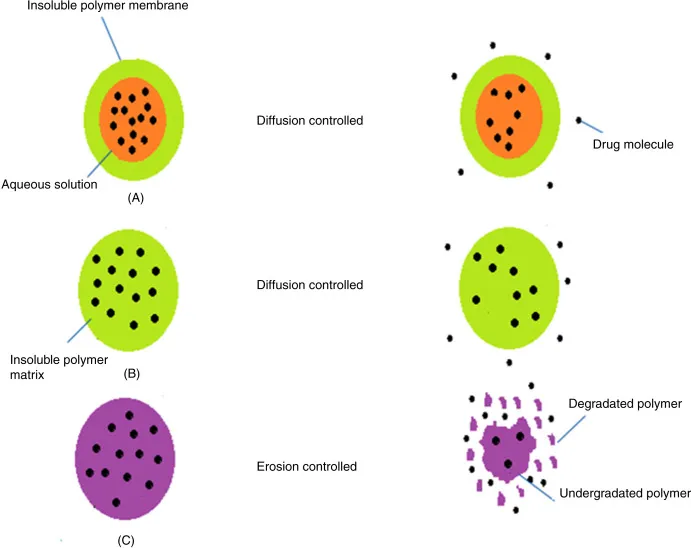
Figure 2: Diagram of Three Main Mechanisms for Obtaining Sustained Drug Release. (a–B) Diffusion via Matrix or Shell of Insoluble Polymer, and (C) Erosion of a Polymer Matrix. [14]
METHODS –
Wet Granulation-
Most of the sustained release tablet prepped by wet granulation method. Basically tablet compression have 3 main methods dry granulation, wet granulation, direct compression. Et.el. Khan R. developed Rabeprazole sustained release tablet by wet granulation techniques using Diferent polymer i.e. Carbapol 934, Sodium CMC etc. they conclude that higher concentration of Carbapol 934 showed better sustained release properties than HPMC. 15 et.el Bos A. prepare sustained release matrix tablet of Itopride HCl they conclude that The drug delivery method used in the sustained release matrix tablets of the Itopride HCl formulation system produces a gradual and prolonged release of the medication over a long duration. Response surface methodology (CCD design) optimizes the formulation's response variables. The SEM's analysis of the matrix tablet's morphology and in vitro dissolution release kinetics show that it was successfully sustained for several hours. Polymer used this formulation is HPMC K100M, PVP K3013 he optimized ODT-SR showed disintegration time of 21 seconds and matrix controlled drug release for 9 h. In-vivo pharmacokinetic studies in Wistar rats showed that the ODT-SR had a prolonged MRT of 11.16 h as compared 3.86 h of conventional tablet. The developed technology is easily scalable and holds potential for commercial exploitation.16
Process –
1) Weigh all material and excipients. Sifting in specific sieve no. (depends on powder size and flow properties
2) Mixing it use RMG (Rapid Mix granulator)
3) That same time start binder preparation using (water starch paste etc.) binder preparation is most critical process in include critical process parameter
4) Addition of binder in RMG. Set impeller and chopper speed as specified limit (impeller – bulk moment, chopper - Breaks down large agglomerates
5) Check Ampere load for granulation
6) Pass in FBD (Fluidized Bed Dryer)
7) Drying
8) Quality and content uniformity test
9) Compression in selected tooling.25
Critical process Parameter and critical Quaity attributes during tablet Manufacturing
Table 02: CPP & CQA During Tablet Manufacturing
| CPP (Critical Process Parameter) | CQA( Critical Quality Attributes ) |
|---|---|
| Mixing Speed | Binder Preparation |
| Impeller Speed | Mixing |
| Chopper Speed | Content uniformity |
| Drying Time | Moisture content |
| Binder addition | Stability |
| Compression force | LOD |
| Compression speed | Binder Quantity |
Marketed Formulations and Clinical Trials of ibuprofen for gout management –
Van Durme et al.'s Cochrane review27
There were 28 studies with 3,406 participants in the 2021 update. Gout lasted less than 48 hours, and the majority were men (69–100%) between the ages of 44 and 66. Research with a moderate degree of certainty indicates that NSAIDs are likely just as effective as COX-2 inhibitors in treating pain and inflammation, but they have greater adverse effects. Cochrane NSAIDs have more adverse effects and are likely just as effective as glucocorticoids for pain, but they are less effective for edema. Cochrane Many NSAIDs that are no longer in clinical use were included in low-certainty comparisons of one NSAID against another. Cochrane This fixes the phrasing I used before. Instead of placebo, the extra adverse events were related to COX-2 inhibitors and glucocorticoids.
Network meta-analysis (Zeng et al., 2021)28
Conduct 30 RCTs of anti-inflammatory treatments for gout disease. Acetic acid derivative NSAIDs (i.e. indomethacin) minimized joint swelling more than ibuprofen-type NSAIDs at day 2. The mean difference was −0.29 (95% CI −0.56 to −0.02) on a 0–4 scale, with moderate. This difference is small and the confidence interval up to touches zero. oral corticosteroids may carry fewer serious adverse events than NSAIDs (risk difference −0.03), with very low certainty.
Key randomized controlled trials from the NSAID class
Table 03: Controlled Trials from the NSAID Class
| Trial Drug | Design and result | Author |
|---|---|---|
| celecoxib vs indomethacin (NCT00549549) | 402 patients were randomized to celecoxib 50 mg bid, 400/200 mg or 800/400 mg regimens, or indomethacin 50 mg tid, for 8 days. High-dose celecoxib reduced day-2 pain more than low-dose celecoxib (LS mean difference −0.46, p = 0.0014). | et.al Schumacher 2012,29 |
| , naproxen vs prednisolone | Double-blind equivalence trial in primary care (Lancet 371:1854–60). It is listed in the Cochrane reference set. | et.al Janssens 200830 |
| , prednisolone vs indomethacin | 416 emergency-department patients in Hong Kong. Indomethacin was 50 mg tid for 2 days, then 25 mg tid for 3 days. | et.al Rainer 201631 |
| naproxen vs low-dose colchicine (NCT01994226) | Described as the first direct head-to-head comparison of naproxen with low-dose colchicine. | et.al Keele trial,32 |
Drug release & Therapeutic potential –
1. Tablets with hydrophilic and hydrophobic matrices
The optimal formulation, HPMC + microcrystalline cellulose, released ibuprofen at a nearly constant rate of roughly 60 mg/h. As a wetting agent, sodium lauryl sulfate broke down tablets more quickly than Tween 80 (Brieflands article).Higuchi-type release was produced by the mixture of hydrophilic and hydrophobic polymers in HPMC K4M + ethyl cellulose (wet granulation) (i-Scholar paper).Ethyl cellulose, Carbopol, and Pemulen (direct compression): Higuchi kinetics were followed by ethyl cellulose by itself and Carbopol 934P + Pemulen TR-1. The highest stable rate, zero-order, was reached by Carbopol 974P + Pemulen TR-1 (Tabandeh 2014)33. A polymer-based matrix with a 12-hour release period is called a 12-hour matrix (Guerra-Ponce 2016)35.A tablet containing Eudragit E100/Carbopol 971P and their salt forms is a once-daily matrix (Obeidat 2022)34
2. Wax or lipid particles and microspheres
Carnauba wax microspheres (melt dispersion): they released 58.1% after six hours with minimal drug loading. Only 38.9% was discharged at high loading (Ghaly 1996)36. Over the course of a six-hour test, Eudragit RSPO/Methocel K4M microspheres: release fitted the Korsmeyer-Peppas model. According to Saha (2013)37, they were made to prevent release in the upper gastrointestinal system.Because of the limited half-life, alginate microspheres (ionic gelation) were created to extend release. No release figures were visible to me.Stearic acid at 30–40% loading provided approximately 4 hours of release for candelilla wax particles (patent example). At 24% loading, stearic acid produced around 8 hours. At 40%, glyceryl monostearate provided instant release.
3. Gastro-retentive mechanisms
The authors of an early-stage investigation on floating ethyl cellulose nanoballoons indicate enhanced bioavailability and a long-lasting anti-inflammatory impact (Philip 2024)38. It's preclinical.
4. Microcapsules that are gastro-resistant or enteric
In 18 volunteers, the peak concentration of a fast-melting tablet containing gastro-resistant microcapsules (200 mg) was 12.04 µg/mL at 3.5 hours, compared to 18.71 µg/mL at 1 hour for a sugar-coated tablet.
Nine volunteers underwent a three-way crossover between 800 mg microcapsule suspension, rapid-release tablets, and sustained-release tablets (Walter 1995)39.
Pharmacokinetic evidence in humans
The clearest human datum I could find was the fast-melting tablet study from 1998. A lower, later peak resulted from slower absorption. The dietary impact and bioavailability of an 800 mg modified-release tablet are being investigated in comparison to a reference product (NCT05329454). There were no results shown. On the other end are fast-acting salts. Compared to dexibuprofen, ibuprofen arginate exhibited a 45% higher Cmax and a Tmax that occurred two hours earlier.40,41
Potential for gout treatment
Acute flare-ups require a quick onset. Sustained-release medications don't work well as first-line flare therapy because of their lower and delayed peaks. Fast-absorbing or immediate-release shapes fit well. Prophylaxis: I couldn't find any trials of sustained-release ibuprofen for this, although long-acting cover might be taken into consideration when beginning urate-lowering medicine.
Chemical and biological barrier of SR drug delivery system
Biological barriers specific to gout
Acute gout pain peaks up to 24 hours, and in one study only 16% of placebo patients had a 50% pain reduction at 24 hours. (42) Oral NSAIDs Specially catch 50% pain reduce by 48–72 hours. (43) In the single placebo-controlled trial in the Cochrane review, 11 of 15 NSAID patients had a 50% pain reduction at 24 hours, against 4 of 15 on placebo. (44) In a volunteer study, a gastro-resistant microcapsule ibuprofen tablet peaked at 12.04 µg/mL at 3.5 h, against 18.71 µg/mL at 1 h for a conventional tablet. (45) Delayed, lower peaks are a direct barrier when early relief matters. Gout is associated with obesity, CKD, hypertension, type 2 diabetes, dyslipidaemia, cardiac disease, stroke and peripheral arterial disease. (46) biomedcentral Combining NSAIDs with ACE inhibitors or diuretics raises the risk of acute kidney injury, and NSAIDs should be avoided with anticoagulants because of bleeding risk. (47) In a retrospective cohort of 1,207 gout patients, the overall cumulative AKI rate was 13.3%. (48) One trial protocol estimates that 20–30% of gout patients are poorly suited to NSAIDs. (49) Inference: SR keeps the drug in the body longer, so it could prolong renal and cardiovascular exposure. I found no data comparing SR and IR on these risks.
Chemical barriers in this context
Ibuprofen comes under BCS class II, and its dissolution in the gut is the main determinant of in vivo performance. (50) Ibuprofen dissolution in a low-strength pH 6.0 phosphate buffer was dramatically reduced compared with simulated intestinal fluid, so absorption depends on intestinal pH and buffer strength. (51) A meal high in protein or fat can lengthen gastric retention by 4 to 10 hours. (52) That adds variability to SR release. Inference: the target is the joint, so delayed or incomplete gut release delays joint exposure.
Stability study-
1. ICH Guidelines for a stability study
2. Published stability studies on SR ibuprofen
Ibuprofen–Eudragit RSPM tablets (Abdel Rahman et al., 1993)
HPMC K4M + ethyl cellulose matrix tablets
Wax-coated ibuprofen (patent data)
CONCLUSION –
Ibuprofen is a guideline-accepted NSAID option for acute gout & arthritis. The best gout trials tested other agents (celecoxib, naproxen, indomethacin, prednisolone). No recent or modern, good -powered ibuprofen-specific gout trial was found. Recent clinical trial Evidence shows NSAIDs work about COX-2 inhibitors and glucocorticoids for pain. Sustained-release (SR) ibuprofen made as matrix tablets, microspheres, wax particles, floating systems and microcapsules. SR forms give delayed and lower peak levels, which is a disadvantage in gout because pain peaks within 24 hours. Ibuprofen is a poorly soluble weak acid with pH-dependent dissolution. Gastric emptying, food and transit time add variability to SR release. Many gout patients have kidney, heart or blood-pressure problems, so longer NSAID exposure from SR forms may add risk. Stability studies on SR ibuprofen show only small drug loss and stable release over months. They are few, short and dated, and full long-term ICH data are lacking. Overall, immediate-release or fast-absorbing ibuprofen suits acute flares. SR has only theoretical roles, such as night-time cover or prophylaxis. Colchicine or glucocorticoids are preferred in patients with kidney disease, heart disease, anticoagulant use or GI disease. Future work should include ibuprofen gout trials, human PK and food-effect studies of SR forms, bedtime-dosing trials and long-term stability studies.
Declarations
Not Applicable
• Consent for publication
Not Applicable
• Funding
Not Applicable
Not Applicable
Acknowledgements
The authors wish to thank the management of MABD Institute of Pharmaceutical Education and Research for Providing the necessary facilities for carrying out the Review work.
Author contribution –
1. R.G.A. conceived the study, carried out the literature search and analysis, prepared the tables and figures, and wrote the first draft of the manuscript.
2. V.A.K. supervised the work, provided scientific guidance, and critically reviewed and revised the manuscript.
3. A.P.J., T.D.P., H.V.P., and S.P.S. helped gather and organize the literature and compile the data, and each reviewed the manuscript.
REFERENCES

Arote R. G., Dr. Kashid V. A., Pawar A. J., Pendharkar T. D., Patil H. V., Pawar S. S., Sustained-Release Ibuprofen for Symptomatic Management of Gout: A Comprehensive Review of Formulation Strategies, Drug-Release Profiles, and Therapeutic Potential, Int. J. Sci. R. Tech., 2026, 3 (11), 1274-1286. https://doi.org/10.5281/zenodo.24527962
 10.5281/zenodo.24527962