

We use cookies to ensure our website works properly and to personalise your experience. Cookies policy
1Department of Community Medicine, Government Medical College, Jalgaon.
2Department of Pharmacology, Government Medical College, Akola.
Background: Animal bites remain a significant public health concern in rabies-endemic countries such as India, which contributes an outsized share of global rabies mortality. While dog bites account for the majority of exposures, bites from non-dog animals (e.g., cats, monkeys, livestock, wild animals) also pose risks of rabies and other complications. These non-dog exposures are frequently under-recognized and inadequately managed due to poor awareness and systemic barriers. Objectives: (1) To determine the proportion and epidemiological characteristics of non-dog animal bites among patients presenting to a tertiary health care centre. (2) To assess socio-demographic and exposure-related factors associated with these bites. (3) To explore patient’s perceptions, experiences and barriers related to health-care seeking behaviour in non- dog animal bite cases. Methodology: A mixed-methods study was conducted from May 2025 to July 2026 at the Anti-Rabies Clinic of a tertiary health care centre in North Maharashtra. The quantitative component included analysis of 300 consecutive animal bite patients. The qualitative component comprised in-depth interviews with purposively selected non-dog bite cases. Quantitative data were analysed with descriptive statistics & thematic analysis was done for qualitative data. Results: Non-dog animal bites constituted 26.00% (78/300) of animal bite cases, consistent with national data reporting 20–30% non-dog bites in India during 2019–2023. Socio-demographically, bites were more frequent among males (62.00%) and rural residents (66.00%). Delay of ?24 hours in hospital arrival was found in 60.33% of cases. Five major qualitative themes emerged: risk perception, health-seeking behaviour, sociocultural beliefs, health-system barriers, and psychological impact. Conclusion: Non-dog animal bites are an under-recognized yet clinically relevant public health concern with 26% prevalence. Addressing awareness gaps and strengthening health-system responsiveness are essential to improve rabies prevention.
Animal bites are a well-recognized public health problem, particularly in rabies-endemic regions. Globally, the World Health Organization (WHO) estimated approximately 59,000 human rabies deaths annually, with over 35,000 deaths in India alone (≈36% of global mortality)1,2. Rabies is nearly always fatal once clinical symptoms develop, yet timely and appropriate post-exposure prophylaxis (PEP) is highly effective1,3.
Epidemiological evidence from WHO-supported population-based surveys in India conducted between 2017 and 2022 indicates that 70–80% of animal bite exposures are due to dogs, whereas 20–30% result from non-dog animals including cats, monkeys, livestock and wild animals4–7. A multicentric surveillance data coordinated by the Association for Prevention and Control of Rabies in India (APCRI) from 2019–2023 report that cats account for approximately 1.7–3% of bites, monkeys for 2–4% in select urban and peri-urban areas, livestock for <3%, and wild animals (e.g., jackals, foxes) for <1% of reported exposures6,8.
Despite lower proportions compared with canine bites, non-dog bites are clinically significant because they often involve high-risk anatomical sites, delayed presentation, lack of awareness and incomplete PEP5,9,10. WHO rabies position papers (updated 2023) emphasize that any mammalian bite should be assessed and managed for rabies risk regardless of species1,3. However, misconceptions persist among the public and even health providers that rabies is transmitted exclusively by dog bites11,12.
Existing Indian literature predominantly focuses on dog bites, with limited systematic data on non-dog bites, especially from tertiary care settings. There is also scanty evidence on patient perceptions and systemic barriers impacting care-seeking for non-dog bites13,14. Understanding these aspects is essential for optimizing rabies prevention strategies and improving clinical outcomes in rabies endemic regions such as Maharashtra.
OBJECTIVES:
MATERIALS AND METHODS:
This mixed-methods study was carried out at the Anti-Rabies Clinic of a tertiary health care centre in North Maharashtra from May 2025 to July 2026. Patients of all age group with a history of animal bite presenting during the study period were included and those having a history of rodent/ Human bite were excluded.
SAMPLE SIZE ESTIMATION:
Using the formula n = Z²pq/e² with:
Prevalence: p = 25% (proportion of non-dog bites based on recent WHO/APCRI data),
q = 75%,
Absolute error: e = 5%,
Z = 1.96 at 95% confidence interval, calculated minimum sample size was 288. To allow for incomplete records, 300 animal bite patients were included.
DATA COLLECTION TOOL:
For quantitative data: A pre-tested structured proforma was used which comprises:
For Qualitative Component: Patients with non-dog animal bites willing to talk freely were purposively selected for in-depth interviews using a semi-structured interview guide.
DATA ANALYSIS:
Quantitative data were analysed using descriptive statistics (frequencies, percentages). Qualitative data were analysed using thematic analysis.
ETHICAL CONSIDERATIONS:
Ethical approval was obtained from the Institutional Ethics Committee. Written informed consent and assent were obtained from all participants; confidentiality was maintained throughout the study.
RESULTS:
|
Characteristic |
No. |
% |
Characteristic |
No. |
% |
||
|
Age |
0- 15 |
99 |
33.00 |
Gender |
Male |
186 |
62.00 |
|
15- 30 |
82 |
27.33 |
Female |
105 |
35.00 |
||
|
30- 45 |
47 |
15.67 |
Transgender |
09 |
03.00 |
||
|
45- 60 |
39 |
13.00 |
Residence |
Rural |
198 |
66.00 |
|
|
≥ 60 |
33 |
11.00 |
Urban |
102 |
34.00 |
||
|
Education |
Illiterate |
03 |
01.00 |
Occupation involving exposure to animal |
Yes |
109 |
36.33 |
|
Primary |
91 |
30.33 |
No |
191 |
63.67 |
||
|
Secondary |
105 |
35.00 |
Socio-economic status (Modified BG Prasad scale, May 2025) |
Class I |
27 |
09.00 |
|
|
High school |
42 |
14.00 |
Class II |
36 |
12.00 |
||
|
Graduate |
50 |
16.67 |
Class III |
101 |
33.67 |
||
|
Post Graduate |
09 |
03.00 |
Class IV |
88 |
29.33 |
||
|
Total |
300 |
100.00 |
Class V |
48 |
16.00 |
||
Table 1: Sociodemographic Characteristics of Animal Bite Patients (n = 300)
Table 1 shows, the sociodemographic profile of the 300 animal‑bite patients, among them one‑third 99 (33.00%) were of aged 0‑15 years, followed by 82 (27.33%) in the 15‑30 age group, indicating a high incidence among children and young adults. The majority were male 186 (62.00%), reside in rural areas 198 (66.00%), and 199 (66.33%) had ≤ secondary school education. Most patients 101 (33.67%) were belonged to Class III and 109 (36.33%) were related to occupations involving exposure to animal.
|
Characteristic |
No. |
% |
Characteristic |
No. |
% |
|||
|
Type of animal |
Dog |
222 |
74.00 |
Nature of bite |
Unprovoked |
183 |
61.00 |
|
|
Cat |
27 |
08.00 |
Provoked |
117 |
39.00 |
|||
|
Monkey |
11 |
06.00 |
WHO exposure category |
Category I |
18 |
06.00 |
||
|
Cattle |
14 |
04.00 |
Category II |
108 |
36.00 |
|||
|
Goat/ Sheep |
10 |
03.00 |
Category III |
174 |
58.00 |
|||
|
Rabbit |
7 |
02.00 |
Time to presentation |
<24 hours |
119 |
39.67 |
||
|
Wild animals* |
9 |
03.00 |
≥24 hours |
181 |
60.33 |
|||
|
Ownership of animal |
Stray animal |
192 |
64.00 |
Anatomical site |
Head & face |
6 |
02.00 |
|
|
Pet animal |
108 |
36.00 |
Upper limb/ Abdomen |
60 |
20.00 |
|||
|
Previous h/o of bite |
Yes |
105 |
35.00 |
Lower limb & back |
234 |
78.00 |
||
|
No |
195 |
65.00 |
Total |
300 |
100.00 |
|||
|
H/o of Vaccination (n=105) |
Yes |
79 |
75.24 |
Completed Vaccination (n= 79) |
Yes |
28 |
35.44 |
|
|
No |
26 |
24.76 |
No |
51 |
64.56 |
|||
*Wild boar, Bat, Horse, Mongoose
Table 2: History of Animal Bite and Exposure-Related Factors
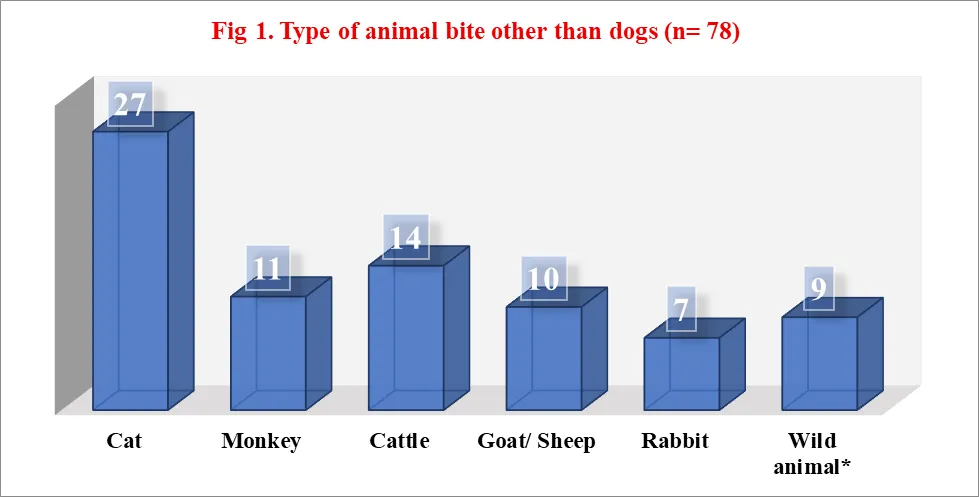
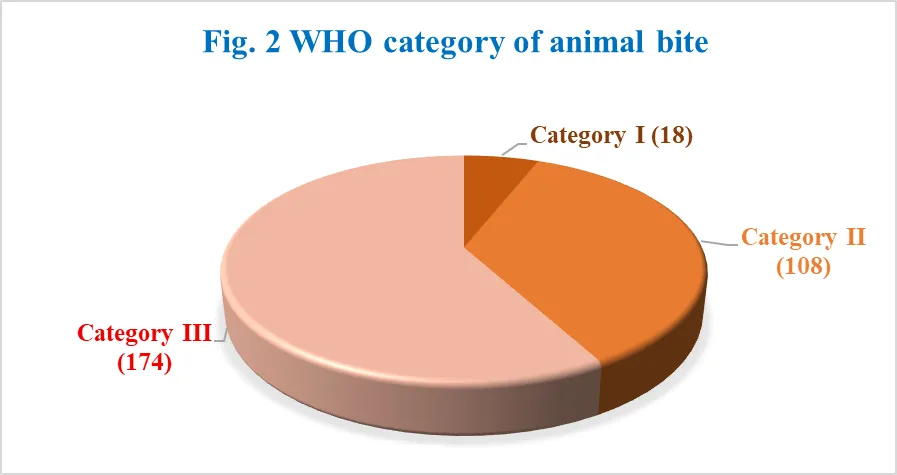
The prevalence of non- dog bite was found to be 26.00% (78/300), among them mostly were cat bite followed by cattle, monkey, goat/ sheep and wild animals like boar, bat, mongoose and horse. Most animal bites were from dogs 222 (74.00%), the majority were unprovoked bites 183 (61.00%) and classified as WHO Category III bite 174 (58.00%). Most patients presented ≥24 hours after the bite 181 (60.33%), bites commonly occurring on the lower limb and back 234 (78.00%). One third 105 (35%) had a previous history of animal bites, 79 (75.24%) of those having received prior vaccination but among them 51 (64.56%) had not completed the vaccination schedule.
|
Treatment Variable |
No. |
% |
Treatment Variable |
No. |
% |
||
|
First Aid after bite (n=300) |
Wound washing |
169 |
56.33 |
Anti-rabies vaccination initiated within 24 hrs (n= 282) * |
Yes |
179 |
63.48 |
|
Application of Chilli, turmeric etc |
57 |
19.00 |
No |
103 |
36.52 |
||
|
Use Antiseptics |
33 |
11.00 |
Rabies immunoglobulin received (n= 174) # |
Yes |
107 |
61.50 |
|
|
Done nothing |
41 |
13.67 |
No |
67 |
38.50 |
||
*Category II & III
# Category III
Table 3: Treatment Details of Animal Bite Patients
Among 300 patients, 169 (56.33%) received appropriate first aid as wound washing, while 57 (19.00%) applied irritants like chilli or turmeric etc. Among those requiring anti‑rabies vaccination, 179 (63.48%) initiated treatment within 24 hours. Of the 174 Category III exposures, 107 (61.50%) received rabies immunoglobulin.
QUALITATIVE ANALYSIS:
Five themes were emerged after In- depth interviews of 27 participants with those having h/o non-dog bite. (number of respondents)
Theme 1: Perception of Risk
Subthemes: 1.1 Underestimation of severity
1.2 Species-specific beliefs
Quotes:
1. From childhood, we were told that rabies comes only from dog bites, especially from dogs that look mad and have foam in their mouth. So if a normal-looking dog bites, we don’t feel much fear. We think it is just a small injury and will heal on its own. Nobody in our family ever explained that even a simple bite from any dog can be dangerous.” (11)
2. “In our homes, cats live around us like family animals. They sit in the kitchen, play with children, and sometimes scratch by mistake. We usually just wash the wound with water or apply some turmeric and leave it. We don’t go to the hospital because we believe a small cat scratch is nothing serious and cannot cause a big disease like rabies.” (15)
3. “Near temples and tourist places, monkeys are very common, and they often snatch food or bite people suddenly. We think it is part of daily life and not something very risky. If a monkey bites, people say just clean the wound and that’s enough. I never thought that monkeys can also spread rabies like dogs do, and that it can become life-threatening if not treated.’’ (09)
Theme 2: Health-Seeking Behaviour
Subthemes: 2.1 Delay in care
2.2 Informal treatments
Quotes:
1. “At first, I thought it was just a small bite and not something serious. There was no severe pain, so I decided to wait and see if it would heal by itself. Going to the hospital means losing a day’s wages and spending money, so I delayed for two to three days. Only when the wound started troubling me, my family insisted that I should go to the hospital.” (11)
2. “In our house, whenever there is a wound, elders tell us to apply turmeric, oil, or some herbal paste. We believe these home remedies can remove infection and help in quick healing. So after the bite, we first tried these traditional methods instead of going to the doctor. We thought it was enough and did not realize that rabies needs proper medical treatment.” (10)
3. “In our area, the local healer is easily available and people trust him a lot. He gives some herbal medicine or ties a thread and says it will prevent any bad effect. It is also cheaper than going to a big hospital. So my first thought was to visit him, because we believe he has experience in treating animal bites.” (13)
Theme 3: Sociocultural Beliefs
Subthemes: 3.1 Traditional practices
3.2 Community influence
Quotes:
1. “In our family, elders’ words are final. When the bite happened, they said in their time there were no injections and people were fine. They told me it was just a small wound and would heal naturally. So I believed them and did not feel it was important to take injections immediately.” (07)
2. “When I told my neighbours about the bite, they laughed and said it happens to everyone. They said there is no need to run to the hospital for such small things. Hearing this, I also felt relaxed and thought maybe I was overthinking. Their words made me delay taking proper treatment.” (03)
3. “In our area, people believe only certain animals like stray dogs spread rabies. They say animals like cats or monkeys are not dangerous in that way. So when I was bitten, many people told me not to worry because this animal doesn’t cause rabies. I trusted what everyone was saying and did not understand the real risk.” (02)
Theme 4: Health-System Barriers
Subthemes: 4.1 Accessibility
4.2 Availability
Quotes:
1. “The government hospital giving rabies injection is very far from our village. We have to take two buses to reach there, and it takes almost half a day. Bus charges are also high for us. Because of distance and travel problem, it is not easy to go immediately.” (10)
2. “When I finally went to the hospital, they told me that injection for severe bite was not available that day. They asked me to come after two days or go to a private hospital. Private hospital is very costly for us. So I felt helpless because I came from far and still did not get full treatment.” (17)
3. “Doctor told me to come many times for full course of injections. I work as daily wage labour, and if I don’t go to work, I don’t get money. Taking leave again and again is very difficult. Because of work and money problem, it was hard for me to complete all follow-up visits.” (06)
Theme 5: Psychological Impact
Subthemes: 5.1 Fear and anxiety
5.2 Social stigma
Quotes:
1. “After the bite, my son showed me videos on mobile about rabies. They were saying once symptoms start, the person can die. After seeing that, I got very scared in my heart. Even small headache or fever was making me think something bad will happen.” (09)
2. “The monkey bit me near the temple when many people were watching. Some people even laughed and said I should have been careful. I felt very ashamed standing there. I did not like telling others about it because I felt people would make fun of me.” (03)
3. “After the bite, everyone in my house was scared. They kept asking me if I am feeling fever or pain. My mother was praying daily thinking something bad might happen. Seeing them so worried was also making me more tense and afraid.” (08)
DISCUSSION:
This mixed-methods study shows that non-dog animal bites accounted for 26% of bite exposures, aligning with national estimates reporting 20–30% non-dog exposures in India(4–7). The male predominance 62% and rural majority 66% reflect consistent patterns noted in Ichhpujani et al. (2008)5 and Agarwal et al. (2019)9. The high proportion of WHO Category III exposures 58% corroborates findings from Sharma et al. (2020)8 and Bharti et al. (2016)11, highlighting the clinical importance of non-dog bites.
Delay of ≥24 hours in hospital arrival was found in 60.33% of cases, a finding similar to Singh et al. (2017)10, who reported delayed care due to low perceived risk. Qualitative themes highlight that misconceptions about species-specific rabies transmission persist, reflecting gaps in community awareness documented by Agarwal et al. and others (9,10).
Although 63% taken vaccination, RIG administration was lower (61%). Similar gaps have been reported by Bharti et al11. and others(12,15). Most patients 101 (33.67%) were belonged to Class III as per Modified BG Prasad scale, similar scale was used in the study conducted by Keshavrao CM et al (2023)21, Shastri A et al (2023)26.
CONCLUSION
Non-dog animal bites are an under-recognized yet clinically relevant public health concern with 26% prevalence. Addressing awareness gaps and strengthening health-system responsiveness are essential to improve rabies prevention.
RECOMMENDATIONS:
REFERENCES

Mahesh Chavhan1, Amrita Shastri1*, Yogita Bavaskar1, Girish Chavhan2, Thinking Beyond Dogs: Epidemiology, Care-Seeking Behaviour And Health-System Barriers Related To Non-Dog Animal Bites- A Mixed Methods Study At Anti-Rabies Clinic Of A Tertiary Health Care Centre In North Maharashtra, Int. J. Sci. R. Tech., 2026, 3 (8), 621-628. https://doi.org/10.5281/zenodo.21979850
 10.5281/zenodo.21979850