

We use cookies to ensure our website works properly and to personalise your experience. Cookies policy
Rohilkhand College of Nursing, Bareilly, (U.P.)
Background: Spill management is an essential component of infection prevention and safety in hospitals. Housekeeping staff require adequate knowledge of appropriate spill management procedures to prevent exposure to hazardous materials and maintain a safe hospital environment. Aim: To evaluate the effectiveness of a Structured Teaching Programme on knowledge regarding spill management among housekeeping staff in a selected hospital of Bareilly, Uttar Pradesh. Objectives: To assess the effectiveness of the Structured Teaching Programme on knowledge regarding spill management. To determine the association between pre-test knowledge level and selected socio-demographic variables. Methods: A quantitative research approach with a pre-experimental one-group pre-test post-test research design was adopted. The study was conducted among 30 housekeeping staff selected through non-probability purposive sampling. Data were collected using a socio-demographic proforma and a 30-item structured knowledge questionnaire. The collected data were analyzed using descriptive and inferential statistics, including frequency, percentage, mean, standard deviation, paired t-test, and Chi-square test. Results: In the pre-test, 17 (56.7%) participants had inadequate knowledge, 13 (43.3%) had moderate knowledge, and none had adequate knowledge. In the post-test, 24 (80.0%) participants had moderate knowledge and 6 (20.0%) had adequate knowledge, while none remained in the inadequate knowledge category. The mean pre-test score was 10.13 ± 2.53, which increased to 17.17 ± 3.37 in the post-test, with a mean difference of 7.03. The calculated paired t-value was 30.94 at 29 degrees of freedom, which was statistically significant (p < 0.001). No statistically significant association was found between pre-test knowledge level and the selected socio-demographic variables. Conclusion: The Structured Teaching Programme was effective in improving knowledge regarding spill management among housekeeping staff and may help promote safe spill management practices in hospital settings.
Hospitals are dynamic and complex environments in which diagnostic, therapeutic, surgical, emergency, rehabilitative and supportive services are provided continuously. Such environments require effective infection prevention and control measures to protect patients, healthcare workers and visitors. Cleanliness and environmental hygiene are therefore integral components of safe healthcare delivery. Among the environmental hazards encountered in hospitals, spills of blood, body fluids, chemicals and other hazardous substances require immediate and appropriate
management.1
Spill management refers to the systematic and safe handling, containment, cleaning, disinfection and disposal of spilled biological or chemical material according to appropriate safety precautions. In a hospital, spills may occur in wards, intensive care units, operation theatres, laboratories, emergency departments and other clinical or support areas. When a spill is not managed promptly and correctly, contaminated surfaces may become a source of exposure and indirect transmission of microorganisms. Therefore, appropriate spill management forms an important part of infection prevention, occupational safety and environmental hygiene.2
Housekeeping staff have an important role in maintaining a clean and safe hospital environment. Their responsibilities commonly include cleaning and disinfection, environmental maintenance, waste handling and management of spills.Because these duties may involve contact with blood, body fluids, infectious materials and chemical substances, housekeeping staff may be exposed to occupational hazards. Adequate knowledge of standard precautions, personal protective equipment, spill containment, cleaning, disinfection and disposal procedures is consequently essential for safe performance of their duties.3
Spill management includes recognition of the spilled material, restricting or containing the contaminated area when necessary, selection of appropriate personal protective equipment, safe removal of the spilled material, cleaning and disinfection, and correct segregation and disposal of contaminated waste. When sharps are present, special precautions are necessary because accidental handling can result in injury.4 Indian national guidance also describes spill management as an activity requiring appropriate materials and trained staff and provides procedures for managing blood, body-fluid and chemical spills.5
NEED FOR STUDY
Considering the importance of infection prevention in India, national recommendations for training housekeeping staff, occupational risks associated with biological and chemical spills, the essential role of environmental hygiene, evidence of knowledge variation and the potential effectiveness of structured education, there is a clear need for the present study. The study will assess existing knowledge, provide a structured teaching programme, measure post-test knowledge and determine the association between pre-test knowledge and selected demographic variables.6
Finally, prevention of occupational exposure and environmental contamination is preferable to dealing with avoidable consequences after an incident. A structured teaching programme is a practical educational intervention that can be delivered in a planned manner and evaluated objectively. If knowledge improves, the intervention may provide a useful basis for strengthening routine training.7
The study also has local relevance. Selected hospitals of Bareilly serve patients from the city and surrounding communities and may have continuous clinical activity. Environmental cleaning and spill response are therefore routine responsibilities rather than occasional activities.8
The Indian healthcare system has responded to this concern through national infection-prevention and control guidance. The National Guidelines for Infection Prevention and Control in Healthcare Facilities emphasize clean hospital premises, hygienic waste disposal, hospital cleaning manuals, cleaning schedules and safe environmental practices. The guidelines also specifically recommend PPE, training and occupational-health measures for housekeeping staff. Therefore, assessing the knowledge of this group is directly relevant to the implementation of national IPC recommendations.9
Healthcare-associated infection prevention is a major patient-safety priority because infections acquired during healthcare may result in additional illness, prolonged hospital stay, increased healthcare expenditure and, in severe cases, disability or death. WHO's Global Report on Infection Prevention and Control 2024 describes healthcare-associated infections as a continuing threat and emphasizes that many infections can be prevented through effective IPC measures and basic water, sanitation and hygiene services. This establishes a strong need for systematic infection-control practices in every healthcare setting.10
OBJECTIVE OF THE STUDY
1. To assess the pre-test knowledge regarding spill management among housekeeping staff in selected hospitals of Bareilly.
2. To evaluate the effectiveness of the structured teaching programme on knowledge regarding spill management among housekeeping staff by comparing pre-test and post-test knowledge scores.
3. To find the association between pre-test knowledge scores regarding spill management and selected demographic variables among housekeeping staff.
HYPOTHESIS
H1: There will be a significant difference between the pre-test and post-test knowledge scores regarding spill management among housekeeping staff after the structured teaching programme.
H2: There will be a significant association between the pre-test knowledge scores regarding spill management and selected demographic variables among housekeeping staff.
MATERIALS & METHODS:
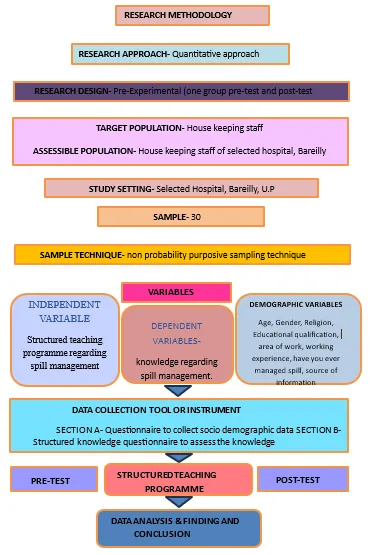
ANALYSIS AND INTERPRETATION:
Table 1: Frequency and Percentage Distribution of Housekeeping Staff According to Socio-Demographic Variables (N=30)
| S. No. | Socio-Demographic Variables | Frequency (f) | Percentage (%) |
|---|---|---|---|
| 1 | Age (in years) | ||
| a) 20–30 years | 12 | 40.0 | |
| b) 31–40 years | 10 | 33.3 | |
| c) 41–50 years | 6 | 20.0 | |
| d) Above 50 years | 2 | 6.7 | |
| 2 | Gender | ||
| a) Male | 19 | 63.3 | |
| b) Female | 11 | 36.7 | |
| 3 | Educational Qualification | ||
| a) No Formal Education | 4 | 13.3 | |
| b) Primary Education | 12 | 40.0 | |
| c) Secondary Education | 11 | 36.7 | |
| d) Higher Secondary | 3 | 10.0 | |
| e) Graduate and Above | 0 | 0.0 | |
| 4 | Area of Work | ||
| a) General Ward | 10 | 33.3 | |
| b) ICU | 5 | 16.7 | |
| c) Operation Theatre (OT) | 4 | 13.3 | |
| d) Emergency Department | 4 | 13.3 | |
| e) OPD | 4 | 13.3 | |
| f) Others | 3 | 10.0 | |
| 5 | Have you ever managed any spill in your work area? | ||
| a) Yes | 21 | 70.0 | |
| b) No | 9 | 30.0 | |
| 6 | Source of Information Regarding Spill Management | ||
| a) Hospital Orientation Programme | 12 | 40.0 | |
| b) In-service Education | 8 | 26.7 | |
| c) Supervisor/Colleagues | 6 | 20.0 | |
| d) Others | 4 | 13.3 | |
Table 2: Comparison of the Pre-test and Post-test Knowledge Level Regarding Spill Management Among Housekeeping Staff
| Knowledge Level | Score Range | Pre-test f | Pre-test % | Post-test f | Post-test % |
|---|---|---|---|---|---|
| Inadequate | 1–10 | 17 | 56.7 | 0 | 0.0 |
| Moderate | 11–20 | 13 | 43.3 | 24 | 80.0 |
| Adequate | 21–30 | 0 | 0.0 | 6 | 20.0 |
| Total | 30 | 100.0 | 30 | 100.0 | |
Table 3: Evaluation of the Effectiveness of the Structured Teaching Programme and Testing of the Research Hypothesis N = 30
| Test | Mean | SD | Mean Difference | Calculated t | df | p-value | Result |
|---|---|---|---|---|---|---|---|
| Pre-test | 10.13 | 2.53 | 7.03 | 30.94 | 29 | <0.001 | S |
| Post-test | 17.17 | 3.37 | |||||
N = 30
Table 4: Association between the pre-test knowledge level regarding spill management and the selected socio-demographic variables of housekeeping staff.
| S.No. | Socio-Demographic Variable | Inadequate n (%) | Moderate n (%) | χ² | df | p-value | Result |
|---|---|---|---|---|---|---|---|
| 1 | Age (in years) | ||||||
| a) 20–30 years | 6 (50.0) | 6 (50.0) | 1.086 | 3 | 0.780 | NS | |
| b) 31–40 years | 7 (70.0) | 3 (30.0) | |||||
| c) 41–50 years | 3 (50.0) | 3 (50.0) | |||||
| d) Above 50 years | 1 (50.0) | 1 (50.0) | |||||
| 2 | Gender | ||||||
| a) Male | 10 (52.6) | 9 (47.4) | 0.042 | 1 | 0.838 | NS | |
| b) Female | 7 (63.6) | 4 (36.4) | |||||
| 3 | Educational Qualification | ||||||
| a) No Formal Education | 3 (75.0) | 1 (25.0) | 1.987 | 3 | 0.575 | NS | |
| b) Primary Education | 5 (41.7) | 7 (58.3) | |||||
| c) Secondary Education | 7 (63.6) | 4 (36.4) | |||||
| d) Higher Secondary | 2 (66.7) | 1 (33.3) | |||||
| e) Graduate and Above | 0 (0.0) | 0 (0.0) | |||||
| 4 | Area of Work | ||||||
| a) General Ward | 7 (70.0) | 3 (30.0) | 9.027 | 5 | 0.108 | NS | |
| b) ICU | 1 (20.0) | 4 (80.0) | |||||
| c) Operation Theatre (OT) | 3 (75.0) | 1 (25.0) | |||||
| d) Emergency Department | 3 (75.0) | 1 (25.0) | |||||
| e) OPD | 3 (75.0) | 1 (25.0) | |||||
| f) Others | 0 (0.0) | 3 (100.0) | |||||
| 5 | Previous Spill Management Experience | ||||||
| a) Yes | 12 (57.1) | 9 (42.9) | 0.000 | 1 | 1.000 | NS | |
| b) No | 5 (55.6) | 4 (44.4) | |||||
| 6 | Source of Information Regarding Spill Management | ||||||
| a) Hospital Orientation Programme | 7 (58.3) | 5 (41.7) | 4.548 | 3 | 0.208 | NS | |
| b) In-service Education | 4 (50.0) | 4 (50.0) | |||||
| c) Supervisor/Colleagues | 2 (33.3) | 4 (66.7) | |||||
| d) Others | 4 (100.0) | 0 (0.0) | |||||
NS = Not Significant at p > 0.05
REFERENCES






Srishti, Surbhi, Shivani Yadav, Sonu Sagar, Anju Singh, Mahima Singh, “A Study to Assess the Effectiveness of a Structured Teaching Programme on Knowledge Regarding Spill Management Among Housekeeping Staff in Selected Hospitals of Bareilly, U.P.”, Int. J. Sci. R. Tech., 2026, 3 (11), 273-278. https://doi.org/10.5281/zenodo.23974849
 10.5281/zenodo.23974849