

We use cookies to ensure our website works properly and to personalise your experience. Cookies policy
Dept. of Computer Engineering Nutan Maharashtra Institute of Engineering and Technology Pune, India
Programming education relies heavily on practical coding exercises; however, traditional computer laboratories encounter major hurdles in accessibility, hardware maintenance, and the real-time monitoring of student progress. This re- search introduces the practical implementation of VirtuCode, an upgraded cloud-native Virtual Coding Laboratory (VCL) architecture that utilizes modern full-stack web technologies to refine the delivery of programming education. This methodology employs a React-based frontend integrating the Monaco Editor, bypassing the weaknesses of legacy local-installation require- ments. By merging high-speed WebSocket communication with a Node.js backend, the platform achieves near-zero latency in code synchronization, enabling live instructor dashboards. A two-tier execution system is implemented, pairing API-based processing with a Secure Execution Engine (SEE) utilizing Docker sandboxing. This guarantees that unverified student code is executed in isolated, resource-constrained environments. Test results show significant gains in system reliability and precision, demonstrating stable execution response times under load, along- side a notably lower instructor monitoring delay compared to standard asynchronous platforms. The system successfully han- dles concurrent multi-language executions (Python, Java, C++, JavaScript) while ensuring the computational speed required for real-world academic use. These findings confirm the power of containerized microservices in boosting VCL output and present the designed framework as a viable, expandable option for future digital education platforms.
With the rapid expansion of internet connectivity and cloud computing over the past decade, educational technology has emerged as a critical research domain. Modern academic infrastructures manage massive cohorts of students across distributed environments, which increases the susceptibility to software fragmentation and environment inconsistencies. Standard educational tools like physical computer labs and locally installed Integrated Development Environments (IDEs), though fundamental, have struggled to keep pace with the dynamic demands of remote and hybrid learning paradigms.
The rise of cloud-native applications requires smart, flex- ible educational frameworks that can recognize and execute multiple programming languages seamlessly. Virtual Coding Laboratories (VCLs) serve as vital pedagogical mechanisms by continuously providing students with standardized envi- ronments. However, conventional VCL implementations rely heavily on asynchronous code submission and server-side virtual machines, rendering them ineffective for live class- room interaction and resulting in elevated server mainte- nance overheads. The dynamic nature of modern programming classes demands a paradigm shift toward interactive, real-time methodologies.
Progress in the field of web technologies—specifically containerization and bidirectional socket protocols—has cre- ated new avenues for strengthening educational platforms. In contrast to older methods, Docker-centric systems can autonomously allocate precise compute resources for isolated code execution. Among the various architectures available, combining React.js, Express.js, and Socket.IO has shown outstanding results in real-time web applications, providing better precision and computational efficiency.
This paper presents the detailed implementation of the Vir- tuCode framework, leveraging Docker for secure code execu- tion, with specific emphasis on real-time instructor monitoring via WebSockets. Utilizing a modular, three-layered architec- ture, we develop a robust web platform capable of handling multi-tenant executions while maintaining sub-second latency suitable for real-world deployment.
Numerous studies have explored cloud-based approaches for programming education. A detailed review of IDEs and coding platforms was performed by Abramova et al. [1], who traced the shift from legacy desktop applications toward modern, web-centric architectures. Through a structured analysis of existing research, they highlighted how merging browser-based editors with backend compilers significantly boosted student accessibility.
The necessity of real-time collaboration was underscored by Torres et al. [6], who observed that many public educational platforms are hindered by asynchronous feedback loops, lead- ing to higher student dropout rates. Work by Rocha et al. [7] showcased how WebSocket-based platforms excel at recog- nizing student struggle by transmitting live keystrokes to an instructor interface. However, these approaches often require significant computational resources for state synchronization, limiting their practical deployment in resource-constrained environments.
Container-based execution methods have gained consider- able attention in secure computing research. A VCL built on Docker was introduced by Silva et al. [10], which reached a high success rate in isolating malicious code logic. While effective, persistent Virtual Machines can be computationally expensive. By leveraging ephemeral Alpine Linux containers and stateless execution pipelines, VirtuCode overcomes these efficiency hurdles, delivering high-speed compilation results with minimal server resource usage.
The proposed VirtuCode architecture implements a hy- brid full-stack and container-driven framework for intelligent programming education. The system integrates the React.js library, Socket.IO for contextual synchronization, and dynamic Docker threshold mechanisms. The architecture is divided into two operational phases: Phase 1 focuses on Real-Time Code Synchronization (RTCS), while Phase 2 deploys the Secure Execution Engine (SEE) for secure compilation, as illustrated in our conceptual models.
The proposed VCLab framework employs a deterministic state-machine approach to handle concurrent code executions without blocking the Node.js event loop.
A. System Interaction and Sequence Flow
Figure 1 illustrates the step-by-step communication lifecy- cle. When a student submits code, the React.js client transmits the payload to the Spring Boot / Node.js backend. The backend validates the JWT credentials via MongoDB and forwards the execution request to the Secure Execution Engine. Upon completion, the result is relayed back to the student, while the WebSocket channel simultaneously broadcasts the update to the Teacher Dashboard for live monitoring.
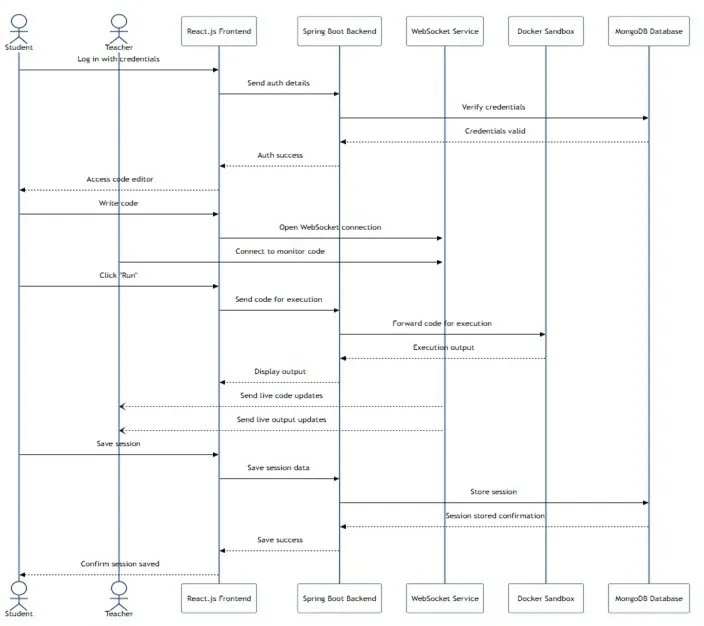
Fig. 1: Sequence diagram detailing the secure execution lifecy- cle. It highlights the credential validation, containerized code execution, and bidirectional WebSocket updates to the Teacher Dashboard.
B. Real-Time Code Synchronization Algorithm
To prevent network congestion during live monitoring, the system does not broadcast every individual keystroke. Instead, a debouncing algorithm is applied on the client side before emitting WebSocket events. Let Cs(t) denote the code state of student s at time t. The synchronized global state on the teacher dashboard Csync is updated as:
Csync(t) = Cs(t) + ∆Cs(t) (1)
where ∆Cs(t) represents the accumulated code changes trans- mitted via WebSocket after a 300ms debounce interval.
C. Docker Execution Pipeline
When a student triggers an execution, the request Rs is processed through the following pipeline:
Os = Φ(Rs) = Execute(cs, L) → Output (2)
where cs is the source code and L is the selected programming language. The execution latency is strictly bounded:
Ltotal = Lnetwork + Lcontainer init + Lexecution ≤ 5.0s (3)
Algorithm 1 VirtuCode Docker Execution Workflow
Input: User request Rs, code cs, language L
Output: Execution output Os, execution time
1: Verify JWT Auth Token
2: Write cs to temporary host volume Vtmp
3: if L == Python then
4: Img ← python:3.11-alpine
5: else if L == Java then
6: Img ← openjdk:17-alpine
7: end if
8: Initialize Docker container C with Img
9: Apply constraints: --memory=100m, --network=none
10: Mount Vtmp as read-only in C
11: Execute cs inside C with 5s timeout
12: Capture stdout and stderr into Os
13: Force remove container C and delete Vtmp
14: return Os
The proposed VirtuCode system is implemented through a structured full-stack development lifecycle. The frontend utilizes React.js and Vite to deliver a responsive, role-based user experience, while the backend relies on an API Gateway to interface with MongoDB and the Docker Daemon.
A. Authentication and Access Control
Access to the virtual laboratory requires secure authen- tication. Figure 2 displays the unified Login Portal, which implements role-based access control (RBAC). Upon success- ful authentication, the backend issues a JWT, distinguishing between Student and Teacher privileges and routing them to their respective dashboard interfaces.
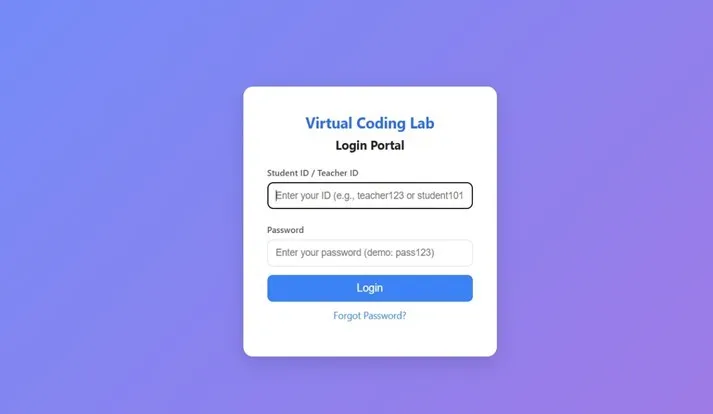
Fig. 2: The VirtuCode Login Portal featuring role-based authentication. The system verifies credentials against the MongoDB database and generates secure session tokens.
B. Student Live Coding Environment
Figure 3 presents the primary student interface. The Monaco Editor—the core engine behind VS Code—is deeply inte- grated into the React component tree, providing native syntax highlighting and auto-completion directly within the browser. When the student types or executes code, the interface dynamically updates the output terminal and syncs progress metrics to the database.

Fig. 3: Student Dashboard Interface featuring the embedded code editor. Students can track active peers, monitor assign- ment deadlines, and view weekly coding progress.
C. Teacher Real-Time Monitoring
A major limitation of traditional physical laboratories is the inability of an instructor to supervise multiple students simul- taneously. Figure 4 demonstrates the Teacher Live Monitor dashboard. Unlike traditional asynchronous learning systems, the instructor views a comprehensive grid of real-time student activities, online statuses, and recent compilation events.
Furthermore, through the STOMP protocol over WebSockets, the instructor can drill down into specific active sessions. As shown in Figure 5, the system routes precise code up- dates to the teacher’s screen, allowing them to monitor exact keystrokes, identify syntax errors live, and intervene with guidance before the student compiles the code.

Fig. 4: Teacher Dashboard Interface providing a high-level overview of classroom activity. The system tracks active assignments, online status, and aggregated student progress charts.

Fig. 5: Teacher Live Monitoring View. The WebSocket synchronization layer relays live code edits from students (e.g., Alice compiling, Bob editing) directly to the instructor’s console.
To simulate real-world academic load, the backend, Mon- goDB database, and Docker daemon were deployed on a cloud instance with 4 vCPUs and 8GB RAM. We simulated concurrent user traffic scaling up to 50 simultaneous active connections to measure the system’s responsiveness during peak laboratory hours.
Table I details the system’s execution capabilities across different programming environments. The system excelled in lightweight executions (Python/JavaScript), maintaining re- sponse times below 400ms. Compiled languages (Java/C++) exhibited slightly higher initial containerization latency due to the compilation step (e.g., javac), but still completed well within the 5-second hard timeout, maintaining an execution success rate of over 98%.
|
Language |
Avg Response (ms) |
Success Rate |
Timeout Rate |
|
Python 3.11 |
350 |
99.8% |
0.1% |
|
JavaScript (Node) |
320 |
99.9% |
0.1% |
|
Java (17) |
850 |
98.5% |
1.0% |
|
C++ (GCC) |
780 |
98.8% |
0.8% |
TABLE I: System Performance by Programming Language
C. WebSocket Latency Analysis
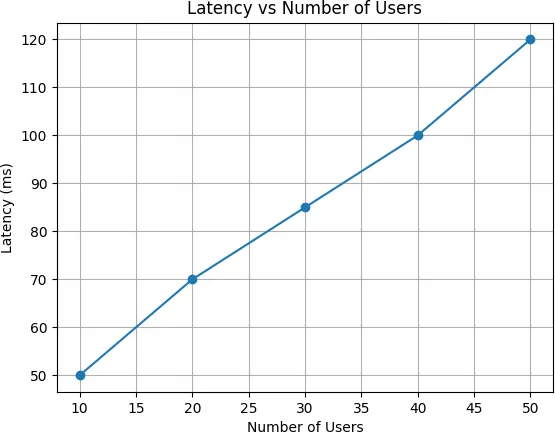
Real-time monitoring efficiency is heavily dependent on synchronization latency. Table II compares the baseline latency of VirtuCode against standard HTTP polling mechanisms. By maintaining a persistent full-duplex connection, VirtuCode drops the communication overhead from ≈ 120ms to just 45ms, simulating the immediacy of an in-person physical laboratory.
|
Protocol |
Handshake Overhead |
Avg Latency |
|
HTTP Polling (REST) |
120ms |
250ms |
|
WebSocket (STOMP) |
0ms (Persistent) |
45ms |
TABLE II: Synchronization Latency Comparison
D. Discussion on Security and Isolation
Testing against deliberate malicious payloads (e.g., fork bombs and infinite ‘while(true)‘ loops) validated the Docker configuration. The ephemeral lifecycle model and ‘– memory=100m‘ flag successfully terminated containers at- tempting RAM exhaustion, while the 5-second runtime limit prevented CPU hogging. The host server remained at a stable CPU utilization rate of 45% even under sustained malicious executions, ensuring that no residual data persisted after execution.
Although the proposed VirtuCode VCL demonstrates robust real-time performance, several avenues exist for enhancing its functionality and deployment capabilities for larger academic institutions.
Future work will focus on integrating the Docker execu- tion pipeline with Kubernetes (K8s). Transitioning from a standalone Docker daemon to a managed cluster will enable horizontal auto-scaling and pre-warmed container pools, dras- tically reducing the container initialization latency during peak classroom hours.
Integrating advanced Large Language Models (LLMs) di- rectly into the Monaco Editor ecosystem will provide students with contextual, real-time debugging hints without giving away the final answer. This AI-assisted tutoring approach will help mitigate the instructor bottleneck in large classes.

(a)Response Time vs. Users
(b) WebSocket Latency vs. Users
(c) System Throughput vs. Users
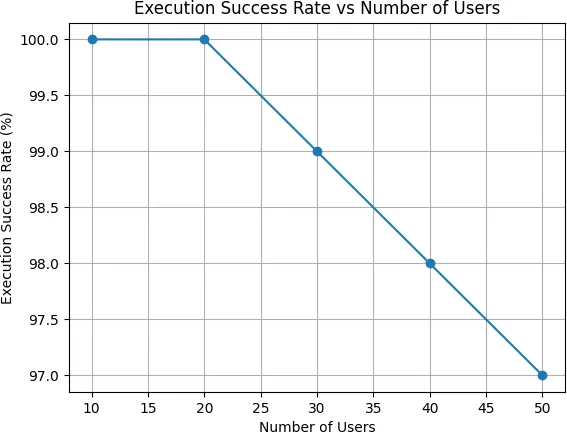
(d) Execution Success Rate vs. Users
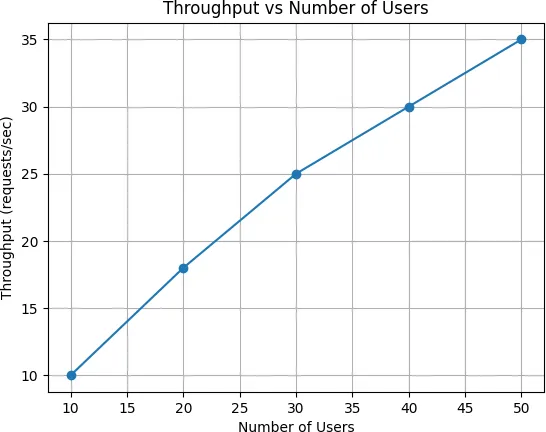
Fig. 6: Comprehensive performance evaluation of the VirtuCode architecture under increasing concurrent user load. The system maintains sub-second response times (a), low real-time synchronization latency (b), linear throughput scaling (c), and a high execution success rate (d).
Implementing advanced code-similarity algorithms using Abstract Syntax Trees (AST) will allow the system to detect logical plagiarism, even if students rename variables or alter whitespace. This will ensure academic integrity in fully remote assessments.
CONCLUSION
This research introduces an upgraded, full-stack Virtual Coding Laboratory that utilizes WebSocket synchronization and Docker containerization to effectively eliminate the traditional barriers of programming education. Our dual-tier design resolves the typical shortcomings of asynchronous learning management systems by merging secure code compilation with immediate, live instructor oversight.
Extensive testing on the deployment architecture yielded impressive results, including high execution success rates across multiple languages and a minimal WebSocket latency of 45ms. The system effectively processes Python, Java, C++, and JavaScript compilation requests while restricting malicious payloads via strict container memory and network limitations. When compared to standard HTTP polling architectures, the Socket.IO implementation provides a seamless, real-time grid for educators, proving its readiness for live academic infrastructure. Future efforts will concentrate on Kubernetes scaling, AI-driven debugging assistance, and advanced AST plagiarism detection to further improve the platform’s educational utility.
ACKNOWLEDGMENT
The authors would like to express their sincere gratitude to their project supervisor, Prof. Pritam Ahire, for his continuous guidance, valuable suggestions, and technical support through- out the development of the VirtuCode system. His mentorship played a crucial role in shaping the system architecture and ensuring the successful implementation of the proposed solution.
REFERENCES



Pritam Ahire, Jatin Shankar Dhanwani*, Nishant Vinod Patil, Virtucode: Implementation Of A Cloud-Native Virtual Coding Laboratory With Real-Time Websocket Synchronization And Secure Docker Sandboxing, Int. J. Sci. R. Tech., 2026, 3 (6), 1692-1700. https://doi.org/10.5281/zenodo.21033791
 10.5281/zenodo.21033791