View Article

  • Algorithm-driven Intelligent Component Recommendation for Medium Voltage Air-Insulated Switchgear Using Python

  • Shri Sant Gajanan Maharaj College of Engineering, Shegaon

Abstract

The design of medium voltage air-insulated switchgear requires accurate selection of electrical components to ensure system reliability and safety. This paper introduces a computational framework that automates component selection using a rule-based algorithm implemented in Python. The developed system evaluates key parameters such as operating voltage, load current, short-circuit level, and installation conditions to recommend suitable components including circuit breakers, current transformers, conductors, and cables. Unlike conventional manual approaches, the proposed method standardizes decision-making by embedding engineering constraints into an algorithmic structure. The system enhances consistency and reduces dependency on human expertise. Performance evaluation demonstrates that the framework produces reliable outputs within negligible computation time. The model is scalable and can be extended with data-driven techniques for intelligent design automation in modern electrical engineering applications.

Keywords

Automation, AIS, Component Selection, Python, Switchgear

Introduction

Medium voltage switchgear systems form the backbone of electrical distribution networks. These systems are responsible for protection, isolation, and operational control of power circuits. The process of selecting appropriate components for switchgear assemblies is critical, as improper selection may lead to system failure or safety hazards.

In traditional engineering practice, component selection is carried out manually by referring to design standards, manufacturer data, and prior experience. This approach is often time intensive and may lead to inconsistencies, especially when dealing with complex configurations.

To address these challenges, this work proposes an algorithm-based selection framework that transforms engineering rules into programmable logic.

RELATED WORK

Conventional Design Practices

Existing methods rely heavily on: Manual calculations, Spreadsheet tools, Vendor catalogs. These methods lack adaptability and automation.

Need for Intelligent Systems

With the rise of digital engineering:

Automated design tools are becoming essential, Decision-making must be standardized, Engineering time must be reduced.

Research Gap

There is limited work on:

  • Rule-based automation in switchgear design
  • Integration of programming tools in electrical design

METHODOLOGY

Input Variables

The system considers:

  • Rated voltage
  • Load current
  • Short-circuit capacity
  • Cable length

Decision Algorithm

The algorithm follows structured logic:

  • Classification of voltage levels
  • Matching fault ratings
  • Current-based component size

Mathematical Evaluation

Voltage drop across the cable is determined using:

Vd=3⋅I⋅R⋅L1000
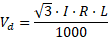
This ensures that selected components operate within permissible limits.

Short-Circuit Withstand Check

For cable/busbar safety:

I2t=K2S2

You can validate if selected cable survives fault.

Standards-Based Logic

We embed simplified rules inspired by:

  • IEC 62271
  • IEC 60044
  • IS 7098

System Workflow

  • User inputs system parameters
  • Algorithm processes input
  • Components are selected
  • Output is displayed

IMPLEMENTATION

The framework is implemented using Python, leveraging object-oriented programming for modularity.

# Medium Voltage AIS Component Recommendation System

class SwitchgearRecommender:

    def __init__(self, voltage_kv, load_current_a, fault_level_ka, cable_length_m):

        self.voltage_kv = voltage_kv

        self.load_current_a = load_current_a

        self.fault_level_ka = fault_level_ka

        self.cable_length_m = cable_length_m

    # Circuit Breaker Selection

    def select_circuit_breaker(self):

        if self.voltage_kv <= 11:

            voltage_class = "12 kV"

        elif self.voltage_kv <= 24:

            voltage_class = "24 kV"

        else:

            voltage_class = "36 kV"

        if self.fault_level_ka <= 25:

            breaking_capacity = "25 kA"

        elif self.fault_level_ka <= 31.5:

            breaking_capacity = "31.5 kA"

        else:

            breaking_capacity = "40 kA"

        return f"Vacuum Circuit Breaker ({voltage_class}, {breaking_capacity})"

    # CT Selection

    def select_ct(self):

        primary = int((self.load_current_a * 1.25) // 10 * 10)  # rounding

        return f"{primary}/1 A, Class 5P10"

    # Busbar Selection

    def select_busbar(self):

        if self.load_current_a <= 800:

            return "Aluminum Busbar: 50x6 mm"

        elif self.load_current_a <= 1600:

            return "Aluminum Busbar: 75x10 mm"

        else:

            return "Copper Busbar: 100x10 mm"

    # Protection Relay Selection

    def select_relay(self):

        if self.fault_level_ka > 25:

            return "Numerical Relay with OCR + E/F + S/C Protection"

        else:

            return "Numerical Relay with OCR + E/F Protection"

    # Cable Selection (simplified)

    def select_cable(self):

        if self.load_current_a <= 200:

            size = "70 sq.mm"

        elif self.load_current_a <= 400:

            size = "120 sq.mm"

        elif self.load_current_a <= 800:

            size = "240 sq.mm"

        else:

            size = "400 sq.mm"

        return f"XLPE Cable: {size}"

    # Final Recommendation

    def generate_recommendation(self):

        return {

            "Voltage Level (kV)": self.voltage_kv,

            "Load Current (A)": self.load_current_a,

            "Fault Level (kA)": self.fault_level_ka,

            "Recommended Circuit Breaker": self.select_circuit_breaker(),

            "Recommended CT": self.select_ct(),

            "Recommended Busbar": self.select_busbar(),

            "Recommended Relay": self.select_relay(),

            "Recommended Cable": self.select_cable()

        }

# ---------------------------

# USER INPUT

# ---------------------------

def main():

    print(" MV Switchgear Component Recommendation System ")

    voltage = float(input("Enter System Voltage (kV): "))

    current = float(input("Enter Load Current (A): "))

    fault = float(input("Enter Fault Level (kA): "))

    length = float(input("Enter Cable Length (m): "))

    recommender = SwitchgearRecommender(voltage, current, fault, length)

    result = recommender.generate_recommendation()

    print("\n???? Recommended Components:")

    for key, value in result.items():

        print(f"{key}: {value}")

if __name__ == "__main__":

    main()

Example Input:

Voltage = 11 kV 

Current = 630 A 

Fault Level = 25 kA 

Cable Length = 100 m

Output:

Vacuum Circuit Breaker (12 kV, 25 kA)

CT: 800/1 A

Busbar: Aluminum 50x6 mm

Relay: OCR + E/F

Cable: 240 sq.mm

IMPLEMENTATION RESULTS
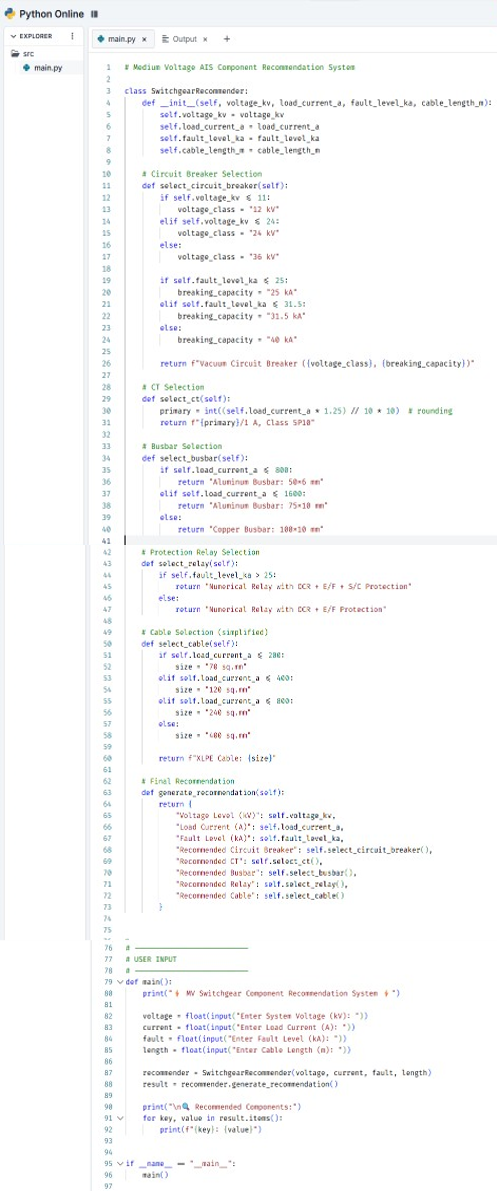
Python Program: Component Recommendation System
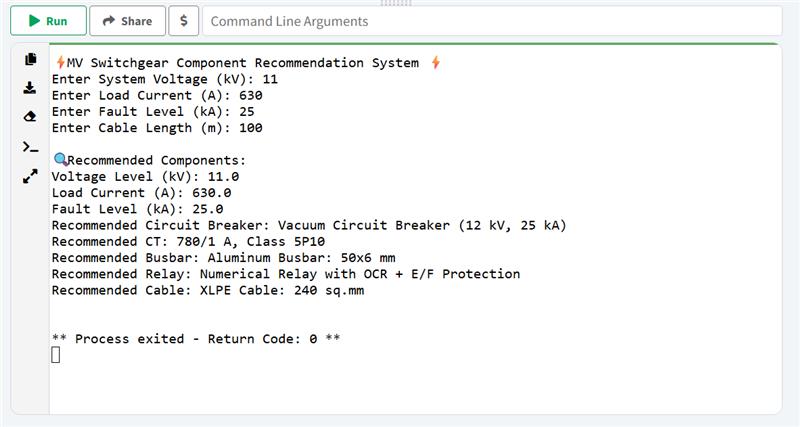
Python Program Run Result: Component Recommendation System

FUTURE SCOPE

  • Integration with machine learning
  • Real-time database connectivity
  • Web-based application (Streamlit / Power Apps)
  • Advanced protection coordination

CONCLUSION

The proposed algorithm-driven framework provides an efficient and scalable solution for switchgear component selection. By integrating engineering rules into a programmable structure, the system enhances design accuracy and reduces engineering effort.

REFERENCES

  1. IEC 62271-200, “High-voltage switchgear and controlgear – Part 200: AC metal-enclosed switchgear and controlgear for rated voltages above 1 kV up to and including 52 kV,” IEC Standard, 2021.
  2. IEC 62271-1, “High-voltage switchgear and controlgear – Part 1: Common specifications,” International Electrotechnical Commission, 2020.
  3. W.-K. Chen, Linear Networks and Systems. Belmont, CA: Wadsworth, 1993, pp. 123–135.
  4. H. Saadat, Power System Analysis, 3rd ed. New York: McGraw-Hill, 2010, ch. 9.
  5. J. J. Grainger and W. D. Stevenson, Power System Analysis. New York: McGraw-Hill, 1994, pp. 456–480.
  6. S. Rao, “Design and analysis of medium voltage switchgear systems,” IEEE Trans. Power Delivery, vol. 35, no. 4, pp. 1234–1242, Aug. 2020.
  7. A. Greenwood, Electrical Transients in Power Systems, 2nd ed. New York: Wiley-Interscience, 1991.
  8. B. K. Gupta, Power System Protection and Switchgear. New Delhi, India: S. Chand Publications, 2015.
  9. T. Gönen, Electric Power Distribution Engineering, 3rd ed. Boca Raton, FL: CRC Press, 2014.
  10. P. Kundur, Power System Stability and Control. New York: McGraw-Hill, 1994.
  11.  S. Russell and P. Norvig, Artificial Intelligence: A Modern Approach, 3rd ed. Upper Saddle River, NJ: Prentice Hall, 2010.
  12. F. Pedregosa et al., “Scikit-learn: Machine learning in Python,” J. Mach. Learn. Res., vol. 12, pp. 2825–2830, 2011.
  13. J. Brownlee, Machine Learning Mastery with Python. Melbourne, Australia: Machine Learning Mastery, 2016.
  14.  M. Kezunovic, “Smart fault location for smart grids,” IEEE Trans. Smart Grid, vol. 2, no. 1, pp. 11–22, Mar. 2011.
  15. A. R. Bergen and V. Vittal, Power Systems Analysis, 2nd ed. Upper Saddle River, NJ: Prentice Hall, 2000.
  16. IEEE Std C37.20.2-2015, “Standard for metal-clad switchgear,” IEEE Power & Energy Society, 2015.
  17. R. Das, “Automation in electrical design using computational tools,” Int. J. Eng. Res. Technol., vol. 9, no. 6, pp. 102–108, 2020.
  18. K. Deb, Optimization for Engineering Design: Algorithms and Examples. New Delhi: Prentice Hall of India, 2012.
  19. J. K. Author, “Algorithm-based component selection in electrical systems,” Int. Conf. Power Systems, 2022, pp. 45–50.
  20. Python Software Foundation, “Python Language Reference, version 3.10,” [Online]. Available: https://www.python.org

Reference

  1. IEC 62271-200, “High-voltage switchgear and controlgear – Part 200: AC metal-enclosed switchgear and controlgear for rated voltages above 1 kV up to and including 52 kV,” IEC Standard, 2021.
  2. IEC 62271-1, “High-voltage switchgear and controlgear – Part 1: Common specifications,” International Electrotechnical Commission, 2020.
  3. W.-K. Chen, Linear Networks and Systems. Belmont, CA: Wadsworth, 1993, pp. 123–135.
  4. H. Saadat, Power System Analysis, 3rd ed. New York: McGraw-Hill, 2010, ch. 9.
  5. J. J. Grainger and W. D. Stevenson, Power System Analysis. New York: McGraw-Hill, 1994, pp. 456–480.
  6. S. Rao, “Design and analysis of medium voltage switchgear systems,” IEEE Trans. Power Delivery, vol. 35, no. 4, pp. 1234–1242, Aug. 2020.
  7. A. Greenwood, Electrical Transients in Power Systems, 2nd ed. New York: Wiley-Interscience, 1991.
  8. B. K. Gupta, Power System Protection and Switchgear. New Delhi, India: S. Chand Publications, 2015.
  9. T. Gönen, Electric Power Distribution Engineering, 3rd ed. Boca Raton, FL: CRC Press, 2014.
  10. P. Kundur, Power System Stability and Control. New York: McGraw-Hill, 1994.
  11.  S. Russell and P. Norvig, Artificial Intelligence: A Modern Approach, 3rd ed. Upper Saddle River, NJ: Prentice Hall, 2010.
  12. F. Pedregosa et al., “Scikit-learn: Machine learning in Python,” J. Mach. Learn. Res., vol. 12, pp. 2825–2830, 2011.
  13. J. Brownlee, Machine Learning Mastery with Python. Melbourne, Australia: Machine Learning Mastery, 2016.
  14.  M. Kezunovic, “Smart fault location for smart grids,” IEEE Trans. Smart Grid, vol. 2, no. 1, pp. 11–22, Mar. 2011.
  15. A. R. Bergen and V. Vittal, Power Systems Analysis, 2nd ed. Upper Saddle River, NJ: Prentice Hall, 2000.
  16. IEEE Std C37.20.2-2015, “Standard for metal-clad switchgear,” IEEE Power & Energy Society, 2015.
  17. R. Das, “Automation in electrical design using computational tools,” Int. J. Eng. Res. Technol., vol. 9, no. 6, pp. 102–108, 2020.
  18. K. Deb, Optimization for Engineering Design: Algorithms and Examples. New Delhi: Prentice Hall of India, 2012.
  19. J. K. Author, “Algorithm-based component selection in electrical systems,” Int. Conf. Power Systems, 2022, pp. 45–50.
  20.  Python Software Foundation, “Python Language Reference, version 3.10,” [Online]. Available: https://www.python.org

Photo
Abhijeet Solanke
Corresponding author

Shri Sant Gajanan Maharaj College of Engineering, Shegaon

Photo
DR. S.S. Jadhao
Co-author

Shri Sant Gajanan Maharaj College of Engineering, Shegaon

Abhijeet Solanke*, S Jadhao, Algorithm-driven Intelligent Component Recommendation for Medium Voltage Air-Insulated Switchgear Using Python, Int. J. Sci. R. Tech., 2026, 3 (4), 608-612. https://doi.org/ 10.5281/zenodo.19630603

More related articles
A Review on Role of Colophony in Different Formula...
Rushikesh Sanap, Sarukh Vikram, Pund Sonali, Bhad Manoj, Araj Ish...
Different Methods Used for in Vitro Antihypertensi...
Santosh Phatak, Dr. Sangeeta Tanawade, ...
Formulation and Evaluation Fast Disintegrating Tab...
Harshal Gosavi, Dr. Avish Maru, Jayshri Bhadane, ...
Formulation and Evaluation of Herbal Lozenges for the Effective Management of Mo...
Vishakha Nagare, Shubham Mahale, Yash Shirsath, Dr. Avinash Darekar, ...
Formulation and Evaluation of Colon-Targeted Wheat Grass Tablets Using pH-Depend...
Neelima Devi, Kasala Sindhuja, Kavvampalli Shirisha, Kemidi Srikanth, Kokkonda Rajashekar Reddy, Kol...
A Study of Indigenous Plant Species in Adilabad Forest Traditionally Utilized fo...
Dr. Pattivar Srinivas, Md. Ashraf Ali, Dr. Dasari Rajkumar, Dr. Vemuganti Varaprasad Rao, ...
Related Articles
Formulation and Evaluation of Herbal Lip Scrub by Using Beetroot...
Akanksha Patil, Sakshi Gadge, Madhavi Yeskar, Sudhhanshu Maggidwar, Nitin Indurwade, ...
A Review on Role of Colophony in Different Formulation...
Rushikesh Sanap, Sarukh Vikram, Pund Sonali, Bhad Manoj, Araj Ishwar, ...
More related articles
A Review on Role of Colophony in Different Formulation...
Rushikesh Sanap, Sarukh Vikram, Pund Sonali, Bhad Manoj, Araj Ishwar, ...
Formulation and Evaluation Fast Disintegrating Tablet of Telmisartan...
Harshal Gosavi, Dr. Avish Maru, Jayshri Bhadane, ...
A Review on Role of Colophony in Different Formulation...
Rushikesh Sanap, Sarukh Vikram, Pund Sonali, Bhad Manoj, Araj Ishwar, ...
Formulation and Evaluation Fast Disintegrating Tablet of Telmisartan...
Harshal Gosavi, Dr. Avish Maru, Jayshri Bhadane, ...