

We use cookies to ensure our website works properly and to personalise your experience. Cookies policy
Nalanda Institute Of Pharmaceutical Sciences, Siddharth Nagar, Kantepudi (V), Sattenapallli (M), Guntur (DIST)522438, Andhra Pradesh, India.
The purpose of this article is the historical survey of the foundation and development of pharmacology in Tartu (Dorpat), Estonia. Pharmacology was founded in Tartu by Naunyn, Buchheim, and Schmiedeberg. Genealogy and biographies including selected references of pharmacologists and pupils, who acted from the very beginning to today as directors of the Department of Pharmacology, as well as its successor, the Institute of Pharmacology and Toxicology, are presented and commented. This history also illustrates the conditions that are important for the development of new scientific areas. It is not a central geographical location or a formal “center of excellence” with lots of financial resources but rather brilliant researchers with the right spirit and vision and academic freedom. The implications of the early history of pharmacology for the future of science are discussed.
PHARMACOLOGY:
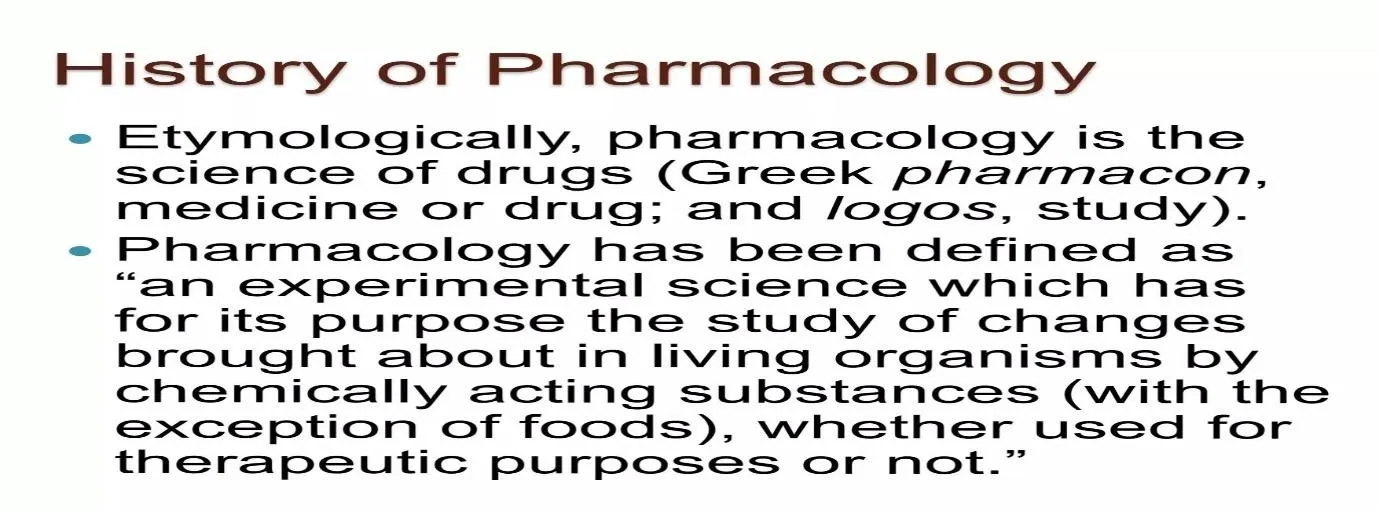
The science of drugs (Greek: Pharmacon-drug; logos-discourse in Pharmacology is the study of the therapeutic value and/or potential toxicity of chemical agents on biological systems. In simple terms, it is study of all the aspects of drug.
It targets every aspect of the mechanisms for the chemical actions of both traditional and novel therapeutic agents. Two important and interrelated areas are: pharmacodynamic and pharmacokinetics. Pharmacodynamic (Greek: dynamis-power) (what drug does with the body) are the study of the molecular, biochemical, and physiological effects of drugs on cellular systems and their mechanisms of action. Pharmacokinetics (Greek: Kinesismovement) (what body does with the drug) deals with the absorption, distribution, and excretion of drugs.
Pharmacotherapeutics It is the application of pharmacological information together with knowledge of the disease for its prevention, mitigation or cure. Selection of the most appropriate drug, dosage and duration of treatment taking into account the stage of disease and the specific features of a patient are a part of pharmacotherapeutics. Clinical pharmacology It is the scientific study of drugs (both old and new) in man. It includes pharmacodynamic and pharmacokinetic investigation in healthy volunteers as well as in patients. Evaluation of efficacy and safety o f drugs and comparative trials with other forms of treatment; surveillance of patterns of drug use, adverse effects, etc. are also part of clinical pharmacology.
The aim of clinical pharmacology is to generate data for optimum use of drugs and the practice of 'evidence based medicine'. Chemotherapy It is the treatment of systemic infection/ malignancy with specific drugs that have selective toxicity for the infecting organism/malignant cell with no/minimal effects on the host cells.
Drugs in general, can thus be divided into: Pharmacodynamic agents These are designed to have pharmacodynamic effects in the recipient. Chemotherapeutic agents These are designed to inhibit/kill invading parasites/malignant cell, but have no/minimal pharmacodynamic effects in the recipient.
Toxicology It is the study of poisonous effect of drugs and other chemicals (household, environmental pollutant, industrial, agricultural, homicidal) with emphasis on detection, prevention and treatment of po isonings. It also includes the study of adverse effects of drugs, since the same substance can be a drug or apoison, depending on the dose.
Knowledge of drugs and their uses in diseases are as old as history of mankind. Primitive men gather the knowledge of healing and medicines by observing the nature, noticing the animals while ill & personal experience after consuming plants & herbs as remedies.
Ancient civilizations discovered that extracts from plants, animals, & minerals had medicinal effects on body tissue. These discoveries became the foundation of Pharmacology.
Pharmacology in the present form is relatively recent branch about hundred years old. It is of intellectual interest to know how drugs are discovered and developed.
Often in the past, this was based on folklore or intelligent observation (e.g. digitalis leaf, penicillin). Nowadays, new drugs are mostly developed by the organic chemist working with a Pharmacologist, increasingly from basic knowledge about key molecular targets. Usually some sort of biological screen is used to select among organic molecules for optimum pharmacological activity.
HISTORICAL LANDMARKS
The knowledge of primitive pharmacology developed from human experiences with use of plants. Some plants were safe while others were toxic. Based on this knowledge, a catalogue of good and bad evolved and was passed down through oral traditions. Over the period of time, the knowledge was transformed to include natural sources which appeared to cure some diseases.
The oldest recorded event cites about events in 16th Century bc when beer, turpentine, myrrh, juniper berries and poppy and other therapies were described to treat disease. Similar historical records exist for most ancient civilizations including the Sumerian, Indian and Chinese. In India, Ayurveda has older traditions even before 16th century BCE. Sumerians around 3400 BCE cultivated the opium poppy in lower Mesopotamia and recorded its action in clay tablets. It was referred to as the “joy plant” and its reputation lead to its spread across neighbouring civilizations like Egypt. Around 460 BCE Hippocrates, a famous Greek physician and teacher of medicine, described opium as having narcotic properties and described use of opium in treating internal diseases. In 330 BCE, Alexander the great, introduced opium to Persia and India and by the year 400 it reached China. In the 10th century, the noted Islamic physician Avicenna of Persia described opium as the “most powerful stupefacients”. About the year 1200, the Indian medical treatises The Shodal Gadanigraph and Sharangdhar- Samahita describe the use of opium for diahorrhoea and sexual debility. In the 1300’s opium disappeared from European historical record till 1527; during which Paracelsusprescribed opium as a pain killer.
Francois Magendie (1783-1855), a French Physiologist laid down the dictum "Facts and facts alone are the basis of science." Experimental procedures with animals are the testing grounds for determination of drug action.
He developed experiment to elucidate the physiological processes and action of drugs on the body. Frederich Sertürner, German Pharmacist’s assistant, isolated morphine—the first pure drug—in 1805. Claude Bernard (1813-1878), investigated the plant extract curare & proposed a site of action for this agent. Considered Father of Experimental Medicine. Rudolph Buchheim (1820-1879). A German pharmacologist in 1847 established the first laboratory devoted to Experimental Pharmacology in the basement of his home in Dorpat which is known as the Cradle of Experimental Pharmacology. Oswald Schmiedeberg (18381921). Father of Pharmacology in 1872 set up an Institute of Pharmacology in Strasbourg, France (Germany at that time). J.N. Langley (1852-1925 & Sir Henry Dale (1875-1968) pioneered Pharmacology in England, taking a physiological approach
John J. Abel (1857-1938) established the first chair of Pharmacology in the U.S.A. (U. Michigan, 1891) after training in Germany. Able went to Johns Hopkins in 1893, and trained many U.S. pharmacologists. He is known as "The Father of American Pharmacology". Cofounded the Journal of Pharmacology & Experimental Therapeutics in 1909. L. Mayer Jones (1912-2002) regarded as father of modern veterinary pharmacology. He authored first book of veterinary pharmacology therapeutics in 1954.
The modern era began in 1680 when the English apothecary, Thomas Sydenham introduced Sydenham’s Laudanum which mentioned about many opium proprietary brands useful for various ailments. In 1803, the German Friedrich Serturner dissolved opium in acid and then neutralised it with ammonia resulting in formation of morphine which exhibited long-lasting and predictable effects. By 1827, morphine became a commercial product.
In 1874, an English researcher, Wright synthesised heroin which went into commercial production in Germany by 1898. The molecular basis of opioid action was revealed by Snyder and Pert who located the molecular site of action for opium in 1972. These opioid receptors were found in neural tissues and mediate the pain reducing effect.
Later Hughes and Kosterlitz discovered that humans produce endogenous morphine-like compounds, called as enkephalins, which act on opioid receptors.
Besides opium there are few more milestones in historical development of pharmacology. In early 19th century, physiologists performed many pharmacological studies.
Magendie studied the action of Nux Vomica (a strychnine-containing plant drug) on dogs and showed that the spinal cord was the site of convulsant action. His work was presented to the Parris academy in 1809. Later in 1842, Bernard discovered that the arrow poison curare acts at the neuro-muscular junction to interrupt the stimulation of muscle by nerve impulses.
Till 1846, the science of effect of drugs developed under physiology only. It was only in 1847, Buchheim was appointed as professor of pharmacology at University of Dorpat in Estonia (then a part of Russia). Initially there were no funds and professor Buchheim built a laboratory on his own expense in the basement of his home. His studies were mostly descriptive.
His student Schmiedeberg (1838-1921) is recognised as founder of modern pharmacology. He obtained his medical doctorate in 1866 with a thesis on the measurement of chloroform in blood.
He worked at Dorpat till 1869. In 1872, he became professor of pharmacology at the University of Starssburg, receiving generous Government support for developing an institute of pharmacology.
He studied the pharmacology of chloroform and chloral hydrate. In 1869, he showed that muscarine evoked the same effect on heart as electrical stimulation of the vagus nerve. In 1885, he introduced urethane as a hypnotic. He was largely responsible for the pre-eminence of German pharmaceutical industry up to Second World War.
Drugs & Medication
SCOPE OF PHARMACOLOGY
It provides the rational basis for the therapeutic use of the drug. Before the establishment of this discipline, even though many remedies were used, but doctors were reluctant to apply scientific principles to therapeutics.
In 1920s, many synthetic chemicals were first introduced & the modern Pharmaceutical companies began to develop. The Second World War was the impetus for accelerated research in Pharmacology (the war time antimalarial program) in the U.S., & introduced strong analytical & synthetic chemical approaches. Scientific understanding of drugs enables us to predict the pharmacological effect of a new chemical that will produce a specified therapeutic effect.
The scope of Pharmacology has expanded greatly over the last decade to incorporate many new approaches such as Computer-assisted Drug Design, Genetic screens, Protein engineering & Use of Novel Drug Delivery Vehicles including Viruses & Artificial cells.
The science of Pharmacology has interfaces with Anatomy and Physiology, Organic and Inorganic Chemistry, Microbiology and Pathophysiology. Pharmacology is related to action and uses of drugs. In development of new drugs, pharmacology has greatest contribution. It has two main components: pharmacodynamics and pharmacokinetics.
Pharmacodynamics deals with what drug does to the human/animal body. It involves study of action of drugs on receptors, its mechanism of action, indications for clinical use, contraindications and adverse reactions caused by drugs.
Pharmacokinetics deals with what body does towards drugs. It has four main components: Absorption, Distribution, Metabolism and Excretion (ADME). Out of these four components, absorption, distribution and excretion are dependent on transport through membranes without any chemical.
change in the entity. In metabolism, there is chemical change in the moiety because of action of enzymes in the body. Cytochromal enzymes in the liver are the main metabolising enzymes in the liver. A drug may have n number of metabolites. Every metabolite can have different action in the body.
Thus, what we observe as action(s) of drugs is the net effect of main drug moiety and its metabolites. Several factors can alter ADME of drugs. It is the main reason why we get different kinds of actions for the same drug in different individuals
Drug (French: Drogue- a dry herb) It is the single active chemical entity present in a medicine that is used for diagnosis, prevention, treatment/cure of a disease.
WHO : “Any substance or product that is used or intended to be used to modify or explore the physiological system or pathological state for the benefit of the recipient.
NATURE OF DRUGS
All drugs are chemical entities with simple or complex molecules. Majority: organic compounds Weakly acidic (aspirin, penicillin)/weakly basic (morphine, chloroquine /nonelectrolytes (alcohol, diethyl-ether). Most are solids: e.g. paracetamol, propranolol, furosemide, ampicillin, etc.,
Some liquids: ethanol, glyceryl trinitrate, propofol, castor oil Few Gaseous: nitrous oxide some purely inorganic: lithium carbonate, ferrous sulfate, magnesium hydroxide, etc.
Molecular weight Majority of drugs: range of 100- 1000 D Molecules30 KD), enzymes, proteins, antibodies (>50 KD) are much bigger. Bulky molecule drugs have to be administered parenterally.
Drugs: Xenobiotics. Many endogenous chemicals: hormones, autacoids, metabolites and nutrients are also used as drugs.
ESSENTIAL MEDICINES (DRUGS)
WHOs Definition: Medicines that satisfy the priority healthcare needs of the population.
They are selected with due regard to public health relevance, evidence on efficacy and safety, & comparative cost effectiveness.
Intended to be available within the context of functioning health systems at all times and in adequate amounts, in appropriate dosage forms, with assured quality & adequate information, & at a price the individual & the community can afford.
1977: 1st Model List of Essential Drugs along with their dosage forms and strengths by WHO
2017: 20th list with 433 medicines, including 25 FDCs.
1996: National Essential Drugs List in India Revised in 2011
2015: National List of Essential Medicines with 376 medicines, including 20 FDCs
ESSENTIAL DRUGS/MEDICINES
WHOs Criterias…….
Adequate data on its efficacy & safety should be available from clinical studies. It should be available in a form in which quality, including bioavailability, & stability on storage can beassured. Choice should depend upon pattern of prevalent diseases; availability of facilities &trained personnel.
financial resources; genetic, demographic & environmental factors.If 2/ more similar medicines: choice should be made on the basis of their relative efficacy, safety,quality, price & availability. Cost-benefit ratio should be a major consideration.
Choice may also be influenced by comparative pharmacokinetic properties & local facilities for manufacture & storage. Most essential medicines should be single compounds. Fixed ratio combination products should be included only when dosage of each ingredient meets the requirements of a defined population group, & when the combination has a proven advantage in therapeutic effect, safety, adherence or in decreasing the emergence of drug resistance. Selection should be a continuous process considering the changing priorities for public health action, epidemiological conditions as well as availability of better medicines/formulations & progress in pharmacological know
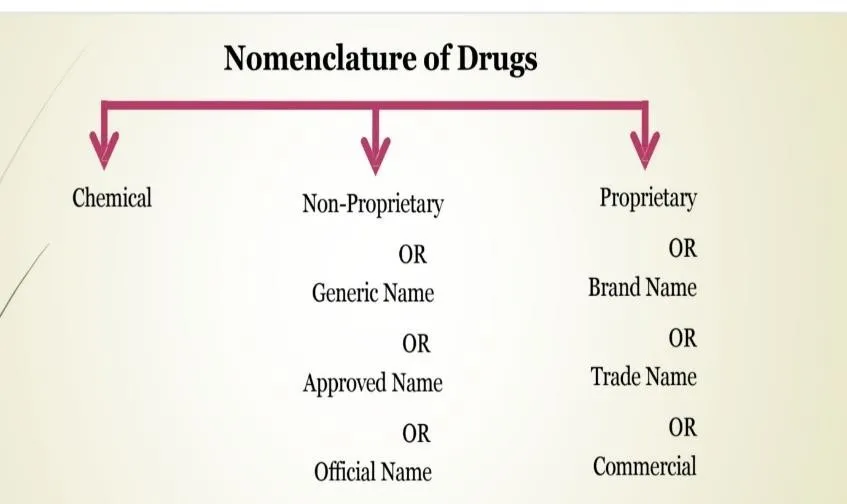
Fig;1 Recent development: to select essential medicines based on rationally developed
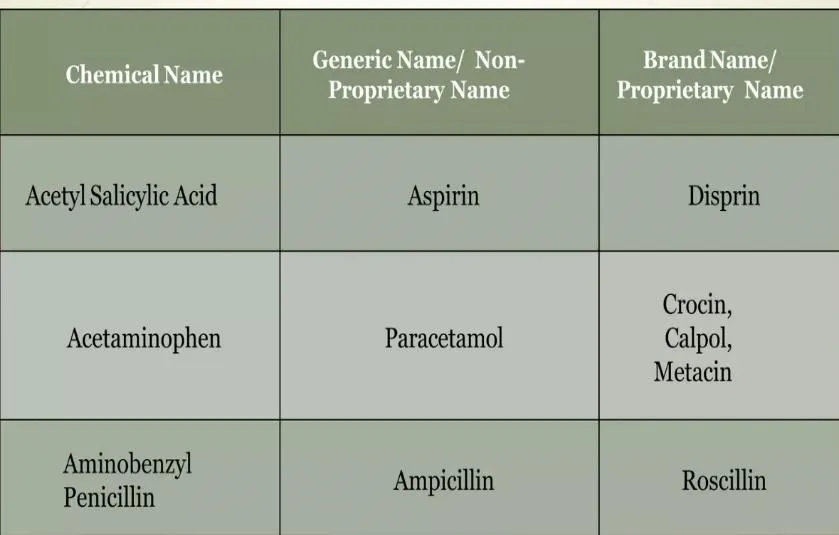
Table:1 Some examples of Chemical, Generic, Brand Names
BRAND NAME/PROPRIETARY
Name given by Pharmaceutical company for commercial purpose. Advantages the consistency or Pharmacokinetics or efficacy does not change with same brand. Single brand name for a Medicine with multiple ingredients. Bioavailability remains same where a patient is maintained on a particular brand. Disadvantages Branded Medicines are costlier. Multiple brands for a same Medicine
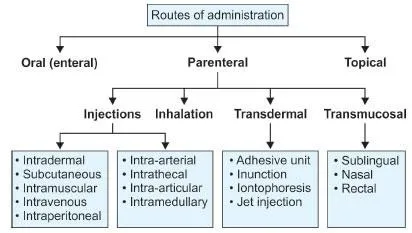
Fig:2 Route of administration
CONCLUSION
Historical landmarks preserve our nation's cultural and historical heritage, helping us understand the achievements of previous generations. Protecting these monuments is the responsibility of every citizen.
Pharmacology is an essential branch of medical science that improves human health through the discovery, development, and safe use of medicines. It has transformed healthcare and continues to contribute to disease prevention and treatment.
Both historical landmarks and pharmacology are valuable in different ways. While one preserves our past, the other safeguards our future by improving human health. Together, they contribute to the development and progress of society.
REFERENCES


Rama Brahma Reddy, K. Malleswari, CH. Gopi Krishna*, A Review On Introduction And Historical Landmark And Scope Of Pharmacology, Int. J. Sci. R. Tech., 2026, 3 (8), 871-877. https://doi.org/10.5281/zenodo.22059374
 10.5281/zenodo.22059374