

We use cookies to ensure our website works properly and to personalise your experience. Cookies policy
Master of Computer Applications (MCA), Bagalkot University, Jamkhandi - 587301
Driver tiredness is a important factor contributing to road accidents, emphasizing the necessity for dependable systems that can identify drowsiness before it leads to hazardous situations. This research proposes a real-time monitoring system for driver that detects fatigue by analyzing facial characteristics captured through a standard webcam. The system employs OpenCV for continuous video acquisition and Dlib's pre-trained 68-point facial landmark detector to locate essential facial regions, particularly the eyes and mouth. Eye Aspect Ratio (EAR) and Mouth Aspect Ratio (MAR) are calculated from the extracted landmark coordinates to determine prolonged eye closure and yawning, which are recognized as key behavioral indicators of drowsiness. A rule-based decision mechanism evaluates these measurements against predefined threshold values to differentiate normal facial activities from fatigue-related events. Whenever drowsiness is identified, the application immediately issues both visual and audio warnings to help regain the driver's attention. The proposed solution is non-invasive, lightweight, and capable of operating efficiently on conventional computing devices without requiring wearable sensors or custom model training. Experimental observations indicate that the system performs continuous real-time monitoring with satisfactory responsiveness under normal operating conditions. Owing to its effortlessness, low computational necessities, and practical implementation, the proposed framework can serve as an effective driver assistance tool for improving road safety. Future enhancements may incorporate deep learning-based facial analysis, head pose estimation, and infrared imaging to improve robustness under challenging environmental conditions.
Highway safety become a all over world concern to the increasing number of traffic accidents caused by driver fatigue. Drowsiness affects a driver's ability to concentrate, slows reaction time, and impairs decision-making, thereby increasing the likelihood of serious accidents. Fatigue-related incidents are particularly common during extended driving periods, nighttime travel, and monotonous road conditions. As a result, the development of intelligent systems capable of recognizing early signs of driver drowsiness has become an important research topic in the fields of computer vision and intelligent transportation. Such systems can assist drivers by providing timely warnings, thereby reducing the possibility of fatigue-related crashes and improving overall road safety.
Quite a few approaches have planned to detect driver drowsiness, including physiological, vehicle-based, and vision-based techniques. Physiological methods utilize signals such as Electroencephalography (EEG), Electrocardiography (ECG), and heart rate measurements to determine the driver's level of alertness. While these methods generally deliver accurate results, they require wearable devices that may reduce driver comfort during long journeys. Vehicle-based methods analyze steering behavior, lane deviation, and vehicle dynamics; however, their effectiveness depends on road conditions and driving environments. In comparison, vision-based structures have expanded considerable attention because they monitor facial expressions without requiring physical contact, assembly them more applied for real-time applications.
The proposed research introduces a real-time drowsiness detection that analyzes facial features using OpenCV and Dlib's pre-trained 68-point facial landmark model. The system continuously acquires video frames from a webcam, identifies facial landmarks, and calculates Eye Aspect Ratio (EAR) and Mouth Aspect Ratio (MAR) to detect prolonged eye closure and yawning. These capacities are assessed using predefined threshold standards to control the driver's level of alertness. Whenever fatigue-related behavior is recognized, the system immediately produces visual and audio notifications to alert the driver. Owing to its lightweight architecture, low computational requirements, and non-intrusive design, the proposed framework provides an efficient and practical solution for real-time driver monitoring and can serve as a valuable component of intelligent driver assistance systems.
Driver drowsiness detection has become an important research topic because of its significant role in reducing fatigue-related road accidents. Many methods have planned to identify driver fatigue by analyzing physiological signals, driving patterns, and facial characteristics. Machine learning-based approaches have demonstrated that combining physiological measurements with vehicle behavior can improve drowsiness prediction accuracy. Though, these means often wearable sensors, making them less applied for continuous real-world applications [1]. Vision-based monitoring systems have emerged as an effective alternative by continuously observing the driver's facial activities using cameras, providing a convenient and non-intrusive solution for fatigue detection [2].
Recent advancements in deep learning for computer vision that further improved the performance of driver monitoring systems. Convolutional Neural Network (CNN)-based approaches have been broadly adopted to recognize eye closure, yawning, and some facial terminologies associated with driver fatigue [3]. The integration of CNN models with facial landmark detection has improved the accuracy of identifying fatigue-related behaviors in real time [4]. Other studies employed conventional ML techniques to analyze eye movements and facial expressions for detecting drowsiness while generating timely warning alerts [5]. Similarly, digital driver monitoring have demonstrated continuous eye monitoring can effectively identify prolonged eye closure and trigger alarm mechanisms to prevent accidents [6].
Recent study has also absorbed on improving the reliability and computational efficiency of fatigue detection systems. Innovative approaches combining facial analysis with additional sensing technologies have improved discovery presentation under different driving conditions [7]. Comprehensive reviews of driver monitoring technologies have highlighted the advantages and limitations of physiological, behavioral, and vision-based approaches while finding chances for future developments [8]. Enhanced DL techniques have further improved facial feature extraction for fatigue recognition [9], whereas hybrid methods combining facial landmark localization deep learning have achieved more robust real-time performance [10]. Motivated by these developments, the proposed work adopts a lightweight vision-based framework that utilizes Dlib's 68-point facial landmark detector together with Eye Aspect Ratio (EAR) and Mouth Aspect Ratio (MAR) analysis to detect driver drowsiness efficiently without requiring wearable sensors or specialized hardware.
The planned driver sleepiness detection project is developed as a real-time vision-based framework that continuously observes the driver's facial activities using a webcam. The overall architecture is composed of six functional modules: image acquisition, image preprocessing, face localization, facial landmark extraction, drowsiness assessment, and alert generation. Initially, the cam captures live frames of videos, which are processed using OpenCV to improve image quality and prepare them for facial analysis. The processed frames are then supplied to Dlib's frontal face detector, which accurately identifies the driver's face before extracting facial landmark points.
Once the facial landmarks are detected, the coordinates corresponding to the eye and mouth regions are isolated for further analysis. The landmark themes are used to calculate Eye Aspect Ratio (EAR) and Mouth Aspect Ratio (MAR), which represent the grade of eye openness and mouth opening, respectively. The calculated values are continuously monitored and compared with predefined threshold values. If the EAR remains below the specified threshold for a consecutive number of frames or the MAR exceeds its threshold due to yawning, the system recognizes the driver's condition as drowsy. This rule-based evaluation helps distinguish fatigue-related behavior from normal blinking and routine facial movements.
After the driver's fatigue state is confirmed, the alert module immediately activates warning mechanisms to notify the driver. The system displays a visual warning message on the screen while simultaneously producing an audible alarm to regain the driver's attention. Since the planned framework relies only on a standard cam and software-based image processing, it eliminates for wearable sensors or specialized hardware. The addition of OpenCV with Dlib's facial landmark detector enables fast and efficient execution, making the system suitable for real-time driver monitoring and intelligent vehicle safety applications.
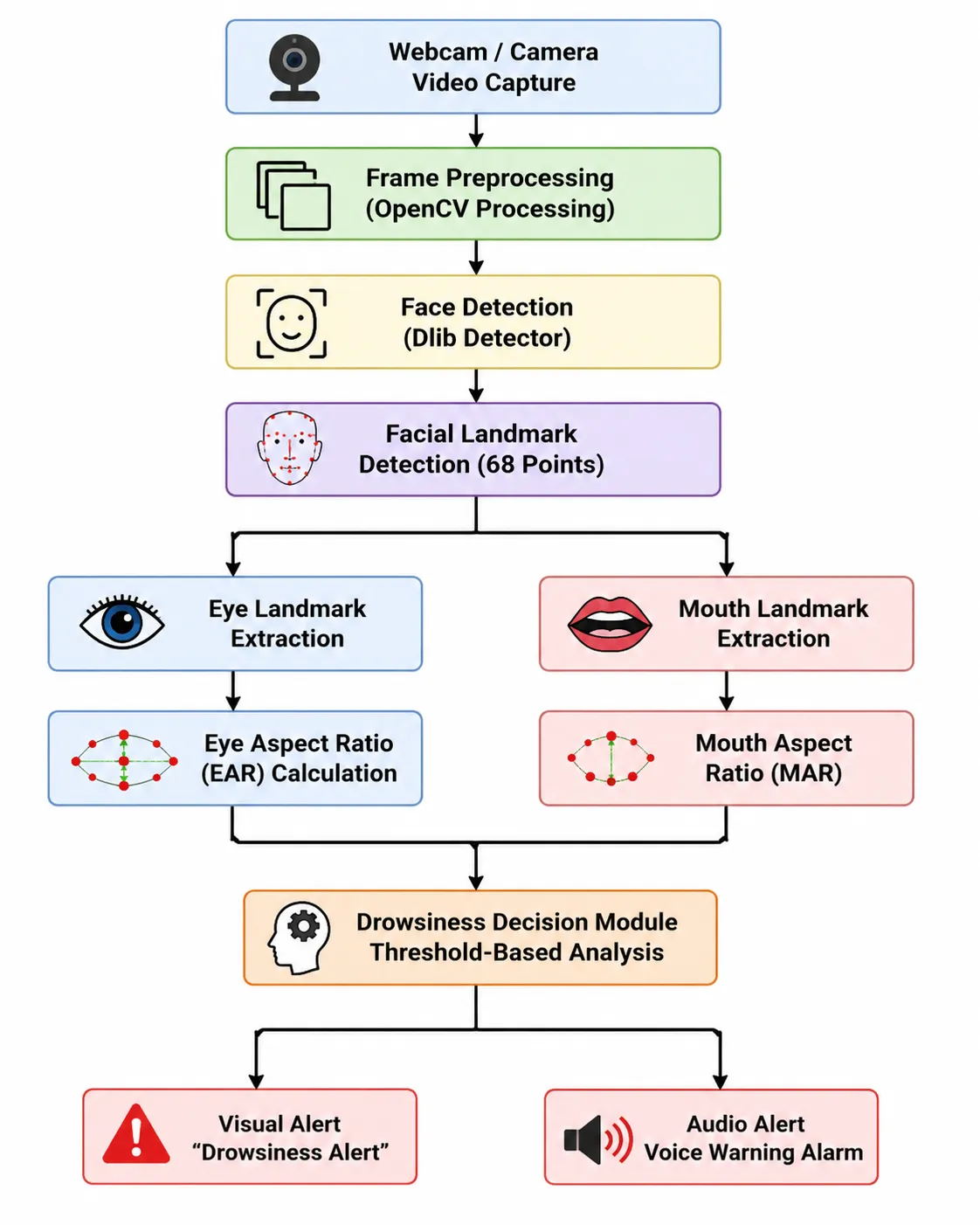
Figure 1: System Architecture
The proposed system follows a real-time computer vision methodology to identify driver drowsiness by continuously analyzing facial movements captured through a webcam. Initially, the camera acquires live video frames, which are processed using the OpenCV library. Each frame is converted into grayscale to reduce processing time and simplify facial feature extraction. The preprocessed images they are analyzed using Dlib's frontal face detector to find the driver's face within the video stream before further processing is performed.
After detecting the face, Dlib's pre-trained 68-point facial landmark model is applied to locate important facial feature points. Among these landmarks, the eye and mouth areas are designated because they provide reliable indicators of fatigue. Eye Aspect Ratio (EAR) is intended to control whether the driver's eyes remain closed for an extended duration, while Mouth Aspect Ratio (MAR) is computed to recognize yawning activity. Both parameters are updated continuously for every captured frame, allowing the project to handle modifications in driver's facial behavior throughout the journey.
The measured EAR and MAR units are associated with predefined unreal values to control the driver's alertness level. When the EAR falls below the threshold for several consecutive frames, the system interprets it as prolonged eye closure. Likewise, if the MAR exceeds the specified threshold, a yawning event is detected. Whenever either condition indicates fatigue, the decision module activates a warning mechanism that displays a visual alert and plays an audio alarm to notify the driver immediately. The proposed methodology is simple, efficient, and suitable for real-time operation, as it requires only a webcam and standard computing resources while providing continuous, non-intrusive monitoring of the driver's condition.
Methodology Steps
The planned sleepiness detection for drivers was successfully implemented using Python by integrating the OpenCV and Dlib libraries. Performance was the evaluation carried out under real-time conditions using a standard webcam to verify the system's ability to monitor the driver's facial behavior continuously. During execution, the system accurately detected the driver's face, extracted the required facial landmark points, and calculated Eye Aspect Ratio (EAR) and Mouth Aspect Ratio (MAR) for all video frame. The processing speed was sufficient for real-time operation, enabling continuous fatigue monitoring without noticeable interruption.
Several experiments were conducted to observe the system's behavior under different driving scenarios, including normal eye blinking, prolonged eye closure, and yawning. Under normal conditions, the computed EAR and MAR values remained within the predefined threshold limits, and no unnecessary alerts were generated. When the driver's eyes remained closed for multiple consecutive frames, the EAR value decreased below the specified threshold, and the system correctly identified the drowsiness condition. Similarly, a increase in the MAR value during yawning activated the detection mechanism. In both situations, the application immediately displayed a warning message on the screen and produced an audible alarm, allowing timely notification of the driver.
The experimental observations indicate that the proposed framework provides reliable real-time performance while requiring only a webcam and standard computing resources. The facial landmark analysis makes the system lightweight and suitable for practical deployment without additional sensors or specialized hardware. However, the performance may be affected under challenging conditions such as poor lighting, extreme head movements, partial facial occlusions, or the use of dark sunglasses. Future enhancements can focus on incorporating deep learning-based face analysis, adaptive threshold selection, head posture approximation and infrared imaging to improve finding accuracy and robustness across a wider range of real-world driving environments.

Figure 2. Driver is Active
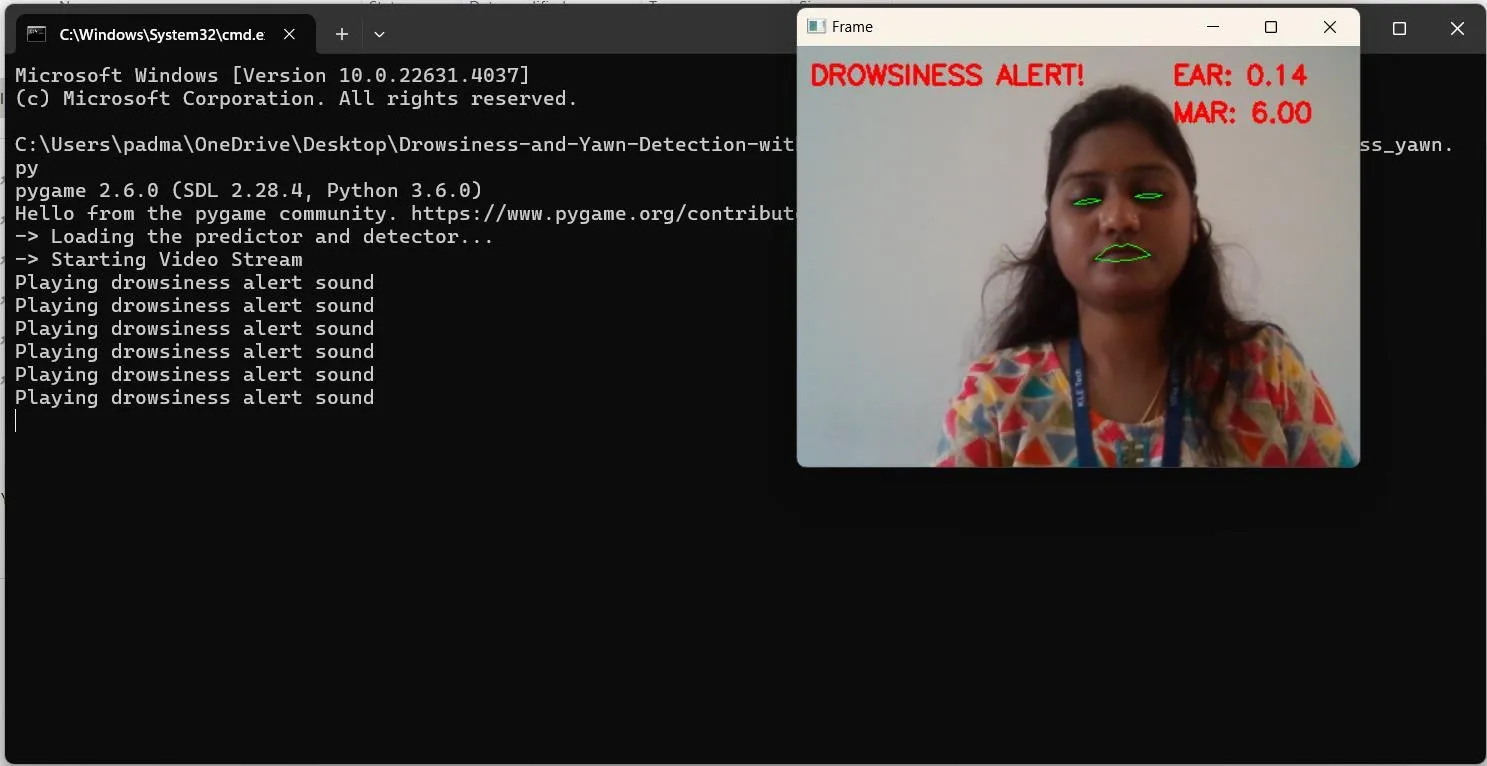
Figure 3. Driver is Drowsy [closed eyes]

Figure 4. Driver is Drowsy [yawning]
CONCLUSION
This research presented a real-time drowsiness for driver to recognize signs of driver tiredness through facial behavior analysis. The proposed framework employs OpenCV for video processing and Dlib's pre-trained 68-point facial landmark detector to extract facial feature points from live webcam images. By scheming Eye Aspect Ratio (EAR) and Mouth Aspect Ratio (MAR), the system effectively identifies prolonged eye closure and yawning, which are important indicators of drowsiness. Based on predefined threshold values, the system promptly generates visual and audio alerts whenever fatigue-related behavior is detected, helping the driver regain attention and reducing the possibility of accidents.
The experimental evaluation demonstrates that the proposed approach is capable of operating efficiently in real time while requiring only a standard webcam and modest computational resources. Its lightweight architecture and non-intrusive design make it suitable for practical implementation in intelligent system support drivers. Although the system performs reliably under normal operating conditions, its accuracy may be influenced by factors such as poor illumination, facial occlusions, and significant head movements. Future research can enhance the proposed framework by integrating deep learning-based facial analysis, adaptive thresholding, head pose estimation, infrared imaging, and advanced behavioral monitoring techniques to improve robustness and detection performance in diverse driving environments.
REFERENCES



Padma Yadahalli*, Anjali Deshapande, Vijaykumar Bellundagi, Real-Time Drowsiness Detection For Drivers Using Facial Landmark Analysis And Eye Facet Ratio, Int. J. Sci. R. Tech., 2026, 3 (7), 311-317. https://doi.org/10.5281/zenodo.21352237
 10.5281/zenodo.21352237