

We use cookies to ensure our website works properly and to personalise your experience. Cookies policy
Department of Medical-Surgical Nursing, AECS Maaruti College of Nursing, Behind Maaruti Dental College, Kammanahalli, Off Bennerghatta , Bangalore-560076, Karnataka
Background: Among people with hypertension, coronary artery disease (CAD) is a major cause of morbidity and mortality. One important modifiable risk factor for the onset and advancement of CAD is hypertension. Effective self-care and risk reduction require a thorough understanding of CAD and how to prevent it. Nonetheless, a large number of hypertension patients are not well informed about lifestyle changes, early warning indicators, and preventive measures. Objectives: To assess the existing level of knowledge among hypertensive patients regarding coronary artery disease and its prevention and to find out the association between knowledge scores of hypertensive patients regarding coronary artery disease& its prevention with their selected demographic variables. Method: A structured knowledge questionnaire created by the researcher was used to gather data for the study. Purposive sampling was used to choose 100 hypertension individuals in total. With a special emphasis on hypertensive patients, the questionnaire included questions about coronary artery disease, its risk factors, signs and symptoms, diagnosis, medication and lifestyle adherence, and preventative strategies. Result: The overall knowledge score of hypertensive patients regarding coronary artery disease and its prevention, the mean score of the patients from Section A was 5.68 with mean percentage 51.63%, the mean score of the patients from Section B was 3.38 with mean percentage 42.25% and the mean score of the patient from Section C was 4.50 with mean percentage 40%. Conclusion: The study comes to the conclusion that hypertension patients don't know enough about CAD and how to prevent it. In order to raise awareness and encourage better habits aimed at reducing the risk of CAD, an information booklet was prepared based on the findings. Preventing problems in people with hypertension can be greatly aided by improving patient education.
The World Health Organization (WHO) estimates that 1.28 billion persons worldwide suffer from hypertension; most of them live in countries with low to middle incomes.Due to urbanization, sedentary lifestyles, poor dietary habits, stress, and low health literacy, the combined burden of hypertension and CAD is quickly increasing in India. According to estimates, the prevalence of CAD in urban populations in India ranges from 2.5% to 12%, with hypertension playing a major role in 30–40% of these cases.1 Karnataka has a high amount of risk factors for heart disease. According to community-based studies, the prevalence of hypertension among people in the state is between 25 and 27 percent. Over 2,500 acute coronary events in those under 40 were recorded in metropolitan Bangalore within two years, with over 1,250 incidents happening in those under 35, according to registry data (Bangalore Premature CAD registry).2
In Karnataka, particularly in urban hubs like Bangalore, the burden of hypertension and CAD is alarming. Health institutions have reported an increase in early-onset heart disease, even among younger adults. Studies have shown that 20–30% of sudden cardiac deaths in Bangalore occur in individuals below the age of 40, many of them are undiagnosed or poorly controlled hypertension. The increasing number of emergency visits and cardiac admissions is straining healthcare resources and underscore the urgent need for preventive strategies.3
Bangalore, the capital city of Karnataka, is witnessing a steady increase in the number of patients presenting with cardiovascular complaints. Leading cardiac centers such as the Sri Jayadeva Institute of Cardiovascular Sciences have reported significant rises in outpatient visits, many of which are related to uncontrolled hypertension or early signs of CAD. Unfortunately, the awareness among hypertensive patients about the progression to CAD and its prevention remains low.4
Information booklets serve as a practical and sustainable method to deliver consistent, evidence-based guidance. They help patients understand their condition, recognize risk factors, and adopt preventive behaviors such as regular monitoring, medication adherence, dietary modifications, and physical activity. Since nurses interact most closely with patients, their role inproviding structured education becomes crucial.5
Materials and Methods:
This study employed a descriptive survey research design and a descriptive survey research approach. One hundred hypertension patients from Bangalore's BGS GIMS Hospital made up the study's sample size. One hundred patients were chosen using a probability Purposive sampling procedure.
Criteria for the selection of samples:
• Inclusion Criteria- Hypertensive patients who are –
i) Present at the time of data collection-
ii) Willing to participate in study.
• Exclusion Criteria- Hypertensive patients who are already been exposed to educational program regarding coronary artery disease.
Description of the tool:
After a thorough review of literature related to the topic and considering the suggestions of experts a structured questionnaire was developed. The structured questionnaire comprised in 2 parts.
• Part 1- Consists of 10 demographic characteristics of respondents seeking information such as age, sex, education level, occupation, income, place of residence, duration of hypertension, duration of taking medication, previous knowledge of CAD, and source of knowledge.
• Part 2- Consist of 30 items pertaining to knowledge regarding coronary artery disease and its prevention. The right answer was scored as one mark, and the wrong answer was scored as zero comprising the maximum score of 36. The total score is arbitrarily divided in to Poor knowledge (0-12), Moderate knowledge (13-24), and good knowledge (25-36).
Validity and Reliability
After the structured questionnaire is ready, it is sent to subject matter experts for approval. The structured knowledge questionnaire had a reliability of r = 0.85. This suggests that the tool were reliable.
Delimitation: Only hypertensive individuals from particular healthcare facilities were included in the study.
Data Collection Procedure
After the formal permission from the hospital authority hypertensive patients who met the inclusion criteria were selected from the outpatient’s department/ inpatient department of the selected hospital. The researcher introduced herself to the participants, explained the purpose of the study, assured confidentiality of the responses, and obtained informed consent before data collection. The structured knowledge questionnaire was administered to each participant. The questionnaire was provided in local language/English to ensure clarity and understanding. Participants were given adequate time to answer all the questions. The researcher remained available for clarification without influencing the responses. Completed questionnaires were collected on the same day. The total duration of data collection was 3 days, depending on the availability of participants. After collection, the responses were checked for completeness. Each questionnaire was scored according to the scoring key, and the data was systematically recorded for analysis.
|
Knowledge Level |
Score |
Frequency |
Percentage |
|
Poor |
0-10 |
36 |
36% |
|
Average |
11-20 |
54 |
54% |
|
Good |
21-30 |
10 |
10% |
Tab 1: The level of knowledge among hypertensive patients regarding coronary artery disease and its prevention
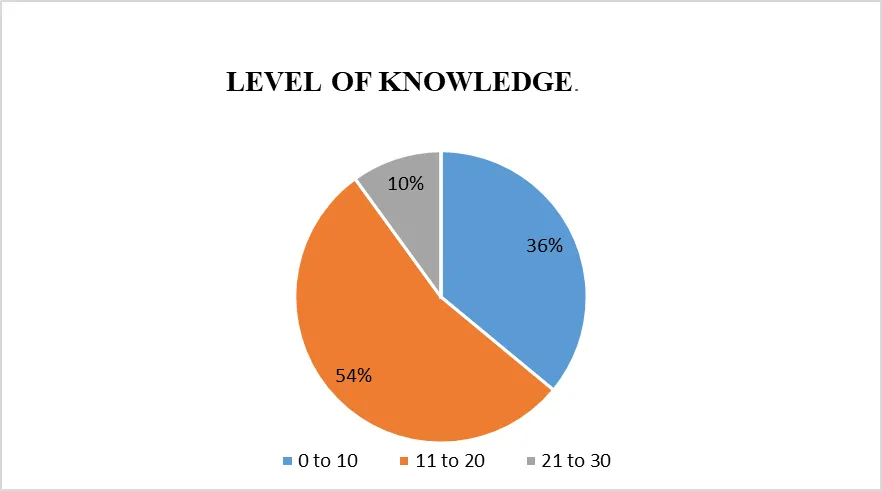
Fig 1: Shows the level of knowledge among hypertensive patients regarding coronary artery disease and its prevention
|
Sl no |
Demographic variable |
Level of Knowledge |
df |
Chi square value |
Inference |
|
|
Above Mean (14) |
Below Mean (14) |
|||||
|
1 |
Age in years 30-50 51-60 and above |
14 38 |
7 41 |
1 |
2.2909 |
NS |
|
2 |
Gender Male Female |
24 28 |
28 20 |
1 |
1.4834 |
NS |
|
3 |
Educational Level Primary Graduate |
31 21 |
43 5 |
1 |
11.6507 |
S |
|
4 |
Occupation Employed Unemployed |
30 22 |
36 12 |
1 |
3.332 |
NS |
|
5 |
Income Rs 7,989-Rs 59,794 Rs 59,795-Rs 1,59,586 and above |
42
10 |
45
3 |
1 |
3.7186 |
NS |
|
6 |
Place of residence Rural Urban |
20 32 |
30 18 |
1 |
5.7692 |
S |
|
7 |
Duration of hypertension Less than 1 year 1-5 year and above |
43 9 |
43 5 |
1 |
0.9844 |
NS |
|
8 |
Patients’ regularity of taking medicine Always rarely |
36 16 |
32 16 |
1 |
0.0754 |
NS |
|
9 |
Previous knowledge of CAD Yes No |
29 23 |
17 31 |
1 |
4.1623 |
S |
|
10 |
Source of knowledge Medias Friends and family |
21 18 |
27 4 |
1 |
10.0485 |
S |
*Significant correlation at the 0.05 level
Table No: 2. Association between the knowledge scores of hypertensive patients with their selected demographic variables.
DISCUSSION
In this study 36 (36%) of the hypertension individuals were poor knowledge, 54 (54%) were average knowledge, and 10 (10%) were good understanding of coronary artery disease and its prevention. The above results supported to the study attempted to quantify knowledge regarding preventive measures of coronary artery disease among patients attending OPD of selected hospital of Ludhiana city. Information was collected from 150 patients attending medical and surgical OPDs who were not diagnosed with any of heart disease. The result revealed that only 15.33% of subjects had good level of knowledge, and 84.67% subject had poor level of knowledge regarding prevention of CAD.6 The research hypothesis (H1) is accepted and the null hypothesis is rejected since the obtained chi-square value indicates a significant connection at the 0.05 level between education, residence, prior knowledge of CAD, and sources of knowledge with their level of expertise. The research hypothesis (H1) is rejected and the null hypothesis is accepted since there is no significant correlation at the 0.05 level between the patient's level of knowledge and age, gender, occupation, income, length of hypertension, or regularity of medication use. The above result supported to the cross-sectional survey on Knowledge, attitudes and practices among patients with coronary artery disease in Dhaka, Bangladesh, Assessed knowledge, attitudes, and health-seeking practices (KAP) toward CAD among 222 Bangladeshi patients. The mean KAP score was 21.45±5.83 with a total possible score being 40. Only 5.86% of the sample was able to demonstrate a high level of proficiency. Men had more knowledge (t (1.962) = 1.334, P= 0.051), but women demonstrated more health-seeking behaviors with stronger statistical significance (t (-2.135) =-0.407, P= 0.034). Several significant chi-square relationships were found between socioeconomic status (SES) and KAP scores.7
CONCLUSION
The results of the study showed that a large number of hypertension patients had little understanding of CAD, its risk factors, warning signals, consequences, and preventative strategies. The study comes to the conclusion that informational booklet are a useful tool for providing hypertension individuals with vital information about CAD and how to prevent it.
LIST OF ABBREVATIONS
|
ABBREVATIONS |
EXPANDED FORM |
|
CAD |
Coronary Artery Disease |
|
CHD |
Congenital Heart Disease |
|
HDL |
High Density Lipoprotein |
|
BMI |
Body Mass Index |
|
CVD |
Cardio Vascular Disease |
|
SPSS |
Statistical package for social sciences |
|
CKD |
Chronic Kidney Disease |
|
LDL |
Low Density Lipoprotein |
|
ECG |
Electro Cardio Gram |
|
X2 |
Chi-Square |
|
Df |
Degree of freedom |
|
A1 |
Assumption |
|
H1 |
Hypothesis |
|
> |
Greater than |
|
< |
Less than |
REFERENCES

K. Gopalakrishnan*, Thushara R., Kovi Poojitha, Aaron Joseph, Manjula, Abin S. Mathai, Kokila G. M., Ashwin Joseph, Nehala Hafees, Akhila S. Das, Sharon M. Reji, Priyanka Basak, Vishnupriya P. M., A Study To Assess The Knowledge Of Coronary Artery Disease And Its Prevention Among Hypertensive Patients In Selected Hospitals Of Bangalore With A View To Develop An Information Booklet, Int. J. Sci. R. Tech., 2026, 3 (7), 281-286. https://doi.org/10.5281/zenodo.21332700
 10.5281/zenodo.21332700