

We use cookies to ensure our website works properly and to personalise your experience. Cookies policy
Department of Quality Assurance, Rashtrasant Janardhan Swami College of Pharmacy, Kokamthan, Tal- Kopargaon, Dist. Ahilyanagar, Maharashtra, 423601, India
Nanoparticle based drug delivery system have gained significant attention for improving drug stability, solubility, bioavability and targeted delivery system. However, sensitivity and complexity of nanoparticle formulations require systematic development approaches to ensure consistent quality and performance. Quality by Design (QbD) provides a scientific and risk- based framework that emphasizes understanding the relationship between formulation variables and product quality. Through the identification of Quality Targeted Product Profile (QTPP), Critical Quality Attributes (CQAs), Critical Materials Attributes (CMAs), Critical Process Parameters (CPPs) QbD enables efficient optimization of nanoparticle formulations. Tools such as Design of Experiment (DoE), Risk Assessment, Process Analytical Technology (PAT) are supports to process understanding, control, and regulatory compliance. Overall, the QbD approaches enhanced the robustness, reproducibility, and scalability of nanoparticle drug delivery system and supports the future development of advanced and personalized nanomedicine.
Nanotechnology based drug delivery systems have made targeted therapy much better by allowing for precise control over how drugs are released, where go in the body, and how cells take them up. Polymeric nanoparticles, lipid-based nanoparticles, solid lipid nanoparticles, nanocrystal, and inorganic nanoparticles are all types of nanoparticles that have many benefits. For example, they can protect drugs that are unstable, make drugs that are not very soluble in water more soluble, make drugs stay in the body longer, and allow for both passive and active targeting by changing the surface and size of the nanoparticles. Nanocarriers can be designed to increase therapeutic index, decrease off- target toxicity, and improve bioavailability by altering physicochemical characteristics like particle size, surface charge, morphology, and surface ligands. It will improve overall clinical outcomes.1
Targeted drug delivery systems have emerged as a promising approach to enhanced therapeutic efficacy while minimizing systemic toxicity by directing drugs specifically to diseased tissues or cells. However, conventional drug delivery strategies often suffer from major limitations such as poor aqueous solubility of drugs, instability in biological environments, rapid systemic clearance, nonspecific biodistribution, and inability to cross complex biological barriers including the blood- brain barrier (BBB) and tumour microenvironment. These challenges frequently result in suboptimal therapeutic outcomes, dose- related adverse effects, and reduced patient compliance, particularly in the treatment of chronic diseases, cancer, and infectious disorders. 2,3
Quality by Design (QbD) has emerged as a systematic, science driven, and risk- based approach to pharmaceutical development that addresses these challenges effectively. QbD emphasizes a thorough understanding of the relationship between formulation components, process parameters, and product quality attributes, beginning with the definition of a Quality Target Product Profile (QTPP). Through structured risk assessment tools and design of Experiments (DoE), critical material attributes (CMAs) and critical process parameters (CPPs) influencing nanoparticles performance can be identified and controlled. The establishment of a design space and an appropriate control strategy enable consistent manufacturing performance, reduces development timelines, and facilitates efficient scale- up and post approval changes. Given the sensitivity of nanoparticles system to minor formulation and process variations, the application of QbD is particularly crucial in ensuring product robustness and regulatory compliance.4
Regulatory agencies worldwide increasingly advocate the implementation of QbD principles, as reflected in the International Council for Harmonization (ICH) guidelines. ICH Q8 (R2) focuses on pharmaceutical development and encourage systematic product and process and process understanding, while ICH Q9 outline quality risk management principals essential for identifying and mitigating potential risks to product quality. ICH Q10 provides a comprehensive pharmaceutical quality system framework that supports continual improvement across the product lifecycle, and ICH Q 11 extend QbD principles to the development and manufacture of drug substances.5
2. Fundamentals of Nanoparticles in Drug Delivery:
Nanoparticles (NPs) are sub- micron carriers typically 1- 1000 nm in the pharmaceutical conditions designed to improve drug stability, solubility, biodistribution, targetability and controlled release. The main types of nanoparticles used in drug delivery system, common materials, preparation & characteristics, advantages, limitations and typical therapeutic use.6
2.1 Types of Nanoparticles
Nanoparticles used in drug delivery system are classified into different types based on their structure, composition, and functional properties. Drug solubility, stability, bioavailability, and targeted delivery are all intended to be improved by these systems. Polymeric, metallic, lipid- based, vesicular, and other sophisticated nanocarrier nanoparticles are frequently employed. Each category has different benefits and is chosen based on the therapeutic need and technique.
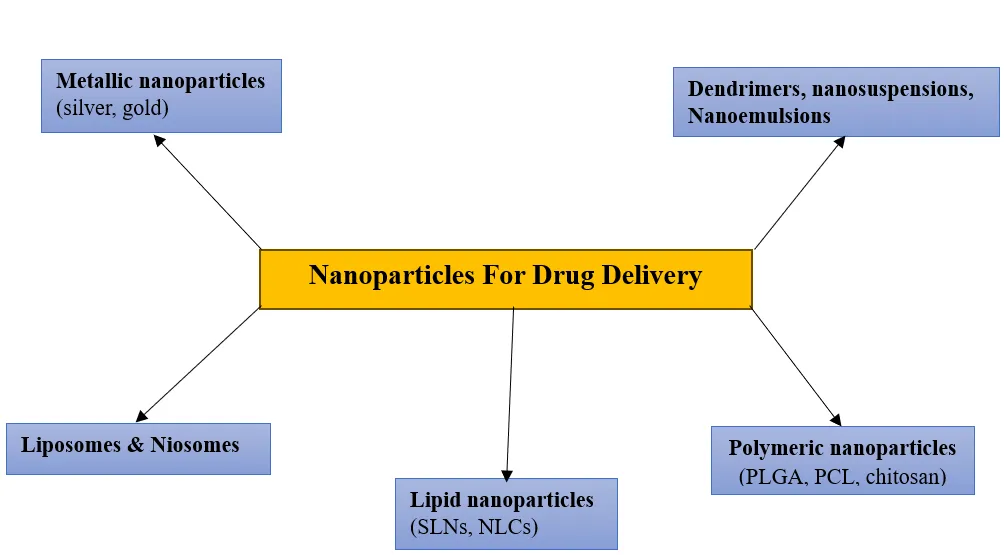
Fig no. 1. Fundamentals : Types of Nanoparticles Used in Drug Delivery
2.1.1. Polymeric nanoparticles:
Polymeric nanoparticles like PCL, PLGA, Chitosan they are biodegradable carriers mainly used for controlled and sustained drug release. They improve drug stability, bioavailability, and allow surface modification for targeted drug delivery. Polymer based nanoparticles are solid colloidal particles composed of synthetic or natural polymers. In natural polymer contain chitosan, alginate, gelatine. Polymeric nanoparticles are safely break down in the body and are non- toxic. This improves targeting, circulation time, and reduce side effect.7
2.1.2. Metallic Nanoparticles (Silver, Gold):
Metallic nanoparticles they are made up silver and gold nanoparticles, have unique physicochemical properties including antimicrobial, antifungal activity as well as photothermal or imaging capabilities. They are mainly used in antimicrobial, diagnostic, topical and cancer therapies. This type of nanoparticles includes gold (AuNPs), silver (AgNPs), iron oxide for magnetic applications and others. Metallic nanoparticles are usually inorganic cores with possible organic functionalization for drug targeting or conjugation.8
Metallic nanoparticles are nanoscale materials typically ranging from 1-100 nm, collection of pure metals or metal oxides, and are widely explored for biomedical and drug delivery applications due to their unique size dependent physicochemical properties.8 These types of nanoparticles are enhanced surface energy, surface area, catalytic activity and surface behaviour to making them promising nanocarriers for diagnostic and therapeutic purposes.9
2.1.3. Lipid Nanoparticles (SLNs, NLCs):
Lipid nanoparticles are divided into two main categories of lipid- based nanoparticles are solid lipid nanoparticles (SLNs) and nanostructured lipid (NLCs). Sinces feature benefits such a favourable release profile, targeted drug delivery, and expectational physical stability, they were created to address the drawbacks of existing colloidal carriers like emulsion, liposomes, and polymeric nanoparticles. NLCs, the next generation of lipid nanoparticles, are modified SLNs that enhance loading capacity and stability. There are three potential structural models of NLCs. These LNPs may find use in the fields of clinical medicine, research, cosmetics and medication delivery. 10
2.1.4. Liposomes & Noisome:
Liposomes are also the type of nanoparticles which are closed spherical vesicles composed of one or more phospholipid bilayers enclosing an aqueous core. Phospholipids are basic building blocks of liposomes, which have hydrophilic fatty acid tails and hydrophilic groups. Phospholipids self-assemble into a bilayer structure when hydrated in an aqueous environment because of hydrophobic interactions, which causes vesicles to form. It can be improving formulation stability, cholesterol is frequently added to the bilayer to control membrane fluidity, increase mechanical strength, and decrease permeability. The amphiphilic nature liposomes allow simultaneous encapsulation of hydrophilic drugs within the aqueous core lipophilic drugs within the liquid bilayer, making them versatile drug delivery system.11
Noisome are vesicular systems formed by the self- assembly of non- ionic surfactants in the presence of cholesterol in an aqueous medium. Structurally, noisome consists of a bilayer arrangement similar to liposomes. The bilayer is composed surfactant molecules rather than phospholipids. Cholesterol is added to enchased bilayer rigidity, reduce leakage, and improve vesicle stability. Charge inducers may also be incorporated to prevent aggregation and improve entrapment efficiency.12
Noisome offer advantages such as greater chemical stability, lower production cost, and lower shelf life, as non- ionic surfactants are less susceptible to oxidative degradation.13
2.2. Comparative Analysis of Essential Nanoparticles Evaluation Parameters with QbD Perspective shown in table no.1:
|
Evaluation Parameter |
Conventional Characterization Approach |
QbD-Based Approach |
QbD Term |
Acceptance Criteria |
|
Particle Size |
Measured after formulation to confirm nanosized. Mainly reported as result. |
Treated as a Critical Quality Attribute (CQA). Controlled through DoE by optimizing CMAs and CPPs to achieve reproducible size. |
CQA |
< 200nm (ideal systemic);200-500 nm (localized delivery) |
|
Polydispersity Index (PDI) |
Measured to check size distribution; often reported without linking to process. |
Considered a key CQA affecting stability & batch reproducibility. Used to define design space & control strategy. |
CQA |
≤ 0.2 (highly uniform); 0.2 -0.3 (acceptable); >0.5 (poor) |
|
Drug Loading (% DL) |
Calculated to know how much drug is inside nanoparticles. |
Considered performance- related CQA because it impacts dose accuracy & formulation economy. Optimized by drug: polymer ratio using DoE. |
CQA |
Depends on formulation; should be consistent batch -batch |
|
Entrapment Efficiency (%EE) |
Determined by separating free drug & calculating %EE. |
Considered major CQA. Controlled by CMAs (polymer/ lipid type, surfactant) & CPPs (mixing, temperature) |
CQA |
40-80% (polymeric NPs) (can be higher for lipid systems) |
|
Surface Morphology (SEM/TEM/AFM) |
Used mainly to confirm shape (spherical/ irregular). |
Considered a supportive CQA. Used to confirmed structural uninformative & predict release & stability. Linked with drying method, stabilizer & preparation technique. |
Supportive CQA |
Smooth, spherical non- aggregated partials preferred |
|
Zeta Potential |
Measured to check charge & stability. |
Treated as stability- related CQA Used for predicting aggregation & shelf life. Controlled by surfactant type, Ph, ionic strength. |
CQA |
±30 mV (high stability); ±20 mV (moderate stability) |
|
Drug Release Profile |
Performed as in vitro release test, reported as curve. |
Treated as performance CQA. Release kinetics are linked to polymer type, particle size, drug distribution, & preparation method. Used to define design space. |
Performance CQA |
Controlled release with limited burst (ex; < 20% in 1hr) |
|
Stability Study |
Done to check shelf -life; usually only at end. |
Treated as regulatory & quality CQA. Stability is monitored through multiple CQAs (size, PDI, %EE, zeta potential) under ICH storage conditions. |
Regulatory CQA |
Minimal change in size/ PDI; no drug leakage; no aggregation |
|
Batch-to-Batch Reproducibility |
Often not systematically evaluated. |
Central part of QbD. DoE + Control strategy ensures reproducibility by fixing CMAs & CPPs within design space. |
Controlled strategy |
RSD low; CQAs within limits in all batches |
Table 1: QbD VS Conventional Nanoparticle Evaluation. 14,15,16
3. Overview of Quality by Design (QbD) in Nanoparticle Drug Delivery System:
Drug delivery systems based on nanoparticles have shown promise in addressing issues with traditional dosage forms, including systemic toxicity, non-specific distribution, low permeability, and low bioavailability. Polymeric, metallic, lipid, liposome, and nanoemulsion these are types of nanoparticles which provide drug targeted delivery, controlled drug release, and enhanced therapeutic activity. There is problem with nanoparticle formulations, and their sensitivity to process variability is one of the barriers to product development and regulatory approval. They can be achieved by improving the understanding of procedure and formulation variables in nanoparticles. 14
Predetermined product quality is ensured by Quality by Design (QbD); it is a scientific, systematic and risk-based approach to pharmaceutical development technique. Integrating quality into the product from the start is highlighted by QbD, and contemporary is “quality by testing” methodology.15 Regulatory authorities like US FDA and EMA are strongly encourage the use of QbD principles to achieve dependable, repeatable, and scalable manufacturing processes, particularly for complex dosage forms like nanoparticles.16
3.1. Principle of Quality by Design (QbD) Applied Nanoparticles:
3.1.1. Product & Process understanding:
In QbD product understanding starts with defining the Quality Target Product Profile (QTPP) for the nanoparticles (e.g., narrow PDI, size < 200nm, specific targeting, sustained released). From the QTPP Critical Quality Attributes (CQAs) are identified such as particle size, zeta potential, polydispersity index (PDI), entrapment efficacy, drug loading, in- vitro drug release profile, which is directly influence drug safety, efficacy, and targeting behaviour.17
Then Process understanding involves identifying Critical Material Attributes (CMAs) (e.g., polymer type, lipid composition, surfactant, drug solubility) etc. Then Critical Process Parameters (CPPs) (including homogenization speed, temperature, sonication time, solvent evaporation rate) that affect these CQAs.18
3.1.2. Risk Assessment:
QbD used systematic risk assessment for e.g. Ishikawa diagrams, Failure Mode and effects Analysis – FMEA to priorities CMAs and CPPs that most strongly influence nanoparticle CQAs. E.g. milling time and rotational speed in nanoparticle milling or coacervation variables in HAS-based nanoparticles are identified as high- risk CPPs and then subjected to experimental screening & optimization.17
In order to concentrate resources on the most important element of the nanoparticle system, risk- based thinking also directs choices about which characteristics to strictly regulate versus those that can withstand grater variation. This system enhancer reproducibility, lowers development failures, & complies with ICH Q9 on Quality Risk Management.17
3.1.3. Design Space:
The design space is the multidimensional region of CMAs and CPPs within which the nanoparticle formulation consistently produces acceptable CQAs. For, nanoparticles, design space is typically explored using DoE (e.g., Factorial, Box- Behnken, central composite designs to model how factors like stabilizer concentration, milling media size, drug loading, & milling time jointly affect size, PDI, and surface charge.19
As long as product quality stays within a Predetermined range, operating within the design space once established permits manufacturing flexibility without requiring regulatory reapproval. Nanotherapeutics, are well- defined design space is especially important because of small changes in size or surface properties can significantly alter biodistribution and targeting efficiency.18
3.1.4. Control Strategy:
A Control strategy is a plan of controls derived from process & product understanding that ensure that nanoparticle quality throughout the lifecycle. It typically includes:
The control strategy is continuously refined as new knowledge is generated continuous improvement and robust manufacturing of nanoparticle bast targeted delivery system. 20,21
3.2 Relevant Guidelines:
Quality by Design (QbD) in nanoparticle development is systematically supported by the (ICH) guidelines which provide a science and risk-based regulatory framework shown in table no.2. 21,22
|
ICH guideline |
Core Focus |
Application in QbD- Based Nanoparticle Development |
Key elements / Tools |
|
ICH Q8 (R2) |
Pharmaceutical Development |
Establishes foundational QbD principles for nanoparticle formulation development |
|
|
ICH Q9 |
Quality Risk Management (QRM) |
Provides structured risk-based evaluation of nanoparticle specific risks |
|
|
ICH Q10 |
Pharmaceutical Quality System (PQS) |
Integrates QbD outputs into management & quality governances. |
|
|
ICH Q11 |
Drug substance Development & Manufacturing |
Extends QbD principles to nanosized APIs & nanocarriers components |
|
Table No.2. ICH Guidelines Supporting QbD- Nanoparticle Development 21,22
4. QbD Framework Applied to Nanoparticle Formulation:
The QbD framework applied to nanoparticles formulation are systematically identifies and optimized the Quality Targeted Profile (QTPP), Critical Quality Attributes (CQAs), Critical Material Attributes (CMAs), & Critical Process Parameters (CPPs). The QTPP define the desired product characteristics that must controlled to ensure the quality, safety, & efficacy. This framework is shown in figure no.2 18,20,21
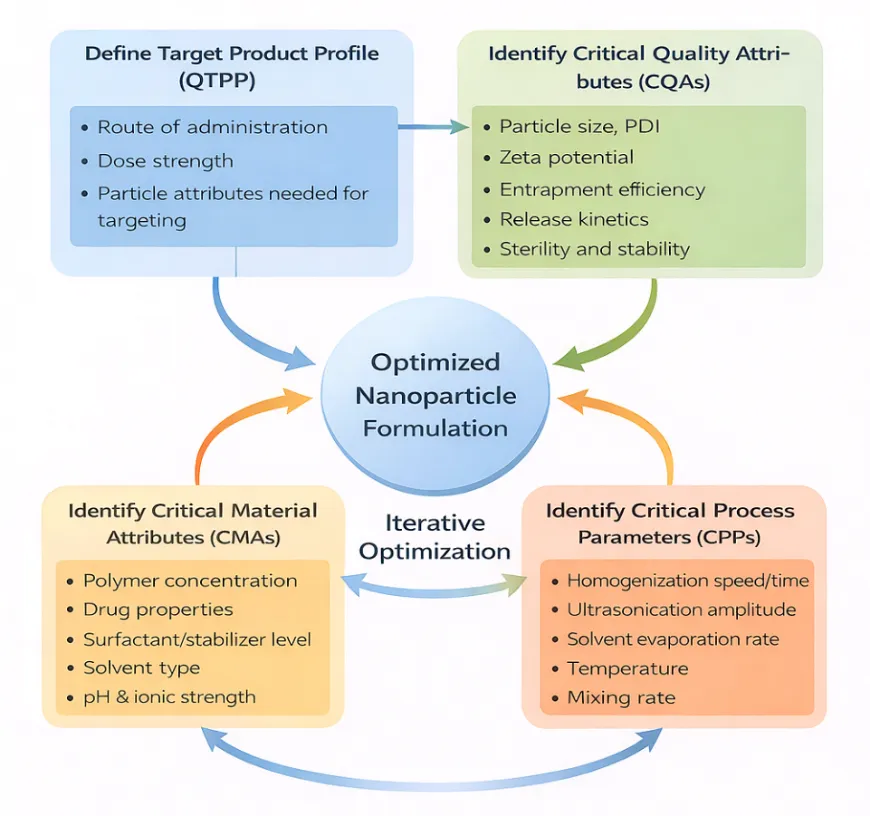
Fig no.2. QbD Framework for nanoparticle formulation
5. Tools and Techniques for Risk Assessment in QbD:
Risk assessment is the main component of the Quality by Design (QbD) structure and plays a critical role in the systematic development of nanoparticle-based drug delivery systems. Hence, the inherent complexity of nanoparticles such as their maximum surface area, sensitivity to formulation variables, and scale- dependant behaviour a structured risk management approach is essential to identify, evaluate, and control factors that may impact product quality, safety, and their performance. The several structured and semi-quantitative tools are used for risk assessment are shown in table no. 3. 18,23
|
Tool / Technique
|
|
Application in Nanoparticle Formulation |
|||
|
Ishikawa (Fishbone) Diagram |
Qualitative identification of potential risk factors |
Identifies sources of variability related to materials, process parameters, equipment, and environment affecting CQAs such as particle size, PDI, and stability. |
|||
|
Failure Mode and Effects Analysis (FMEA) |
Semi-quantitative risk evaluation and prioritization |
Assesses failure modes (e.g., aggregation, low entrapment efficiency) using Severity, Occurrence, and Detectability to calculate Risk Priority Number (RPN). |
|||
|
Risk Ranking and Filtering |
Prioritization of CMAs and CPPs based on impact |
Ranks formulation and process variables to identify high-risk parameters influencing nanoparticle quality and performance. |
|||
|
Risk Matrix (Probability–Impact Matrix) |
Classification of risks into high, medium, or low |
Evaluates likelihood and impact of process variability on CQAs such as drug release and physical stability. |
|||
|
Design of Experiments (DoE) |
Quantitative confirmation and mitigation of risks |
Statistically evaluates critical factors and interactions to establish design space and reduce formulation risk. |
Table No.3 Several structured and semi-quantitative tools are used for risk assessment:18,23
5.1. Identifying High-Risk Parameters in Nanoparticle Formulation:
High risk parameter in nanoparticle QbD are those variables that apply significant and direct influence on CQAs and consequently on the safety and efficacy of the final product. Commonly high-risk CMAs include concentration, polymer type, drug solubility, stability, surfactant level and solvent properties these factors are strongly affect to formulation of the nanoparticles.23 Similarly, CPPs such as homogenization pressure, mixing speed, temperature, sonication time these are effect on the particle size distribution and batch reproducibility. Through structured risk assessment tools, and high-risk parameters are prioritized for control and optimization, forming the basis for establishing a robust design & control strategy in nanoparticle drug development.24
6. Experimental Design in QbD:
6.1 Design of Experiments (DoE)
6.1.1 Screening Design (Plackett- Burman Design)
6.1.2 Optimization of Critical Quality Attributes:
6.2 Development of Design Space:
Comparison of development of design space in NPs pharmaceutical formulation are shown in table no.4.
|
Critical Material Attributes (CMAs) |
Critical Process Parameters (CPPs) |
|
Physical, chemical, biological properties of raw materials they are influence to the final product quality. |
Process variables that affect the manufacturing process and influence the quality of the final product. |
|
CMAs are mainly used to understand how materials characteristics affect Critical Quality Attributes. |
CPPs are evaluated to determined how processing conditions affect CQAs and product performance. |
|
CMAs are studies to understand how material characteristics affect Critical Quality Attributes. |
CPPs are evaluated to determined how processing conditions affects CQAs and product performance. |
|
Preparation of nanoparticles they show minor variations in material properties such as particles size or composition can significantly affect nanoparticle formulations. |
Small changes in process conditions like temperature, mixing speed, pH, can alter nanoparticle characteristics. |
|
To ensure raw materials meet specific quality requirements for consistent product performance. |
To control the manufacturing process within optimal limits for reproducible results. |
Table no.4 Understanding of CMAs and CPPs is essential for defining the design space & achieving robust NPs pharmaceutical formulation development. 25,26,27
7. Concept of Process Analytical Technology (PAT) in Nanoparticle:
Process Analytical Technology (PAT) is an important parameter of ICH Q8 pharmaceutical development and the QbD approach. PAT refers to systems used to analyse, design, and control pharmaceutical manufacturing process through real time measurements of critical quality & performance attributes. 3,14
In nanoparticle formulation PAT helps monitor parameters such as particle size, shape, PDI, zeta potential, drug loading and concentration during synthesis and processing. Nanoparticle system is highly sensitive to slight variations in formulation variables, PAT tools enable real-time monitoring and control, ensuring consistent product quality and improved process understanding. Common PAI tools and techniques used in nanoparticle formulation are given in table no.5. 23
|
PAT Tool / Technique |
Parameter Monitored |
Example |
|
Near Infrared Spectroscopy |
Drug concentration, moisture |
Determining drug content in polymeric nanoparticles |
|
Raman Spectroscopy |
Chemical composition, crystallinity |
Monitoring API distribution in nanoparticles |
|
Dynamic Light Scattering |
Particle size, shape, PDI |
Measuring size of nanoparticles |
|
Zeta Potential Analyzer |
Surface charge |
Stability analysis of polymeric nanoparticles |
|
UV- Visible Spectroscopy |
Drug Concentration |
Determining drug release from nanoparticle |
|
FTIR Spectroscopy |
Functional groups interaction |
Drug & excipients compatibility study |
Table no.5 Common PAI Tools and Techniques Used in Nanoparticle Formulation:3,14,23
Role of PAT in Nanoparticle QbD Framework:14,15,16
In the QbD approach, PAT tools help to:
8. Advantages of QbD in nanoparticle Development:
9. Challenges and Limitations in Applying QbD to Nanotechnology:
9.1 Lack of Standardized Regulatory Guidelines
9.2 Complexity of Nano-Bio Interaction
9.3 Analytical challenges (Size, surface, Morphology)
9.4 Scale up and Manufacturing Issue
Future Perspective in QbD- Based Nanotechnology:
In addition to regulatory authorities' clearance for the use of QbD in pharmaceutical research, a variety of computer software programs are available for flexible and user-friendly. Application of QbD to identify and create a better formulation and provide a finished product with pre-estimated. All different marketed QbD Softwares and their sources are given in table no.6.1
|
Sr.no. |
Software |
Link |
|
1. |
Design-Expert® |
www.statease.com |
|
2. |
Fusion QbD® |
www.smatrix.com |
|
3. |
MODDE |
www.umetrics.com |
|
4. |
Minitab |
www.minitab.com |
|
5. |
STATISTICA |
http://www.statsoft.com/ |
|
6. |
JMP |
www.jmp.com |
|
7. |
CODESSA PRO™ |
www.compudrug.com |
|
8. |
MATREX |
www.rsd-associates.com/matrex. htm |
Table no.6 Different marketed QbD Softwares and their accessible sources18
CONCLUSION
Quality by Design (QbD) has emerged as a robust & systematic approach for the development and optimization of nanoparticle-based drug delivery system. QbD enables the identification and CMAs, CPPs, CQAs to ensure the consistent product quality, safety and efficacy. The application of QbD improves formulation robustness, facilities regulatory compliance, and enhances reproducibility of nanoparticle formulations. In future the integration of advanced technologies such as Process Analytical Technology (PAT), artificial intelligences, and continuous manufacturing is expected to strengthen the QbD framework and supporting to the future development of personalized and effective nanomedicine for targeted delivery system.
ABBREVIATIONS:
NPs (Nanoparticles), QbD (Quality by Design), QTPP (Quality Targeted Product Profile), CMAs (Critical Material Attributes), CQAs (Critical Quality Attributes), CPPs (Critical Process Parameters), DoE (Design of Experiment), PAT (Process Analytical Technology), PDI (Polydispersity Index), ICH (International Council for Harmonization)
REFERENCES

Shraddha Kamankar*, Nitin Jain, Usha Jain, Sonali Aher, Application Of Quality By Design (Qbd) In The Formulation & Process Optimization Of Nanoparticles For Targeted Drug Delivery Systems: A Comprehensive Review, Int. J. Sci. R. Tech., 2026, 3 (7), 395-409. https://doi.org/10.5281/zenodo.21376541
 10.5281/zenodo.21376541