

We use cookies to ensure our website works properly and to personalise your experience. Cookies policy
Department of Pharmacy, JES, s SND College Of Pharmacy Babhulgaon (Yeola), India.
Nanoparticle-based drug delivery is an emerging strategy in drug research due to its ability to protect the drug from degradation, control the release of a drug and deliver the drug to specific tissues. Creating appropriate formulations of nanoparticles, however, is time consuming because many factors play a role in the physical properties and the performance of nanoparticles in the body. Artificial intelligence (AI), such as machine learning (ML) and deep learning (DL), could aid with this process by sifting through experimental data and uncovering patterns that might be beneficial. The review focuses on recent advances in the design, selection of materials, formulation development and optimization using AI in the design of nanoparticles. It also explains the basics of drug loading, encapsulation efficiency, drug-release profile, particle size, polydispersity index (PDI), and zeta potential that can be estimated using AI-based models.They are also beginning to be discussed in the context of targeted delivery, such as identification of targets, surface engineering and prediction of interactions between nanoparticles and biology. In addition, examples of application in cancer therapy, RNA loaded lipid nanoparticles, drug delivery to the cardiovascular system and arthritis therapy and personalized nanomedicine are emphasized. Recent progress in the field of nanoinformatics, big data analysis, quality by design (QbD) approaches with the aid of artificial intelligence, and multiscale modelling further opens the potential for more systematic development of nanocarriers. While achieving these breakthroughs, data quality, a lack of datasets, model interpretability, experimental validation, and standardization and regulatory requirements are still significant hurdles to clinical translation. In summary, the combination of AI and the use of nanoparticles could play a role in enhancing the drug delivery development process by providing more efficient, predictive, and personalized strategies, provided that computational predictions are complemented with experimental validation and reliable data.[1]
Drug delivery using nanoparticles has been suggested as a novel method to enhance the solubility, stability, and control of drug delivery and targeting. But the formulation of nanoparticles requires many physicochemical, formulation and biological parameters and conventional formulation takes up a lot of time and resources.
AI, specifically ML and DL, is making its way to bridge these gaps. AI can provide technical analysis on complex formulation information and help with the design, selection of materials and optimization of formulations for nanoparticles. It can also estimate some vital properties like particle size, polydispersity index (PDI), zeta potential, drug loading and drug-release behaviour.
In recent years, AI has been leveraged in nanomedicine for predictive modelling, nanoinformatics, big data analysis, targeted delivery and personalized nanomedicine.
These techniques can cut down on the effort required to conduct experiments, and can accelerate and improve the evolution of nanoparticles. However, there are obstacles to be surmounted, including data quality, understandable models, standards, experiment validation, regulatory requirements and translation to the clinic.
This review focuses on the recent advancements in the field of AI for Nanoparticle based Drug Delivery, applications and challenges of AI in the field, and future prospects, with particular attention on Nanoparticle Design, Formulation Optimization, Predictive Modelling, Targeted Delivery and Personalized Nanomedicine.[2]
2.AIM AND SCOPE OF THE REVIEW
The present review is focused on the current advancement and future prospects of artificial intelligence in nanotechnology-based drug delivery, especially in the recent times. AI and machine-learning strategies applied to the design, formulation optimization, prediction of physicochemical and biological properties, prediction of drug release, and targeted delivery of nanoparticles are discussed. It also features recent applications in cancer, lipid nanoparticle/RNA delivery, cardiovascular and other therapeutic areas, followed
Through an analysis of current issues, barriers to translation and opportunities for advancing nanomedicine through AI
3.NANOPARTICLE-BASED DRUG DELIVERY
3.1 Basic Concept of Nanoparticle Based Drug Delivery.
Nanoparticle-based drug delivery is an advanced technique that involves the incorporation, encapsulation or association of the drug with nanosized carriers to enhance the delivery and therapeutic efficacy. Nanoparticles can be made from various materials and surface can be changed based on therapeutic need.
They are small in size, have a modifiable surface and can enhance drug solubility, stability, cellular interaction, drug release and distribution. They can also help to shield sensitive drugs from early degradation and facilitate delivery to target tissues or cells.
Hydrophilic, hydrophobic and biological therapeutic agents can be transported by the nanoparticles. Targeting and cell uptake can be further enhanced by surface modification with an appropriate ligand or functional groups.
3.3.1 Immobilized and Targeted Nanoparticles for Drug Delivery
There are three major types of nanoparticles; Organic nanoparticles, Inorganic nanoparticles, and Hybrid nanoparticles.
3.2.1 Organic Nanoparticles
Lipids, polymers and proteins are the primary materials used for the preparation of organic nanoparticles.
- Lipid based nanoparticles: Include liposomes, lipid nanoparticles. They are capable of carrying drugs and biological molecules (nucleic acids) which may be poorly soluble.
- Polymeric nanoparticles: These are made from biodegradable or biocompatible polymers and are able to provide controlled drug release.
- Nanoparticles made of self-assembled peptides: Are self-assembled and can be tailored for other drug delivery purposes.
3.2.2 Inorganic Nanoparticles
These are metal, metal-oxide and carbon based nanoparticles. They have specific physicochemical characteristics and could be potentially applied in drug delivery, imaging and therapeutic applications. Gold nanoparticles are extensively studied in this field.
3.2.3 Hybrid Nanoparticles
Hybrid nanoparticles are nanoparticles composed of more than one type of materials to achieve its complementary benefits. They can offer better drug loading and stability, targeting and multifunctional properties.
There are several significant features defined by nanoparticles.Nanoparticles have several important characteristics.
The following are some of the physicochemical properties that affect performance of nanoparticle formulations.
3.3.1 Particle Size
The size of the particle may affect cellular uptake, tissue penetration, biodistribution and/or drug release. Its composition and preparation conditions influence it and it must be properly controlled.
3.3.2 Polydispersity Index
Polydispersity index (PDI): A measure of the distribution of particle size in a formulation.Lower and controlled PDI typically indicate a more uniform population of particles.
3.3.3 Zeta Potential
Zeta potential provides us with insights into the charge on the surface of nanoparticles. The net charge can alter the stability of the particles, aggregation behaviour, cell interaction and the behaviour of the particles in biological systems.
The interaction of nanoparticles with biological systems is affected by surface chemistry. Stability, cellular uptake and targeting can be enhanced by surface modification with appropriate ligands or functional groups.
Drug loading and encapsulation efficiency of the nanogels were determined.
The amount of drug attached to the nanoparticle is known as the drug loading and the percentage of the original drug contained in the carrier is the encapsulation efficiency. All of these factors play an important role in understanding the effectiveness of the formulation.
3.3.6 Drug Release
Drug release is the availability of the drug from the nanoparticle with the passage of time. The interaction between the drug and its carrier, the composition of nanoparticles and their structural characteristics all play a part in this process. The scientists can make nanoparticles which can reased the drug in a controlled or constant manner.
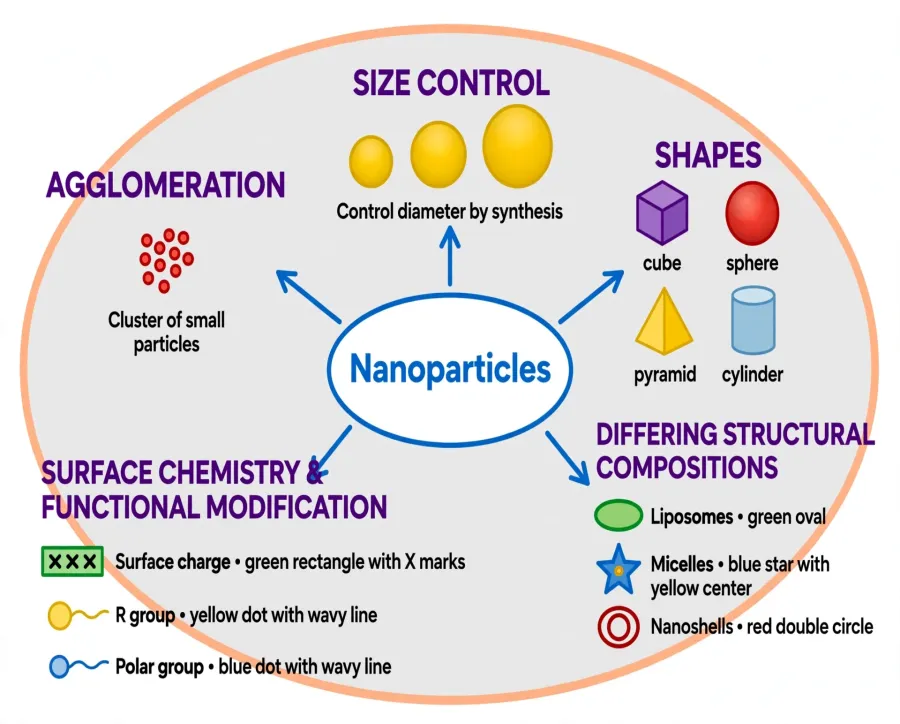
Fig. Schematic representation of nanoparticle-based drug delivery
3.4 Advantages of Nanoparticle-Based Drug Delivery
The major advantages include:
1. Better ability for drugs that don’t dissolve well in water to mix.
2. Increased effectiveness and availability of the drug where it’s needed.
3. Steady or controlled release of medicine for longer-lasting effects.
4. Delivery aimed at certain cells or tissues.
5. Improved absorption by cells using tiny interactions.
6. Fewer side effects throughout the body by improving targeting and release control.
7. Shielding sensitive medications from breaking down too soon.
8. Flexible options for loading various types of medicines.
3.5 Challenges in Conventional Nanoparticle Development
Creating nanoparticles is a complicated task because many factors during the formulation and process can influence the final result. Adjustments in ingredients or how they are prepared can change things like particle size, PDI, surface charge, and how much drug is loaded and released. Their effectiveness in biological settings can also be influenced by how they interact with proteins, how cells take them in, where they go in the body, their toxicity levels, and how well they penetrate tissues. Because of this, it is tough to get consistent formulations and reliable biological performance.
Traditional methods often involve running many lab experiments to find the right formulation conditions. Trying out different combinations of materials and processes can take a lot of time and resources. These challenges have led to a growing need for methods that use computers and data analysis.
3.6 Role of Nanoparticle Characteristics in Drug Delivery
The properties of nanoparticles are connected and together affect how well they deliver drugs.
- The size of the particles impacts how cells take them in and where they go in the body.
- The charge on their surface affects their stability and how they interact with cells.
- The features of the surface play a role in targeting specific areas and interacting biologically.
- How much drug is loaded onto them determines how much medicine gets delivered.
- Their makeup and structure influence how drugs are released and their overall stability.
Because of this, trying to improve all these properties at once can be challenging with traditional methods.
3.7 Transition to AI-Assisted Nanoparticle Development
The development of nanoparticles is slowly shifting towards using data to create better formulas. Artificial intelligence (AI) and machine learning can examine how different formulation factors relate to the properties of nanoparticles by using experimental data. These methods can assist in predicting characteristics like particle size, PDI, and drug loading and release behaviour and can assist researchers in selecting promising formulations for experimental validation.
So, knowing about the different types of nanoparticles, their features, benefits, and the challenges in developing them sets the stage for talking about how AI plays a role in drug delivery using nanoparticles in the next chapters..
4.ARTIFICIAL INTELLIGENCE AND MACHINE LEARNING IN NANOMEDICINE
4.1 Introduction to Artificial Intelligence
Artificial Intelligence (AI) is a branch of computer science focused on creating systems that can carry out tasks usually requiring human thinking. These tasks include recognizing patterns, making predictions, classifying information, making decisions, and analyzing complex data. In the fields of pharmaceuticals and biomedical research, AI is increasingly used to examine large and complex datasets, helping with drug discovery, developing formulations, and making treatment decisions. In nanomedicine, AI offers computational tools to explore how material properties, formulation conditions, and biological results are connected. This approach is especially valuable because nanomedicine produces data from various sources such as physicochemical tests, pharmacokinetic studies, biological experiments, and clinical or preclinical observations.
4.2 Machine Learning
Machine Learning (ML) is an important part of AI where computer models learn patterns and connections from data instead of just following programmed instructions. After these models are trained and tested, they can predict or classify new data that they haven’t seen before.
In the field of nanomedicine, ML helps find links between what we do in experiments and the results we want. For instance, we can use different formulation variables as input features, while the properties of nanoparticles or biological responses measured in experiments act as output variables. Once the model is trained, it can help predict results for new combinations of these variables. This provides a basis for data-driven rather than exclusively empirical formulation development.
4.3 Deep Learning
Deep Learning (DL) is a specialized area of machine learning that uses multilayered artificial neural networks to learn complex patterns from data. Deep-learning models are particularly useful when the relationships between input variables and outcomes are highly nonlinear or when datasets contain multiple interacting features.
Within nanomedicine, deep learning has been explored for prediction of nanoparticle behaviour, material selection, formulation optimization, biological interactions and drug-release profiles. It can also support the analysis of complex relationships between nanoparticle structural features and biological responses.
4.4 Artificial Neural Networks
Artificial Neural Networks (ANNs) are computational models inspired by the interconnected structure of biological neural systems. They consist of interconnected processing units arranged in layers and can learn relationships between input and output variables through training.
ANNs have been investigated in pharmaceutical formulation development because they can model nonlinear relationships between formulation variables and product characteristics. In nanoparticle research, ANN-based models can be trained using experimental datasets to predict formulation outcomes and assist in identifying suitable combinations of formulation variables.
4.5 Major Machine Learning Approaches Relevant to Nanomedicine
Different machine-learning approaches can be selected according to the type of problem and available dataset.
4.5.1 Supervised Learning
In supervised learning, a model is trained using labelled data in which the expected output is already known. The model learns the relationship between input features and corresponding outcomes.
Applications in nanomedicine include:
Supervised learning is particularly useful when sufficient experimental data are available for training and validation.
4.5.2 Unsupervised Learning
Unsupervised learning works with datasets where predefined output labels are not necessarily available. The algorithm attempts to identify patterns, clusters or relationships within the data.
In nanomedicine, this approach can potentially assist in identifying groups of nanoparticles with similar physicochemical or biological characteristics and in exploring complex datasets before predictive modelling.
4.5.3 Reinforcement Learning
Reinforcement learning (RL) uses an iterative process in which an algorithm learns by evaluating the outcomes of its actions according to a defined objective or reward. It can therefore be useful for optimization problems involving repeated decision-making.
Recent nanomedicine research has considered reinforcement learning for optimizing nanoparticle design, drug distribution and controlled-release strategies.
4.5.4 Generative AI and Generative Models
Generative approaches are designed to generate new candidate structures or data based on patterns learned from existing datasets. In nanomedicine, generative models have potential for exploring new material chemistries and nanocarrier architectures rather than merely predicting properties of already known systems.
This creates an opportunity to move from prediction of existing formulations toward computational generation of new candidate formulations.
4.6 Important Machine Learning Algorithms
Several algorithms have been explored for nanomedicine-related applications.
Random Forest (RF):
Random forest is an ensemble-based machine-learning method that combines multiple decision trees. It can be useful for classification and regression tasks and has been investigated
Support Vector Machine (SVM):
SVM is a supervised-learning approach commonly used for classification and regression. It can perform effectively with small-to-medium datasets and can provide useful results when relationships between variables are complex.
Artificial Neural Networks (ANN):
ANNs are useful for modelling nonlinear relationships and can be applied to formulation prediction and optimization.
Deep Neural Networks (DNN):
DNNs contain multiple neural-network layers and can analyse complex relationships within high-dimensional datasets.
Convolutional Neural Networks (CNN):
CNNs are particularly useful for image-based data and can potentially support image analysis and characterization-related applications in nanomedicine.
Generative Models:
Generative models can be used to explore new molecular or material configurations and may support computational design of novel nanocarriers.[3]
4.7 Predictive Modelling in Nanomedicine
Predictive modelling is one of the major contributions of AI to nanomedicine. The general principle involves using existing experimental or computational data to construct a model capable of predicting outcomes for new conditions.
The input dataset may contain formulation variables, material descriptors, physicochemical characteristics, pharmacokinetic information and biological parameters. The model analyses these features to predict a selected outcome.
Recent reviews indicate that ML and DL approaches can predict parameters such as particle size, drug-loading efficiency and biodistribution. Such predictive models can reduce the number of experimental combinations that need to be evaluated and can guide researchers toward promising candidates.
4.8 Data and Nanoinformatics
The development of AI-based nanomedicine depends heavily on the availability of suitable datasets. Nanoparticle research produces information from multiple experimental stages, includeing material synthesis, physicochemical characterization, biological evaluation, pharmacokinetics and therapeutic studies.
Nanoinformatics refers to the application of computational and information-management approaches to nanomaterial-related data. It can support the organization, integration, analysis and interpretation of large datasets.
Integration of nanoinformatics with AI can improve cross-study comparisons and support more systematic analysis of nanoparticle data. Large-scale repositories and standardized datasets may also improve reproducibility and facilitate the development of more reliable predictive models.
4.9 AI-Driven Closed-Loop Approach
A major development in AI-assisted nanomedicine is the movement from simple prediction toward iterative and adaptive design.
In a conventional workflow, researchers may:
Design → Prepare → Characterize → Evaluate → Modify
4.10 Role of AI in Pharmaceutical and Nanomedicine Research
AI is increasingly being used across different stages of nanomedicine development. Its applications include:
1. Data analysis– identifying relationships within complex datasets.
2. Prediction– estimating formulation, physicochemical and biological outcomes.
3. Classification– grouping materials or formulations according to defined characteristics.
4. Optimization– identifying combinations of variables that satisfy multiple desired outcomes.
5. Material discovery– exploring potential materials and nanocarrier compositions.
6. Simulation– modelling nanoparticle–biological interactions.
7. Personalization– incorporating patient-specific information into therapeutic design.
8. Decision support– helping researchers select promising candidates for experimental
4.11 Importance of AI and ML in the Development of Nanomedicine
Combining AI with nanomedicine moves us from mainly trial-and-error methods to designs guided by computer analysis. AI can manage complicated data, find non-linear connections, and make predictions that help direct further experiments. Recent studies highlight this shift as a key advancement for creating more efficient, reliable, and patient-focused nanomedicine. Using AI can help speed up the process of developing new formulas, cut down on unnecessary tests, and aid in creating nanocarriers with specific treatment purposes. However, the success of these methods relies on having the right data, effective algorithms, proper model validation, and experimental confirmation.
5.ROLE OF AI IN NANOPARTICLE DESIGN AND FORMULATION
5.1 AI-Assisted Nanoparticle Design
Creating nanoparticles requires choosing the right materials and managing various conditions during the formulation process. Traditional methods often require several experimental trials. AI can analyse previous formulation data and help identify suitable materials and conditions, making the development process faster and more efficient.
5.2 Selection and Optimization of Formulation
The selection of nanomaterials affects drug incorporation, stability and overall performance of the formulation. AI can help compare different materials and predict suitable combinations. It can also analyse the effect of formulation variables and help optimize conditions with fewer experimental trials.
5.3 Prediction of Nanoparticle Properties
AI can help predict important properties such as particle size, PDI, zeta potential, drug loading and encapsulation efficiency. It can also be used to estimate drug-release behaviour. These predictions help researchers understand how changes in formulation conditions may affect the final nanoparticle product.
5.4 Overall Role of AI
AI allows several nanoparticle quality attributes to be considered together during formulation development. Thus, it can reduce unnecessary trial-and-error experiments and support a more efficient and data-based approach to nanoparticle formulation. Predicted results should, however, be confirmed through laboratory experiments.
6. AI TECHNIQUES USED IN NANOPARTICLE DRUG DELIVERY
AI techniques help analyse nanoparticle-related data and support prediction, classification and optimization of drug delivery systems.
6.1 Machine Learning
Machine learning identifies patterns in data and helps predict nanoparticle properties and formulation outcomes. Common methods include Random Forest, SVM and decision trees.
6.2 Artificial Neural Networks
ANNs can handle complex relationships between formulation variables and are useful for predicting nanoparticle characteristics and performance.
6.3 Deep Learning
Deep learning is useful for analysing large and complex datasets, including imaging, biological and biodistribution data.
6.4 Predictive and Regression Models
These models use existing data to predict numerical and biological outcomes, such as formulation properties and delivery behaviour.
6.5 Classification Models
Classification methods group nanoparticle systems according to selected properties and help in screening suitable candidates.
6.6 Optimization Algorithms
Optimization methods help select suitable formulation and process conditions to achieve desired nanoparticle properties.
6.7 Big Data and Nanoinformatics
Nanoinformatics helps organize and integrate data from nanoparticle studies. Combined with AI, it supports pattern identification and predictive analysis.
7.AI-BASED PREDICTION OF NANOPARTICLE PROPERTIES AND DRUG DELIVERY BEHAVIOUR
AI-based predictive approaches can be used to relate nanoparticle characteristics with their expected drug-delivery behaviour. Analysis of physicochemical and biological data allows computational models to estimate important properties and in-vivo behaviour, supporting early 7screening of nanoparticle systems.
.1 Prediction of Physicochemical Properties
AI models can predict important nanoparticle characteristics such as particle size, PDI and zeta potential using formulation and material-related data. These predictions can help identify formulations with desirable physicochemical characteristics and reduce the number of experimental trials.
7.2 Prediction of Drug Loading
AI can analyse relationships between drug properties, carrier characteristics and formulation variables to estimate drug-loading or encapsulation performance. This can assist in screening nanocarriers with better drug incorporation capacity.
7.3 Prediction of Drug Release
Models that use AI can study data from experiments on drug releases and forecast how drugs will be released over time. These predictions can help in creating and choosing nanoparticle systems that have the release patterns we want.
7.4Prediction of stability
AI can help analyze data related to formulation and storage to find out what affects the stability of nanoparticles. This can assist in predicting stability early on and choosing the right conditions for formulation.
7.5 Prediction of Cellular Uptake
Nanoparticles can affect how drugs enter cells. AI models can analyze the features of nanoparticles along with biological information to find patterns linked to how cells absorb them. This helps in choosing the best nanocarriers for effective drug delivery into cells.
7.6 Prediction of Biodistribution
AI and ML methods can forecast how nanoparticles spread and are removed in various organs and tissues by examining the properties of the nanoparticles and biological factors.Such prediction can provide useful information about in-vivo nanoparticle behaviour before extensive animal experimentation.
7.7 Prediction of Tumour Delivery
For cancer nanomedicine, AI can be used to analyse relationships between nanoparticle aracteristics and biological factors associated with tumour accumulation and delivery. This may help identify nanocarriers with better potential for tumour-directed drug delivery.[14]
8. AI IN TARGETED DRUG DELIVERY
Targeted drug delivery aims to deliver drugs mainly to the desired tissue or cells while reducing exposure to healthy tissues. In nanoparticle-based delivery, AI can analyse biological and formulation data to support target selection and improve nanoparticle design.
8.1 Concept of Targeted Drug Delivery
Nanoparticles can achieve targeting through passive accumulation or active targeting using surface ligands. AI can help analyse the factors affecting these approaches and support better nanocarrier design.
8.2 AI-Assisted Target Identification
AI and machine learning can analyse biological and molecular data to identify potential disease-specific targets. This helps researchers select suitable targets for nanoparticle delivery.
8.3 Ligand–Receptor Interaction
Active targeting depends on the interaction between a ligand on the nanoparticle surface and a receptor on the target cell. AI can examine these interactions and assist in finding the right ligand-receptor pairs.
8.4 Surface Engineering and Tumour Targeting
The surface features of nanoparticles influence how they interact with cells and tissues. Artificial intelligence (AI) can connect these surface traits to biological reactions, helping design nanoparticles that recognize targets better. In cancer treatment, AI can also assist in examining tumor data and aid in creating more precise nanoparticles.
8.5 Smart and Stimuli-Responsive Nanoparticles
Smart nanoparticles can release drugs in response to specific biological or environmental stimuli. AI can help analyse the relationship between nanoparticle design, stimulus conditions and drug release, supporting the development of controlled and targeted delivery systems.
9.APPLICATIONS OF AI IN NANOPARTICLE-BASED DRUG DELIVERY
AI helps improve nanoparticle formulation and drug delivery for different diseases, including cancer, cardiovascular disorders and arthritis. It also supports RNA delivery and personalized treatment.
9.1 Cancer Drug Delivery
AI analyses tumour and nanoparticle data to improve drug targeting and delivery to cancer cells. It may also support personalized cancer treatment.[12]
9.2 RNA/Lipid Nanoparticle Delivery
AI helps select suitable lipids and optimize RNA-loaded lipid nanoparticles for better encapsulation, stability and delivery.
9.3 Cardiovascular Drug Delivery
AI supports nanoparticle selection and formulation optimization for improved drug delivery to cardiovascular tissues.[9]
9.4 Arthritis / Intra-Articular Delivery
AI and experimental design have been used to optimize piroxicam-loaded nanoparticles for sustained drug release and potential localized arthritis treatment.[14]
9.5 Personalized Nanomedicine
AI analyses patient-specific biological and clinical data to help select suitable nanoparticles and treatment strategies.
10.RECENT ADVANCES IN AI-BASED NANOPARTICLE DRUG DELIVERY
AI is improving nanoparticle design, formulation optimization and drug delivery by predicting properties and reducing experimental trials.
10.1 AI-Assisted Design
AI helps select suitable nanoparticle materials and formulations using existing data.
10.2 Drug-Release Prediction
AI models predict drug-release patterns and support formulation development.
10.3 AI and Quality by Design (QbD)
AI helps identify the effects of formulation variables on product quality.[13]
10.4 Nanoinformatics and Big Data
AI analyses large datasets to compare nanoparticle properties and support material selection.
10.5 Targeted Drug Delivery
AI supports the design of nanoparticles for delivery to specific tissues or cells.
10.6 AI-Designed Lipid Nanoparticles
AI helps identify suitable lipid combinations for RNA delivery.
10.7 Personalized Nanomedicine
AI uses patient-specific data to support individualized treatment decisions.
10.8 Multiscale Modelling
Computer models help predict nanoparticle behaviour at different biological levels before laboratory testing.
11.ADVANTAGES OF AI IN NANOPARTICLE DRUG DELIVERY
AI offers several advantages in nanoparticle-based drug delivery by making formulation development more predictive and data-driven.
1) Faster formulation development – Helps identify promising formulations in less time.
2) Reduced trial-and-error experiments – Computational prediction can reduce the number of unnecessary laboratory experiments.
3) Prediction of nanoparticle properties – Important properties and formulation responses can be estimated from available data.
4) Better formulation optimization – Multiple formulation variables can be analysed simultaneously to identify suitable conditions.
5) Handling of complex datasets – AI can process large and diverse physicochemical, biological and pharmacokinetic datasets.
6) Improved targeting strategies – Analysis of nanoparticle and biological data can support more selective delivery approaches.
7) Prediction of drug-release behaviour – AI models can estimate release patterns and support development of controlled-release systems.
8) Potential reduction in development cost – Fewer preliminary experiments and faster screening may reduce development resources.
9)Personalized drug delivery – Patient-specific biological and clinical information can potentially be incorporated into nanomedicine development.
10)Improved decision-making – Data-driven predictions can provide additional evidence for selecting materials, formulations and delivery strategies.
12.CHALLENGES AND LIMITATIONS OF AI IN NANOPARTICLE DRUG DELIVERY
AI offers several benefits in nanoparticle drug delivery, but its use faces challenges related to data quality, prediction accuracy and clinical validation.[3]
12.1 Data Availability and Quality
Limited and inconsistent data can affect the accuracy of AI models.
12.2 Small Datasets
Insufficient data may reduce model reliability and performance.
12.3 Model Interpretability
Some AI models are difficult to understand, making their predictions harder to explain.
12.4 Biological Complexity
Complex interactions between nanoparticles and biological systems are difficult to predict accurately.
12.5 Experimental Validation
AI predictions must be confirmed through laboratory, in-vitro and in-vivo studies.
12.6 Regulatory and Clinical Challenges
Proper validation and regulatory approval are necessary before AI-based approaches can be used clinically.
13. FUTURE PERSPECTIVES
AI is expected to improve the design, optimization and development of nanoparticle-based drug delivery systems. Future research will focus on faster, safer and more personalized approaches.
13.1 AI-Driven Nanoparticle Design
AI may help select suitable nanomaterials and optimize formulation variables, reducing repeated experiments.
13.2 Personalized Nanomedicine
AI may use patient-specific data to support individualized treatment and improve therapeutic outcomes.
13.3 Virtual Screening and Digital Twins
These approaches may help researchers evaluate nanoparticle formulations computationally before laboratory testing.
13.4 AI, Big Data and Nanoinformatics
Combining AI with large datasets may improve material selection and prediction of nanoparticle properties and behaviour.
13.5 Targeted Delivery and QbD Integration
AI may support target selection and formulation optimization when combined with Quality by Design (QbD).
13.6 Clinical Translation and Regulation
Future AI models require proper validation and clear regulatory guidelines to ensure safety, reliability and clinical applicability.
CONCLUSION
Nanoparticle-based drug delivery has emerged as a promising approach for improving drug stability, delivery efficiency and therapeutic performance. The integration of artificial intelligence (AI) with nanoparticle technology provides a data-driven strategy for designing and optimizing nanocarrier systems. AI can support the prediction of important nanoparticle properties, optimization of formulation variables and drug-release behaviour, and development of targeted delivery approaches.
Its use also has the potential to enhance personalized nanomedicine by taking into account the specific traits of patients. However, for AI to work well in delivering nanoparticle drugs, it needs trustworthy and large datasets, proper validation of models, and better understanding of how they work. Using standardized methods for experiments and consistent data formats is crucial to create models that can be reproduced and applied widely. Additionally, meeting regulatory standards and translating findings into clinical practice are major hurdles. Overall, blending AI with nanoparticle technology could greatly improve the efficiency, predictability, and personalization of nanomedicine development, as long as these challenges are tackled through ongoing research, testing, and suitable regulations.
REFERENCES


Yogita Lanke, Payal Khairmode, Samiksha Jadhav, Sujata Nagare, Artificial Intelligence in Nanoparticle-Based Drug Delivery: Recent Advances and Future Perspectives., Int. J. Sci. R. Tech., 2026, 3 (11), 587-598. https://doi.org/10.5281/zenodo.24214954
 10.5281/zenodo.24214954