

We use cookies to ensure our website works properly and to personalise your experience. Cookies policy
Medical Surgical Nursing, Driems University, Tangi, Cuttack
Rosacea is a chronic dermatological condition characterized by recurrent facial flushing, erythema, and inflammatory lesions, often influenced by genetic predisposition and environmental triggers. This report summarizes current treatment options for rosacea, drawing from published literature on its management. Patients are advised to avoid physiological and environmental stimuli that exacerbate facial redness. Topical therapies, including metronidazole, azelaic acid, and sulphur preparations, remain effective first-line options. For individuals with erythematotelangiectatic or papulopustular rosacea, oral antibiotics such as tetracycline are beneficial, while isotretinoin may be reserved for severe or refractory cases. Maintenance of remission can be achieved with continued topical therapy. Ocular rosacea requires long-term antibiotic use alongside topical metronidazole gel. Surgical interventions, particularly laser therapy, are recommended for telangiectasias and rhinophyma. Additionally, cosmetic camouflage offers psychological relief for patients distressed by visible symptoms. With the availability of diverse oral, topical, and procedural treatments, rosacea can be effectively managed, enabling patients to maintain both dermatological health and quality of life.1,3
Rosacea is a chronic inflammatory skin disorder that primarily affects the central face, manifesting as recurrent flushing, persistent erythema, papules, pustules, and telangiectasias. It is a condition with a variable course, often triggered by environmental, physiological, and lifestyle factors. Although not life-threatening, rosacea significantly impacts patients’ quality of life due to its visible nature and associated psychosocial distress. The disorder is commonly underdiagnosed and misinterpreted as acne or other dermatological conditions, leading to delayed treatment. With the availability of diverse therapeutic options, ranging from topical agents to systemic medications and procedural interventions, effective management is possible. This review aims to consolidate current evidence on treatment strategies for rosacea, highlighting their clinical utility and relevance for patient care.5,11
CASE SCENARIO :
Mrs. S, a 42‑year‑old school teacher, presented with a five‑year history of recurrent facial flushing that worsened with sun exposure and spicy food. She reported persistent redness over her cheeks and nose, accompanied by occasional papules and pustules, along with a burning sensation after outdoor activities. Her family history was notable for similar symptoms in her mother. On examination, erythematotelangiectatic rosacea was evident with visible telangiectasias on the cheeks and papulopustular lesions scattered over the nose and chin.
BACKGROUND OF THE STUDY
Rosacea is a chronic, relapsing dermatological condition that predominantly affects the central facial region, presenting with recurrent flushing, persistent erythema, papules, pustules, and telangiectasias. Its etiology is multifactorial, involving vascular hyperreactivity, immune dysregulation, microbial factors such as Demodex mites, and genetic predisposition. Although rosacea is not life‑threatening, its visible manifestations often result in significant psychosocial distress, reduced self‑esteem, and impaired quality of life.Globally, rosacea is more frequently observed in fair‑skinned populations of Northern European descent, but it can affect individuals across all ethnic groups. The condition typically appears in adulthood, with a higher prevalence among women, though men are more prone to severe phymatous changes such as rhinophyma. Clinically, rosacea is categorized into four major subtypes: erythematotelangiectatic, papulopustular, phymatous, and ocular, each requiring tailored management strategies.5,11
Despite the availability of multiple therapeutic options, rosacea remains underdiagnosed and often mismanaged due to its resemblance to acne and other inflammatory skin disorders. Patients frequently experience frustration with recurrent flare‑ups and inadequate control. The chronicity of the disease, combined with its cosmetic implications, underscores the need for comprehensive reviews that consolidate evidence‑based treatment approaches. Such reviews not only guide clinicians and nursing professionals in selecting appropriate interventions but also highlight the importance of patient education, lifestyle modification, and psychological support in holistic care.5,11
REVIEW OF LITERATURE
Literature Review related to Procedural and Supportive Interventions
The research study reviewed procedural options such as laser therapy and intense pulsed light (IPL) for the management of telangiectasias and rhinophyma. Their analysis demonstrated that these interventions are particularly effective in reducing vascular lesions and improving cosmetic appearance. Furthermore, the study highlighted the importance of psychological support and cosmetic camouflage in patients experiencing distress due to visible symptoms. The authors stressed that combining medical treatment with supportive measures enhances both dermatological control and quality of life. 2,9
Literature Review related to Topical and Systemic Therapies
A study emphasized the effectiveness of topical agents such as metronidazole and azelaic acid in reducing erythema and inflammatory lesions in rosacea. Their findings highlighted that topical therapy remains the cornerstone of initial management, particularly in mild to moderate cases. In addition, systemic antibiotics like tetracyclines were shown to provide significant improvement in papulopustular rosacea, with isotretinoin reserved for severe or refractory cases. The authors concluded that a stepwise approach, beginning with topical agents and progressing to systemic therapy when necessary, ensures optimal patient outcomes. 2,9
A systematic review analyzed 43 clinical trials involving 18,347 patients with rosacea. The study found that oral isotretinoin was the most effective therapy for reducing inflammatory lesions, particularly in severe and recalcitrant cases. Topical agents such as ivermectin, metronidazole, and azelaic acid demonstrated consistent efficacy in mild to moderate disease, while oral antibiotics like minocycline and doxycycline were effective for papulopustular rosacea. The review emphasized the role of Demodex folliculorum mites in pathogenesis and highlighted the need for combination therapies to improve long‑term outcomes. 2,9
Literature Review related to Advancement in Targeted and Emerging Therapies
A systematic review evaluated 15 studies with 537 rosacea patients and 77 controls. The review highlighted vascular‑targeted therapies (oxymetazoline, pulsed‑dye laser, platelet‑rich plasma) and microbiome‑oriented approaches as promising new strategies. Established agents like ivermectin, azelaic acid, dapsone, sulph study ur preparations, and metronidazole continued to show benefit, while tofacitinib (a JAK inhibitor) and oral ivermectin emerged as potential options for refractory cases. The authors concluded that a multimodal, mechanism‑based approach—addressing vascular, inflammatory, immunological, and microbial pathways—offers the best outcomes. However, they stressed the need for large randomized controlled trials to validate long‑term efficacy and safety. A systematic review analyzed 43 clinical trials involving 18,347 patients with rosacea. The study found that oral isotretinoin was the most effective therapy for reducing inflammatory lesions, particularly in severe and recalcitrant cases. Topical agents such as ivermectin, metronidazole, and azelaic acid demonstrated consistent efficacy in mild to moderate disease, while oral antibiotics like minocycline and doxycycline were effective for papulopustular rosacea. The review emphasized the role of Demodex folliculorum mites in pathogenesis and highlighted the need for combination therapies to improve long‑term outcomes. 2,9
A systematic review evaluated 15 studies with 537 rosacea patients and 77 controls. The review highlighted vascular‑targeted therapies (oxymetazoline, pulsed‑dye laser, platelet‑rich plasma) and microbiome‑oriented approaches as promising new strategies. Established agents like ivermectin, azelaic acid, dapsone, sulfur preparations, and metronidazole continued to show benefit, while tofacitinib (a JAK inhibitor) and oral ivermectin emerged as potential options for refractory cases. The authors concluded that a multimodal, mechanism‑based approach addressing vascular, inflammatory, immunological, and microbial pathways offers the best outcomes. However, they stressed the need for large randomized controlled trials to validate long‑term efficacy and safety. 2,9
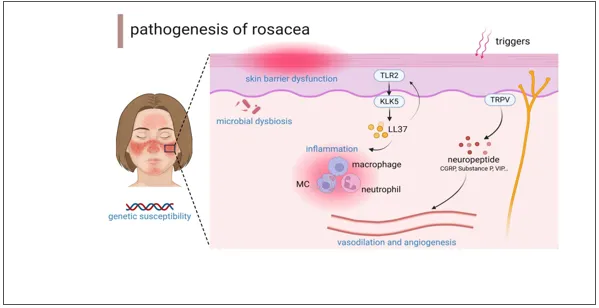
Figure 1: Pathogenesis of Rosacea
Rosacea is a common, chronic inflammatory skin condition that primarily affects the central face, causing persistent redness, visible blood vessels, and acne-like breakouts. It most frequently occurs in adults over 30, particularly those with fair skin and with global prevalence of around 5.1%. Causes psychosocial distress and reduced quality of life.
Genetic Factors: Twin studies show ~46% heritability. GWAS identified HLA variants and STAT1 mutations. Other implicated genes include LRRC4, SH3PXD2A, and SLC26A8. Vitamin D receptor polymorphisms also influence susceptibility.
Neurovascular Dysregulation: TRP channels (TRPV1, TRPV4) mediate flushing and burning. Neuropeptides (PACAP, CGRP, VIP) drive vasodilation and inflammation. Dysregulated amino acid metabolism (glutamate, aspartate) enhances neurovascular reactivity.
Immune Dysregulation:
Skin Barrier Dysfunction: Increased transepidermal water loss, reduced claudins, altered lipid layers, and STAT3 overexpression contribute to barrier impairment.
Microbial Dysbiosis:
Rosacea arises from interplay of genetics, neurovascular changes, immune dysregulation, barrier dysfunction, and microbiota imbalance. Advances in genomics and immunology are paving the way for personalized therapies.
SYMPTOMS AND SUBTYPES
Rosacea typically manifests in one or a combination of four primary subtypes:
Common Triggers: Symptoms often flare up in response to specific environmental or lifestyle factors that increase blood flow to the skin's surface:
TREATMENT AND MANAGEMENT
While there is no cure for rosacea, symptoms can be managed effectively through medical treatments and lifestyle adjustments:
1. Classification & Diagnostic Paradigm
Historically categorized into four fixed subtypes (erythematotelangiectatic, papulopustular, phymatous, and ocular), modern dermatologic consensus—including the Global Rosacea Consensus (ROSCO) panel—has shifted toward a phenotype-directed framework. This approach emphasizes assessing individual clinical presentations (e.g., persistent centrofacial erythema, inflammatory papules/pustules, telangiectasias, or ocular features) to allow for tailored, combination therapies.
2. Etiology & Pathogenesis
Rosacea is understood as a chronic, multifactorial inflammatory disease involving immune dysregulation, neurovascular dysfunction, and skin barrier alterations.
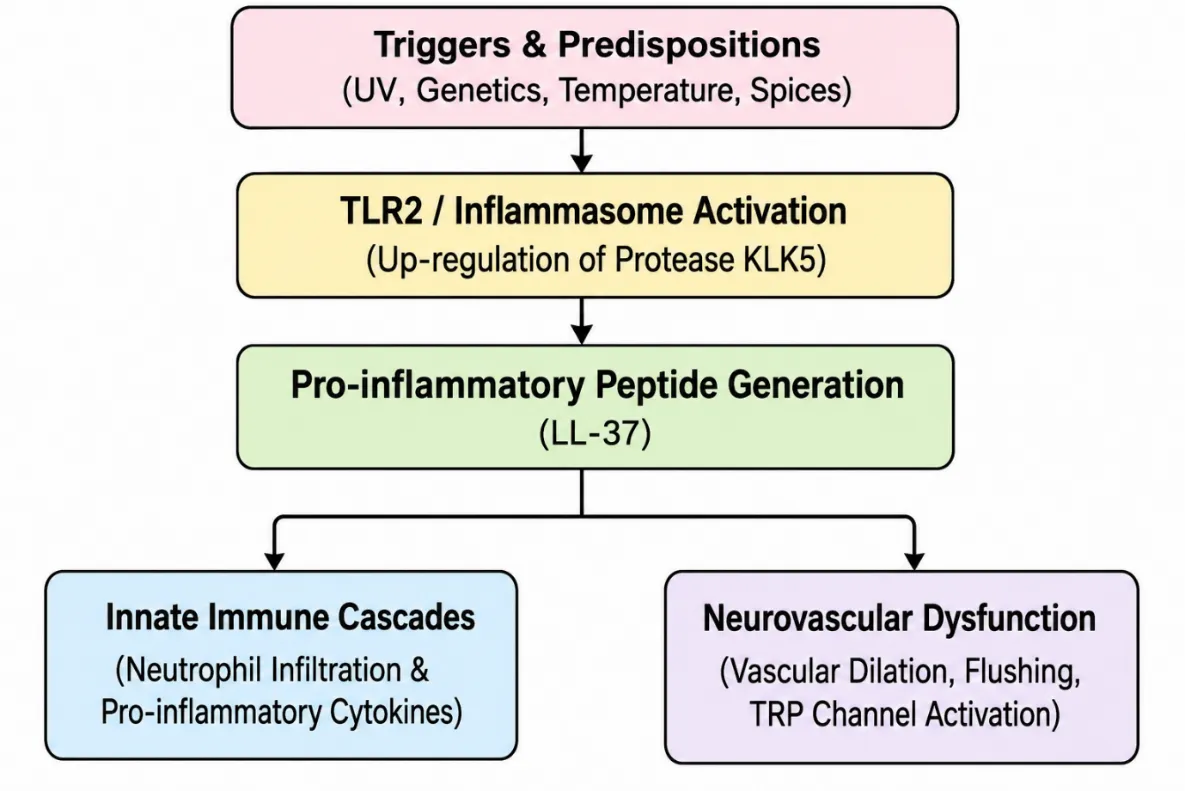
Figure 2: Pathophysiology of Rosacea
3. Therapeutic Modalities & Emerging Targets
Contemporary management combines skin barrier repair with targeted pharmacologic interventions:
Nursing Process for Rosacea 8,13
|
Assessment |
Nursing Diagnosis |
Goal/Expected Outcome |
Nursing Interventions |
Evaluation |
|
Facial redness, flushing, visible small blood vessels, papules/pustules; patient reports burning or stinging |
Impaired skin integrity related to inflammatory skin changes |
Skin remains intact with reduced redness and inflammation |
|
Skin integrity maintained; redness and lesions reduced |
|
Patient reports burning, stinging, itching or discomfort of facial skin |
Acute pain/discomfort related to skin inflammation |
Patient reports reduced discomfort |
|
Patient reports decreased burning/stinging |
|
Patient expresses embarrassment or concern about facial appearance |
Disturbed body image related to visible facial changes |
Patient demonstrates improved acceptance of appearance |
|
Patient verbalizes improved self-confidence |
|
Patient may be unaware of triggers such as sunlight, heat, spicy food, alcohol, stress and hot beverages |
Deficient knowledge regarding disease management |
Patient demonstrates adequate knowledge of rosacea care |
|
Patient correctly explains self-care measures and triggers |
|
Recurrent flushing and inflammatory lesions; risk of worsening symptoms |
Risk for exacerbation of symptoms related to exposure to known triggers |
Patient remains free from frequent exacerbations |
|
Frequency and severity of flare-ups are reduced |
Important Health Education
CONCLUSION
Nursing management is a multidimensional concept that encompasses both direct patient care and leadership responsibilities within healthcare organizations. Clinically, the nursing process (ADPIE) provides a systematic framework to assess, diagnose, plan, implement, and evaluate patient care, ensuring safe and effective outcomes. This structured approach empowers nurses to deliver evidence‑based interventions, monitor progress, and adapt care plans to meet evolving patient needs. On the other hand, administrative nursing management focuses on planning, organizing, staffing, directing, and controlling healthcare services. These functions are essential for maintaining quality standards, optimizing resource utilization, and fostering a supportive work environment. Together, clinical and administrative management ensure holistic patient care while strengthening nursing leadership. Effective nursing management not only improves patient outcomes but also enhances staff satisfaction, teamwork, and organizational efficiency. By integrating clinical expertise with managerial skills, nurses contribute to both bedside care and broader healthcare delivery. Ultimately, nursing management is the cornerstone of professional practice, bridging patient care and healthcare leadership to achieve excellence in service.16
REFERENCES



Yerni Jyothi Kolli*, Sheeba Anitha Rani, Anusuya Devi, Blush Beyond The Skin: Healing Paths In Rosacea, Int. J. Sci. R. Tech., 2026, 3 (9), 103-110. https://doi.org/10.5281/zenodo.22303407
 10.5281/zenodo.22303407