

We use cookies to ensure our website works properly and to personalise your experience. Cookies policy
1Sri Ramakrishna College of Arts & Science, Nava India, Coimbatore 641 006, Tamil Nadu, India
2Department of Physical Education Health Education and Sports, St. Josephs College, Tiruchirappalli-620002, Tamil Nadu, India
Plyometric training and Ladder have been widely acknowledged as effective conditioning methods for enhancing physical fitness variables such as agility, balance, speed, and neuromuscular coordination through quick, explosive, and multi-directional movement patterns (Miller et al., 2006). The present study aimed to examine the combined effects of ladder training and plyometric exercises on selected physical fitness variables, specifically agility and explosive power, among college-level Volleyball players. Participants were selected from colleges affiliated with Bharathiar University, and a total of forty Volleyball players aged between 18 and 21 years voluntarily participated in the study. The subjects were randomly assigned into two groups: an experimental group that underwent an eight-week training programme consisting of ladder drills and plyometric exercises, and a control group that did not participate in any structured physical training during the experimental period. The training intervention was conducted five days per week and included various ladder footwork drills, lower- and upper-body plyometric exercises, and specific movement patterns emphasizing rapid direction changes, jumping, and landing control. Agility and explosive power were assessed before and after the training period using standardized testing protocols. Statistical analyses were employed to determine the significance of differences between the pre- and post-test scores of the two groups. The results revealed that the experimental group showed significant improvements in agility and explosive power when compared with the control group. These findings suggest that the integration of ladder training with plyometric exercises is an effective approach for enhancing key physical fitness components essential for volleyball performance. Overall, the study supports the inclusion of ladder and plyometric training programmes as valuable conditioning strategies for improving agility and explosive power among competitive Volleyball players.
Ladder training has emerged as an effective and practical method for improving agility, coordination, and footwork efficiency. Agility ladder drills involve fast, repetitive foot movements performed in multiple planes, which stimulate the neuromuscular system and improve motor unit recruitment. These drills enhance proprioception, reaction time, and lower-limb coordination, all of which are crucial for Volleyball players who must respond quickly to opponents’ movements during raids and defensive formations. Ladder training also promotes better body control and spatial awareness, enabling athletes to execute complex movement patterns with precision and speed.
Plyometric training, on the other hand, is widely recognized for its ability to develop explosive power, dynamic balance, and muscular strength through stretch–shortening cycle activities. Plyometric exercises such as jump squats, bounding, hopping, and depth jumps train the muscles and tendons to produce maximal force in minimal time. In Kabaddi, plyometric ability is directly linked to performance elements such as powerful take-offs, quick directional changes, sudden stops, and effective tackling actions. Moreover, plyometric training enhances dynamic balance by improving joint stability, postural control, and the efficiency of neuromuscular responses during landing and take-off phases.
The integration of ladder training with plyometric exercises offers a comprehensive training approach that simultaneously develops agility and balance. While ladder drills emphasize speed, coordination, and foot placement, plyometric exercises focus on explosive strength and dynamic postural stability. Previous research has indicated that combined training programmes incorporating agility and plyometric components lead to greater improvements in physical fitness variables compared to isolated training methods. Such integrated training enhances neuromuscular efficiency, improves movement economy, and increases the athlete’s capacity to control body movements under fatigue. For Volleyball players, this translates into quicker raids, more effective defensive maneuvers, and improved overall performance.
In the context of collegiate Volleyball players, structured ladder and plyometric training programmes are particularly relevant, as this age group represents a critical phase for physical development and performance enhancement. Implementing scientifically designed training interventions can help players develop essential fitness qualities that form the foundation for advanced skill execution and competitive success.
Therefore, the present study aims to examine the effects of ladder training combined with plyometric exercises on selected physical fitness variables, namely agility and explosive power among Volleyball players. (Baechle & Earle, 2016).
METHODOLOGY
The study adopted a randomized experimental design to evaluate the impact of ladder with plyometric training on selected physical variables among Volleyball players. Participants were selected from Bharathiar University–affiliated colleges, and a total of forty Volleyball players aged 18 to 21 years volunteered to take part in the research. Prior to data collection, all subjects were briefed about the objectives and procedures of the study, and informed consent was obtained. The selected participants were then randomly divided into two groups: an experimental group and a control group. The experimental group underwent an 8-week structured training programme, conducted five days a week, which included ladder with playometric training towards the jumping movements lead to the agility and explosive power efficiency. The control group did not participate in any organized physical training during the study period and maintained their routine daily activities. Pre-test measurements of physical variables namely agility and balance were collected using standardized and widely accepted laboratory and field-testing procedures. Following the 8-week intervention, the same tests were administered as post-tests to determine changes in physiological performance. All data were statistically analyzed using appropriate techniques, including mean, standard deviation, and paired t-test, to assess the significance of differences between pre- and post-test scores within and between the groups. The level of significance was set at 0.05, ensuring that the results were scientifically valid and reliable. The methodological framework was designed to provide a systematic and controlled evaluation of the effects of ladder with plyometric training on the physical fitness of Volleyball players.
TRAINING SCHEDULE FOR PLYOMETRIC WITH LADDER TRAINING OF VOLLEYBALL PLAYERS
Table I:
| PLYOMETRIC WITH LADDER TRAINING |
Phase- I I to II |
Phase- II III to IV |
Phase- III V to VI |
Phase- IV VII to VIII |
|---|---|---|---|---|
| One-In Drill Two-In Two-Out Lateral Quick Steps Line Jumps (front/back) Squat Jumps Standing Broad Jumps Plyometric Lunges |
In-In-Out-Out Carioca (grapevine) Crossover Step Zig-Zag Ladder Run Box Jumps (low height) Lateral Hurdle Jumps Tuck Jumps |
Double Trouble (double steps per box) 3-Step Lateral Run Backward Ladder Run Hopscotch Drill Bounding (20-30m) Lateral Box Jumps 180° Jump Turns |
Chaos Footwork Drill (random call commands) Zig-Zag with Reaction Ball Ladder + Sprint Combo Lateral Bounds to Sprint Hurdle Hops + Sprint Reactive Tuck Jumps (coach’s clap) Combo Drill: Plyo Lunge + Ladder In-Out |
|
| Repetition | 4-5 | 5-6 | 6-7 | 5-6 |
| Sets | 3 | 4 | 5 | 4 |
| Rest | 90 Seconds | |||
| Total | 90 Minutes | |||
CALCULATION OF THE ‘T’ RATIO FOR AGILITY OF VOLLEYBALL PLAYERS IN THE EXPERIMENTAL AND CONTROL GROUPS
(Scores in Seconds)
Table II:
| Group | Test | Mean | Std. Deviation | T ratio | |
|---|---|---|---|---|---|
| Agility | Experimental Group | Pre test | 15.60 | 0.21 | 7.68* |
| Post test | 14.91 | 0.66 | |||
| Control Group |
Pre test | 15.61 | 0.22 | 0.59 | |
| Post test | 15.56 | 0.23 | |||
*significant level 0.05 level (degree of freedom 2.09, 1 and 19)
Table II shows the computed mean, standard deviation, and t-ratio for agility in the experimental group. The calculated t-value was 7.68, whereas the critical value at the 0.05 level of significance with 19 degrees of freedom was 2.09. Because the obtained t-value was greater than the table value, the improvement in agility for the experimental group was considered statistically significant. In comparison, the control group produced a t-value of 0.59, which was below the critical value of 2.09, indicating that the change in agility for the control group was not statistically significant.
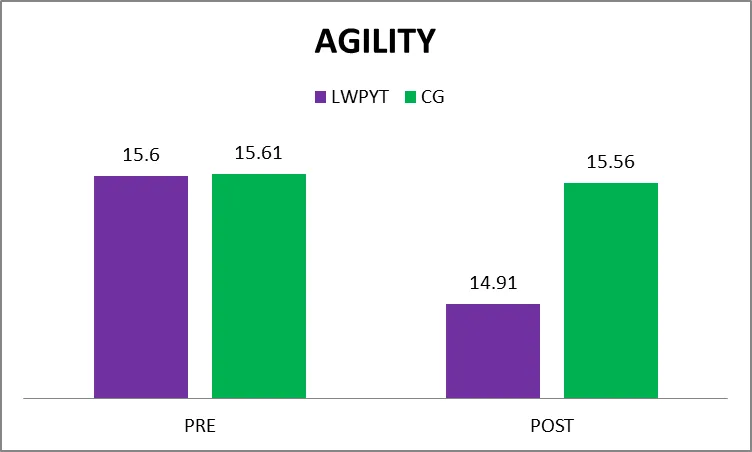
Figure I:
BAR DIAGRAM ILLUSTRATING THE MEAN AGILITY OF VOLLEYBALL PLAYERS IN THE EXPERIMENTAL AND CONTROL GROUPS
Table II:
MULTIPLICATION OF ‘T’ RATIO ON EXPLOSIVE POWER OF VOLLEYBALL PLAYERS
ON INVESTIGATIONAL AND REGULATOR GROUPS
(Scores in Centimeters)
| Group | Test | Mean | Std. Deviation | T ratio | |
|---|---|---|---|---|---|
| Explosive Power | Experimental Group | Pre test | 50.62 | 0.62 | 12.63* |
| Post test | 57.60 | 0.75 | |||
| Control Group |
Pre test | 50.65 | 0.55 | 0.60 | |
| Post test | 50.55 | 0.51 | |||
*significant level 0.05 level (degree of freedom 2.09, 1 and 19)
Table II displays the computed mean, standard deviation, and ‘t’ ratio for explosive power in the experimental group. The obtained ‘t’ value for balance was 12.63, whereas the critical table value for degrees of freedom (df = 19) at the 0.05 level of significance was 2.09. Since the obtained ‘t’ value was substantially greater than the table value, the difference between the pre-test and post-test scores of the experimental group was determined to be statistically significant, signifying a notable improvement in explosive power development as a result of the intervention. Conversely, the control group achieved a ‘t’ value of 0.60, which was lower than the table value (2.09), indicating that there was no significant difference in explosive power for participants who did not undergo the LWPYT program.
\
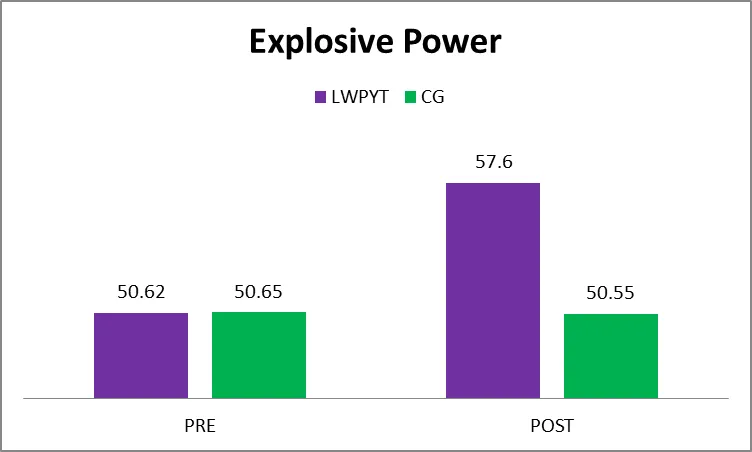
Figure II:
TABLET FIGURE DISPLAY THE MEAN VALUE ON EXPLOSIVE POWER OF
VOLLEYBALL PLAYERS ON INVESTIGATIONAL AND REGULATOR GROUPS
DISCUSSION ON FINDINGS
The purpose of the present study was to examine the effects of ladder training combined with plyometric exercises on selected skill-related physical fitness variables, namely agility and explosive power, among volleyball players. The findings of the study revealed that the experimental group, which underwent the integrated ladder and plyometric training programme, showed statistically significant improvements in agility and explosive power when compared with the control group. These results clearly indicate that the combined training intervention was effective in enhancing key performance-related fitness components essential for volleyball players.
The significant improvement in agility observed in the experimental group may be attributed to the nature of ladder training, which emphasizes rapid foot movements, quick directional changes, and precise neuromuscular coordination. Agility ladder drills stimulate the central nervous system and enhance motor unit recruitment, resulting in improved reaction time and movement efficiency. Volleyball requires players to perform sudden directional changes, quick dodging, and fast chasing movements during offensive and defensive situations, and ladder training closely replicates these sport-specific movement patterns. Similar findings have been reported by Miller et al. (2006), who stated that agility-based training programmes significantly improve change-of-direction speed and movement control in athletes.
The improvement in explosive power can also be explained by the addition of plyometric exercises, which enhance the stretch–shortening cycle of muscles. Plyometric training improves the ability of muscles and tendons to generate force rapidly, thereby contributing to powerful take-offs, quick sprints, and sudden directional changes during volleyball performance. According to Markovic and Mikulic (2010), plyometric training leads to neuromuscular adaptations that enhance explosive movements and agility performance in team sport athletes. The combined effect of ladder and plyometric training likely produced greater neuromuscular efficiency than either method alone.
Ladder training also contributes to explosive power development by improving coordination and movement efficiency, which allows players to utilize muscular strength more effectively during rapid acceleration and deceleration. Additionally, plyometric exercises such as bounding, hopping, and jump drills improve lower limb muscle strength and power, which are essential for fast chasing, quick dodging, and sudden directional changes in volleyball. Previous studies have emphasized that combined agility and plyometric training improves lower-limb coordination, neuromuscular responsiveness, and explosive performance (Haff & Triplett, 2016).
Overall, the findings of the present study support the effectiveness of ladder training combined with plyometric exercises in improving agility and explosive power among volleyball players. The integrated training approach closely matches the physiological and biomechanical demands of volleyball and offers a practical and efficient method for enhancing performance-related fitness variables. Therefore, coaches and trainers are encouraged to incorporate ladder and plyometric training into regular volleyball conditioning programmes to improve agility, explosive power, and overall game performance.
CONCLUSIONS
Based on the findings of the study, it was concluded that ladder training combined with plyometric exercises significantly improved the skill-related physical fitness variables of agility and explosive power among volleyball players. The experimental group showed greater improvement compared to the control group, indicating that the combined training programme was effective in enhancing performance and overall game ability of volleyball players.
REFERENCES

Dr. R. Saravanan, Dr. P. Pratheep, Combined Plyometric with Ladder Training on Agility and Explosive Power of Volleyball Players, Int. J. Sci. R. Tech., 2026, 3 (10), 1041-1046. https://doi.org/10.5281/zenodo.23473410
 10.5281/zenodo.23473410