

We use cookies to ensure our website works properly and to personalise your experience. Cookies policy
Child Health Nursing Department Driems University, School Of Nursing Kotasahi, Tangi, Cuttack, Odisha 754022
Hutchinson–Gilford progeria syndrome (HGPS), commonly called progeria, is a very rare genetic disorder characterized by accelerated-aging features beginning in childhood. Affected children are generally normal at birth but develop severe growth failure, loss of subcutaneous fat, sparse hair, characteristic facial features, skin changes, and joint abnormalities. Intellectual development is usually preserved. The major life-limiting complication is premature and progressive cardiovascular and cerebrovascular disease. HGPS is most often associated with a pathogenic Lmna variant that produces abnormal lamin A called progerin. Diagnosis is based on characteristic clinical findings and molecular genetic testing. Management is multidisciplinary and includes cardiovascular surveillance, nutritional support, physical and occupational therapy, dental and eye care, family education, and targeted therapy such as lonafarnib when appropriate. Nursing care focuses on growth and hydration, cardiovascular monitoring, mobility, skin and comfort, psychosocial support, and family education.
Progeria is an extremely rare childhood-onset progeroid disorder. It is not simply normal aging occurring faster; a molecular abnormality affects lamin A and nuclear structure.
Classic HGPS is most commonly caused by an LMNA c.1824C>T variant, producing abnormal splicing and progerin accumulation. The disorder requires lifelong multidisciplinary surveillance, especially for cardiovascular and cerebrovascular complications.
Nurses have an important role in the early recognition of changes, maintaining comfort and mobility, supporting nutrition and hydration, educating caregivers, and coordinating multidisciplinary care.1,7
Review Of Literature
Hutchinson-Gilford Progeria Syndrome (HGPS) is an extremely rare and uniformly fatal premature aging disorder that provides important insights into aging at both cellular and organismal levels. Children typically present in early childhood with growth retardation and dermatologic changes, while the primary causes of morbidity and mortality are atherosclerotic cardiovascular disease and strokes, leading to death at an average age of 14.6 years. Literature highlights a distinctive craniofacial and cerebrovascular phenotype, with strokes occurring due to carotid or vertebral artery occlusion, stenosis, and calcification, often accompanied by collateral vessel formation. Both large and small vessel disease are implicated, and many strokes remain clinically silent. Interestingly, despite multisystem premature aging, cognitive function is preserved, with no evidence of dementia or Alzheimer-type pathology in limited autopsy studies. Transgenic mouse models expressing the common HGPS mutation show severe nuclear distortions in neurons, including irregular shapes and invaginations, but no tau inclusions or aberrant gene expression changes in hippocampal neurons. These findings suggest selective tissue vulnerability to progerin, the disease-causing protein. Current literature emphasizes the importance of multidisciplinary care, focusing on cardiovascular monitoring, stroke prevention, and dermatologic management, while experimental therapies targeting progerin pathways offer hope for future treatment.5,6,7
Etiology And Pathophysiology:
The primary molecular abnormality involves the LMNA gene. Abnormal RNA splicing produces progerin, a shortened, abnormal lamin A protein. Progerin accumulation disrupts nuclear architecture and contributes to cellular dysfunction.
Major downstream effects include:
Severe growth deficiency and lipodystrophy.
Tight skin and alopecia.
Joint stiffness and reduced mobility.
Musculoskeletal changes
Bone abnormalities → Joint stiffness → Reduced range of motion
→ Impaired mobility
↓
Cardiovascular changes
Vascular cell dysfunction → Arterial stiffness → Premature atherosclerosis
→ Reduced blood flow → Increased risk of heart attack and stroke
↓
Craniofacial and dental changes
Abnormal craniofacial growth → Small jaw (micrognathia)
Delayed or abnormal tooth eruption
↓
Progressive multisystem complications,
particularly cardiovascular and cerebrovascular disease
↓
Reduced life expectancy, progressive arterial stiffness
with accelerated atherosclerosis.1,5,7
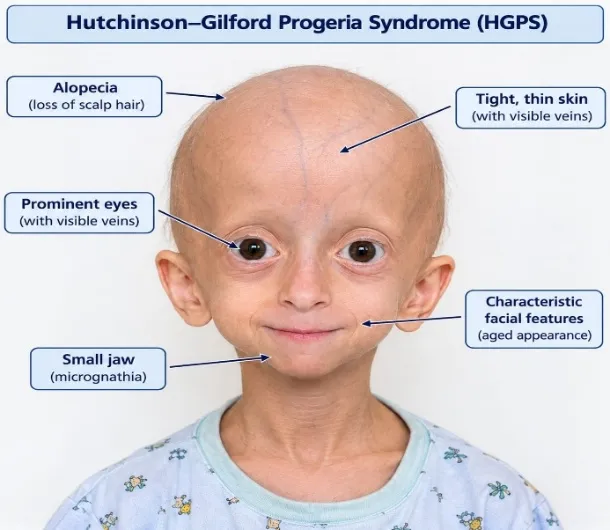
Clinical Manifestations:
Figure: Characteristic clinical features and genetic basis of Hutchinson–Gilford Progeria Syndrome.
| System | Important findings |
|---|---|
| Growth and body composition | Poor weight gain, short stature, loss of subcutaneous fat, thin limbs, prominent veins. |
| Skin, hair and face | Tight skin, alopecia or sparse hair, prominent eyes, thin nasal structures, small mouth and micrognathia. |
| Musculoskeletal | Joint stiffness, contractures, hip abnormalities and reduced range of motion. |
| Cardiovascular and neurological | Arterial stiffness, premature atherosclerosis, possible angina or myocardial ischemia, stroke or transient neurological events. |
| Dental and sensory | Delayed or abnormal dentition; possible hearing or eye problems.1,7 |
Diagnosis And Investigations:
Diagnosis is suspected from the characteristic phenotype and confirmed by molecular genetic testing. Comprehensive clinical assessment and workup include:
Nursing Care Plan :
| Assessment | Nursing Diagnosis | Goal / Expected Outcome | Nursing Interventions | Evaluation |
|---|---|---|---|---|
| Poor weight gain, low body mass, and reduced subcutaneous fat. | Imbalanced Nutrition: Less Than Body Requirements related to altered growth and increased nutritional needs, as evidenced by poor weight gain and low body mass. | To maintain adequate nutrition, hydration, and energy. | 1. Monitor weight, height, food intake, and hydration status. 2. Encourage prescribed small, frequent meals. 3. Coordinate referral to a dietitian. 4. Observe for nutritional deficiencies. 5. Educate the caregiver about nutrition and prescribed medicines. |
Nutritional status is maintained or improved, and hydration remains adequate. |
| Risk associated with progressive vascular disease. | Risk for Decreased Cardiac Output related to cardiovascular involvement. | To maintain stable cardiovascular status and detect complications early. | 1. Monitor heart rate, blood pressure, and general cardiovascular status. 2. Observe for chest pain, dyspnea, syncope, unusual fatigue, or neurological changes. 3. Maintain scheduled specialist follow-up. 4. Promptly report acute changes. | No acute cardiovascular event goes unrecognized, and abnormal findings are reported promptly. |
| Joint stiffness and limited range of motion. | Impaired Physical Mobility related to musculoskeletal abnormalities, as evidenced by joint stiffness and reduced range of motion. | To maintain safe mobility and functional independence. | 1. Assess range of motion, gait, pain, and activity tolerance. 2. Encourage prescribed physical and occupational therapy. 3. Support safe stretching and age-appropriate activity. 4. Implement fall-prevention measures. Provide comfortable positioning. | Mobility is maintained or improved, and injury is prevented. |
| Tight or dry skin and musculoskeletal discomfort. | Impaired Comfort related to skin and musculoskeletal changes, as evidenced by pain, tight or dry skin, or stiffness. | To improve comfort and prevent avoidable skin problems. | 1. Assess pain and skin condition. 2. Provide prescribed skin care. 3. Encourage adequate hydration. 4. Maintain comfortable positioning. 5. Protect exposed skin from excessive sun. 6. Report persistent or worsening pain. | The child reports or appears more comfortable, and the skin remains intact. |
| Family concerns about chronic illness, uncertainty, and long-term care needs. | Anxiety (Family) related to chronic illness, uncertainty, and long-term care needs, as evidenced by caregiver concerns and questions. | To help the family understand the condition and develop improved coping strategies. | . Explain the condition in simple language. 2. Teach warning signs requiring prompt medical attention. 3. Encourage the family to ask questions. 4. Provide emotional support. 5. Reinforce multidisciplinary care and genetic counselling when appropriate. 6. Encourage normal school and play participation when appropriate. |
The family verbalizes understanding, asks relevant questions, and demonstrates improved coping. |
Medical Management:
Management is multidisciplinary and focuses on mitigating cardiovascular complications, maintaining nutritional and functional status, and enhancing quality of life. Targeted pharmacological therapy: Lonafarnib when indicated and prescribed. Cardiovascular and cerebrovascular surveillance: Regular monitoring for complications. Nutritional support: Individualized high-calorie nutritional support with frequent small meals and adequate hydration. Physical and occupational therapy: Gentle range-of-motion stretching and joint protection. Dental and sensory care: Proactive dental care, skin protection, and support for vision and hearing. Psychosocial support: Emotional support and appropriate education.1,7
Health Education:
| Topic | Health education guidelines |
|---|---|
| Nutrition and hydration | Provide frequent small meals as prescribed, encourage adequate fluids, monitor appetite, intake and weight, and follow dietitian recommendations. |
| Cardiovascular warning signs | Teach caregivers to seek urgent medical attention for new chest pain, severe breathlessness, fainting, sudden weakness, speech difficulty, or other acute neurological symptoms. |
| Mobility and safety | Encourage prescribed physiotherapy, gentle stretching, and safe age-appropriate activity. Prevent falls and avoid activities that cause excessive pain or fatigue. |
| Skin and comfort | Use prescribed moisturization and skin care, maintain hydration, protect exposed skin from excessive sun, and report skin breakdown or persistent pain. |
| Dental, eye and hearing care | Maintain regular dental, eye and hearing assessments and follow prescribed treatments, such as lubrication or hearing support, when indicated. |
| Medication and follow-up | Give prescribed medicines exactly as directed. Keep regular pediatric, genetic, cardiovascular, and multidisciplinary appointments. Do not stop or change medicines without medical advice. |
| Psychosocial support | Encourage normal play, school participation, and age-appropriate independence. Provide emotional support and allow the child and family to ask questions. |
| Family and genetic counselling | Explain that classic HGPS is usually due to a new (de novo) LMNA variant and encourage appropriate genetic counselling for the family. |
CONCLUSION:
Hutchinson–Gilford progeria syndrome is an exceptionally rare genetic disorder characterized by accelerated-aging features during childhood. Nursing priorities include nutrition and hydration, cardiovascular monitoring, mobility and safety, comfort and skin care, psychosocial support, and family education. Early recognition of cardiovascular or neurological warning signs and coordinated multidisciplinary follow-up are essential for safe, holistic care. 1,5,
REFERENCES




Krishna Prabina Patra, Sheeba Anitha Rani, Yerni Jyothi Kolli, Prathima Prakasam, Every Insight into Hutchinson-Gilford Progeria Syndrome Brings Science One Step Closer to Understanding the Complex Biology of Aging- a Case Report, Int. J. Sci. R. Tech., 2026, 3 (10), 1165-1169. https://doi.org/10.5281/zenodo.23594798
 10.5281/zenodo.23594798