

We use cookies to ensure our website works properly and to personalise your experience. Cookies policy
OCPR, Oriental University, Indore, Madhya Pradesh, India
This study sought to develop and test a microemulsion containing leaf extract of the Nyctanthes arbor-tristis plant that has anti-inflammatory properties.[A]. The medicinal plant Nyctanthes arbor-tristis, also known as Night Jasmine or Harsingar, is renowned for its anti-inflammatory, antioxidant, analgesic and immunomodulatory effects. The therapeutic efficacy of the bioactive components is frequently hindered by inadequate water solubility and low bioavailability. In order to overcome these limitations, a system that uses microemulsion for drug delivery was developed. Using appropriate oil, surfactant, and co-surfactante systems we added suitable microemulsion formulations to the leaf extract. The prepared formulations were subjected to tests on physicochemical parameters such as appearance, pH, viscosity, globule size, the zeta potential, drug content, and in vitro drug release. In addition, stability studies were conducted to evaluate the formulation's durability under different storage scenarios. Optimal physicochemical traits, high drug-loading efficiency, release profile, and good stability were observed in this optimized formulation. Its ability to promote the solubility of herbal bioactive compounds and maintain their release was demonstrated by its enhanced soolization properties. Moreover, It was concluded that the newly created microemulsion, derived from Nyctanthes arbor-tristis, could be an excellent drug delivery mechanism to enhance anti-inflammatory efficacy and therapeutic effectiveness.
Therapeutic effectiveness, safety, and patient acceptance of herbal medicines have led to their increasing interest in the field. The use of natural products to treat acute and chronic illnesses is due to their significant contribution of bioactive compounds. The clinical applications of numerous herbal constituents are limited due to their poor solubility, low permeability (fecal matter increase), low bioavailability, and instability, despite their significant pharmacological potential. Improved drug delivery systems are now a viable option to overcome these limitations and enhance therapeutic outcomes.
Oil, water, surfactant and co-surfactante are the components of microemulsions – they are thermodynamically stable, transparent dispersions. The nanometer-sized droplets and high solubilization capacity of microemulsions make them a better choice for drug dissolution, absorption, controlled release, and bioavailability. These benefits enable them to be used as carriers for both synthetic and herbal therapeutic agents. Night Jasmine, Har-tristis or Parijat are also known as members of the Oleaceae family (Nyctanthes arbor-tigristinis Linn.). Traditional Ayurvedic medicine has made the plant a popular remedy for treating fever, arthritis, inflammation, skin disorders, and various infectious diseases. Flavonoids, glycosides and alkaloids along with tannins, phenolic compounds and iridoid glycodes are among the phytoconstituents found in different parts of the plant, such as leaves (including their color), flowers, seeds and bark. It has various pharmacological activities, including anti-inflammatory, antioxidant (antibiotic), hepatoprotective, antimicrobial, and immunomodulatory effects.
Inflammation is the complex biological response caused by tissue injury, infection or immune-mediated reactions. A range of pathological conditions, including rheumatoid arthritis and other cardiovascular disorders as well as diabetes and neurodegenerative diseases, are linked to chronic inflammation. Conventional anti-inflammatory drugs can provide symptomatic relief, but their use is frequently associated with side effects. There's a growing trend of developing safer and more effective alternatives to traditional medicine.
It is possible to increase the solubility, stability, and bioavailability of the active phytoconstituents by adding leaf extract from Nyctanthes arbor-tristis to a microemulsion system. This may enhance therapeutic efficacy while minimizing the effects of dose-dependent limitations. This study aimed to develop and test a microemulsion infused with leaf extracts of Nyctanthes arbor-tristis, which could be used as inflammatory antidepressant.
AIM OF THE STUDY
To produce and test a new microemulsion using the leaf extract of Nyctanthes arbor-tristi, that is more effective in anti-inflammatory activities.
Objectives
1. Prepare and describe the leaf extract of Nyctanthes arbor-tristis.
2. Using appropriate excipients, microemulsion systems are created.
3. To examine the physicochemical features of the prepared compounds.
4. To ascertain the drug content and release properties of in vitro drugs.
5. Assessing the stability of a formulation during storage.
6. Considering the possibility of using microemulsion as an anti-inflammatory agent.
MATERIALS AND METHODS:
In a local area of Madhya Pradesh, India, fresh leaves of Nyctanthes arbor-tristis Linn. were discovered in the field. To remove dust and foreign matter from the plant material, distilled water was used to wash it thoroughly. They shade-dried the leaves at room temperature before grinding them finely in a mechanical grinder. The final outcome: powdered leaves. Powdered material was kept in sealed containers until it could be used again.
The extracted dried leaf powder was filtered through a suitable solvent system. This extraction was made using the maceration/soxhlet extraction method. A rotary evaporator was utilized to filter and concentrate the extract under reduced pressure. We then dried the concentrated extract, weigh it and put it in a desiccator to be used for further study of its formulations.
Qualitative phytochemical screening was performed on the prepared extract to identify various secondary metabolites.'... Standard phytochemical tests were administered for:
Phytoconstituents were assessed in terms of color changes or precipitation, with respect to their presence and absence.
Various oils, surfactants and co-surfactant were also used for the solubilisation of extract from Nyctanthes arbor-tristis.
The optimal oil for the extract was selected due to its maximum solubility.
Water titration was employed to create microemulsion formulations. The mixture of oil, surfactant, and co-surfactante was weighed accurately to ensure a homogeneous blend. This extracted became dispersed in the chosen oil phase. By adding distilled water and stirring it continuously until a stable and transparent microemulsion system was achieved, the process continued.
The concentration of oil, surfactant, and co-surfactante was adjusted to achieve an optimized formulation by preparing different variants (F1–F5).
Pseudo-ternary phase diagrams were created by utilizing different proportions of surfactant and co-surfactants (Smix). A water titration method was employed to pinpoint the microemulsion area. The clear and isotropic zone was deemed appropriate for formulation advancement.
7.1. Physical Appearance
A visual examination was conducted on the prepared formulations:
7.2 pH Determination
The pH of each formulation was measured by a digital pH meter that was calibrated at room temperature. The average was reported after three measurements were made.
7.3. Viscosity Measurement
At controlled temperatures, a Brookfield viscometer was employed to measure viscosity. A total of three measurements were taken.
7.4. Globule Size Analysis
Dynamic Light Scattering (DLS) techniques were utilized to establish the typical size of individual droplets in the microemulsion. They were then measured, with distilled water in proper dilation.
7.5. Polydispersity Index (PDI)
To ensure a consistent distribution of droplet sizes in the formulation, PDI values were recorded.
7.6. Zeta Potential Analysis
Using the zeta potential analyzer, they determined the physical stability of the developed microemulsion.
7.7. Drug Content Determination
By using UV-Visible spectroscopy, the microemulsion was diluted with a suitable solvent and subject to an accurate measurement. A calibration curve was utilized to determine the drug content of extract.
7.8. In Vitro Drug Release Study.
Drug release in vitro was studied using a membrane diffusion dialysis technique.
Procedure:
The cumulative amount of drugs released was calculated and plotted against time.
According to ICH guidelines, stability studies were conducted on the optimized formulation.
Storage conditions included:
Samples were evaluated periodically for:
All experiments were run in triplicate and the results were expressed as Mean Standard Deviation (SD).. The significance of p 0.05 was determined through statistical analysis using appropriate software.
RESULTS AND DISCUSSION:
|
Phytoconstituent |
Result |
|
Alkaloids |
Present |
|
Flavonoids |
Present |
|
Glycosides |
Present |
|
Phenolics |
Present |
|
Tannins |
Present |
|
Terpenoids |
Present |
|
Saponins |
Present |
|
Carbohydrates |
Present |
The plant extract is rich in flavonoids and phenolic compounds, which contribute to its anti-inflammatory and antioxidant properties.
In order to prepare microemulsions, soluble factors were identified through the study of reabsorption properties. It was used for formulation development because the selected oil phase, surfactant, and co-surflatant system in the extract exhibited maximum solubility.
These selected excipients facilitate stable microemulsion formation and efficient solubilization of phytoconstituents
The microemulsion region was determined by using different Smix ratios and resulting pseudo-ternary phase diagrams.
This meant that at optimal surfactant/co-surfactants ratios a larger transparent region was observed, suggesting higher efficiency for the process of making emulsification and better thermodynamic stability.
Additional study on the composition of compounds was conducted with the recommended Smix ratio.
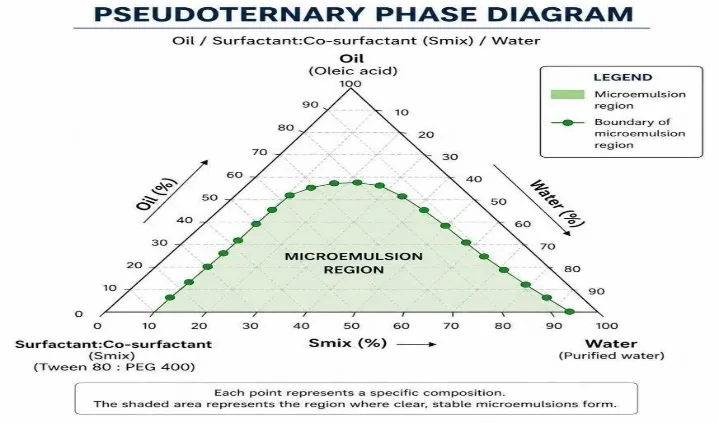
Fig 1: Pseudoternary Phase Diagram
|
Parameter |
F1 |
F2 |
F3 |
F4 |
F5 |
|
Appearance |
Clear |
Clear |
Clear |
Clear |
Clear |
|
pH |
Suitable |
Suitable |
Suitable |
Suitable |
Suitable |
|
Viscosity |
Moderate |
Moderate |
Moderate |
Moderate |
Moderate |
|
Stability |
Stable |
Stable |
Stable |
Stable |
Stable |
The absence of phase separation and transparency were present in all formulations while maintaining a uniformity.
The size of particles is a significant factor in determining the drug's release and absorption properties.
This optimal form presented the droplets as nanometre-sized, evenly distributed.
Interpretation
Optimized formulations demonstrated better particle size characteristics than those previously suggested.
PDI analysis showed that the particles had a restricted size distribution.
This confirmed the uniformity of the microemulsion system, and that the formulation process could be reproduced.
Lower PDI values were indicative of greater stability and homogeneity in formulations.
The droplet distribution is influenced by PDE.
|
PDI Value |
Interpretation |
|
<0.3 |
Uniform distribution |
|
>0.5 |
Broad distribution |
Measurements of zeta potential were taken to determine physical stability.
The improved formula demonstrated an adequate surface charge that prevented the accumulation of droplets.
Significance
A steady state of microemulsion system was confirmed by the obtained zeta potential values.
|
Zeta Potential |
Stability |
|
±30 mV |
Highly stable |
|
±20 mV |
Moderately stable |
|
±10 mV |
Unstable |
The drug content examination demonstrated a consistent distribution of extract throughout the formulation.
|
Formulation |
Drug Content (%) |
|
F1 |
90–92 |
|
F2 |
92–94 |
|
F3 |
94–96 |
|
F4 |
95–97 |
|
F5 |
97–99 |
The optimal formulation demonstrated the highest possible drug content and excellent encapsulation performance.
The dialysis membrane diffusion technique was employed to investigate in vitro release.
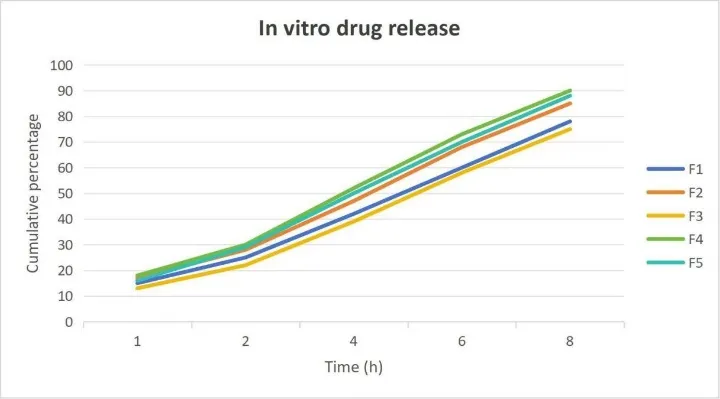
Fig 2: In vitro drug release graph
Drug Release Data
|
Time(hr) |
Percentage Drug Release |
|
1 |
18.2 |
|
2 |
31.4 |
|
4 |
52.7 |
|
6 |
71.8 |
|
8 |
89.5 |
DISCUSSION
The rate of drug release for all formulations increased gradually over time.
The highest cumulative drug release was attributed to the optimized formulation (F5), which are:
By using a microemulsion system, the release behavior of the herbal extract was improved.
Stability tests for different storage conditions of the optimal formulation.
Observations
Stability Data
|
Parameter |
Initial |
After 3Months |
|
Appearance |
Clear |
Clear |
|
pH |
6.8 |
6.7 |
|
Particle size |
78.5 nm |
80.2 nm |
|
Drug content |
96.8% |
95.9% |
It was found that the formulation remained stable both physically and chemically throughout the study.
This study has been successful in creating a microemulsion with leaf extract from Nyctanthes arbor-tristis that exhibits favorable physicochemical traits. Excellent transparency, stability of drug loading capacity and demonstrated good sustained drug release behavior were also features of this optimized formulation.
Phytoconstituents solubilization is facilitated by the nanometric droplet size, which may lead to better bioavaility after administration. The formulation was well-suited for pharmaceutical applications due to its ability to withstand various storage conditions.
Herbal extracts can be effectively targeted for therapeutic purposes through microemulsion-based delivery systems, which are a promising new method of delivering anti-inflammatory drugs.
CONCLUSION
The present study has successfully created and tested a microemulsion containing leaf extracts from Nyctanthes arbor-tristis, which is now considered 'novel' for anti-inflammatory use as. These formulated microemulsions demonstrated desirable physiological properties, including transparency, homogeneity, pH stability, drug content, and distribution of nanometers.
The microemulsion system was modified to incorporate Nyctanthes arbor-tristis extract, which resulted in a significant enhancement of the bioactive phytoconstituents solubilization and release profile. The improved formulation demonstrated superior drug release behavior, satisfactory zeta potential, and good physical stability in storage experiments. The microemulsion system was found to effectively address the limitations posed by poor water solubility and bioavailability of herbal constituents, as evidenced by these results.
Phytochemical screening revealed the presence of various biologically active compounds, including flavonoids, phenolics, alkaloids and tannins as well as glycosides that have anti-inflammatory properties. A stable carrier system was created from the formulation, which could enhance phytoconstituents' therapeutic effects.
The results indicate that the application of microemulsion infused with leaf extracts from Nyctanthes arbor-tristis is a promising and efficient method for administering herbal drugs. This is quite significant. This formula could also improve anti-inflammatory efficacy and patient compliance, as well as help develop newer phytopharmaceuticals. Further in vivo pharmacological and clinical studies are recommended to prove the effectiveness of this therapy and its commercial potential.
ACKNOWLEDGEMENT:
The authors are sincerely grateful to Oriental University, Indore, Madhya Pradesh, for providing the necessary facilities and infrastructure in addition to academic assistance. The authors are notably grateful to Dr. Thanks to Vishakha Chauhan's valuable guidance, her unwavering backing and advice, as well as her supportive ear and positive management of the research. Additionally, the authors acknowledge the support of the faculty members and laboratory staff of Oriental University's Faculty of Pharmacy for their research.
CONFLICT OF INTEREST
There is no conflict of interest associated with the publication of this research work, as stated by the authors.
FUNDING
As per the authors, there was no outside funding for conducting this research work.
AUTHOR CONTRIBUTION
Shivansh Soni: Introduction, literature analysis, formulation, experimental design/conception, data collection, analysis and interpretation of results, as well as manuscript preparation.
Dr. Vishakha Chauhan: Research supervision, methodology validation, data interpretation, manuscript review, critical revision, and overall guidance throughout the study.
After reading and agreeing to publish the final manuscript, both authors have signed it.
ETHICAL APPROVAL
The study didn't involve any human subjects. Standard laboratory practices and institutional research guidelines were followed in all experimental procedures.
DATA AVAILABILITY STATEMENT
If requested by the corresponding author, they will provide data that supports the findings of this study.
REFERENCES


Shivansh Soni*, Vishakha Chauhan, Sachin Kumar Jain, Formulation And Evaluation Of Nyctanthes Arbor-Tristis Leaf Extract Loaded Microemulsion For Anti Inflammantory Activity, Int. J. Sci. R. Tech., 2026, 3 (7), 722-731. https://doi.org/10.5281/zenodo.21473754
 10.5281/zenodo.21473754