

We use cookies to ensure our website works properly and to personalise your experience. Cookies policy
1Child Health Nursing, Driems University.
2Medical Surgical Nursing, Driems University.
3Community Health Nursing, Driems University.
4Obstertrics and Gynaecology, Driems University.
Glucagon-Like Peptide-1 (GLP-1) is an incretin hormone secreted by intestinal L-cells in response to nutrient intake. It regulates glucose homeostasis, appetite,and energy metabolism. GLP-1 receptor agonists mimic these physiological actions by stimulating glucose-dependent insulin secretion, suppressing glucagone release, delaying gastric emptying ,and promoting satiety. These mechanisms improve glycemic control and support significant weight reduction. This review highlights the therapeutic relevance of agents such as Semaglutide, Liraglutide, Dulaglutide, Exenatide, and Tirzepatide. Beyond glycemic control, these drugs demonstrate cardiovascular protection, improved lipid metabolism, and reduced systemic inflammation. Trizepatide, a dual GIP and GLP-1 receptor agonist, shows superior efficacy in both glucose lowering and weight reduction. Inhibition of dipeptidyl peptidase-4 (DPP-4) further prolongs incretin activity, enhancing outcomes. Overall, GLP-1 receptor agonists represent a physiologically based, highly effective strategy for managing type 2 diabetes and obesity.
Glucagon-Like Peptide-1 ( GLP-1) is released after meals and acts on multiple organs including the pancreas, stomach, brain, heart, and liver. Its major physiological functions include :
In type 2 diabetes and obesity, the natural incretin response is impaired. GLP-1 receptor agonists and dual incretin drugs restore this pathway, improving both blood glucose control and body weight regulation.1
LITERATURE REVIEW
The literature review provides a comprehensive and scholarly examination of glucagon-like peptide-1 receptor (GLP-1R) agonists, tracing their evolution from glycemic control agents in diabetes mellitus (DM) to multifaceted therapeutics with expanding indications in cardiovascular, renal, and metabolic health. We explore the underlying biological mechanisms, summarize clinical trial evidence, and highlight emerging applications in non-diabetic populations. Recent developments underscore the relevance of GLP-1R agonists in addressing the complex interplay of cardiovascular-kidney-metabolic (CKM) syndrome, microvascular dysfunction, and metabolic-associated steatohepatitis (MASH). We also discuss combination therapies and strategies to mitigate muscle mass loss during treatment and calls for targeted research, improved clinical education, and policy reforms to optimize the translational potential of GLP-1R agonists in both individualized care and population health.2
Another study states that Glucagon-like peptide-1 (GLP-1) receptor agonists are incretin analogues that promote glucose-mediated insulin release and are used to treat type 2 diabetes mellitus and obesity. GLP-1 receptor agonists and GLP-1 and glucose-dependent insulinotropic peptide agonists have several mechanisms of action, including reduction in gastric emptying, inhibition of glucagon secretion, beneficial changes in the intestinal microbiome, and direct action on hypothalamic nuclei to enhance satiety (which promotes weight loss). Beyond the impressive effects of GLP-1 receptor agonists on blood glucose levels and body weight, large-scale randomized, controlled trials have shown that GLP-1 receptor agonists reduce cardiovascular risk and slow progression to renal failure in persons at high risk and those with type 2 diabetes. Adverse side effects from GLP-1 receptor agonists are mostly gastrointestinal but may also include loss of muscle and bone mass. Questions remain about long-term adherence, weight regain after discontinuation of treatment, and the functional implications of the loss of muscle and bone mass. Recent and ongoing targeted studies suggest the possibility of additional uses for GLP-1 receptor agonists.3
GLP-1 receptor agonists Action
Mechanism of action
Effect in Type 2 Diabetes
Effect in Obesity
Additional Benefits
Mechanism of action
In Obesity
Special Point
Mechanism of action
In Diabetes
In Obesity
Additional Benefit
Mechanism of action7,8
In Diabetes
In Obesity
Limitation
5. Tirzepatide
Mechanism of action
Acts on two incretin receptors:
This dual action creates stronger metabolic effects.
In Diabetes
In Obesity
Metabolic Shift
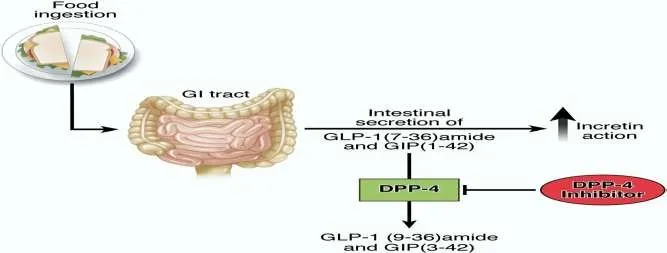
Figure : Bioactive GLP-1 and GIP are released from the small intestine after meal ingestion and enhance glucose stimulated insulin secretion (incretin action)9
Summary Of Metabolic Effects4
|
Drug |
Main Action |
Weight Loss |
Diabetes Control |
|
Semaglutide |
GLP-1 agonist |
Very high |
Excellent |
|
Liraglutide |
GLP-1 agonist |
Moderate–high |
Excellent |
|
Dulaglutide |
Long-acting GLP-1 |
Moderate |
Excellent |
|
Exenatide |
Early GLP-1 agonist |
Mild–moderate |
Good |
|
Tirzepatide |
GLP-1 + GIP dual agonist |
Highest |
Most powerful |
Core Physiological Changes Produced
These agents collectively cause:
Simplified concept
In Obesity
CONCLUSION
This review focuses on regulating the mechanism of Glucagon-Like Peptide -1 which is an incretin hormones released rapidly after food intake the help regulate glucose metabolism and energy balance. Both hormones stimulate glucose-dependent insulin secretion through specific receptors on pancreatic beta-cell growth and reducing apoptosis GIP mainly supports energy storage by acting on adipose tissue and also promotes bone formation by stimulating osteoblast activity. In contrast, GLP-1 regulate blood glucose by slowing gastric emptying, suppressing glucagon secretion, and increasing satiety, leading to weight loss. Both incretins are rapidly degraded by the enzyme Dipeptidyl peptidase-4 (DPP-4). This led to the development of GLP-1 receptor agonists and DPP-4 inhibitors for treating Type 2 Diabetes. These therapies effectively lower HbA1c with minimal risk of weight gain and represent important physiologic approaches in modern diabetes management.
REFERENCES

Sheeba Anitha Rani1*, Yerni Jyothi Kolli2, Anusuyadevi V.3, Prathima Prakasam4, GLP- 1 Receptor Agonists In Type 2 Diabetes And Obesity: Review Article, Int. J. Sci. R. Tech., 2026, 3 (8), 361-365. https://doi.org/10.5281/zenodo.21872967
 10.5281/zenodo.21872967