

We use cookies to ensure our website works properly and to personalise your experience. Cookies policy
1Department of Quality Assurance- Agnihotri Institute of Pharmacy, Wardha
2Department of Pharmaceutics- Jagadambha Institute of Pharmacy & Research, Kalamb, Maharashtra , India
3Department of Pharmaceutical Chemistry - Jagadambha Institute of Pharmacy & Research, Kalamb, Maharashtra , India
4Department of Pharmaceutics- Tulaskar College of Pharmacy
5Department of Pharmaceutics-Ujjain Institute of Pharmaceutical Science,Ujjain.
6Department of Pharmaceutics-School of Pharmacy G.H. Raisoni University, Amravati
7Department of Pharmaceutics-Anurag College of Pharmacy,Bhandara
Lipid nanostructures have emerged as versatile drug delivery platforms capable of improving drug solubility, protecting therapeutic agents from degradation, modifying pharmacokinetic behaviour, and facilitating targeted delivery. Conventional dosage forms may be associated with poor aqueous solubility, limited bioavailability, rapid drug elimination, nonspecific distribution, and dose-related adverse effects. Lipid-based nanocarriers offer opportunities to overcome several of these limitations through the encapsulation or association of therapeutic molecules within organized lipid matrices or vesicular structures. Major systems include liposomes, solid lipid nanoparticles (SLNs), nanostructured lipid carriers (NLCs), lipid nanoparticles (LNPs), and liquid-crystalline lipid nanocarriers. Their physicochemical properties can be adjusted through lipid composition, particle size, surface charge, surfactant selection, and surface functionalization. Targeted delivery can be achieved through passive accumulation, ligand–receptor interactions, and tissue-specific formulation strategies, whereas controlled drug release can be regulated through matrix composition, drug–lipid interactions, diffusion, degradation, and stimuli-responsive mechanisms. These systems have demonstrated potential in cancer therapy, nucleic acid delivery, infectious diseases, neurological disorders, and topical and ocular drug delivery. Nevertheless, challenges involving colloidal stability, drug loading, biological variability, toxicity, manufacturing scale-up, reproducibility, and regulatory characterization continue to restrict broader clinical translation. This review discusses the principal lipid nanostructures, their formulation and characterization, mechanisms of targeting and controlled release, therapeutic applications, and emerging developments in precision nanomedicine.
Drug delivery systems are designed to transport therapeutic agents to their intended biological sites while maintaining an appropriate concentration over a suitable period. Conventional dosage forms may not provide optimal therapeutic outcomes when drugs exhibit poor aqueous solubility, limited membrane permeability, instability in biological fluids, rapid systemic clearance, or dose-limiting toxicity. These limitations have stimulated the development of advanced delivery platforms capable of modifying drug distribution, release, and cellular uptake.
Nanotechnology has expanded pharmaceutical formulation possibilities by enabling the incorporation of drugs into nanoscale carriers. Lipid-based nanocarriers are particularly attractive because their composition can be adapted to accommodate different therapeutic molecules, including hydrophobic drugs, hydrophilic compounds, peptides, proteins, and nucleic acids. Depending on their architecture, these carriers may protect drugs against premature degradation, improve apparent solubility, modify circulation time, and influence interactions with biological membranes [1-3].
Lipid nanostructures encompass several distinct systems. Liposomes contain one or more lipid bilayers surrounding an aqueous compartment, whereas SLNs consist primarily of a solid lipid matrix stabilized by surfactants. NLCs combine solid and liquid lipids to create a less ordered lipid matrix, potentially improving drug incorporation and reducing drug expulsion during storage. LNPs, particularly ionizable lipid-containing formulations, have become important for intracellular delivery of nucleic acids. Cubosomes and other liquid-crystalline lipid nanoparticles provide additional opportunities for incorporating compounds within organized lipid structures [4,5].
The performance of these systems depends on more than particle size alone. Lipid composition, morphology, surface charge, membrane fluidity, elasticity, internal organization, and interactions with biological fluids can influence cellular uptake, circulation, tissue distribution, and clearance. Recent research emphasizes the importance of understanding these relationships when designing effective lipid-based delivery systems [6].
Targeted drug delivery aims to increase drug exposure at a desired tissue or cell population while limiting exposure elsewhere. Controlled drug delivery, in contrast, focuses on regulating the rate, duration, or location of drug release. Although these objectives are complementary, they are not interchangeable: a carrier may accumulate at a target without releasing its payload effectively, or release its payload slowly without achieving tissue specificity. Successful formulation therefore requires coordinated optimization of targeting, stability, intracellular delivery, and release kinetics.
This review examines lipid nanostructures as integrated platforms for targeted and controlled drug delivery, emphasizing formulation principles, delivery mechanisms, therapeutic applications, evaluation parameters, and barriers to clinical translation.
2. Classification of Lipid Nanostructures
2.1 Liposomes
Liposomes are spherical vesicles formed by one or more phospholipid bilayers surrounding an aqueous compartment. Their amphiphilic architecture permits the incorporation of hydrophilic compounds within the aqueous core and hydrophobic compounds within the lipid bilayer. Amphiphilic drugs may associate with the lipid–water interface, depending on their physicochemical characteristics.
Liposomes can be prepared from phospholipids, cholesterol, and other membrane-modifying components. Phospholipids form the bilayer, while cholesterol can influence membrane packing, permeability, and mechanical stability. Surface modification with hydrophilic polymers or targeting ligands may alter circulation behaviour and cellular interactions [2,7].
Liposomes are among the most clinically established lipid nanocarriers. Liposomal formulations of anticancer agents illustrate how changing the delivery vehicle can modify drug distribution and tolerability without changing the identity of the active pharmaceutical ingredient. However, liposomes may experience leakage, lipid oxidation, aggregation, or changes in vesicle structure during storage. Their performance also depends on the relationship between drug loading, membrane composition, and release behaviour [2,7].
2.2 Solid Lipid Nanoparticles
Solid lipid nanoparticles are colloidal carriers in which the dispersed lipid matrix remains solid at the relevant storage and physiological temperatures. They are commonly formulated using physiologically acceptable solid lipids and suitable surfactants.
SLNs were developed to combine selected advantages of emulsions and polymeric nanoparticles with the use of a lipid matrix. Potential benefits include protection of incorporated drugs, controlled release, compatibility with different administration routes, and the use of established lipid-processing techniques [3,8].
However, the highly ordered crystalline structure of some solid lipids can limit drug incorporation. During storage, lipid polymorphic transitions or crystal reorganization may displace previously incorporated drug molecules, causing drug expulsion or changes in release behaviour. These limitations depend on lipid selection, drug–lipid compatibility, processing conditions, and storage environment [3,8].
2.3 Nanostructured Lipid Carriers
Nanostructured lipid carriers are generally considered a second-generation development of SLNs. They contain a combination of solid and liquid lipids, producing a lipid matrix that is less perfectly ordered than a highly crystalline solid-lipid matrix.
The inclusion of liquid lipid can create structural imperfections that provide additional space for drug incorporation. Depending on the formulation, this approach may improve loading capacity, reduce drug expulsion, and modify release kinetics. NLCs are therefore investigated for poorly water-soluble drugs and for oral, topical, dermal, ocular, and other delivery applications [9].
NLC performance remains formulation-dependent. Excessive liquid lipid may affect particle structure, physical stability, or drug retention. The ratio of solid to liquid lipid, surfactant concentration, drug solubility in each lipid phase, and cooling conditions must therefore be optimized.
2.4 Lipid Nanoparticles for Nucleic Acid Delivery
Lipid nanoparticles used for nucleic acid delivery are compositionally distinct from conventional SLNs and NLCs. Many contain an ionizable lipid, phospholipid, cholesterol, and a PEG-lipid or comparable surface-stabilizing component. The proportions and chemical structures of these ingredients influence particle assembly, cargo encapsulation, stability, cellular uptake, and intracellular release.
Ionizable lipids can interact with negatively charged nucleic acids during formulation and may become positively charged under acidic conditions. Following cellular uptake, interactions between ionizable lipids and anionic membrane components can contribute to endosomal escape, allowing some of the nucleic acid payload to reach the cytosol. This is particularly important for messenger RNA and small interfering RNA, whose therapeutic activity requires access to intracellular machinery [10].
The successful clinical application of lipid nanoparticle technology to nucleic acid therapeutics demonstrates its importance in modern drug delivery. Nevertheless, effective delivery remains dependent on cargo integrity, biodistribution, endosomal escape, tolerability, and formulation stability[8].
2.5 Liquid-Crystalline Lipid Nanostructures
Liquid-crystalline lipid nanostructures, including cubosomes and hexosomes, possess internal lipid arrangements characterized by ordered phases. These structures can provide distinct hydrophobic and hydrophilic domains that support the incorporation of compounds with different solubility characteristics.
Their internal architecture may influence drug loading, diffusion, and release. Such systems are being investigated for applications including poorly soluble drugs, topical delivery, and localized administration. However, formulation complexity, phase stability, manufacturing reproducibility, and the need for detailed structural characterization remain important considerations.
Table 1: Major Lipid Nanostructures and Their Delivery Characteristics
| Carrier | Principal structure | Potential advantages | Major limitations |
|---|---|---|---|
| Liposomes | Phospholipid bilayer surrounding an aqueous compartment | Incorporation of hydrophilic and lipophilic drugs; established clinical platform | Leakage, oxidation, aggregation, and storage challenges |
| SLNs | Solid lipid matrix | Drug protection, potential sustained release, and versatile administration routes | Limited loading in some formulations and drug expulsion |
| NLCs | Mixed solid–liquid lipid matrix | Improved loading potential and adjustable release | Composition-dependent stability and lipid-phase changes |
| Nucleic acid LNPs | Lipid assembly containing nucleic acid, often with ionizable lipids | Intracellular delivery of RNA and other nucleic acid payloads | Endosomal trapping, biodistribution limitations, and stability challenges |
| Cubosomes and related systems | Internally ordered liquid-crystalline lipid phases | Distinct internal domains and potential for controlled release | Complex manufacturing and structural characterization |
The advantages and limitations listed above are general tendencies rather than universal properties; actual performance depends on formulation composition and the intended route of administration [26,8,9].
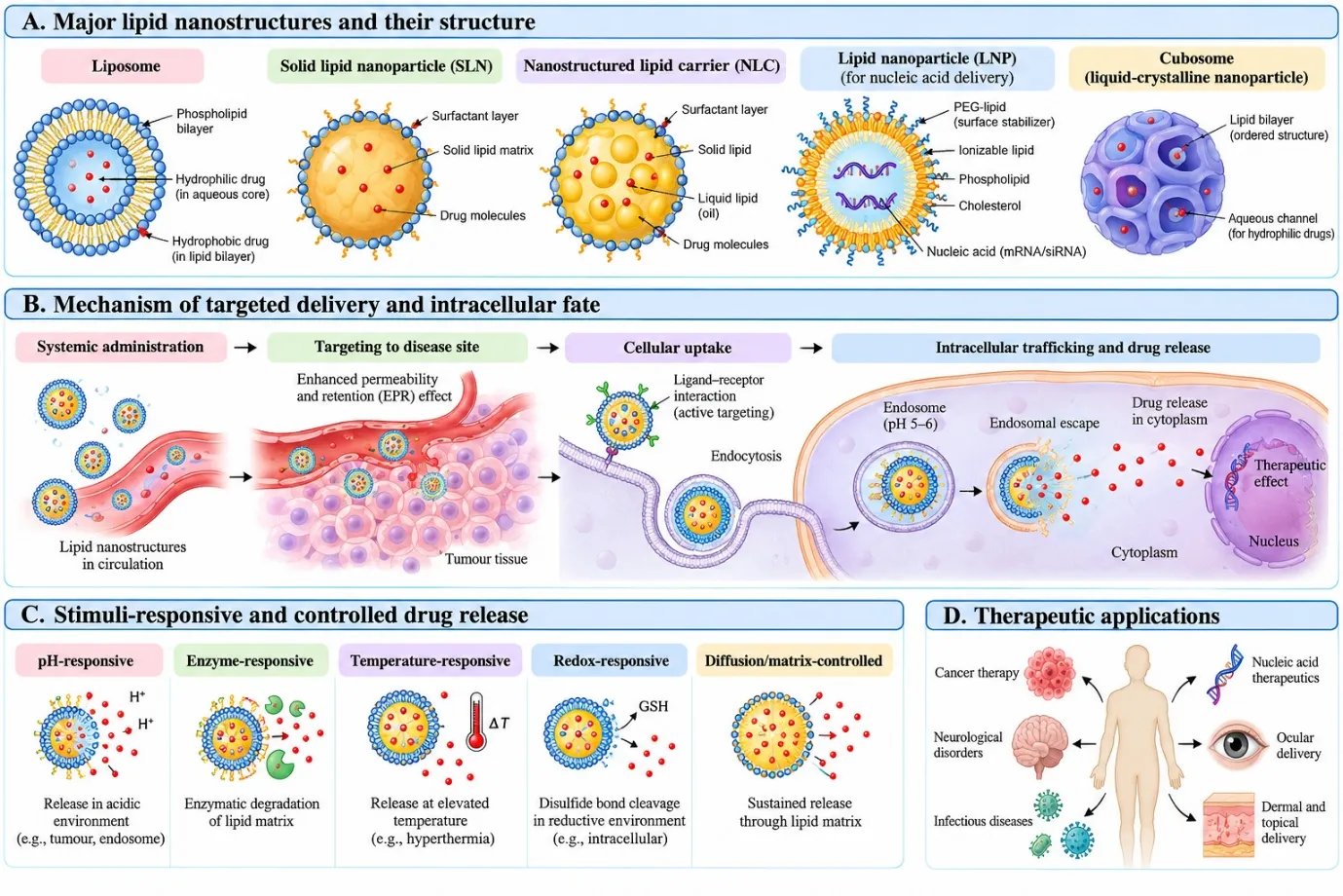
Figure 1: Schematic Representation of Lipid Nanostructures for Targeted and Controlled Drug Delivery, Illustrating Major Lipid Nanocarrier Types, Mechanisms of Targeted Cellular Delivery, Stimuli-Responsive Drug Release, and Therapeutic Applications[7].
3. Composition and Formulation of Lipid Nanostructures
The selection of formulation components determines the physicochemical properties and biological performance of lipid nanocarriers. An effective formulation must maintain structural integrity, retain the therapeutic agent during storage and circulation, and release it at the intended site.
3.1 Lipid components
Lipids form the principal structural component of these delivery systems. Phospholipids are commonly used in liposomes, while triglycerides, fatty acids, waxes, and other lipid excipients may be used in SLNs and NLCs. Ionizable lipids are particularly important in nucleic acid LNPs because they facilitate cargo association during preparation and may support intracellular delivery.
The choice of lipid depends on melting behaviour, hydrophilic–lipophilic balance, drug solubility, chemical stability, biodegradability, and compatibility with the intended route of administration. Lipid purity and susceptibility to oxidation should also be considered.
3.2 Surfactants and stabilizers
Surfactants reduce interfacial tension during particle formation and can help prevent aggregation. Common formulation strategies employ nonionic surfactants or other suitable stabilizers selected according to the lipid system and administration route. Polyethylene glycol-containing lipids are used in many LNP formulations to influence colloidal stability and interactions with biological components.
The stabilizer concentration must be optimized because insufficient stabilization can result in aggregation, whereas excessive surfactant may affect drug retention, membrane integrity, or biological tolerability.
3.3 Preparation techniques
Common methods for producing lipid nanostructures include:
The optimal preparation method depends on the carrier architecture, payload, required particle size, solvent restrictions, and intended production scale [3,5,8].
4. Mechanisms of Targeted Drug Delivery
Targeting aims to improve the distribution of a therapeutic agent toward a selected tissue, cell type, or intracellular compartment. Targeting performance depends on carrier properties as well as the biological environment encountered after administration.
4.1 Passive targeting
Passive targeting refers to drug-carrier accumulation resulting from physiological or pathological characteristics of tissues. In some solid tumours, abnormal vasculature and impaired lymphatic drainage may favour the accumulation of certain nanoparticles, a phenomenon commonly associated with the enhanced permeability and retention (EPR) effect.
However, the magnitude of this effect varies between tumour types, individual patients, and disease stages. Tumour penetration may be restricted by elevated interstitial pressure, dense extracellular matrix, heterogeneous blood flow, and cellular barriers. Consequently, passive targeting should not be assumed to guarantee effective tumour delivery [11].
4.2 Active targeting
Active targeting involves the attachment or incorporation of ligands that interact with biological recognition sites. Examples include antibodies, antibody fragments, peptides, carbohydrates, and selected small molecules.
A ligand may increase binding to cells expressing its corresponding receptor and, in some cases, enhance receptor-mediated internalization. However, ligand attachment does not necessarily increase whole-organ or whole-tumour accumulation. The density and accessibility of the receptor, ligand orientation, carrier size, protein adsorption, and penetration through tissue influence the final outcome.
Targeted formulations must therefore be evaluated for both binding specificity and delivery of pharmacologically active cargo.
4.3 Cellular uptake and intracellular delivery
Nanocarriers may enter cells through endocytosis or other membrane-associated uptake processes. Following internalization, the carrier may remain within endosomal compartments, undergo intracellular processing, or release its payload into the cytoplasm.
Endosomal entrapment is particularly important for nucleic acid therapeutics. Ionizable lipid formulations can facilitate interactions with endosomal membranes under appropriate conditions, promoting the release of some cargo into the cytosol. Nevertheless, intracellular delivery efficiency depends on lipid chemistry, cargo characteristics, cellular uptake, and the properties of the endosomal environment [5,10].
4.4 Organ- and tissue-directed delivery
Lipid composition, particle size, surface chemistry, and administration route can influence biodistribution. For example, formulation design may be directed toward hepatic delivery, tumour-associated tissues, mucosal surfaces, or local skin application. Brain delivery remains challenging because of the blood–brain barrier, and accumulation in brain-associated tissues does not by itself establish transport into the brain parenchyma.
Organ-specific targeting therefore requires direct evidence of biodistribution, cellular localization, payload delivery, and therapeutic activity.
5. Controlled and Stimuli-Responsive Drug Release
Controlled drug delivery seeks to regulate the rate, duration, or location of drug release. Lipid nanostructures can modify release through matrix organization, drug partitioning, membrane permeability, and interactions with biological fluids.
5.1 Diffusion-controlled release
In diffusion-controlled systems, drug molecules move from regions of higher concentration within the carrier toward the surrounding medium. The release rate depends on drug solubility, diffusivity, carrier structure, particle dimensions, and the surrounding environment.
A densely organized lipid matrix may retard diffusion, whereas a less ordered matrix may permit greater molecular mobility. These relationships are formulation-dependent and should be established experimentally.
5.2 Matrix erosion and structural reorganization
Changes in the lipid matrix may alter drug retention and release. Lipid degradation, enzymatic interactions, polymorphic transitions, or changes in lipid organization can influence the mobility of the encapsulated compound.
For SLNs and NLCs, storage-related changes in crystallinity may affect drug distribution within the matrix. Formulation development must therefore consider both initial release behaviour and changes occurring during long-term storage [3,4,8].
5.3 pH-responsive systems
pH-responsive lipid systems are designed to respond to differences between the formulation environment and selected biological compartments. Such systems may incorporate ionizable lipids or pH-sensitive components that alter membrane interactions or carrier organization under acidic conditions.
These approaches are relevant to endosomal delivery and selected tumour-associated environments. However, the magnitude of pH differences in vivo may be insufficient to trigger a desired response consistently. Appropriate controls are required to demonstrate that release is genuinely pH-dependent.
5.4 Enzyme-responsive systems
Enzyme-responsive formulations exploit the activity of selected enzymes to modify a carrier or its associated components. Lipid degradation and enzyme-mediated transformations may alter drug release or facilitate intracellular payload delivery.
The effectiveness of this approach depends on enzyme abundance, accessibility, substrate specificity, and the stability of the carrier before it reaches the intended site.
5.5 Temperature- and redox-responsive systems
Temperature-sensitive lipid systems may undergo changes in membrane permeability or phase behaviour in response to temperature variation. Redox-responsive systems may exploit differences in the chemical environment, including intracellular reducing conditions, to promote changes in carrier structure or cargo release.
Such approaches remain dependent on formulation design and the ability to achieve the required stimulus at the target site. Claims of selective release should be supported by comparative release studies under relevant physiological and pathological conditions.
5.6 Release kinetics and mathematical modelling
In-vitro drug release can be evaluated using suitable diffusion cells, dialysis-based approaches, or other validated methods. The experimental design should account for sink conditions, membrane limitations, drug stability, adsorption, and the possibility of free drug being measured incorrectly as released drug.
Common mathematical models include:
Model fitting alone does not prove a specific mechanism. Interpretation should consider the geometry of the carrier, experimental conditions, the assumptions of each model, and independent evidence.
6. Therapeutic Applications
6.1 Cancer therapy
Cancer treatment is an important application of lipid nanocarriers because conventional anticancer drugs may exhibit systemic toxicity, limited solubility, rapid clearance, or inadequate tumour exposure. Liposomal formulations can modify drug distribution, while SLNs and NLCs are being investigated for the delivery of poorly soluble compounds and combination therapies.
Surface-functionalized lipid carriers may improve interactions with selected tumour cells. However, therapeutic benefit depends on adequate tissue penetration, release of active drug, and avoidance of dose-limiting toxicity. Nanocarrier accumulation should not be equated with successful delivery into every tumour cell [2,11].
6.2 Nucleic acid therapeutics
LNPs have become important for delivering messenger RNA, small interfering RNA, and other nucleic acid payloads. Their composition facilitates the association of nucleic acids with lipid components and can protect the payload during formulation and administration.
After cellular uptake, intracellular release is essential for therapeutic activity. Current research focuses on improving cell- and organ-specific delivery, reducing unwanted immune responses, enhancing endosomal escape, and improving storage stability and manufacturing consistency [5,10].
6.3 Neurological disorders
Delivery of drugs to the central nervous system is limited by the blood–brain barrier and other biological obstacles. Liposomes, SLNs, and NLCs have been investigated as potential carriers for neurological therapeutics.
Potential strategies include surface modification, selection of suitable administration routes, and formulation approaches intended to influence interactions with brain-associated barriers. Nevertheless, promising in-vitro findings or animal biodistribution results are insufficient to establish effective human brain delivery. Studies must distinguish vascular association from actual transport into relevant brain tissue.
6.4 Infectious diseases
Lipid nanocarriers may help protect antimicrobial compounds, modify their distribution, and improve delivery to infected tissues or intracellular pathogens. Liposomes have also been investigated for antifungal and antibacterial agents, while lipid nanoparticles support the delivery of nucleic acid-based vaccines and therapeutics.
The effectiveness of these systems depends on the pathogen, site of infection, host immune response, drug susceptibility, and ability of the carrier to release an active dose at the relevant location.
6.5 Dermatological and topical applications
SLNs and NLCs are investigated in topical and dermal formulations because lipid matrices can influence drug retention, release, skin hydration, and interactions with the stratum corneum. Depending on formulation properties, they may support local delivery or improve the performance of selected poorly soluble compounds [8].
However, enhanced skin deposition does not necessarily establish systemic absorption or delivery to deeper tissues. The desired endpoint must be clearly defined and measured.
6.6 Ocular drug delivery
Ocular administration presents challenges associated with tear turnover, limited residence time, epithelial barriers, and rapid clearance. Liposomes and lipid nanoparticles are being investigated to improve local retention and delivery of selected ophthalmic agents.
Formulations intended for ocular use require careful evaluation of sterility, particle characteristics, irritation, tolerability, and compatibility with ocular tissues. Improved residence time should be distinguished from demonstrated therapeutic efficacy.
7. Characterization and Evaluation
Comprehensive characterization is essential to establish the quality, stability, and biological performance of lipid nanostructures.
Table 2: Important Characterization Parameters
| Parameter | Common analytical approach | Purpose |
|---|---|---|
| Particle size and polydispersity index (PDI) | Dynamic light scattering | Estimates hydrodynamic size and distribution breadth |
| Morphology | Transmission electron microscopy or cryo-electron microscopy | Examines particle shape and structural features |
| Zeta potential | Electrophoretic light scattering | Estimates electrokinetic potential under specified conditions |
| Entrapment efficiency | Validated separation and analytical quantification | Estimates the proportion of drug associated with the carrier |
| Drug loading | Quantitative drug and carrier analysis | Determines drug content relative to the formulation |
| Lipid crystallinity and thermal behaviour | Differential scanning calorimetry and X-ray diffraction | Evaluates lipid organization and physical transitions |
| In-vitro drug release | Validated release testing with an appropriate analytical assay | Evaluates release profiles under defined conditions |
| Stability | Physical, chemical, and microbiological testing as appropriate | Assesses changes during storage |
| Biological performance | Cell-based assays, pharmacokinetics, biodistribution, and toxicity studies | Investigates delivery, efficacy, and safety |
Results should be interpreted in relation to the formulation and intended route of administration. A small particle size or narrow PDI does not independently demonstrate stability, targeting efficiency, safety, or therapeutic superiority. Analytical methods should be appropriately validated, and sample preparation should not unintentionally change the carrier being measured [3,6].
8. Safety, Limitations, and Regulatory Considerations
Despite their potential, lipid nanostructures present formulation-specific safety and development challenges. Potential concerns include inflammatory or immune responses, complement activation in susceptible formulations, lipid-related toxicity, degradation products, and unintended tissue exposure. The risk profile depends on the lipid composition, dose, route of administration, particle characteristics, and frequency of exposure.
Manufacturing introduces additional challenges. Small differences in raw materials, lipid ratios, mixing conditions, temperature, solvent removal, filtration, or storage may influence particle characteristics and drug distribution. Scale-up must preserve the critical quality attributes established during formulation development.
For liposomal drug products, regulatory assessment includes chemistry, manufacturing and controls, human pharmacokinetics and bioavailability, and product labelling. Nanomaterial-containing drug products may require additional attention to the characteristics and behaviour introduced by the nanomaterial [12,13]. These considerations support a quality-by-design approach, including identification of critical material attributes, critical process parameters, and suitable analytical methods.
Clinical translation also requires evidence that improvements observed in laboratory studies translate into meaningful clinical outcomes. Biodistribution, pharmacokinetics, therapeutic efficacy, and safety should be evaluated using study designs appropriate to the intended indication.
9. Recent Advances and Future Perspectives
Recent research is increasingly focused on understanding how the physical properties of lipid nanostructures influence their interactions with biological systems. Particle size, surface charge, elasticity, curvature, membrane fluidity, and lipid organization may affect biological barrier penetration, clearance, and cellular uptake [6].
Several research directions are particularly relevant:
1. Rational carrier design: Connecting lipid composition and physical properties with reproducible delivery outcomes.
2. Cell- and organ-specific targeting: Developing strategies that improve selectivity without compromising tissue penetration or safety.
3. Improved intracellular delivery: Enhancing endosomal escape and cytosolic availability of nucleic acid payloads.
4. Stimuli-responsive formulations: Developing systems with predictable release under biologically relevant conditions.
5. Advanced manufacturing: Using controlled mixing, microfluidic methods, and process monitoring to improve reproducibility.
6. Computational formulation development: Applying modelling and machine-learning approaches to prioritize compositions and processing conditions.
7. Better translational evaluation: Establishing meaningful relationships between laboratory characterization, in-vivo performance, and clinical outcomes.
Artificial intelligence may help identify relationships among formulation variables, particle properties, and biological performance. However, computational predictions require appropriate experimental validation and sufficiently representative training data.
Future research should prioritize reproducible manufacturing, clinically relevant models, transparent reporting of formulation composition, standardized characterization, and robust comparisons with existing therapies. Particular attention should be given to whether targeted or controlled-release formulations provide measurable advantages over conventional formulations in efficacy, safety, convenience, or treatment outcomes.
CONCLUSION
Lipid nanostructures provide a versatile platform for targeted and controlled drug delivery. Liposomes, SLNs, NLCs, nucleic acid LNPs, and liquid-crystalline lipid systems offer different structural and formulation characteristics that can be adapted to specific therapeutic requirements. Their performance depends on lipid composition, particle architecture, drug–carrier interactions, surface properties, biological barriers, and release mechanisms.
Targeting and controlled release are complementary but distinct objectives. Effective delivery requires not only carrier accumulation at a desired site but also adequate penetration, cellular uptake where required, payload release, and maintenance of therapeutic activity. Although lipid nanocarriers have demonstrated important clinical and research applications, formulation stability, safety, manufacturing consistency, and translational predictability remain substantial challenges.
Continued integration of pharmaceutical formulation science, nanomaterial characterization, biological evaluation, and manufacturing quality control will be essential to develop lipid nanostructures that provide reliable and clinically meaningful improvements in drug delivery.
REFERENCES




Anup P. Bannagare, Dr. Karishma A. Nikose, Dr. Suraj P. Rajurkar, Suraj D. Thakare, Shivani S. Shirbhate, Sankuli S. Parate, Dinesh Bawankar, Lipid Nanostructures for Targeted and Controlled Drug Delivery, Int. J. Sci. R. Tech., 2026, 3 (10), 1446-1455. https://doi.org/10.5281/zenodo.23762442
 10.5281/zenodo.23762442