

We use cookies to ensure our website works properly and to personalise your experience. Cookies policy
JES's SND. College of Pharmacy, Babhulgaon
Biologics, comprising therapeutic peptides, proteins, enzymes, antibodies, vaccines, and nucleic-acid-based drugs, have created a new dimension in pharmacotherapy by virtue of their molecular mechanism of action, which goes beyond the scope of traditional pharmacological agents. Despite their clinical promise, they are often associated with various physiological and physicochemical barriers that limit their therapeutic efficacy. Peptides and protein drugs are highly susceptible to enzymatic and chemical degradation, as well as hydrolytic cleavage as a result of exposure to the challenging in vivo environment. Additionally, their large size and hydrophilicity contribute to poor permeability across biological membranes and rapid clearance from circulation after administration. Nanocomposite solution Nanocomposite formulations allow designing nanomaterials in which two or more chemical compounds or units are combined to form an aggregate or a supramolecular structure with characteristic properties that differ from those possessed by each component. Polymer-nanoparticle, lipid-polymer, inorganic-polymer, hydrogel-nanoparticle, nanofibers, and biomimetic structures can be used to create nanocomposite materials for carrying various types of cargo with different physicochemical properties. At the same time, such particles can protect the delivered substance and actively interact with various barriers and cells, tissues, and organisms. Unlike many traditional nanocarriers, nanocomposite particles can have multiple components, allowing their independent control to achieve the desired overall effect. Recent Advances Recent research trends have shifted from conventional encapsulation strategies toward multifunctional designs involving mucus penetrating, receptor-mediated, stimuli-responsive, endosomal escaping, biomimetic, microfluidic, and formulation-optimized approaches. Lipid-polymer hybrid nanoparticles have emerged as promising systems for protein and peptide drug delivery due to the possibility to combine the advantages of polymers and lipids. Mesoporous silica allows for the construction of systems with diverse pore structures and surface chemistry to control the release of macromolecules, while chitosan-based systems have been explored for oral and mucosal peptide delivery. Nanofibers and biomimetic systems offer alternative strategies for transmucosal delivery or engineering of cell interfaces. Challenges Despite an extensive preclinical exploration, the clinical translation of peptide and protein nanocarriers remains limited. Key challenges include biologic stability during processing and storage, formulation uniformity, aggregation, lot-to-lot variability, manufacturability, sterilization, scale-up, physico-biological complexity, immunotoxicity, and insufficient characterization. Regulatory evaluation is inherently product- and quality-driven and requires systematic physicochemical and clinical characterization rather than a binary good/bad assessment of nanoscale features. Future Perspectives The next generation of advanced delivery systems will employ rational material design, microfluidic fabrication, bio-inspired systems, predictive and mechanistic modeling, artificial intelligence/machine learning, and Quality by Design paradigm. Artificial intelligence/machine learning is expected to play an important role in multi-variable formulation design and critical quality attribute prediction, but the complexity of biological systems and the limitations of available data may impede progress. Conclusion: Nanocomposites for Peptide/Protein Delivery Nanocomposite materials offer attractive opportunities for biologic drug delivery due to the possibility to combine multiple functionalities. However, the value of most nanocomposite systems for peptide/protein delivery should be evaluated from the perspective of biologic stability, pharmacokinetics, mechanism of action, safety, and manufacturability. Progress in this area will rely on controlled complexity that is grounded in biologic rationale, amenable to analytical characterization, scalable, and clinically relevant.
Biologic medicines represent an increasingly important class of therapeutic agents due to their potential to engage with exquisite molecular specificity a variety of extracellular, membrane-associated, and intracellular targets that are not amenable to conventional small molecule modulation. Therapeutic peptides and proteins, enzymes, antibodies, vaccines, and nucleic acid-based therapeutics, are all subclasses of biologics. Therapeutic peptides, in particular, represent a broad class of medicines with diverse clinical applications, ranging from endocrine/metabolic and cardiovascular diseases to gastro-intestinal, oncologic, and anti-infective indications [1]. Moreover, advances in peptide engineering and chemical biology enable the design of peptides with enhanced pharmacological properties that may impact multiple disease areas.
The same physicochemical properties that give peptides and proteins their unique biological activity often make them challenging to formulate and deliver. For example, these biomolecules can be sensitive to proteolytic enzymes and tend to aggregate and associate with surfaces. Their overall size and hydrophilicity, charge, and complex secondary structure can impede their ability to cross biological membranes and reduce their oral bioavailability, whereas their short circulating half-life limits systemic efficacy [2,3,4,5]. Thus, despite their favorable pharmacological properties, these classes of drugs are associated with significant formulation and delivery challenges.
Nanotechnology-based approaches can be utilized to formulate biologics and address a variety of physicochemical and physiological barriers to their systemic delivery. Nanoparticles can act as protective vehicles for biologics, contribute to their targeted delivery, and release their payload in a spatiotemporally controlled manner. At the same time, hybrid or composite systems can offer enhanced protection and stability, reduced immunogenicity, and a combination of desirable physicochemical properties.
The present review discusses the development of composite systems for biologic and peptide drug delivery. The concept of nanocomposite materials is not new, but it is often used interchangeably with polymers, lipids, or other individual materials that comprise nanoparticles. To emphasize the multifunctionality of such systems and the benefits of combining two or more individual components, in this review, we use the term nanocomposites to refer to multi-component, multiphase systems. Specifically, we focus on hybrid lipopolymer or polymer/lipid systems, polymer/inorganic composites, and hydrogels containing nanoparticles, as well as surface-modified nanoparticles, and biomimetic composites.
Overall, our goal is to highlight the importance of a rational approach to the design of composite systems in which the specific physicochemical properties of individual building blocks are combined in a manner that yields desirable biopharmaceutical performance. As such, this review is focused on biologically relevant factors, including biologic stability, pharmacokinetic and pharmacodynamic properties, mechanism of action, safety, and manufacturability. In most cases, the choice of a particular formulation or material alone is not sufficient to ensure successful biologic delivery. Instead, the following rational chain must be considered:biologic properties,delivery barriers,materials,formulation,design,physicochemicalproperties,Biologicalperformance,pharmacoki-netics/pharmacodynamics,safety,manufacturability,clinical success.
This is an especially important consideration for nanomedicine and biopharmaceutics because many studies have demonstrated that individual cells or small animals can be effectively targeted using nanoparticles or other nanostructures. However, such encouraging preclinical results are often not translated into effective clinical therapeutics due to the inability to maintain the desired biologic activity during manufacturing and storage or achieve sufficient clinical exposure after systemic administration.
The review discusses composite systems for biologic delivery in the context of formulation design, materials, and physicochemical properties, as well as barriers to biologic delivery, routes of administration, and characterization of formulations. Particular attention is drawn to emerging technologies, translational opportunities, and regulatory considerations, as well as the critical quality attributes (CQAs) of composite systems for biologic delivery. By focusing on the key elements of formulation design, materials selection, and biologic performance, this review aims to highlight the opportunities and challenges of composite systems for biologic delivery. It also attempts to distinguish between experimental systems and clinically relevant nanomedicine product forms and highlight the critical scientific and pharmaceutical problems that must be resolved for effective clinical translation.
2. Biologics and Peptides as Therapeutic Agents
2.1 Classification of biologics
Biologics encompass diverse therapeutic modalities with substantially different formulation requirements. Relevant classes include:
Nucleic acids are included here where relevant to delivery technology because their formulation requirements overlap with that of other macromolecular therapeutics, although their molecular behavior is distinct from that of proteins and peptides.
2.2 Therapeutic peptides
Peptides generally occupy an intermediate physicochemical space between small molecules and proteins. Their high target specificity has contributed to continued development across metabolic, endocrine, cardiovascular, gastrointestinal, infectious, and oncological indications. Modern peptide development increasingly incorporates sequence engineering, cyclization, lipidation, PEGylation, non-natural amino acids, and other modifications to improve metabolic stability and pharmacokinetics [1].
The delivery challenge remains substantial. Peptides may exhibit high polarity, substantial hydrogen-bonding capacity, charge, susceptibility to proteolysis, and insufficient membrane permeability. These characteristics become particularly problematic for oral administration [2,4].
2.3 Therapeutic proteins
Protein therapeutics include insulin, growth factors, enzymes, cytokines, coagulation factors, and antibodies. Their higher-order structure is often essential for biological activity. Consequently, a formulation process that achieves high encapsulation efficiency but alters tertiary or quaternary structure may be pharmaceutically unacceptable.
Protein aggregation is particularly important because aggregates may decrease biological activity and potentially alter immunogenicity. Formulation development must therefore preserve both chemical integrity and conformational integrity.
2.4 Advantages of biologics
Biologics can provide:
â— high molecular selectivity;
â— potent pharmacological activity;
â— defined molecular mechanisms;
â— access to targets poorly addressed by conventional small molecules;
â— opportunities for receptor-specific or tissue-selective therapy.
Therapeutic peptides have progressed substantially through advances in peptide chemistry, production, structural modification, and delivery technologies [1].
2.5 Major formulation limitations
Important degradation pathways include:
Proteolysis
Proteases can rapidly degrade peptides and proteins in gastrointestinal fluids, tissues, blood, and intracellular compartments.
Aggregation
Proteins may associate through partially unfolded intermediates or non-native interactions.
Denaturation
Temperature, pH, ionic strength, interfaces, and organic solvents can perturb protein structure.
Oxidation
Methionine, cysteine, tryptophan, tyrosine, and other residues may undergo oxidation.
Deamidation
Asparagine and glutamine residues may undergo chemical transformation, potentially altering charge and activity.
Hydrolysis
Peptide bonds and susceptible side chains can undergo hydrolytic degradation under appropriate conditions.
Surface adsorption
Proteins may adsorb to glass, polymers, filters, tubing, air–liquid interfaces, and nanoparticle surfaces.
These issues mean that the formulation scientist must optimize not only encapsulation and release but also molecular integrity.
3. Biological Barriers to Biologic and Peptide Delivery
The principal advantage of a nanocomposite is its ability to address multiple barriers through different structural components.
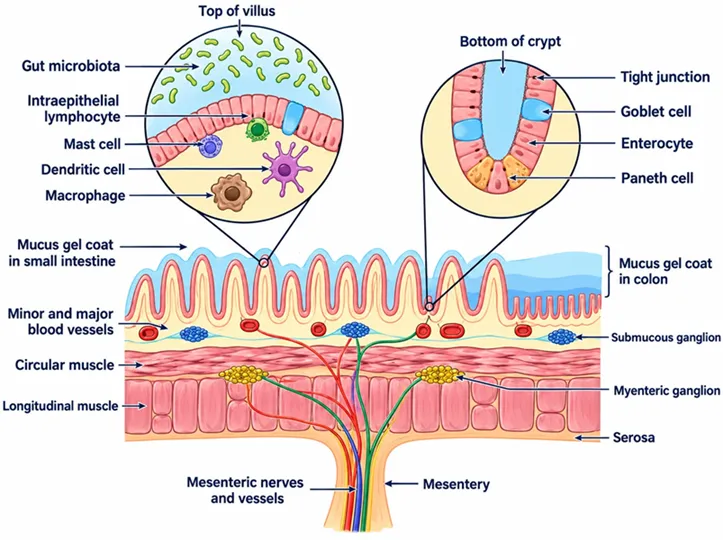
3.1 Gastrointestinal barriers
Oral biologic delivery encounters sequential barriers including:
1. gastric acidity;
2. digestive enzymes;
3. luminal dilution;
4. mucus;
5. epithelial membrane;
6. tight junctions;
7. intracellular degradation;
8. basolateral transport;
9. hepatic first-pass effects.
The mucus layer is both a protective barrier and a dynamic transport environment. Mucoadhesive particles may prolong residence but can also become trapped within mucus, whereas mucus-penetrating surfaces can reduce adhesive interactions and promote movement toward the epithelial surface. Therefore, mucoadhesion and mucus penetration should not be treated as interchangeable objectives [2–5].
3.2 Mucosal barriers
Nasal, pulmonary, buccal, sublingual, vaginal, and ocular surfaces possess mucus, enzymatic, cellular, and clearance mechanisms that limit macromolecular transport.
3.3 Cellular barriers
Following extracellular transport, nanoparticles must interact with the cell membrane, undergo uptake, and release cargo in a biologically active form.
3.4 Endosomal and lysosomal degradation
For intracellular delivery, uptake alone is insufficient. Cargo may remain trapped in endosomes and ultimately reach lysosomes. Consequently, systems designed for intracellular biologics frequently incorporate pH-responsive, membrane-active, fusogenic, or other endosomal escape mechanisms.
3.5 Blood–tissue barriers
The vascular endothelium and extracellular matrix can substantially restrict transport into tissues. The blood–brain barrier represents an especially restrictive example.
3.6 Renal clearance
Small peptides and some nanosystems or their degradation products can undergo renal elimination. Increasing molecular or particle size can reduce filtration but may introduce other clearance mechanisms.
3.7 Mononuclear phagocyte system
Systemically administered nanoparticles can undergo opsonization and uptake by macrophages in organs such as the liver and spleen. Surface chemistry, size, charge, shape, and protein corona formation all contribute to this process.
3.8 Extracellular matrix
Dense extracellular matrix can impede nanoparticle movement through tumors and other tissues. High cellular uptake therefore does not necessarily correspond to effective tissue penetration.
4. Nanocomposites: Fundamentals
4.1 Definition
A pharmaceutical nanocomposite is a multicomponent nanoscale or nanostructured delivery system in which distinct material phases or functional domains are integrated to generate complementary physicochemical or biological functions.
The essential feature is functional integration, rather than simply the presence of a small particle.
4.2 Concept and architecture
A nanocomposite may contain:
â— a structural matrix;
â— a nanoparticle or nanofiller;
â— therapeutic cargo;
â— surface stabilizers;
â— targeting ligands;
â— responsive components;
â— protective coatings.
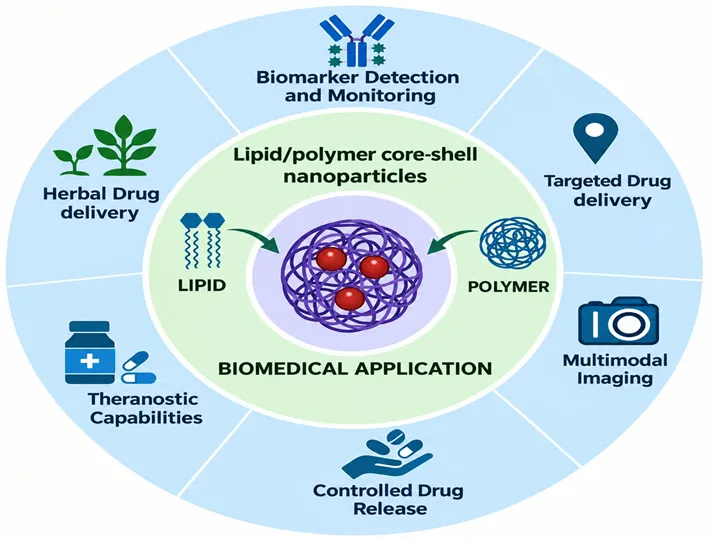
The components may be arranged as core–shell structures, layered systems, matrix-dispersed composites, interpenetrating networks, surface-decorated particles, or combinations thereof.
4.3 Major components
Matrix
Provides structural integrity, mechanical characteristics, degradation behavior, and controlled release may be provided.
Nanofiller
Possibly provides high surface area, mechanical reinforcement, optical or magnetic functionality, porous loading capacity, or stimulus responsiveness.
Therapeutic cargo
May be physically entrapped, adsorbed, conjugated, or incorporated into a secondary carrier.
Surface modifier
Controls colloidal stability, mucus interactions, immune recognition, protein adsorption, or cellular uptake.
Targeting ligand
May provide a receptor-mediated interaction but may also affect the manufacturing complexity and biological behavior.
4.4 Classification
Major architectures include the following:
â— polymer–nanoparticle composites;
â— lipid–polymer hybrids;
â— inorganic–polymer;
â— hydrogel–nanoparticle composites;
â— nanofiber systems;
biomimetic hybrids;
â— stimuli-responsive composites.
| Feature | Conventional nanoparticle | Nanocomposite |
|---|---|---|
| Material design | Often single dominant material | Two or more integrated functional components |
| Primary objective | Encapsulation/protection/release | Combination of complementary functions |
| Architecture | Relatively simple | Often multiphasic or hierarchical |
| Surface engineering | Optional | Frequently central |
| Process complexity | Usually lower | Often higher |
| Translational burden | Variable | Potentially higher because of additional CQAs |
4.5 Nanocomposite versus conventional nanocarrier
Complex formulations are not necessarily better formulations. Additional materials always bring the prospect of variability, compatibility, analytical, and regulatory issues.
5. Nanomaterials Used in Biologic and Peptide Delivery
5.1 Polymeric nanoparticles
Biodegradable polymers such as PLGA can protect peptides and proteins and provide sustained release. Polymer composition, molecular weight, particle size, internal microenvironment, and degradation products influence loading and release. However, organic solvents and water–oil interfaces used during some fabrication processes can destabilize proteins, and acidic degradation products generated by polyester hydrolysis may affect sensitive cargo.
5.2 PLGA-based systems
PLGA remains attractive because its degradation and release characteristics can be adjusted through polymer composition and molecular weight. However, protein encapsulation can produce low loading, burst release, interfacial denaturation, and exposure to unfavorable microenvironments. These limitations have motivated use of stabilizing excipients, alternate fabrication processes, and hybrid architectures [6].
5.3 Chitosan-based systems
Chitosan provides cationic surface functionality, mucoadhesion, biodegradability, and potential enhancement of epithelial interactions. Chitosan nanoparticles have therefore been investigated extensively for oral peptide delivery. Their limitations include pH-dependent solubility, variability associated with molecular weight and degree of deacetylation, and the possibility that strong mucoadhesion can reduce mucus penetration [7].
5.4 Liposomes
Liposomes possess aqueous compartments surrounded by lipid bilayers and can accommodate both hydrophilic and lipophilic substances. Their biocompatibility and clinical experience make them important nanocarriers, but oral protein/peptide delivery can be limited by structural instability, leakage, digestion, and limited epithelial transport [8].
Liposomes are among the most clinically established nanomedicine platforms, although most clinically successful products contain small-molecule drugs rather than protein or peptide therapeutics [9].
5.5 Lipid nanoparticles
Lipid nanoparticles have become particularly important for nucleic-acid delivery. Their clinical success in mRNA vaccination demonstrated that appropriately engineered lipid systems can protect labile macromolecules and facilitate intracellular delivery at scale [10,11].
This experience is highly relevant to biologic delivery, but lipid nanoparticles for nucleic acids should not be presented as direct clinical validation of nanocomposite peptide/protein systems.
5.6 Lipid–polymer hybrid nanoparticles
Lipid–polymer hybrid nanoparticles combine a polymeric core or matrix with a lipid layer or lipid-associated surface. Their principal rationale is to combine polymer-mediated structural and release control with lipid-mediated interfacial compatibility and biological functionality.
Recent reviews specifically addressing peptide/protein delivery identify lipid–polymer hybrids as a promising multicomponent approach and discuss nanoprecipitation, emulsification, and microfluidic fabrication as relevant processes [12].
5.7 Mesoporous silica nanoparticles
Mesoporous silica nanoparticles possess tunable pore dimensions, high surface area, and modifiable surface chemistry. These properties permit protein adsorption or pore loading and support stimuli-responsive release. Studies have investigated MSNs for protein protection, intracellular delivery, and oral peptide/protein delivery [13–15].
However, silica systems remain primarily experimental for many biologic applications, and questions concerning long-term biodegradation, tissue accumulation, surface chemistry, and reproducibility require careful assessment.
5.8 Gold nanoparticles
Gold nanoparticles offer highly controllable surface chemistry and optical properties and have been investigated for peptide/protein delivery, imaging, and combined therapeutic systems. Their principal limitations for systemic biologic delivery include concerns about long-term fate, accumulation, surface ligand complexity, and manufacturing consistency.
5.9 Other inorganic nanoparticles
Iron oxide, calcium phosphate, magnetic materials, and other inorganic systems can provide imaging, magnetic targeting, mineral-based delivery, or responsive behavior. Their value is greatest where the inorganic component provides a clearly justified function rather than simply increasing formulation complexity.
5.10 Graphene-based nanomaterials
Graphene derivatives possess high surface area and unusual electrical and mechanical properties. Nevertheless, uncertainties regarding biodegradation, impurities, inflammation, oxidative stress, and long-term fate have limited their pharmaceutical translation.
5.11 Nanocellulose
Nanocellulose offers renewable origin, tunable surface chemistry, high aspect ratio, and potential use in gels and fibrous matrices. Its application to biologic delivery remains largely experimental.
5.12 Hydrogel nanocomposites
Hydrogel–nanoparticle systems can combine a hydrated three-dimensional matrix with nanoscale cargo carriers. Such systems are particularly attractive for local, injectable, ocular, transdermal, and tissue-engineering applications because the hydrogel can provide depot behavior while nanoparticles control protection and release.
5.13 Nanofiber systems
Electrospun and related nanofibers offer high surface area and can be engineered for rapid dissolution, sustained release, or transmucosal administration. Recent reviews describe protein/peptide-loaded nanofibers for oral and other mucosal routes, although the evidence remains predominantly preclinical [16].
6. Nanocomposite Formulation Strategies
6.1 Encapsulation
Encapsulation physically separates the biologic from the external environment. It can reduce enzymatic exposure and enable controlled release, but the process itself can damage the payload. Formulation development must therefore evaluate encapsulation efficiency alongside molecular integrity.
6.2 Adsorption
Adsorption can avoid harsh encapsulation conditions but may expose the protein to the particle surface. Surface interactions can alter conformation and potentially promote aggregation.
6.3 Covalent and non-covalent conjugation
Covalent attachment can provide stable association but may alter pharmacological activity if conjugation occurs near the active site. Non-covalent interactions are less chemically invasive but can produce premature release.
6.4 Core–shell architecture
Core–shell systems provide spatial separation of functions. The core may contain the biologic, whereas the shell can provide protection, targeting, mucus interaction, or controlled permeability.
6.5 Surface modification
PEGylation can reduce nonspecific interactions and improve colloidal stability, although PEG-associated anti-PEG responses and heterogeneous surface coverage complicate some applications. Alternative hydrophilic, zwitterionic, polysaccharide, or biomimetic coatings are therefore being explored.
6.6 Stimuli-responsive systems
Responsive systems can exploit:
â— pH;
â— temperature;
â— redox conditions;
â— enzymes;
â— light;
â— magnetic fields.
For biologics, the stimulus must be sufficiently selective to avoid premature release and sufficiently strong to produce predictable release under physiological conditions.
6.7 Mucoadhesive systems
Mucoadhesion may increase residence time and local concentration. Chitosan and thiolated polymers have been widely explored. However, prolonged mucus association can be counterproductive when epithelial penetration is required.
6.8 Mucus-penetrating systems
Mucus penetration generally requires reducing adhesive interactions with mucin. Hydrophilic and near-neutral surfaces have frequently been investigated for this purpose.
6.9 Targeted delivery
Passive targeting depends on physiological distribution and tissue properties.
Active targeting uses ligands such as antibodies, peptides, sugars, aptamers, or receptor-binding molecules.
Cell-specific targeting can increase uptake into selected cell populations but requires receptor availability and accessibility in vivo.
Targeting ligands should therefore be evaluated under physiologically relevant conditions rather than assuming that increased receptor binding in vitro guarantees improved therapeutic distribution.
7. Biologic–Nanomaterial Interactions
7.1 Protein adsorption
The adsorption of proteins onto nanomaterial surfaces can alter both the protein and nanoparticle.
7.2 Protein corona formation
Nanoparticles rapidly acquire a protein corona in biological fluids. The resulting biological identity can differ substantially from the original synthetic surface. Corona composition depends on particle size, surface charge, chemistry, composition, biological fluid, and experimental conditions [17–20].
7.3 Protein structural changes
Surface interactions may cause partial unfolding or changes in protein orientation. For therapeutic proteins, this is particularly important because biological activity is structure-dependent.
7.4 Aggregation
Nanoparticle surfaces can either inhibit or promote aggregation depending on the interaction energy, surface chemistry, protein concentration, and environmental conditions.
7.5 Immunological interactions
Complement activation, opsonization, macrophage uptake, cytokine responses, and adaptive immune recognition can influence both safety and pharmacokinetics.
7.6 Biological versus synthetic identity
A central concept in nanomedicine is that the material administered to a patient is not necessarily the same biological entity encountered by cells. Protein corona formation, adsorption of lipids and other biomolecules, and interactions with extracellular matrix components can substantially modify the effective surface.
Consequently, characterization of the pristine particle alone is insufficient for comprehensive understanding of biological performance [17–20].
8. Mechanisms of Biologic and Peptide Delivery
8.1 Protection from enzymatic degradation
Nanocomposites can physically isolate peptides and proteins from proteases. The extent of protection depends on matrix permeability, degradation rate, cargo location, and release kinetics.
8.2 Protection from chemical degradation
Encapsulation can reduce exposure to oxygen, water, interfaces, and destabilizing excipients, although the nanocomposite microenvironment may itself introduce new degradation pathways.
8.3 Protection from physical instability
Confinement can sometimes reduce aggregation and unfolding, but high local concentrations or strong surface adsorption can have the opposite effect.
8.4 Enhanced cellular uptake
Nanoparticles may enter cells through clathrin-mediated endocytosis, caveolae-associated pathways, macropinocytosis, phagocytosis, or other mechanisms.
8.5 Endosomal escape
Endosomal escape is particularly important for intracellular protein and nucleic-acid delivery. Ionizable, fusogenic, membrane-active, or pH-responsive components can facilitate escape, but excessive membrane activity can produce toxicity.
8.6 Controlled and sustained release
Release can be governed by:
â— diffusion;
â— polymer degradation;
â— lipid reorganization;
â— hydrogel swelling;
â— pore opening;
â— stimulus-responsive bond cleavage.
8.7 Transcellular transport
Nanoparticles can interact with epithelial cells and undergo transcellular transport, although efficient cellular uptake does not necessarily result in productive systemic absorption.
8.8 Paracellular transport
Tight junction modulation may increase permeability but can compromise barrier integrity. Any permeation-enhancing strategy therefore requires safety assessment.
8.9 Receptor-mediated uptake
Targeting ligands can facilitate receptor-mediated endocytosis, but receptor expression, accessibility, internalization rate, and intracellular trafficking all determine whether targeting produces a meaningful pharmacological benefit.
9. Routes of Administration
9.1 Oral delivery
Oral delivery remains the most challenging and clinically attractive route for many peptides and proteins. Major barriers include luminal degradation, mucus, epithelial permeability, and intracellular degradation .
Nanocomposite approaches can combine:
â— enteric protection;
â— enzyme shielding;
â— mucus modulation;
â— permeation enhancement;
â— epithelial targeting;
â— controlled release.
Importantly, nanocarrier-mediated oral delivery should not be considered clinically validated merely because increased plasma exposure is observed in rodents.
The clinical landscape demonstrates that oral peptide delivery can also succeed through approaches that are not nanocomposite-based. For example, oral semaglutide uses the absorption enhancer salcaprozate sodium, while oral octreotide has been developed as a delayed-release capsule formulation . These examples demonstrate that the delivery problem can sometimes be solved through optimized molecular and excipient strategies rather than increasing nanoscale complexity. [21,22]
9.2 Parenteral delivery
IV administration permits immediate systemic exposure but introduces concerns regarding:
â— protein corona formation;
â— complement activation;
â— hepatic and splenic uptake;
â— aggregation;
â— injection-site reactions;
â— systemic immunological responses.
SC and IM administration can provide depot behavior and are attractive for long-acting systems.
9.3 Transdermal delivery
The stratum corneum remains the principal barrier. Nanocomposite hydrogels, nanofibers, microneedles, and deformable vesicles have been investigated.
9.4 Nasal delivery
Nasal delivery can bypass gastrointestinal degradation and potentially provide systemic or nose-to-brain transport. Mucociliary clearance and limited dosing volume remain important limitations.
9.5 Pulmonary delivery
The large alveolar surface area makes the lung attractive for biologic delivery. However, particle deposition, macrophage uptake, mucus, protein instability during aerosolization, and device compatibility require consideration.
9.6 Ocular delivery
Rapid tear turnover and corneal barriers limit retention. Mucoadhesive systems, hydrogels, nanocarriers, and stimuli-responsive formulations have been investigated.
9.7 Buccal and sublingual delivery
These routes bypass much of the gastrointestinal tract and first-pass hepatic metabolism but possess limited surface area and epithelial barriers.
9.8 Other mucosal routes
Rectal and vaginal delivery may be useful for localized or systemic peptide/protein administration. Nanofiber and hydrogel systems are particularly relevant to these routes.
10. Factors Affecting Nanocomposite Formulation
10.1 Particle size
Size influences cellular uptake, biodistribution, filtration, mucus interaction, and aggregation. A smaller particle is not universally superior; the optimal size is route- and mechanism-dependent.
10.2 Polydispersity index
High PDI may indicate heterogeneous particle populations and can complicate biological interpretation and process control.
10.3 Surface charge
Charge affects colloidal stability, membrane interaction, mucus penetration, protein adsorption, and toxicity.
10.4 Morphology
Shape can influence circulation, cellular uptake, tissue penetration, and macrophage recognition.
10.5 Drug loading and encapsulation efficiency
High loading is desirable only if the biologic remains intact and biologically active.
10.6 Polymer composition
Polymer chemistry determines degradation, hydrophobicity, mechanical properties, and release.
10.7 Molecular weight
Polymer molecular weight can alter viscosity, degradation, particle formation, and release.
10.8 Material ratio
The ratio between polymer, lipid, inorganic material, and stabilizer can represent a critical material attribute.
10.9 Biologic concentration
Increasing cargo concentration may alter viscosity, aggregation, osmolarity, particle formation, and surface saturation.
10.10 Surface chemistry
Functional groups influence protein adsorption, ligand attachment, mucus interaction, and cellular uptake.
10.11 Processing conditions
Mixing energy, solvent composition, temperature, pH, shear, residence time, and drying conditions may affect both nanoparticle attributes and biologic integrity.
10.12 Sterilization
Heat sterilization is often unsuitable for proteins. Filtration can be difficult for particulate systems. Aseptic manufacture, radiation, or alternative sterilization approaches therefore require product-specific evaluation.
10.13 Storage
Freeze–thaw cycles, water activity, oxygen, temperature, aggregation, lipid oxidation, and polymer hydrolysis can influence stability.
11.Formulation and Processing Methods
| Method | Principle | Advantages | Principal limitations for biologics |
|---|---|---|---|
| Nanoprecipitation | Rapid solvent displacement | Simple;Scalable potential | Organic solvent exposure;Limited loading for hydrophilic proteins |
| Single emulsion | Polymer dissolved in organic phase | Helpful for hydrophobic cargo | Interface/solvent stress |
| Double emulsion | Water –Oil-Water Encapsulation | Suitable for hydrophilic proteins | Share,Interface, Burst release |
| Ionic gelation | Electrostatic polymer cros slinking | Mild condition | Most sensitive to ionic condition |
| Self-assembly | Spontaneous organization of components | Can avoid harsh prossesin g | Sensitive to composition and environment |
| Microfluidics | Controlled rapid mixing | Reproducible mixing;Scalable continuous concept | Eqquipment/ Process development required |
| Spray drying | Automization and rapid drying | Potantial solid dosage form | Thermal/Shear stress;Aerosol losses |
| Lyophilization | Sublimation after freezing | Improves storage stability in suitable systems | Freeze concentration and interfacial stress |
| Electrospining | Fiber formation under electric field | High surface area mucosal/local delivery | Process complexity residual solvent consideration |
| Layer-By-Layer assembly | Sequential deposition | Precise multilayer structures | More manufacturing steps |
| Crosslinking | Process formation | Tunable release | Crosslinking chemistry may damage cargo |
| In situ gelation | Gel forms after administration | Local depot | Trigger and tissue compatibility |
Microfluidic systems are particularly attractive in situations where there is a need to exercise a high degree of control over mixing and composition. Recent studies focusing on lipid-polymer hybrids underline the importance of material characteristics and critical process parameters in the choice of an appropriate preparation process.
12. Evaluation and characterization
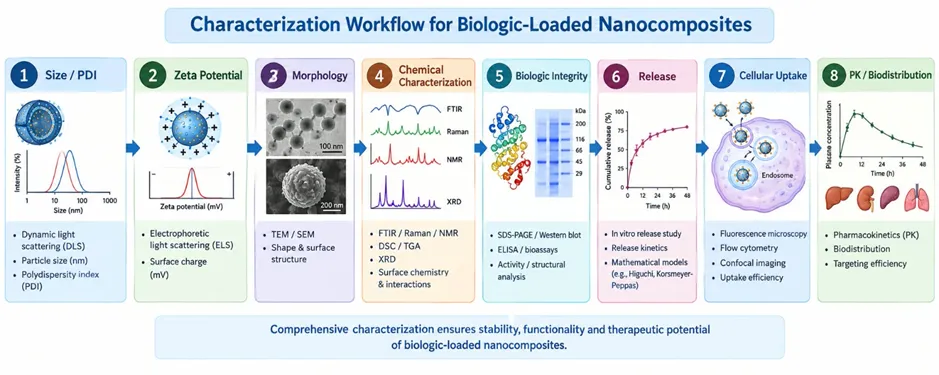
A publication quality nanocomposite study should characterize the material, the biologic and the biological function.
12.1 Physical characterization
Should include dynamic light scattering for hydrodynamic diameter and PDI, zeta potential, TEM, SEM, AFM and nanoparticle tracking analysis where applicable.
12.2 Chemical characterization
FTIR, Raman spectroscopy, NMR, chromatography, mass spectrometry, and elemental analysis maybe be appropriate depending on composition.
12.3 Thermal characterization
DSC and TGA can elucidate transitions, residual solvents, thermal stability and material interactions.
12.4 Crystallinity
XRD may be important where crystalline and amorphous phases play role in loading or release.
12.5 Encapsulation efficiency and loading
These should be measured using validated or appropriately qualified analytical methods rather than indirect mass-balance assumptions only.
12.6 Biologic integrity
A biologic loaded nanoparticle should ideally be assessed at several levels including primary structure, purity, aggregation state, secondary structure, tertiary structure where pertinent, and biological activity. Useful methods include HPLC, SEC, SDS-PAGE, CD spectroscopy, DSC, mass spectrometry and bioactivity assays.
12.7 In-vitro release
Studies should be performed using physiologically relevant media and conditions. Sink conditions, membrane artifacts, adsorption and analytical recoveries should be considered.
12.8 Stability
Should assess:
Stability should evaluate:
12.9 Cellular uptake
Fluorescent labeling should be interpreted carefully because fluorophore dissociation can produce false-positive uptake.
12.10 Cytotoxicity
Multiple assays and relevant exposure conditions should be used rather than relying on a single viability assay.
12.11 Hemocompatibility
Relevant for systemic administration and may include complement activation, hemolysis, coagulation, platelet interactions, and cytokine responses.
12.12 Pharmacokinetics and biodistribution
Important parameters include:
â— Cmax;
â— Tmax;
â— AUC;
â— half-life;
â— clearance;
â— volume of distribution;
â— tissue exposure.
For biologics, total protein concentration may not adequately represent intact or active therapeutic molecule. Analytical methods should distinguish intact drug, degraded fragments, aggregates, and biologically active species where feasible.
13. Applications
13.1 Insulin and peptide hormones
Insulin has become a major model for oral and alternative-route delivery research because of its sensitivity to proteolysis and poor epithelial permeability. Chitosan, polymeric nanoparticles,
liposomes, hydrogels, silica systems, and hybrid carriers have all been explored. The evidence base remains predominantly preclinical for many nanocomposite approaches [2,7].
13.2 Vaccines
Nanostructured formulations can protect antigens and influence antigen-presenting-cell uptake. However, vaccine nanocomposites must balance antigen stability, immune activation, tissue distribution, and manufacturing reproducibility.
13.3 Monoclonal antibodies
Antibody delivery using nanoparticles has been investigated for systemic, local, mucosal, and intracellular applications. The large size and structural sensitivity of antibodies make formulation conditions particularly important.
13.4 Growth factors
Nanocomposites can protect growth factors and provide local sustained release. Hydrogel–nanoparticle systems are especially relevant to regenerative medicine.
13.5 Enzyme therapeutics
Nanocomposites may protect enzymes from degradation and permit localization or controlled release. However, enzyme immobilization or adsorption can alter catalytic activity.
13.6 Cytokines
Local delivery may reduce systemic exposure while increasing concentration at the desired tissue. The major challenge is controlling pharmacological activity because cytokines can have potent effects at relatively low concentrations.
13.7 Nucleic-acid-related biologics
Lipid nanoparticles have achieved major clinical validation for mRNA delivery. Their success demonstrates that multicomponent nanoscale formulations can progress from formulation research to large-scale clinical manufacture [10,11]. However, LNP–mRNA vaccines should be distinguished from experimental peptide/protein nanocomposites.
13.8 Cancer therapeutics
Cancer remains a major application area for nanomedicine. Yet biological heterogeneity, variable vascular permeability, extracellular matrix barriers, and differences between animal tumor models and human tumors limit generalization. Improved cellular uptake alone should therefore not be equated with improved clinical efficacy.
14. Recent Advances and Emerging Technologies
14.1 AI-assisted nanocomposite formulation
Nanocomposite formulation is a high-dimensional optimization problem. Variables include:
â— material composition;
â— polymer molecular weight;
â— lipid ratio;
â— solvent ratio;
â— mixing rate;
â— flow rate;
â— temperature;
â— pH;
â— stabilizer concentration;
â— drug concentration.
Outputs may include particle size, PDI, encapsulation efficiency, loading, release rate, stability, and biological activity.
AI/ML can potentially assist by:
1. constructing surrogate models;
2. identifying nonlinear relationships;
3. performing Bayesian optimization;
4. prioritizing experiments;
5. predicting CQAs;
6. integrating formulation and process variables;
7. identifying multi-objective design spaces.
Recent reviews emphasize that AI should be regarded as a decision-support technology rather than an autonomous replacement for mechanistic pharmaceutical science. Data scarcity, model interpretability, experimental validation, and biological complexity remain important limitations [23–25].
14.2 Smart nanocomposites
Stimuli-responsive materials are increasingly being designed to respond to disease-associated pH, enzymes, redox environments, temperature, or externally applied stimuli.
The major translational question is not whether a material responds to a stimulus under idealized laboratory conditions, but whether the stimulus is sufficiently specific and reproducible in humans.
14.3 Biomimetic nanocarriers
Cell membrane-coated nanoparticles and related biomimetic systems attempt to exploit naturally occurring surface proteins and membrane properties. They have been investigated for immune evasion, targeting, prolonged circulation, and tissue-specific delivery [26,27].
However, biological-source variability, membrane composition, purification, characterization, sterilization, and manufacturing are major barriers.
14.4 Exosome-based systems
Extracellular vesicles provide naturally derived lipid–protein interfaces and endogenous trafficking mechanisms. Hybrid systems combining exosomes or extracellular-vesicle components with synthetic nanomaterials are emerging, but standardization of isolation, loading, potency, identity, and safety remains challenging.
14.5 Cell membrane-coated systems
Membrane-coated nanoparticles may provide biological functions unavailable to synthetic polymers alone. Their greatest opportunity may lie in situations where the biological surface provides a specific and mechanistically useful interaction.
14.6 Personalized delivery
Patient-specific delivery could theoretically incorporate disease state, receptor expression, pharmacokinetics, immune status, and genetic information. In practice, personalized nanomedicine remains an emerging concept rather than a routine clinical formulation strategy.
14.7 3D-printed delivery systems
Three-dimensional printing may enable patient-specific geometries, implantable depots, or spatially controlled combinations of materials. Integration with nanoscale delivery systems remains largely experimental.
14.8 Microfluidic manufacturing
Microfluidics provides precise control of mixing and residence time and is increasingly important for reproducible nanoparticle manufacture. The critical translational issue is demonstrating that laboratory-scale control can be maintained at clinically relevant production scales.
14.9 Precision targeting
Future targeting strategies are likely to emphasize quantitative receptor biology, tissue accessibility, and intracellular trafficking rather than simply adding a ligand to a nanoparticle surface.
14.10 Combination nanocomposites
Combination systems may integrate:
â— protective polymer;
â— lipid interface;
â— targeting ligand;
â— responsive release element;
â— imaging component.
Such systems are scientifically attractive but introduce a corresponding increase in CQAs, analytical burden, manufacturing complexity, and regulatory uncertainty.
15. Translational and Clinical Perspective
15.1 Preclinical development
A translational sequence should ideally progress from:
material screening → formulation optimization → biologic integrity → mechanistic in-vitro studies → relevant ex-vivo models → small-animal pharmacokinetics → efficacy → toxicology → larger-animal studies where justified → GMP-compatible manufacture → clinical development.
15.2 Pharmacokinetic translation
Nanoparticle exposure is not necessarily equivalent to active biologic exposure. Analytical methods should distinguish carrier-associated drug from released, intact, and pharmacologically active drug.
15.3 Animal-to-human translation
Rodent models provide useful mechanistic information but may poorly reproduce human mucus properties, gastrointestinal physiology, immune responses, nanoparticle clearance, and tissue architecture.
Recent translational analyses emphasize the value of larger animal models in selected nanomedicine development programs and identify formulation scale-up and predictive preclinical modeling as major barriers [28].
15.4 Clinical nanomedicine
Nanomedicine has achieved clinical success, particularly in liposomal and lipid-based technologies. The success of clinically used liposomes demonstrates that complex nanoscale products can be manufactured and regulated successfully, but this experience should not be generalized automatically to every nanocomposite architecture .
15.5 Clinically translated technologies
Important examples include:
â— liposomal formulations;
â— lipid nanoparticles for mRNA vaccines;
â— selected polymeric and protein-based nanoparticle systems;
â— nanocrystal technologies.
The clinical success of mRNA lipid nanoparticles is especially relevant because it demonstrates the feasibility of protecting fragile biological cargo, achieving cellular delivery, establishing manufacturing processes, and conducting clinical development at scale.
15.6 Why promising laboratory systems fail
Common reasons include:
â— poor scalability;
â— unstable formulations;
â— insufficient biologic integrity;
â— inadequate analytical methods;
â— animal models with limited predictive value;
â— unexpected immune interactions;
â— protein corona effects;
â— heterogeneous biodistribution;
â— insufficient dose loading;
â— difficult sterilization;
â— high manufacturing cost;
â— lack of reproducibility.
Translation literature consistently identifies CQAs, analytical characterization, process parameters, batch consistency, scale-up, and appropriate preclinical models as central development requirements [28,29].
16. Challenges and Limitations
16.1 Biologic stability
The delivery system must protect the biologic without damaging it.
16.2 Nanocomposite stability
Multicomponent systems may undergo component migration, phase separation, aggregation, lipid oxidation, polymer hydrolysis, or ligand loss.
16.3 Aggregation
Aggregation may affect injectability, biodistribution, release, and immunological responses.
16.4 Manufacturing complexity
Each additional component adds another source of variability.
16.5 Scale-up
A formulation that works at milligram scale may behave differently during kilogram-scale manufacture because mixing, heat transfer, solvent exchange, and residence times change.
16.6 Batch-to-batch variability
Biological source materials and complex surface coatings are particularly susceptible to variability.
16.7 Sterilization
Sterilization must preserve particle attributes and biologic activity simultaneously.
16.8 Toxicity
Potential toxicity depends on composition, dose, route, particle persistence, degradation products, and exposure duration.
16.9 Immunogenicity
Nanomaterials can influence complement, innate immune pathways, and adaptive immune responses. The formulation may also change the immunogenicity of the therapeutic biologic.
16.10 Long-term safety
Long-term biodistribution and clearance require evaluation when materials persist or degrade slowly.
16.11 Biodistribution uncertainty
In vitro targeting does not guarantee tissue-specific delivery in vivo.
16.12 Protein corona
The protein corona can mask targeting ligands and change biodistribution.
16.13 Cost
Highly sophisticated nanocomposites may require expensive raw materials, specialized equipment, extensive characterization, and complex quality control.
16.14 Standardization
There remains considerable heterogeneity in nanoparticle characterization, biological assays, release testing, and reporting.
16.15 Regulatory uncertainty
Regulatory evaluation must be based on product-specific properties rather than the broad label "nanotechnology." FDA guidance explicitly emphasizes product characteristics, safety, effectiveness, quality, characterization, controls, and process considerations for drug products containing nanomaterials [30].
17. Regulatory and Safety Considerations
17.1 Quality control
The analytical package should characterize:
â— particle size and distribution;
â— morphology;
â— composition;
â— surface properties;
â— cargo content;
â— cargo integrity;
â— impurities;
â— degradation products;
â— release;
â— stability.
17.2 Critical quality attributes
Potential CQAs include:
â— particle size;
â— PDI;
â— surface charge;
â— composition;
â— drug loading;
â— encapsulation efficiency;
â— free drug;
â— biologic integrity;
â— potency;
â— residual solvent;
â— sterility;
â— endotoxin;
â— aggregation.
The appropriate CQAs must be established through product-specific understanding rather than adopted as a universal checklist.
17.3 Critical process parameters
Potential CPPs include:
â— mixing rate;
â— flow ratio;
â— temperature;
â— pressure;
â— solvent concentration;
â— pH;
â— polymer/lipid ratio;
â— crosslinking conditions;
â— drying conditions.
17.4 Nanotoxicology
Assessment should consider:
â— acute cytotoxicity;
â— oxidative stress;
â— inflammatory signaling;
â— complement activation;
â— hemocompatibility;
â— genotoxicity where relevant;
â— organ accumulation;
â— chronic exposure;
â— degradation products.
17.5 Sterility and endotoxin
Parenteral nanocomposites require appropriate sterility assurance and endotoxin control. The nanoscale structure can complicate filtration and analytical recovery.
17.6 FDA considerations
FDA's current guidance states that nanomaterials may be used as active or inactive components, including carriers for active ingredients, and that nanoscale characteristics may produce product attributes requiring particular consideration. FDA emphasizes a product-focused, science-based assessment rather than treating nanotechnology itself as inherently safe or hazardous [30,31].
17.7 EMA considerations
EMA has developed reflection papers addressing specific nanomedicine categories and issues such as liposomal products, coated nanomedicines, and block-copolymer micelles. The regulatory landscape therefore consists of product-specific and category-specific considerations rather than a single universal "nanomedicine" pathway [32,33].
18. Quality by Design and CMC Considerations
QbD provides a particularly appropriate framework for nanocomposite development because formulation performance depends on interacting material and process variables.
18.1 Quality Target Product Profile
The QTPP should define:
â— route;
â— dosage form;
â— dose;
â— release profile;
â— therapeutic exposure;
â— stability;
â— sterility where applicable;
â— administration requirements.
18.2 Critical material attributes
Potential CMAs include:
â— polymer molecular weight;
â— lipid purity;
â— lipid composition;
â— degree of deacetylation of chitosan;
â— nanoparticle composition;
â— ligand density;
â— biologic concentration;
â— excipient grade.
18.3 Critical process parameters
CPPs should be identified using risk assessment and experimentally evaluated.
18.4 Design space
A multidimensional design space can define acceptable ranges for formulation and process variables that reliably produce CQAs.
18.5 Process analytical technology
PAT may eventually support real-time monitoring of:
â— particle size;
â— concentration;
â— mixing;
â— solvent exchange;
â— aggregation;
â— process endpoint.
18.6 Lifecycle management
ICH Q8, Q9, Q10 and related quality guidelines provide the broader pharmaceutical-development framework encompassing pharmaceutical development, risk management, and pharmaceutical quality systems [34,35]. For nanocomposites, QbD should be integrated from the earliest stage rather than applied retrospectively after the formulation has been optimized by trial and error.
CONCLUSION
Nanocomposite formulations offer a versatile framework for addressing the multifactorial delivery barriers encountered by peptides, proteins, antibodies, enzymes, vaccines, and other biologics. Their principal scientific value lies in the ability to assign complementary functions to different components—for example, a polymer provides structural stability and controlled degradation, a lipid layer offers interfacial compatibility, an inorganic phase offers high-capacity or stimulus-responsive loading, and a surface coating modifies biological interactions.
Nevertheless, nanocomposite complexity comes at a cost. The same interfaces that protect a biologic can lead to adsorption or structural changes; the same surface modifications that prolong circulation can change the protein-corona formation; and the same multicomponent architecture that allows sophisticated targeting can make manufacturing and regulation substantially more challenging.
The evidence base is therefore best interpreted according to the development stage. Many systems demonstrate convincing in vitro proof of concept, while a smaller subset have progressed to reproducible animal studies. Clinical validation is much more limited for peptide/protein-specific nanocomposites. By contrast, the clinical success of liposomal medicines and lipid nanoparticles for nucleic-acid delivery demonstrates that nanoscale systems can achieve regulatory and manufacturing maturity when their critical attributes are sufficiently understood and controlled .
The next phase of the field should therefore move away from demonstrating increasingly elaborate nanoparticle architectures and instead focus on establishing quantitative structure–function relationships. Formulation design should link biologic stability, particle attributes, biological identity, pharmacokinetics, pharmacodynamics, toxicity, manufacturability, and regulatory requirements from the earliest stages.
Successful translation will require optimization of formulation performance, biological activity, safety, reproducibility, manufacturability, stability, cost, and regulatory acceptability in parallel. Nanocomposites should therefore be seen not as an intrinsic solution to biologic delivery but as a flexible engineering platform whose clinical value depends on whether its added complexity offers a demonstrable therapeutic advantage.
REFERENCES


Ritesh Vilasrao Deshmukh, Ramdas B. Darade, Nanocomposite Formulations for Biologics and Peptide Delivery: Recent Advances, Challenges, and Future Perspectives, Int. J. Sci. R. Tech., 2026, 3 (11), 914-933. https://doi.org/10.5281/zenodo.24389506
 10.5281/zenodo.24389506