

We use cookies to ensure our website works properly and to personalise your experience. Cookies policy
1Reasearch Scholar, MIT Art Design and Technology University, Pune, India
2School of Holistic Dean, School of Humanities, MIT Art Design and Technology University, Pune, India
This study proposes SamaLingua, a teacher-guided model based on the Indian knowledge system of Samved, blending it with artificial intelligence to generate customised English songs for English tone and prosody in language learning. It is observed that grammar and vocabulary take central place and full attention in English language teaching. However, it is essential to focus on elements like rhythm, pitch, and expressive intonation. These elements enhance the interpretation of meaning. SamaLingua focuses on the teacher's role as a pedagogical designer, where the teacher evaluates learners' tonal needs and guides them to select appropriate artificial intelligence tools. In this method, the teacher designs song-based activities with the use of artificial intelligence. Such activities support speaking challenges for the students and reinforce teachers' creativity and critical thinking. SamaLingua is a blended learning method which is rooted in Indian Vedic Heritage and in the latest Artificial Technology. This method primarily focuses on Samveda’s musical chanting, customization in pedagogy using Artificial Intelligence to make language learning more engaging. Here, music serves as a powerful tool that catches attention and engages learners. It encourages learners to follow the natural pronunciation of the English language. With continuous exposure to such a method, learners build social confidence and express fluency in the language. SamaLingua is inclusive and scalable, requiring minimal resources that can be implemented and executed easily in the classroom. It is a sustainable and personalised model of language learning. It can potentially combine the Indian knowledge system and artificial intelligence for innovative language learning.
Voicing Sustainability in Language Learning: -
When we teach English as a second language, various tools, including digital platforms are used, though they are effective in a traditional setup, they lack customisation. SamaLingua serves a tailor-made method focusing on the expressive dimension of speech, like stress rhythm and intonation, contributing to linguistic clarity and emotional expression with social nuance. Sylvain Moreno, in his research paper titled “Short-term Music Training Enhances Verbal Intelligence and Executive Function” (2011), states, “Music training engages brain networks that overlap with those used for language, particularly in processing supra-segmental features such as pitch, rhythm, stress patterns.” In continuation with Moreno’s observation, SamaLingua can be an effective holistic model that addresses the language on the tonal and rhythmic level without concentrating on the isolated phoneme level. According to Gerry Farrell, in his paper ‘Music Cognition and Culture,’ “A holistic understanding of music and language recognizes their shared reliance on rhythm contour and intonation- the suprasegmental elements that convey emotion and meaning.” Here, Farrell blends the concept of Western and Indian traditions, where the tone is treated with a communicative and meaning-bearing manner, is well articulated.
This paper concentrates on teaching pronunciation and phonetic accuracy with fluency. Learners will acquire technically correct speech with natural rhythm and expressiveness. In the changing global scenario of teaching languages, there is a need to explore various methodologies that address tone as a core component of communication. This paper proposes a pedagogical model that draws on the perennial power of song, which is guided by teachers and generated by artificial intelligence to meet the linguistic needs of learners. Songs rich in rhythm, melody and emotion offer an evolving medium through which tone can be naturally acquired. The model seeks to create a more resonant and individualised path to learn English with better speaking ability and fluency by customising the songs to each learner’s tonal challenges
In ELT (English Language Teaching), songs have been widely used as a tool. Across cultures, music has traditionally served as a pedagogical medium for preserving memory, identity, and oral knowledge in the Indian context. Practices such as Samaveda chanting help to retain the knowledge for a longer time. While talking about how heritage learning informs tone, Danielou says, “The chanting of Samveda demonstrates one of the oldest intersections of music and language where tonal precision carried sacred as well as commutative value.” (Danielou 1976, p.45) This emphasises the importance of cultural continuity in Indian heritage learning that sinks with musical pedagogy. Shruti and raga-based intonation illustrate the longstanding role of music in penetrating tonal accuracy, phonetic precision, and the effective dimension of learning (Powers, H.S. 1965). These traditions highlight not only the sustainability of oral methods over centuries, but also their cognitive efficiency and cultural rootedness.
This paper does not seek to replicate such traditions in a literal sense. Rather, it explores how their pedagogical essence—the use of sound, repetition, and emotional engagement—can be translated into a contemporary framework through artificial intelligence-generated song-based content, guided by the teacher. In this model, the teacher assesses learners’ speech rhythm and tone, then uses generative tools to produce song materials customised to those needs. The artificial intelligence functions as a responsive content creator, and pedagogical decisions remain in the hands of the teacher. The teacher ensures both educational quality and cultural sensitivity.
Such an approach resonates with the emphasis on resilience, cultural belonging, and arts-based methods in education. It is rooted in ancestral sound practices with the latest technological tools. In the advent of artificial intelligence SamaLingua supports effective language acquisition along with the formation of learning communities that are emotionally engaged, culturally connected, and pedagogically sustainable.
Pedagogical Power of Song: Cultural and Cognitive Foundations
Tone is a significant linguistic feature. It is considered the soul of meaning, mood, and social presence. Tone, in spoken communication includes rhythm, pitch variation, stress, and intonation. All these elements evoke subtle emotional cues in the minds of listeners and help them interpret content. Mastering tone is essential for learners who are learning English as a second language, as it helps in clarity, confidence and social integration. Moreno validates the above point: “After just 20 days of music training, children showed significant gains in verbal IQ and executive control.” These statements emphasises that music helps the brain for linguistic performance. (Moreno et al., 2011, p. 3)
This loophole needs to be effectively addressed in language learning to improve the pronunciation of the learners. Tone is dynamic and context sensitive, unlike grammar or lexical items, which are rule-driven. Tone cannot be easily taught through traditional rote exercises or textual explanation only. In traditional methods, learners develop speech that is intelligible but lacks intonational naturalness. They miss native euphony and fluency in expression. This is where music, particularly songs, offers itself as a persuasive pedagogical bridge. In, ‘This Is Your Brain On Music,’ Levitin emphasizes “Music activates nearly every region of the brain that has been mapped so far, engaging emotion, memory, and cognition simultaneously.” (Levitin,2006, p.85). Listening or performing music engages multiple brain regions. In this classic, neuroscientific and accessible reference, it is explored how listening to music engages multiple brain regions such as the auditory cortex, motor cortex limbic system. The distinct characteristic of song is that it is tonal and rhythmic in nature, which beautifully engages a person with emotions. The notes of a song linger on the mind as memory with auditory processing which helps in accelerating natural acquisition of tone and rhythm. When the learners hear the tune and try to sing along, they unconsciously learn the speech patterns of the language. They acquire stress timing without any cognitive stress. This process happens in an abstract prosodic manner and keeps reproducing tunes and simultaneously learning pronunciation.
There is a deep connection between music and speech. The human race has been drawn to music in many cultures across the globe. A child takes birth and cries, making sounds. later on, as it grows up, it learns words. Then starts with small sentences. It listens to lullabies. It has a calming effect. Then, as it grows up, it learns rhymes and tries to reproduce them, and unknowingly the bond with language gets deep-rooted with the tunes and the vocabulary of those rhymes. It tries to recreate them as it is and understands the layers of language prosody unknowingly. If we look at the broader perspective, this whole process is neurological, linguistic, cultural and historically inclusive. In oral cultures across the world songs are the primary mode of communication and knowledge transfer. We learn poetry, ethics, identity everything else through the language, along with hidden music right from childhood itself.
In the rich Indian heritage are four Vedas, which are considered as the mines of knowledge. They are the most ancient scripts in the world. Samveda (originated in c. 1200–1000 BCE). has been described as the “Book of Songs” or the “Veda of Chants” or even as the “Yoga of Songs.” Historically, the Sama chanting is recognised by all musicologists as the basis for Indian music. The roots of Sangeeta (Music), the traditional classical Indian music is formerly founded in Sama-gana. Samveda consists of the knowledge of musical patterns. Vedic chants are structured in such a magnificent way that they define the perfect structure of the manuscripts which are thousands of centuries ago, sung along with precise sound patterns, which is unbelievable. Even Western modern scholars’ emphasis that ‘This could happen all because of exact phonetic and tonal delivery, which is the most successful part of this long-lasting lineage of oral literature of Vedas. This ensured both linguistic fidelity and spiritual resonance’ (Daniélou 1976).
The tradition of Vedic chanting has been inscribed by UNESCO on the Representative List of the Intangible Cultural Heritage of Humanity from India in 2008 (originally proclaimed in 2003). The Vedic chanting ensures that the sound of each word remains unaltered and practitioners are taught from childhood the complex recitation techniques that are based on tonal accents and a unique manner of pronouncing each letter and specific speech combinations through Samveda. This has preserved the text intact for thousands of years with exact pronunciation.
The common and most important factor related to the music tradition of Samaveda has a close relationship with the music tradition of India, especially classical music as it originates from Samaveda. All seven Swaras (Musical notes) of Indian classical music are found and used in its primitive form in Sama chanting. Prathama, Dvitiya, Trutiya, Chaturtha , Mandra and Atisvara are the seven Swaras used in Sama chanting. Krusta is the Svara in the highest pitch. Triyaswara is considered the basic Swara (Àdharaswara) and it is also known as Dhratapracaya. Naradiyasiksa states that the seven Swaras, Prathama, Dvitiya, Tritiya, Caturtha, Mandra (Panchma), Krusta and Atisvara and respectively. Which is the base of today’s Indian Classical Music. The oral Gana tradition of Sama chanting is related to classical music in many ways. The close relationship of Sama chanting with music is highlighted by many earlier scholars in their authoritative statements. In Indian context the importance of Samveda is such that there are references in Bhagavad-Gita where Lord Krishana identifies himself with Samveda among the four Vedas.
The ‘Samved’ has several mantras that are both musically and spiritually significant. These mantras are set melody for chanting which is called Samagayan. Ancient hymns to praise Fire are in Samaved Agnim īḷe purohitaṃ yajñasya devaṃ á¹›tvijam” — “I worship Agni, the household priest, the divine minister of sacrifice.” Some Mantras or Chants for the Thunder God named Indra, Soma etc, several other Gods. Most importantly, Samved includes UdgÄ«tha a powerful chant where the sacred syllable Om is at the beginning of rituals, representing the eternal sound, cosmic vibration, and unity of speech and song. Pratihara means to refrain or respond. It is a recurring segment in chanting like a musical refrain. When we use it to teach language, it mirrors repetition in language drills, dialogues, and call-response teaching methods. This surely enhances rhythm, memory, and fluency. To illustrate the seriousness behind the science of the origin of Indian music which carries a long-lasting oral literary tradition in the Indian knowledge system, is another example which is called ‘Samans’. It includes in Sangeet Rathantara and Brihat melodies which that are still preserved in certain priestly traditions. These are sung in rituals with highly quantified musical patterns showing the fusion of sound, meaning and spirituality. Samved includes knowledge of Indian Classical Music called ‘Indian Raaga Shastra’. This research emphasizes utilizing Raaga based pedagogy. Raaga based pedagogy can be taught to students to express emotions through tonal patterns which could be an aesthetic and mnemonic form of education that transcended mere linguistic competence (Powers 1965).
Vedic chanting anticipated many concepts of phonetics thousands of years before modern linguistics. The Samveda not only includes phonetics itself, but it uses phonetic principles. These principles are precisely intonation, stress patterns, and tonal control which has proven to be the reason behind preserving rich, oral, literary tradition for hundreds of years without print or technological media. Stress, pitch and intonation are one of them. That is why SamaLingua, the name is inspired with the fusion of words Samveda and Linguistics.
The nature of Samveda is of a sacred Vedic text called ‘Veda of melodies’. Phonetics is a branch of linguistics. Samved focuses on melody, rhythm, and chanting of hymens. Phonetics is the scientific study of speech sounds. Samved uses tonal accents such as udatta (raised), anudatta (not raised), savarita (falling tone). On the other hand, phonetics uses tools like articulatory, acoustics and auditory analysis. The purpose behind Samved is spiritual expression, oral preservation and musical tradition, whereas phonetics deals with describing, analysing and teaching pronunciation. The Samved laid the foundations for Indian classical music and chanting traditions in oral literature for several ages with its unique approach to pronunciation patterns. Whereas phonetics forms the basis of the study of speech sounds and their physiological production and acoustic qualities. The unique connection between ancient Samveda and modern phonetics is that Samaveda applies phonetic precision to preserving hymens and meaning, whereas phonetics provides the scientific framework to understand tonal practices. Music is spoken, sung, and remembered through songs, be it through the rising and falling tone of a lullaby or some part of epic poetry that has travelled across generations. This clearly inspires that the timeless pedagogy of using song in the language can be highly effective in the teaching and learning process.
Traditional songs might not always be a good option in fulfilling the need behind learning specific tonal patterns. Thus, the main challenge behind using music or songs in teaching is customising them as per the learners' needs, which remains unsolved. With the help of digital tools and artificial intelligence, new possibilities have emerged to address this issue. Artificial intelligence music-generating tools can work as a big help for the teacher to create customization in the teaching pedagogy that can target specific prosodic difficulties. Teachers can use artificial intelligence-generated music-based pedagogy to tackle problems like flat intonation, misplaced stress, and unnatural pitch modulation. Teachers’ role in this process will not be substituted by artificial intelligence but in fact highlighted as a creative collaborator.
Teachers can be in the new avatar as Pedagogical Designers. They can observe learners’ expressions and patterns of pronunciation. They can select thematic content and provide cultural and emotional context that artificial intelligence can respond to by composing melodies with rhythm, lyrics, and specific sets of words or vocabulary. It can be tailored to learners’ tonal requirements. The art of instruction should remain technologically and pedagogically innovative and humane. The research on multi-modal learning consists of the effectiveness of such an approach, which aligns with this research. According to Blas (2022), ‘A learner shows higher concentration and retention when learning activities incorporate multiple sensory channels. Such channels are sound movement and visual rhythm.’ Yeh (2024) effectively argues, “Musical personalisation through artificial intelligence increases learners’ motivation, introduces performance anxiety in second language contexts”. The researcher puts forward the process where the teacher forms inputs of those words for which the pronunciation needs to be corrected, which is called learning goals. After this, with the help of artificial intelligence teacher generates the composition and the song with an emotional tone. The teacher plays the song in the class and tells to recite to acquire familiarity with the song. In this stage, the learner not only tries to grasp fluency but also the sense of right expression for those words in correct tonal patterns. This is an example of multi-model learning incorporated in the class.
Music-based learning can be easily possible across all cultures and generations, so this approach aligns effectively with the suitability of education principles. With the help of artificial intelligence, this method does not require heavy infrastructural investment such as hiring any poet, singer, musicians, or booking any studio to record the song. It reduces the lengthy and highly expensive process with the help of artificial intelligence. Teaching with SamaLingua model can be low resource settings across anywhere to implement. It will just need a mobile device and open-source artificial intelligence tools. It also means that this method is ecologically friendly. It needs no commute as well as dependency on various factors can be reduced by producing customised music or songs for the students.
Song-based pedagogy can teach tone, which has deep roots in Indian heritage and blends with artificial intelligence in collaboration with teachers’ guidance. It gives a promising framework which is often neglected in language learning. By incorporating this method teacher takes forward the lineage of cultural heritage along with technological precision with undoubtedly navigated through human intelligence which makes the classroom teaching and learning an exclusive experience.
III. Teacher-Guided, AI-Customized Song Pedagogy: A Sustainable Model for Tonal Language Learning
“Experimental humanities demand that we imagine technology not as efficiency but as a medium for meaning.” (Kitch, 2018, p.3)
This section introduces a practical as well as adaptable model for a multi-model English language learning experience. It is theoretically grounded with tone, songs and cultural sustainability. The teacher and the technology are integral and important part of this model. Other automated language learning apps function independently, but SamaLingua functions with a teacher handling learners’ tonal needs and utilizing the effectiveness of artificial intelligence in the best capacity. In SamaLingua model, the teacher observes the learner’s speech, mother tongue effect, rhythm, intonation patterns and expressions and identifies the tonal nuance that is lacking or which is incorrect. The first step of using the model is forming a learning goal on the basis of above said criteria. For example, If the student is from western regions of India, then he/she may mispronounce the words like zebra as ‘jebra’, world as ‘vorld’ or ‘varld’, stripe as ‘strip’, video as ‘weedio’, judge as ‘judj’ because of mother-tongue influence. /v/ and /w/ are often merged — “vorld” instead of “world.” Dental /t̪/ and /d̪/ replace English alveolars /t/ and /d/. No /θ/ or /ð/ — replaced by /t/ or /d/. In western regions, every syllable is equally stressed while speaking, whereas with native speakers, it is not the case. An artificial intelligence-generated, customised music example can be a good resource at the teacher’s disposal to teach this effectively.
The next step would be generating song. The teacher takes such words and many more and gives input to artificial intelligence to make understandable songs along with composed music. By heading further teacher can make students to listen to the song and after it. Students will listen to those specific words which they earlier mispronounced. With the help of the teacher, in a friendly manner and positive atmosphere, students would learn the pronunciation by listening to artificial intelligence-generated song.
Similar activity can be done by recognizing the origin of student’s first language or region or country or his own way of speaking or articulating English language. Diagnosing mispronounced words, the teacher can instantly take help of artificial intelligence, formulate and guide accordingly and correct the pronunciation. An artificial intelligence-generated music platform can be used as a tool to generate short repetitive melodious songs in English that are not only grammatically correct but tonally rich and rhythmically expressive. Such tailor-made songs for the individual or group learners can be made depending on the classroom needs.
SamaLingua model takes care of active listening of the students. The learners get encouraged to sing along. If the teacher finds any challenge, he/she can modify the rhythm or create new verse by giving required instructions to artificial intelligence in this way the teacher can strike the balance with his/her human touch and intelligence. Music engages motor, auditory, loop enhancing memory, pronunciation accuracy and emotional connection to the language. Repeated exposure to these tonal patterns enables learners understand music of language. It fosters more natural fluency than the mundane text-based repetition. This model can be used with Google Magneta Studio, Amper, Music or Sound Draw or Sono AI so it is not limited to a single platform. Teaching can modify mood, tempo and linguistic input control which means teacher will be the perfect navigator or controller of learning process. The teacher can implement more integrated natural language processing with speech assessment tools for feedback. There could be question raised as why a blend of music and artificial intelligence and not the individual separate tools can be used for language learning. Here, the researcher wants to formulate that ‘tone’ is the internal part of music according to Samaveda which can be learned effectively only through musical patterns and not static content. On this surface level we can teach English language with Artificial intelligence pronunciation correction or gamification quizzes but the expressions and emotions or the cultural resonance behind language can be effectively learned through SamaLingua model. Recent study of MIT University in the United States finds that music sharpens neural mechanisms that amplify the sound they want to listen to while turning down distractions. (Cassia Low Manting, et.al sep 2025) This study shows music incorporated in learning experience can boost the focus towards language, which can also achieve the correct pronunciation and overall language learning process. Teaching environment in the classroom becomes playful in manner while listening to the songs and music and repeating it rather than rehearsing sentences or pronunciation patterns under pressure.
Moreover, music transcends literary barriers, and SamaLingua can be an instrumental model in formal education revalidating oral culture which offers an entry point for learners who may feel alienated by rigid traditional curricula. The role of the teacher in SamaLingua is to work as a pedagogical designer who identifies individual tone struggles. After identification next step would be to select appropriate content or themes like daily life, emotions, cultural idioms etc. Then songs can be created with artificial intelligence that reflect community values or social relevance. The teacher becomes a practical pedagogical bridge who acts as a cultural mediator and an emotional guide in this method. With SamaLingua the teacher can serve as a mediator using technological advancements and effectively implementing ancient nuances of linguistics and the modern world with justifiable use of artificial intelligence. SamaLingua’s way of teaching ensures that artificial intelligence remains a tool to be used by the teacher, not a replacement to the teacher. A sense of belonging is created in the classroom, especially in multilingual or post-colonial environments, where teaching with Samaved-rooted English language learning experience takes place. This method is used at nominal cost as it does not require high tech classroom infrastructure or a language lab. SamaLingua model has the potential to create shared song banks and to revitalise local oral culture int the English classroom.
SamaLingua addresses the gap of absence of musicality and emotionality in language learning. It empowers the students to speak English with rhythm, resonance, and self-assurance. In the SamaLingua model a creative space can be cultivated for the learners who feel linguistically marginalized and under-resourced in traditional language classroom. Samagayan, a traditional way of chanting, can be used as the base learning of tonal patterns. The process of generating artificial intelligence-assisted songs and singing them along in the classroom becomes an act of co-creation between teacher and learner. In this process local knowledge is valued while reaching for global fluency. SamaLingua model evokes learners to be part of a transformative learning experience in a pedagogical environment by listening carefully, expressing openly, and responding emphatically. This method enables learners for global citisenship and makes language acquisition more effective, ethical and rational. While using SamaLingua educators become active composers of culturally relevant learning experiences, even if they lack formal musical training or high-end technology.
Practical Implementation — Design and Application of the SamaLingua Model
We can create a lesson plan based on the SamaLingua model. It is important to have a vision of how this model operates within real educational contexts. SamaLingua is designed as a teacher-guided, musically-driven, artificial intelligence-assisted approach that is founded on flexibility, accessibility, and sustainability. It does not rely on standardized curricula or fixed tools, but on the dynamic relationship between teacher intuition, learner needs, and creative technology gained through finding gaps between students' mispronunciation and teachers' insight into correcting it.
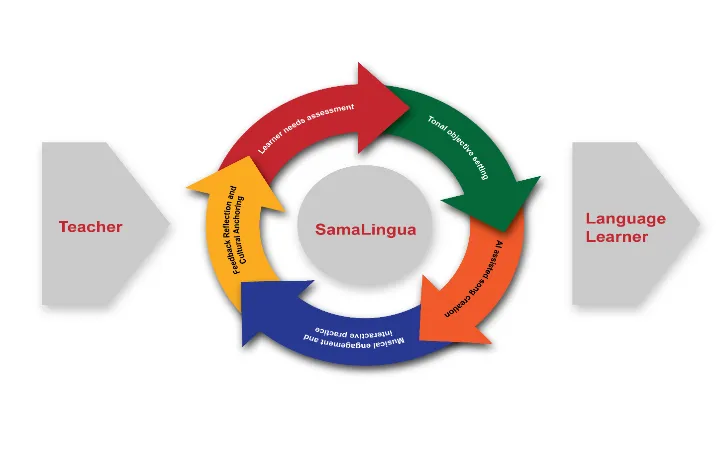
Diagram with Explanation
1. Pedagogical Flow of SamaLingua
The model follows a cyclical five-step process:
The teacher observes or evaluates learners' pronunciation challenges, emotional tone gaps, or prosodic limitations in spoken English. This could be done via informal conversations, recorded speech samples, or classroom activities.
After assessing the students, the teacher has to identify specific tonal goals such as stress-timing, rising intonation for questions, emotional inflection in speech, etc. These objectives guide the song creation wisely and are goal-oriented.
The teacher provides continuous formative feedback on accuracy and on expressive fluency to learners. Additionally, learners notice how singing English connects them to cultural nuances of sound, expression, or emotion of the language. Keeping in mind the Indian context learners can be encouraged to draw parallels with musical experiences from devotional songs, folk music, or cinematic playback singing.
This cyclical approach focuses on personalization, repetition, and empowerment of the learner without demanding expensive infrastructure or expert-level music training.
2. Technological Adaptability
SamaLingua does not require high-tech classrooms. It adapts to a range of learning settings:
· High-Tech Contexts: Teachers can use artificial intelligence-generated tools like Suno AI, Soundraw, AIVA, or Boomy to create customized English songs.
To understand this concept through a live example with demonstration here is link for a customised song generated for reducing mother tongue influence of the students from the western regions of India.
https://qr-codes.io/3XIjqS
Self generated URL
Self-generated QR Code
· Multilingual Environments: SamaLingua supports code-mixed approaches where native-language melodies are adapted for English phrases and expressions, enhancing comfort and reducing resistance among learners.
3. Inclusivity and Accessibility:
One of SamaLingua’s greatest strengths is inclusion
SamaLingua is a method that respects learners’ starting points, tracks and celebrates their continuous progress in the most foot-tapping, expressive language use.
4. Cultural Sustainability and Teacher Empowerment
Teacher keeps Vedic traditional alive emphasising the importance of ancient tonal system and making students aware of learning it through specific tunes. Artificial intelligence serves as an empowering tool in language teaching. Artificial intelligence uses tonal patterns rooted in Samved. This is how teacher feels empowered that makes the lessons more effective for the students and less tiring for the teachers.
CONCLUSION
Towards Artificial Intelligence Assisted Language Learning with the Heritage of the Indian Knowledge System.
Tone is the soul of meaning, memory, and cognition in any language. This paper explores the importance of tone through chanting in language learning. It traces the cultural and cognitive lineage of the recitations of the ancient Indian SamaVed. The researcher comes up with a blended method called SamaLingua, that combines features of SamVed and modern phonology with the use of artificial intelligence. SamaLingua consolidates that teaching languages is not only about rules and structures but also about voice, feelings, and connections. SamaLingua incorporates Howard Gardner’s theory of multiple intelligences which highlights musical intelligence as one of the foundations to language development. It uses theory by Ferreri et al. (2019) that demonstrate tonal emotion which is involved in music. Music undoubtedly boosts long-term memory of verbal content amongst learners. Such model also empowers teacher in creating resources by working with artificial intelligence in urban classroom and rural settings. The classroom becomes a concert hall with learners singing, repeating, improvising and interacting with customized melodies and advance their learning abilities. This experience is deeply directed by a teacher who is culturally strong and contemporary with the help of technological resources. With this method we can surely say that with SamaLingua, art meets technological advancement for a joyous and fruitful learning experience.
REFERENCES

Sneha Date Ranade1*, Atul Patil2, Samalingua: Samaveda Inspired, A Teacher-Guided, Artificial Intelligence-Assisted Model For Teaching Tone And Prosody Through Music In English Language Learning, Int. J. Sci. R. Tech., 2026, 3 (8), 560-569. https://doi.org/10.5281/zenodo.21945705
 10.5281/zenodo.21945705