

We use cookies to ensure our website works properly and to personalise your experience. Cookies policy
Department of Science and Humanities, EASA College of Engineering and Technology, Affliated to Anna University, Coimbatore, India
Generative Artificial Intelligence (Generative AI) has emerged as a transformative technology with the potential to redefine English Language Teaching (ELT) by enhancing instructional practices, learner engagement, and educational accessibility. Unlike conventional educational technologies, Generative AI can create original content, provide personalized learning experiences, generate instant feedback, and support teachers in curriculum planning, assessment, and instructional design. This review paper critically examines the applications, opportunities, and challenges associated with the integration of Generative AI in ELT. It synthesizes recent scholarly literature to explore how AI-powered tools facilitate the development of the four language skills—listening, speaking, reading, and writing—as well as grammar, vocabulary, pronunciation, and formative assessment. The paper further discusses the role of AI in reducing teachers' administrative workload while promoting differentiated and learner-centred instruction. At the same time, it highlights significant ethical and pedagogical concerns, including academic integrity, AI hallucinations, algorithmic bias, data privacy, copyright infringement, digital inequality, and the potential deskilling of educators. The review argues that the effective integration of Generative AI requires responsible institutional policies, continuous professional development, and AI literacy among both teachers and learners. Rather than replacing educators, Generative AI should function as a collaborative pedagogical partner that complements human expertise, creativity, critical thinking, and ethical decision-making. The paper concludes that the future of ELT lies in a balanced human–AI partnership where technology enhances, rather than substitutes, the educational process.
1.1 Digital Transformation in Education
The fast development of the digital technology has changed the practices of education all over the world, replacing classroom-based educational settings with technologically supported and learner-centered practices. Cloud computing, mobile learning, learning management systems, and artificial intelligence (AI) are some of the innovations that have allowed teachers to give students more opportunities of flexible learning and more interactive and personalized experiences 1. This process has been significantly boosted in recent years due to the popularity of online and blended learning approaches. 2AI has become one of the drivers of digital transformation through intelligent tutoring, adaptive learning, automatic grading, and data-driven instruction of numerous technological inventions of recent years, Generative Artificial Intelligence (GenAI) has received quite a lot of attention because of the opportunity of creating human-like texts, images, audio files, and other digital content. In contrast to previous generation of AI that was mostly used for analysis or performing some set tasks, GenAI is able to generate educational materials, provide instant feedback, and make learning personalized. Therefore, it is perceived as a helpful educational technology.
1.2 Emergence of ChatGPT and Large Language Models
The advent of Large Language Models (LLMs) has immensely enhanced the potential of AI in education. Using the transformer model architecture, LLMs are trained on large-scale data sets that allow them to understand context, generate language, answer queries, and carry out various linguistic operations3. The launch of ChatGPT by OpenAI in 2022 was another big achievement in educational technology which showed the potential for supporting learning through conversational AI in education.
After the success of ChatGPT, there have been some more Generative AI platforms such as Google Gemini, Anthropic Claude, and Microsoft Copilot which have further diversified the use of educational AI. They help educators and students alike in developing lesson plans, explaining ideas, summarizing readings, developing assessment tests, and language feedback. Their extensive use has inspired educators to review their teaching practices while at the same time initiating crucial conversations about the ethical use of AI, plagiarism, data privacy, and information credibility4.
1.3 Artificial Intelligence in English Language Teaching
English language teaching (ELT) has proved to be one of the most interesting domains for implementing Generative AI due to the continuous need for interaction, practice, and feedback involved in the process of language acquisition. AI-based tools help students with many aspects of language learning, such as reading, writing, speaking, listening, grammar, and vocabulary improvement.
During reading lessons, AI tools assist the learner by generating comprehension questions, summaries of texts, and definitions of unknown vocabulary items. The field of writing has especially profited from the use of AI in creating formative feedback on grammar mistakes, ideas, essay structuring, and developing academic writing skills. Speaking is also developed by means of conversational AI through dialogues and role-playing, as well as through pronunciation training; listening is improved by using audio files produced by AI.In addition, AI tools help with grammar improvement through contextual explanation and personalized grammar practice. Learners get assistance in acquiring new vocabulary through context examples, adaptive revision exercises, and semantic explanations depending on their level of knowledge. Teachers also get assistance from AI tools in preparing lessons, designing assessment tasks and rubrics, and creating instructional materials.
1.4 Purpose of the Review
Considering that the use of Generative AI in education is experiencing fast growth nowadays, there is an evident necessity to summarize the existing research related to the use of Generative AI in English Language Teaching as well as its potential and drawbacks. The present literature review intends to overview the use of Generative AI in different areas of language learning, analyze its opportunities and ethical problems, and define directions for further research.
1.5 Structure of the Paper
The rest of this paper is structured as follows. Section 2 provides an overview of the basic concepts of Generative Artificial Intelligence and Large Language Models. Section 3 describes existing uses of Generative AI in English Language Teaching. Educational opportunities of the technology are discussed in Section 4, while Section 5 analyses the challenges and ethical issues connected with the use of Generative AI in English Language Teaching. Best practices of responsible AI use in English Language Teaching are presented in Section 6, while Section 7 states directions for further research.
1.6 Review of Literature
Existing literature establishes that Generative Artificial Intelligence has developed as a important improvement in English Language Teaching, with studies analytical its solicitations in language teaching, personalized understanding, mechanized feedback, content generation, and assessment. Former research reliably reports that AI-powered tools improve learner engagement, progress language skill, and sustenance teachers in instructional planning and administrative tasks. Recent studies have also explored the amalgamation of large language models in emerging writing, speaking, reading, and vocabulary abilities. Despite these improvements, the literature recognizes tenacious concerns concerning academic reliability, algorithmic predisposition, data confidentiality, ethical AI usage, and the likely overreliance on AI-generated content. Moreover, there remains a requirement for a complete synthesis that analytically examines both the educational prospects and ethical challenges connected with Generative AI in ELT, in that way notifying its accountable and in effect integration into language education.
2. Understanding Generative Artificial Intelligence
Artificial intelligence is defined as the ability of computer software to carry out tasks that normally demand human intelligence such as reasoning, learning, problem solving, natural language processing, and decision-making. The AI software does not simply operate on pre-set instructions but is able to process data, discover patterns, and make suggestions that help humans. AI has been increasingly important in education due to its application in personalized learning, intelligent tutoring systems, automated assessment, and adaptive instructional designs5.
Machine Learning (ML) is an approach to artificial intelligence where computer software is capable of learning from the data and not being programmed for each task individually. This software gets better in its predictions by analyzing big amounts of data and discovering relations. Applications of machine learning in education include learning analytics, personalized learning materials, prediction of students at risk, and adaptive assessment systems 6.
Deep Learning (DL) is a specialized type of machine learning algorithm which uses artificial neural networks of many layers to process complex data. These algorithms are inspired by the brain structure and are able to recognize complex language and image patterns in large amounts of data. These capabilities have significantly advanced natural language processing, speech recognition, image generation, and educational technologies that require sophisticated language understanding 7.
One significant step forward in deep learning has been the advent of Large Language Models (LLMs). These models were based on the transformer model that was invented by Vaswani et al. (2017). In addition, the models can be trained using billions of words obtained from different textual sources. As a result of the intensive training process, they are able to produce relevant and human-like outputs. Thus, LLMs serve as the basis of modern Generative AI tools that are used for such purposes as writing, translating, summarizing, question answering, programming, and educational content creation8.
Among those tools, ChatGPT that has been created by the company OpenAI has become the most popular educational AI system. Presented to the public in 2022, this tool can assist the users with explanation, lesson planning, writing, feedback, quiz production, and conversation. It has helped Generative AI find its application in education and initiated the research on AI-assisted education 9.
Further advancements in Generative AI have opened new avenues in education. Google’s Gemini is one such technology that uses multimodal techniques through text, images, audio, and code. This makes the platform highly useful for varied educational purposes. Claude, an AI platform created by Anthropic, highlights its focus on safety, reliability, and reasoning. This makes Claude suitable for use in academic writing and document analysis. Microsoft’s Copilot has used Generative AI in combination with productivity applications such as Word, Excel, PowerPoint, and Teams. It makes it easy for teachers to prepare materials and analyses data using academic software. All these platforms show how rapidly Generative AI has moved forward from experimental language models to full-fledged education assistants.
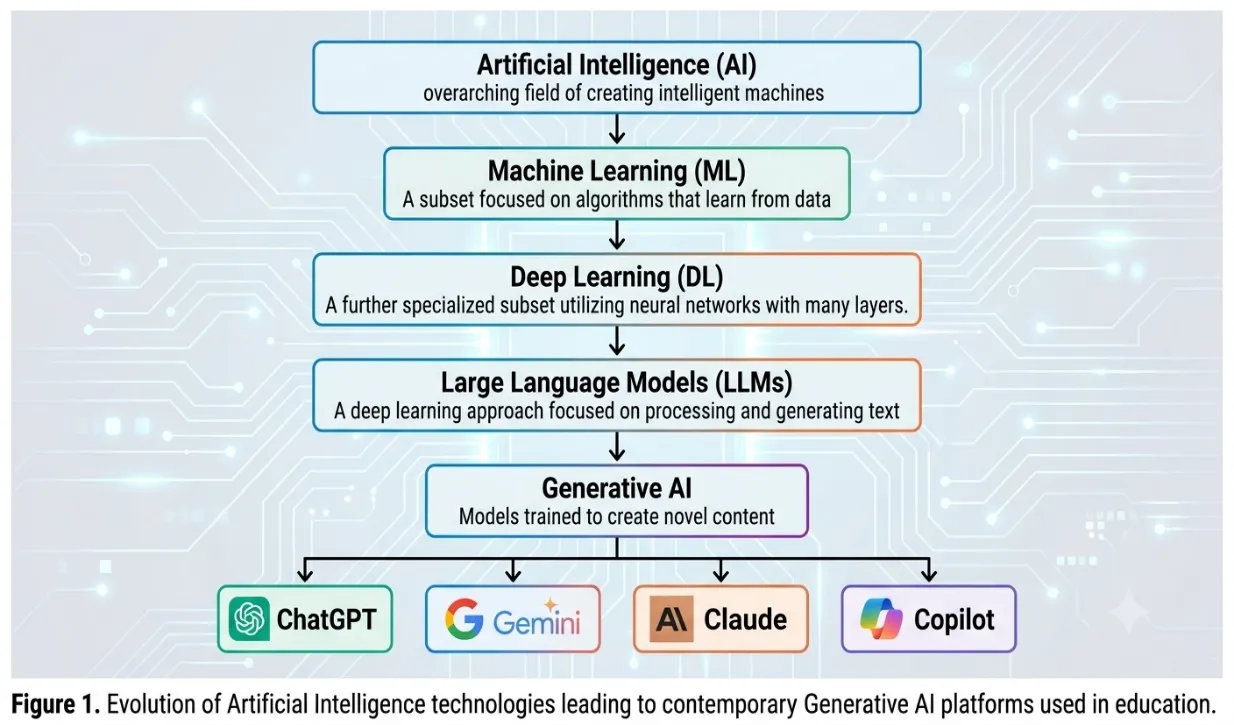
Figure 1. Evolution of AI Technologies
3. Current Applications of Generative Artificial Intelligence in English Language Teaching
3.1 Writing Instruction
Among the areas where Generative Artificial Intelligence (GenAI) has made the greatest contribution to education is writing. In conventional practice, writing instruction involves a lot of engagement on the part of teachers in idea generation, drafting, revision, editing, and individualized feedback. Nowadays, tools like ChatGPT, Gemini, Claude, and Microsoft Copilot enable teachers to facilitate these processes as AI works as an intelligent assistant to writing rather than substituting human creativity.
For instance, in the pre-writing phase, the use of AI helps learners come up with ideas, create an outline, and structure their arguments using a thesis statement. This becomes especially helpful for those students suffering from writer's block and not confident enough in their academic writing skills. At the drafting stage, students may get help with sentence structures, paragraph structuring, transitions, and coherence without taking away any responsibilities for producing the original content10.
The other popular application is grammar checking. AI technologies detect spelling mistakes, punctuation errors, incorrect verb tenses, issues with subject-verb agreements, and wrong word choice. Different from conventional grammar checkers, AI systems provide explanations of why particular corrections need to be made 12.
Paraphrasing, summarizing, citations, and formatting are some of the other advantages of AI assistance in academic writing. Students can polish their writing to make it clear, adopt an appropriate academic style, and develop a logical flow of ideas in addition to learning the writing norms of various disciplines. Moreover, AI helps provide continuous formative feedback that allows learners to revise their work multiple times before its final submission. Nevertheless, teachers stress the importance of using AI assistance only for enhancing critical thinking and creative writing skills of the learners 17.
3.2 Reading Comprehension
Generation AI improves reading comprehension through customization of instructional material in accordance with the learners' skill level and provision of instant assistance with reading comprehension process. In particular, generation AI is capable of producing reading passages, creating comprehension questions, simplifying complex text, and explaining new concepts 11.
Question generation is particularly helpful due to the fact that it promotes active reading. The technology of artificial intelligence is able to generate questions of factual, inferential, analytical, and evaluative nature in order to encourage critical thinking about the text in question. This type of adaptive questioning makes it possible for teachers to deliver differentiated instruction depending on the skills of learners, and save on preparation time.
Moreover, generative AI is able to create concise summaries of long academic texts in order to help learners to understand the major ideas of the text prior to reading the whole text. Moreover, vocabulary support includes contextual definitions, example sentences, synonyms, antonyms, and explanation of idioms used in the text. AI provides information not only about meaning of isolated words but also about their use in discourse. As a result, AI-enabled reading fosters learner independence and helps teachers to develop differentiated literacy activities.
3.3 Speaking Skills
Learning to speak may become an obstacle for English language learners due to insufficient opportunities for communication in class. Generative AI overcomes this problem by creating conversational settings in which one can train speaking skills without any fear of being evaluated. Conversational agents create realistic dialogues, role plays, interviews, discussions, and various situations in which communication takes place, thus contributing to communicative competence 11.
The AI-based programs also help improve pronunciation as they identify phonological mistakes, give suggestions on how to articulate more correctly, and demonstrate native-like pronunciation. Immediate feedback makes it possible for learners to practise at their own pace, which helps to reduce communication anxiety and build confidence.
Fluency is also developed by engaging in interactive conversations in which learners have to speak spontaneously. Instead of learning pre-written answers, learners have to communicate actively by producing language spontaneously. Such conversational experience improves both vocabulary and grammar knowledge at once. Although AI is useful for developing speaking skills, there is no way to replace teachers when it comes to pragmatic competence, intercultural communication, and real interaction 17.
3.4 Listening Skills
Similarly, improvements in Generative AI have helped listening comprehension skills thanks to the emergence of tailored audio material for students. AI creates dialogue, lessons, interviews, podcasts, and stories in line with proficiency level, learning aims, and classroom setting. Teachers are able to quickly create listening materials that relate to certain vocabulary, grammatical topics, or communicative situations without depending on commercially available material only 4.
Another innovative development in the field is interactive listening. Instead of just listening to a recording, students interact with AI through questions, comprehension checks, and clarifications. If there are any problems in understanding, AI explains what was said, repeats the information, or uses more easily comprehensible language.
In addition, with the help of multilingual AI, comparisons can be made between learners' native language and English, helping in comprehension, but gradually pushing them towards using the target language.
3.5 Vocabulary Development
The knowledge of vocabulary is essential for any language ability, and Generative AI provides very personalized methods of vocabulary acquisition. The software assesses the proficiency level, field of study, aims of study, and past mistakes of the learner and suggests appropriate vocabulary 10.
Digital flashcards created with AI include definition, pronunciation, example sentences, collocation usage, and spaced repetitions which help to remember vocabulary better. Contrary to regular memorization, AI flashcards adjust to the progress of the learner and highlight words which need to be reviewed more often.
Lastly, the context in which the vocabulary appears separates Generative AI from the usual vocabulary apps. Instead of presenting learners with lists of words, AI provides words in real contexts of conversation, story, academic reading, and everyday life situations.
3.6 Grammar Learning
From memorizing rules repetitively, grammar education has moved to interactive methods enhanced by Generative AI. In addition to identifying grammar mistakes, AI provides a deeper explanation of the linguistic concepts that make learners understand why changes should be made. Error correction encompasses the use of verb tenses, agreement in sentences, punctuation, word order, articles, and prepositions 12.
Generative AI is also used in sentence rephrasing to provide alternative phrases that are clear, coherent, and grammatically accurate. The learner compares multiple sentences and appreciates different styles that apply in academic and professional contexts. This immediate and personal feedback helps learners make corrections on their own.
3.7 Lesson Planning and Teacher Support
Apart from aiding the learner-centered functions, Generative AI is becoming common in curriculum planning and classroom management. AI quickly comes up with lesson plans consistent with learning outcomes, provides instructional materials, designs classroom activities, and provides teaching strategies appropriate for diverse learners1.
Creation of quizzes, discussion questions, rubrics, worksheets, and formative assessments has become easier for teachers with the assistance of Generative AI. The teacher is able to adapt the generated materials depending on the level of proficiency among other factors.
Through automation of routine administrative activities, Generative AI enables teachers to focus more on mentoring, interactions in class, critical thinking activities, and assistance to learners. However, educationists have continuously warned that AI-generated educational material must be thoroughly evaluated by human beings for suitability and accuracy of content 17.
|
ELT Domain |
Major AI Applications |
Educational Benefits |
|
Writing |
Essay planning, grammar correction, academic writing support, feedback |
Improved writing quality, learner autonomy |
|
Reading |
Question generation, summarisation, vocabulary explanation |
Better comprehension and critical reading |
|
Speaking |
Conversational practice, pronunciation feedback, dialogue simulation |
Increased fluency and communication confidence |
|
Listening |
AI-generated audio, adaptive listening tasks |
Enhanced listening comprehension and engagement |
|
Vocabulary |
Personalised vocabulary lists, flashcards, contextual learning |
Improved vocabulary retention and usage |
|
Grammar |
Error correction, sentence restructuring, grammar explanations |
Greater grammatical accuracy and self-correction |
|
Teacher Support |
Lesson plans, rubrics, assessments, learning resources |
Reduced workload and enhanced instructional efficiency |
Table 1. Current applications of Generative Artificial Intelligence across major domains of English Language Teaching.
4. Opportunities of Generative Artificial Intelligence in English Language Teaching
Rapid development of GenAI offers numerous opportunities for the innovation of English Language Teaching (ELT). Contrary to previous educational technologies focused on content delivery, Generative AI helps learners and educators in creating instructional content, communicating, and delivering adaptive learning experience. If used effectively, such technologies will not only increase the quality of teaching but also engage learners more, make education accessible and support rather than substitute human instructors 1,17.
One of the greatest benefits of Generative AI is its ability to create personalized learning experience. In the conventional classroom environment, it might be difficult to accommodate the diverse levels of learners' skills, ways of learning and personal educational needs. The use of AI allows analyzing learners' input and creating customized explanations, exercise tasks, texts, and writing prompts based on individual skills of the learner. Personalized learning environment allows students to study on their own pace and receive individual instruction based on their skills and needs. Moreover, personalization promotes the development of learner autonomy through possibility to repeat certain notions, to ask for additional explanations, and to learn about different aspects that interest the learners4.
Another potential opportunity for generative AI is immediate feedback, which is an integral part of language acquisition. Efficient language learning presupposes constant corrections and prompt reinforcements, yet sometimes it may be hard for teachers to provide personalized feedback to all class members due to the sheer number of people in a group. Generative AI can help overcome this problem by providing immediate feedback on grammar, vocabulary, sentence structure, pronunciation, and writing skills. Instant feedback helps learners spot mistakes, fix them, and correct their language behavior before misconceptions become entrenched. This kind of formative assessment fosters self-regulated learning and makes learners more responsible for developing their language skills 12.
Generative AI is another tool to foster higher levels of learner engagement and develop interactive, learner-centered learning environments. Conversational AI agents simulate real-life conversations and engage learners with role-playing, debates, interviews, storytelling exercises, and problem-solving tasks. What distinguishes AI from ordinary learning materials is its ability to adapt responses to learners' interactions thus keeping them motivated and interested. Gamified tasks, adaptive quizzes, and generated scenarios make language learning even more dynamic and interesting for learners 11.
It increases accessibility by offering educational aid beyond the traditional classroom environment. Students can access educational tools enhanced with AI from any place and at any time by utilizing their computers and phones. The technology allows continuous learning outside the regular classrooms and assists those who need to review lessons again. Explanations, summaries, and interactive learning aids created by AI make independent learning possible and increase the accessibility of language education for a greater number of learners 1 Another feature of AI that is linked to accessibility and makes education more accessible and inclusive is its ability to adapt to learners' needs and help learners with disabilities and diverse linguistic backgrounds participate in class activities. Classrooms nowadays contain a diverse range of students with different linguistic and educational backgrounds and preferences. The technology allows for adapting instructional materials to the reading level of students, simplifying difficult language, using multimodal explanations, and adjusting learning pace. Functions like voice recognition, text-to-speech, captioning, and multilingual translation help in making the learning process inclusive 17.
Moreover, Generative AI enhances multilingual learning, which is an essential factor in the modern culturally-diverse educational settings. Contemporary AI tools allow for translation, bilingual explanations, cross-linguistic comparisons, and code-switching where appropriate. Students can draw parallels between grammar structures, vocabulary use, and sentence patterns in English and in their native language. This increases language awareness, as well as removes cognitive barriers to second language acquisition. This kind of multilingualism is especially helpful for beginning learners and students who study English as a foreign language 10.
One more critical advantage relates to stimulating creativity in both learners and educators. The AI creates stories, dialogues, debate topics, writing prompts, project suggestions, and multimedia material that helps to enhance imagination and critical thinking. Instead of limiting one's creativity, Generative AI becomes a partner in brain storming and expanding ideas, exploring alternative viewpoints, and experimenting with different writing styles. Educators benefit from such technology, as they will be able to create innovative class activities, authentic materials for learning, and interdisciplinary projects faster than they can using traditional resource development techniques 4.
Generative AI also helps with lowering the workload of the teachers, mainly in terms of administrative and instructional work. Lesson planning, assessment creation, rubric generation, worksheet creation, quiz preparation, and initial feedback on homework can take a lot of time. AI aids teachers in automating these mundane activities and letting them focus more on mentoring, communicating in the classroom, and helping every student individually. Most importantly, AI should be considered a productivity tool that helps professionals to do their job without taking away decision-making powers from them1.
Outside of class activities, the use of Generative AI becomes ever more important when it comes to research support. Scholars and postgraduates use various AI software applications to summarize the literature, organize their thoughts for research, write academic papers, find key words, formulate research questions, and help with the proper citation format. While AI is not able to replace the researcher's judgement and critical thinking, it speeds up several stages of the research and lets them spend more time on its interpretation and evaluation 9.
In conclusion, Generative AI facilitates lifelong learning by facilitating the process of acquiring new skills outside the formal framework of education. Language acquisition is a dynamic process that does not end at any point in professional or personal life. Flexible AI-based educational platforms allow learners to engage in independent learning, professional development, and practice of their language skills regardless of their age or level of education. They can revise the content, work on communication skills, learn new special terminologies, and update their professional knowledge based on their changing career needs. Flexibility is vital for the general educational goal of creating independent learners ready to adjust to changing technological and professional contexts17.
In summary, the possibilities provided by Generative AI reveal its potential to improve English Language Teaching through individualization of learning, prompt feedback, creation of inclusive environments, and greater effectiveness of the teaching process. However, realizing this potential will be possible only with the responsible use of technology and teachers' participation in the process.
|
Opportunity |
Educational Contribution |
|
Personalized learning |
Adapts learning materials to individual proficiency and learning pace |
|
Immediate feedback |
Provides real-time correction for writing, grammar, vocabulary, and pronunciation |
|
Student engagement |
Encourages interactive, motivating, and learner-centred activities |
|
Accessibility |
Enables anytime, anywhere learning through digital platforms |
|
Inclusive education |
Supports diverse learners through adaptive and multimodal learning resources |
|
Multilingual learning |
Facilitates bilingual explanations, translation, and cross-linguistic understanding |
|
Creativity |
Generates innovative writing prompts, projects, and instructional resources |
|
Reduced teacher workload |
Automates lesson planning, assessments, and routine instructional tasks |
|
Research support |
Assists with literature review, writing organisation, and academic drafting |
|
Lifelong learning |
Promotes continuous professional development and independent learning |
Table 2. Major educational opportunities offered by Generative Artificial Intelligence in English Language Teaching.
5. Challenges and Ethical Concerns
Although there is great educational potential in AI implementation in ELT, it is important to acknowledge the difficulties this integration poses in terms of pedagogy, ethics, and institutions. Although AI contributes to efficient teaching and high motivation of the students, at the same time it poses questions about responsible application, education quality, and human role. These matters should be considered in order to make sure that AI helps, but does not harm the process of language acquisition 17,1.
The most common issue related to GenAI use in ELT is academic integrity. Due to its potential, students are able to write essays, assignments, reports with little effort, which makes it possible for them to commit plagiarism, ghostwriting, and unauthorized AI-assisted writing. As AI-generated texts are coherent and unique in wording, they cannot be recognized by standard plagiarism checking tools. Therefore, educators have to reconsider the existing approaches to assessment and focus on critical thinking, reflective writing, oral presentations, and other assignments requiring demonstration of knowledge and skills (Cotton et al., 2024, 17).
One more limitation that should be mentioned is AI hallucinations – the creation of false information by language models that is being presented by them as true one. Such hallucinations may be in the form of wrong statements of facts, fictitious citations, incorrect analysis, etc. In an educational setting, when students do not have enough background on the subjects, such hallucinations may be taken as true information. That is why, teachers and students have to evaluate the results obtained through AI technology, and check the information received from reliable academic sources 9.
Algorithmic bias is another major issue related to ethics. The thing is that LLMs are trained using a large amount of public data that includes some biases regarding culture, language, ideology, gender, etc. In this way, AI may be reproducing stereotypes or excluding some languages, cultures, and social groups. Biased responses in ELT may affect the aspects of cultural representation, literary criticism, language examples, etc. That is why developers and educators are responsible for promoting fairness, inclusivity, and criticism of the information provided by AI (Bender et al., 2021).
The rising popularity of artificial intelligence also gives rise to concerns regarding the privacy of users. The majority of AI systems need their users to enter essays, assignments, personal reflections or even institutional documents in order to analyze them. Such processes may involve collecting and storing highly sensitive and private information of individuals. Absence of clear policies about data management will allow exposing personal information of individuals without their knowledge to third parties. Institutions of education should formulate clear rules of responsible usage of artificial intelligence tools and motivate learners not to upload any sensitive information 17.
One more aspect which is very closely related to the privacy of individuals is data security. All AI systems operate using the infrastructure of the cloud that makes them very vulnerable to cyber security risks. It is important for schools and universities to comply with data protection policy of the institution in question while choosing an appropriate AI platform.
The other issue of growing concern is that of overreliance on AI. While AI can serve as a very useful source of support, its overuse may limit students' ability to think independently, solve problems, and produce language. If students depend too much on AI for idea generation, writing, or translation, they may feel less confident when generating their linguistic abilities on their own. In the same vein, overuse of the support provided by AI may demotivate students from engaging in hard work and critical thinking key elements in language learning 13.
The rapid adoption of AI creates issues of teacher deskilling. With increasing amounts of automation in lesson preparation, materials creation, feedback generation, and assessment design, teachers may eventually begin to rely on AI in making pedagogical decisions. This trend may lead to limited opportunities for exercising professional judgement, teaching creativity, and reflecting on practice 1.
Another problem is posed by the digital divide. Generative AI requires a stable connection to the Internet, proper digital tools, and digital literacy skills. Students belonging to economically disadvantaged backgrounds or residing in rural regions may lack access to such resources, thus contributing to existing inequities in education. The differences in infrastructure at institutions and teachers' digital literacy may influence the way AI is used in schools and universities as well. Thus, it is vital to ensure equitable access to technologies and provide proper digital literacy training 17.
Legal and ethical issues surrounding copyright and intellectual property protection also become relevant. AI is trained using large amounts of data, including copyrighted literary pieces, articles, photos, and other creative products. Issues of authorship, ownership, proper citation, and fair use of such material have not yet been resolved and are under discussion legally. In the educational context, students and teachers should appropriately cite the usage of AI while obeying the rules of their institution and copyright law 4.
Fourthly, there are some challenges to assessing learners in Generative AI. Traditional assessment tools such as take-home tests, written papers, and examinations become more and more prone to AI assistance, which makes it impossible to assess learners' true competences. In order to solve the problem, teachers need to reconsider traditional approaches to assessment by introducing oral examinations, project work, class presentations, reflective diaries, teamwork, and authentic assessment of higher-order thinking and language skills. It is necessary to develop new approaches to assessment as technology develops (Cotton et al., 2024).
To conclude, despite the fact that Generative AI provides many opportunities for English Language Teaching, they cannot be used properly without responsible governance, ethical considerations, and pedagogical use.
6. Best Practices for Responsible AI Use
Successful incorporation of Generative Artificial Intelligence (GenAI) in ELT requires more than the availability of technologies; it requires proper pedagogical use of them. It means that AI must be considered an aid tool that enhances teacher professionalism and learners' involvement17. Among the key best practices is the presence of human supervision. While AI can create content, provide feedback and organize educational processes almost instantly, human beings retain the responsibility of ensuring the correctness and appropriateness of all AI generated materials. Human intervention becomes absolutely crucial when dealing with complex language application, cultural issues, ethical questions, and learners' individual peculiarities 1 .
Another vital practice concerns prompt engineering. All answers from AI depend on users' prompts to a great extent, and both teachers and students need to know how to write clear and specific prompts resulting in educational benefits. Prompt literacy becomes a significant element of digital literacy in modern HEIs16. Educational establishments need to foster awareness regarding AI. Students should know about the abilities and weaknesses of Generative AI and be familiar with such problems as AI hallucination, AI bias, copyright infringement, privacy violations, and plagiarism. Various training courses and guidelines may help people utilize AI responsibly and refrain from misusing it for their academic purposes 17.
The other crucial step to consider is information verification in case of using AI-generated content. As the responses provided by AI models may sometimes be misleading, inaccurate, or made up, the students will need to confirm the data, citations, and statistics provided via reliable academic sources. Critical thinking is an important skill that cannot be substituted by modern technologies9.
Lastly, AI must be implemented using a balanced pedagogical approach. Instead of using only AI-assisted learning, the lecturers will have to apply a mixed method involving collaboration, class discussion, reflection, and the actual use of the language. The relevant policies will have to clarify the way to use AI in the teaching, learning, and assessment process in a transparent manner.
7. Future Directions
There are several prospective directions for Generative Artificial Intelligence in which further studies may develop. First, the use of AI tutors can be considered as one of them. In this case, the AI tutor will be able to observe and assess students' performance throughout the entire period of learning and provide learners with personalized instructions based on their specific learning needs. Another prospective direction may be represented by future multi-modal applications which include the integration of text, speech, images, videos, and simulations into a single learning experience. These innovations may facilitate teaching such skills as listening, speaking, pronunciation, and intercultural communication using authentic learning experiences 4.
Also, the use of AI for assessment purposes is one of the prospective directions for future studies. Intelligent assessment tools may help teachers to conduct continuous formative assessment, provide automated feedback and analyze learners' performance in order to understand their strengths and weaknesses. Nevertheless, in the future, intelligent assessments should still focus on fostering learners' critical thinking, creativity, and authentic language production.
It is also essential that research focuses on cooperation between the teacher and AI and not on considering the artificial intelligence as a replacement for the teacher. Research on the ways of how teachers incorporate AI into lesson planning, class interaction, feedback practices, and professional development would add knowledge regarding how to implement AI in education effectively 11.
Future research should focus on such factors as AI literacy, perception of learners, awareness of ethics, and readiness of institutions for adopting artificial intelligence. It is essential to conduct comparative research within different educational settings such as schools, colleges, universities, and multilingual environments to understand how artificial intelligence influences education in the long run.
CONCLUSION
Generative Artificial Intelligence is one of the most groundbreaking inventions which has changed Contemporary English Language Teaching dramatically. The capacity of Generative AI to produce educational content, to provide personalized education, to give instant feedback, and plan instruction presents great opportunities in terms of enhancing teaching efficiency and learner engagement. Different uses of AI in writing, reading, speaking, listening, grammar, vocabulary, and teacher support show that artificial intelligence has become an important educational tool as opposed to being just a technological invention. On the other hand, the usage of Generative AI raises several ethical, pedagogical, and institutional questions. The problem of academic integrity, hallucination, algorithmic bias, privacy, data protection, copyright issues, teacher deskilling, and digital divide must be addressed. To solve these problems, one needs responsible institutional policies, ongoing professional development, and AI ethics of educators and learners 17. AI should not be seen as a replacement for teachers. In order to learn language efficiently, students need interaction, critical thinking, reflection, creativity, and pedagogical expertise which are still human qualities. Thus, the best possible model of education will be that where AI assists teachers by taking care of all repetitive tasks and leaving teachers with the task of planning the curriculum, motivating learners, assessment, and making moral decisions 1 With further advancement in the technologies used in AI, there will be more positive impacts of human-AI partnership on English Language Teaching. The future of education would rely on the technology only if its use within learner-centered approaches of teaching is done judiciously.
REFERENCES

Ethina V.*, Generative Artificial Intelligence In English Language Teaching: Opportunities, Challenges, And Future Directions, Int. J. Sci. R. Tech., 2026, 3 (8), 19-30. https://doi.org/10.5281/zenodo.21739311
 10.5281/zenodo.21739311