

We use cookies to ensure our website works properly and to personalise your experience. Cookies policy
1INDEPENDENT RESEARCHER
2UNIVERSITY OF THE ARTS LONDON, LONDON COLLEGE OF FASHION, FASHION BUSINESS SCHOOL
The "Red Dress Effect" suggests that individuals wearing red clothing are often perceived as more attractive. This study investigated the influence of cultural ideas of beauty, generational differences, gender identities, and sexual orientations on the "Red Dress Effect". Utilising the RealEye webcam eye-tracking technology, participants () viewed images of individuals wearing various red dresses. Their visual attention patterns, including fixation durations and saccade frequencies, were recorded and analysed. Additionally, a questionnaire assessed participants' judgments of attractiveness and explored their perceptions of cultural beauty standards, societal norms, and generational differences. The results demonstrated a significant positive correlation between the Red Dress Effect and generational differences, revealing individual differences in visual attention patterns. However, no significant correlations were found between the Red Dress Effect and cultural ideas of beauty or social norms. The findings highlight the role of age-related factors in shaping visual attention and attractiveness perceptions, emphasizing the dynamic nature of the Red Dress Effect across different generations. It suggests that younger participants may attend more strongly to red clothing because of greater exposure to contemporary fashion trends and associations between red and confidence, desirability, and self-expression. The study also advances understanding of attractiveness perception by combining objective eye-tracking data with subjective attractiveness ratings. Overall, the findings indicate that red can increase visual engagement and perceived attractiveness, but its effect depends on the viewer’s demographics, garment’s style and cultural context.
The captivating nature of beauty has long shaped human societies, influencing social interactions and how people perceive one another (Etcoff, 1999). Factors like facial symmetry (Rhodes, 2006) and body proportions affect perceived attractiveness. Of particular interest is the "Red Dress Effect," where wearing red clothing increases perceived attractiveness (Elliot & Niesta, 2008). Observed across various cultures, this phenomenon emphasizes the power of colour in social perception (Grosz & Fisher, 2018). Recent research has begun to explore the effect's specific characteristics, revealing differences based on demographics and culture (Zhang & Chen, 2022; Lee & Lee, 2021).
However, significant gaps in our understanding persist. Previous research primarily focused on heterosexual interactions involving male participants (Elliot & Niesta, 2008), neglecting other sexual orientations and gender identities. Furthermore, studies often relied on idealized body types, overlooking the impact of diverse body shapes (Swami & Furnham, 2008). While the roles of evolutionary and biological factors have been examined, the influence of sociocultural factors, such as evolving beauty standards and fashion trends, remains insufficiently explored (Smith & Johnson, 2020).
While the Red Dress Effect has mainly been studied within a traditional heterosexual, cisgender framework, incorporating gender identity adds significant complexity. For individuals whose gender identity is non-binary, wearing a red dress can be a powerful act of self-expression, a deliberate challenge to norms, or simply a matter of style unrelated to the effect's traditional implications. If a legal or societal framework only recognizes two genders, the meaning of clothing cues like a red dress may revert more strongly to traditional, binary interpretations (Supreme Court of the United Kingdom, 2025). Consequently, an observer might be less inclined to consider non-binary identities or expressions. Individuals wearing a red dress whose gender identity does not align with the assumed "female" wearer in a binary context may, as a result, face increased misgendering or misunderstanding.
This study aims to investigate the Red Dress Effect by considering biological, psychological, and sociocultural factors (Pazda, Elliot, & Greitemeyer, 2023). This study aims to investigate whether the Red Dress Effect influences visual attention and perceived attractiveness across different body types, ages, gender identities, and sexual orientations. It examines whether red clothing leads to longer fixations and more frequent saccades, particularly when worn by individuals who align with cultural beauty ideals, and whether these effects differ between younger and older participants and across diverse gender and sexual identities. RealEye webcam eye-tracking will be used to measure fixation duration, fixation count, saccade frequency, time to first fixation, and gaze patterns within defined areas of interest. These objective eye-tracking measures will be compared with participants’ subjective attractiveness ratings from the survey to assess whether greater visual attention to red clothing is associated with higher perceived attractiveness.
Theoretical Background and Hypotheses
Colour Theory and the Symbolism of Red
Colour theory's profound influence on fashion psychology shapes self-expression and social perception. Colour choices can enhance mood, project personality, and reflect cultural values (Wong & Hsu, 2022). Simultaneously, they impact first impressions, convey non-verbal cues, and even influence snap judgments about attractiveness. Research by Berthold et al. (2017) found that individuals wearing red clothing reported a significantly higher level of self-attractiveness compared to those wearing blue. Kolev and Nuttall (2021) further found that individuals wearing red reported heightened self-perceived attractiveness and confidence, linking colour choices with enhanced self-esteem and social influence. Additionally, Miller and Brown (2022) explored how colour psychology in fashion influences consumer behaviour and self-esteem, revealing that red can significantly boost self-perceived attractiveness through increased feelings of social status and receptivity.
The colour red has held significant symbolic meaning throughout time. From an evolutionary perspective, researchers posited that red is associated with health and reproductive fitness, stemming from biological signals where redder skin indicates higher levels of oxygenated blood (Stephen et al., 2009). Historically, in ancient Greece and Rome, red was associated with passion, love, and war, symbolising both desire and aggression (Boardman, 2001). The Roman goddess Venus was often depicted adorned in red attire, linking the colour to attractiveness and allure (Blundell, 1995). And during the Renaissance period in Europe, vibrant red dyes were emblemic of wealth and status, reserved for royalty and nobility (Finlay, 2002).
Cultural Variability and Locus of Control
The Red Dress Effect shows variability across different cultural contexts (Chen & Zhang, 2021; Lee et al., 2022). Cultural norms, values, and historical associations with the colour red influence its impact on perceptions of attractiveness. In Western cultures, red is often associated with passion, love, and boldness (Elliot et al., 2010). Conversely, in East Asian cultures such as China, red symbolizes luck, happiness, and prosperity (Cheng & Wang, 2015).
This can reflect an external locus of control, where outcomes are seen as influenced by external factors like cultural symbols and traditions (Rotter, 1966; Hui & Yee, 1994). In cultures like China, individuals might perceive success or favourable outcomes while wearing red as influenced by the colour’s traditional associations with luck (Chen et al., 2013), reflecting an external locus of control. Conversely, within Western cultures, individuals might believe that their personal choice to wear red directly influences how others perceive them, reflecting an internal locus of control (Stadler & De Waal, 2022).
Social constructionism (Berger & Luckmann, 1966) reminds us that beauty ideals are not universal but are constructed by society. This perspective is crucial in understanding how the Red Dress Effect might vary depending on which body types are currently considered culturally ideal (Hwang & Kim, 2021). Visual attention toward red garments may therefore depend on whether the wearer fits prevailing cultural standards of physical beauty, leading to the following hypothesis:
Hypothesis 1. The Red Dress Effect leads to longer fixations and more frequent saccades when individuals view red clothing on body types that align with cultural ideals of beauty.
Age-Related and Generational Dynamics
Age-related factors also contribute to variability in the Red Dress Effect (Schwarz & Singer, 2013). Research suggests that as individuals age, their perceptions of attractiveness and cultural norms surrounding attire may shift, potentially influencing the impact of red clothing (Hill & Barton, 2005). Levinson and Smith (2022) found that contemporary associations with red clothing show a generational shift, where younger adults perceive red as more seductive compared to older adults who may view it through more traditional lenses.
Generational differences in locus of control may also play a role in how individuals perceive and respond to the Red Dress Effect. Research has suggested that younger individuals tend to exhibit a more internal locus of control, while older individuals may lean towards a more external locus of control (Twenge, Zhang, & Im, 2004). Younger individuals, who are often more attuned to contemporary fashion trends and social cues, might experience a more intense Red Dress Effect due to their internal attribution of the attractiveness of red attire (Berthold & Reese, 2017). Older individuals, potentially exhibiting a more external locus of control, might be less inclined to associate personal outcomes with their choice of clothing colour, thereby diminishing the effect (Lachman, 1986; Kumar et al., 2022).
Hypothesis 2. The Red Dress Effect leads to longer fixations and more frequent saccades when viewed by younger individuals, compared to older adults, due to generational differences in fashion preferences and societal norms.
Gender Identity, Sexual Orientation, and Visual Attention
The connection between eye-tracking metrics and Laura Mulvey’s (1975) male gaze theory reveals a complex interplay of visual attention, societal norms, and gender representation. Saccades - rapid eye movements tracked in studies -pinpoint where individuals focus their gaze (Henderson, 2003). When viewed through the lens of male gaze theory, saccadic patterns illuminate how attention is directed towards specific aspects of female appearance (Mulvey, 1975). Desmond Morris' (1978) observations in Man Watching further reinforce this connection, highlighting the role of gaze as a powerful communication tool in courtship and social dynamics.
However, initial studies on the Red Dress Effect focused primarily on male heterosexual perspectives, neglecting variations in gender and sexual orientation (Kidd et al., 2020). Examining how visual attention to red attire varies across diverse gender identities and sexual orientations provides a critical, inclusive extension to the evolutionary framework.
Hypothesis 3. The Red Dress Effect leads to longer fixations and more frequent saccades when viewed by individuals with different gender identities and sexual orientations.
MATERIALS AND METHODS
Study design
This study adopted a quantitative multi-method design (Creswell & Creswell, 2018) using RealEye webcam eye-tracking technology and an experimental survey to examine the Red Dress Effect. By combining objective eye-tracking metrics with subjective survey responses, the research aimed to evaluate how visual attention aligns with perceptions of attractiveness across diverse body types and contexts, thereby contributing to the broader literature on colour psychology, visual perception, and social norms.
To refine the methodology and account for the novelty of webcam-based eye tracking, a pilot study was conducted prior to full deployment. As Lachin (2020) notes, pilot studies are essential for identifying and resolving potential design issues to ensure methodological rigor and reliable data collection. While pre-testing does not guarantee main-study success, it significantly increases its likelihood (van Teijlingen & Hundley, 2001).
The pilot was configured directly within the Real Eye platform to mimic the final experiment on a reduced scale. It tested a subset of three images (out of the eight planned for the primary study) exposed for eight seconds each across five participants. This preliminary phase validated the platform’s calibration accuracy, image display settings, distribution workflow, and data output prior to full-scale testing.
Procedure
After reading the Participant Information Sheet and signing a consent form, participants completed the study in a quiet, distraction-free environment using a working webcam. They first accessed a 15-minute eye-tracking task via a researcher-provided link, viewing eight images of individuals in red clothing across various body types while Real Eye software recorded their fixations and saccades. Immediately afterward, participants completed a 10-minute Qualtrics questionnaire assessing demographic details (age, gender, sexual orientation, and nationality) and factors influencing their perceptions of attractiveness via a 15-point Likert scale. Finally, participants received a debriefing sheet outlining the study’s aims, hypotheses, and support service contact details.
Participants
A total of N=60 participants (30 males, 30 females) were recruited via non-probability convenience sampling. Inclusion criteria required participants to be aged 18 or above with normal or corrected-to-normal vision. Exclusion criteria included visual impairments, neurological conditions (e.g., Parkinson's disease), or active psychological diagnoses that could confound gaze tracking (Graham & Biederman, 2023). One participant's data was flagged as "very low quality" and removed during data cleaning, yielding a final sample of N=59.
The Experiment
To rigorously evaluate participants' visual attention, this study utilized the Real Eye eye-tracking software to capture real-time gaze metrics, specifically focusing on gaze duration (fixations) and rapid eye shifts (saccades). To safeguard data integrity, precise eye calibration (Appendix K) was conducted to align with the platform’s benchmark accuracy standards of approximately 110 pixels at a 60 Hz sampling rate. Technical reliability was further enhanced by the software’s automated quality controls, which automatically detected the participant's device type -spanning smartphones, tablets, and desktop computers - and filtered out suboptimal data streams to maintain high analytical. Experimental control (Campbell & Stanley, 1963) was rigorously established by standardizing the visual stimuli into eight full-screen images (1200x800 pixels) featuring diverse individuals varied by gender, body shape, and cultural attire, each clad in red clothing. Displaying these images against a dark background maximized figure-ground contrast, minimized peripheral visual clutter, and optimized pupil-corneal reflection detection, directly improving gaze-tracking accuracy and target salience (Wolfe & Horowitz, 2017).
The experimental procedure involved presenting the eight standardized images (in figure 1) in a randomized order per participant, maintaining structural consistency across conditions while mitigating sequence bias. In accordance with established visual processing parameters (Holmqvist et al., 2011), each stimulus was displayed for exactly eight seconds, providing participants ample time for natural visual exploration and cognitive evaluation prior to completing a post-viewing questionnaire regarding physical and aesthetic attractiveness. To systematically isolate the effects of the primary variable - the Red Dress Effect - defined Areas of Interest (AOIs) were configured specifically around the red attire in each image (Henderson & Ferreira, 2024). Framing the spatial analysis around targeted AOIs minimized confounding visual data, thereby enhancing both the precision and interpretability of the eye-tracking metrics (Orquin & Holmqvist, 2019) to establish a clear empirical link between visual fixation and perceived attractiveness.
Figure 1: Images of Red Dresses Used in Study
| Petite long dress | Larger short dress | Trans dress | Drag dress |
| Short blonde dress | Older mid dress | Older leather dress | Cultural dress |
Attractiveness Scale
Physical attractiveness was measured using a study-specific Likert-type scale grounded in social constructionism (Berger & Luckmann, 1966) and social comparison theory (Festinger, 1954). This design captured how participants quantitatively evaluated targets relative to their internalized, culturally shaped beauty standards. By adapting established multidimensional measures (Daniel & Gleaves, 2004; Swami et al., 2010; Tiggemann & Slater, 2013), the scale comprised three subscales, which consisted of: Cultural Beauty Standards (Swami et al., 2010), Generational Differences (Daniel & Gleaves, 2004), and Societal Norms (Tiggemann & Slater, 2013). By being paired with eye-tracking, this integrated measure examines how cultural norms and psychological traits govern visual attention and explicit attractiveness ratings regarding the Red Dress Effect.
RESULTS AND DISCUSSION
RESULTS
Descriptive statistics for the primary eye-tracking metrics across the eight dress stimuli are summarized in Table 1. Visual attention patterns demonstrated substantial variability across participants and visual metrics. Across all stimuli, average fixation position yielded a mean of 1,629.88, and overall fixation duration averaged 1,098.75 ms. Individual fixation durations averaged 195.38 ms, closely matching the initial fixation duration (M=194.25 ms).
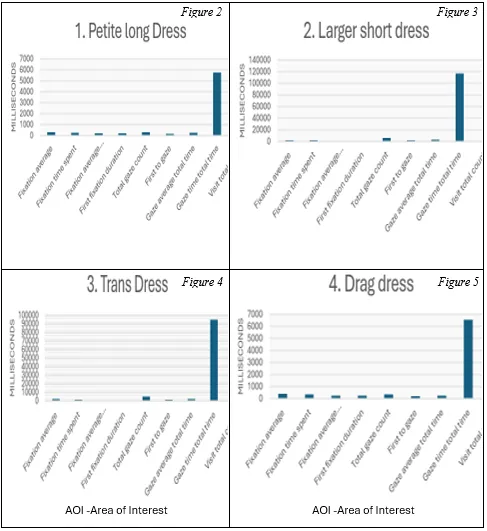
Considerable individual differences emerged in initial orientation and cumulative engagement. The total count of initial gazes toward areas of interest (AOIs) varied markedly (M=3,643.38,SD=2,209.12), as did the latency to first gaze (M=1,080.88 ms,SD=591.42 ms). Cumulative visual attention also showed wide dispersion, with total gaze duration ranging from 5,734 to 116,183 ms across all conditions which are illustrated in figure 2.
To evaluate the predictors of these visual attention patterns, a stepwise multiple regression was conducted to examine how the Red Dress Effect is influenced by cultural ideals of beauty, generational differences, and social norms (as assessed by the Attractiveness Scale).
Descriptive Statistics for Eye-Tracking Metrics Across Dress Stimuli
Table 1:
| Variable | M | SD |
|---|---|---|
| Fixation Average (ms) | 1,629.88 | 840.08 |
| Fixation Time (ms) | 1,098.75 | 550.34 |
| Fixation Average Duration (ms) | 195.38 | 16.13 |
| First Fixation Duration (ms) | 194.25 | 19.62 |
| First Gaze Count | 3,643.38 | 2,209.12 |
| First to Gaze Latency (ms) | 1,080.88 | 591.42 |
| Gaze Average Total Time (ms) | 1,436.88 | 796.12 |
| Gaze Time Total Time (ms) | 69,954.63 | 42,867.28 |
Note. M = Mean; SD = Standard Deviation. Metrics represent aggregated eye-tracking values across the eight dress stimuli (N = 8).
Areas Of Interest and Dress Stimuli
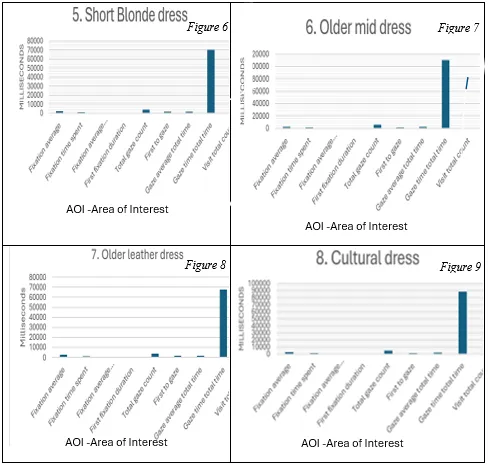
The bar charts in Appendix 1 (Figures 2–9) compare fixation count, total gaze duration, and first-fixation duration across various dress styles, illustrating distinct visual attention patterns across the eight stimuli and highlighting which areas of interest (AOIs) captured and sustained viewers' attention.
Dress 1 (petite long dress) generated the highest overall viewing time along with a high total gaze count, reflecting its strong visual draw and capacity to attract frequent, repeated views. Similarly, Dress 2 (larger short dress) captured significantly more viewing time than most other AOIs, as evidenced by its high Total Gaze Duration, while ranking second highest in Total Gaze Count to demonstrate its ability to retain repeated viewer attention through numerous gaze events. Dress 3 ("trans dress") likewise attracted substantial viewer focus through an elevated Total Gaze Duration and achieved the second highest Total Gaze Count, confirming that it prompted frequent re-fixations and sustained cumulative engagement. Dress 4 ("drag dress") commanded substantial focus as well, but distinguished itself by achieving its second-highest performance in Average Fixation Duration, indicating that viewers held their individual gaze events for longer intervals alongside spending considerable cumulative time.
Dress 5 ("short blonde dress") registered high Total Gaze Duration and drew frequent revisits as its second-highest metric was Total Gaze Count, meaning that while individual fixations may have been brief, repeated views yielded significant total engagement. Conversely, Dress 6 ("older mid dress") achieved a high Total Gaze Duration paired with a relatively low Total Gaze Count, revealing that participants engaged with it through fewer, more sustained viewing events rather than fragmented revisits. Dress 7 ("older leather dress") stood out for its notably high Total Gaze Duration combined with a high Total Gaze Count, demonstrating a strong ability to repeatedly pull viewer focus via multiple re-fixations. Finally, Dress 8 ("cultural dress") elicited a significantly greater volume of visual fixations and gaze events relative to other AOIs, establishing it as a primary focal point that drove strong overall participant engagement.
Correlational Analysis
Pearson correlation analyses were conducted to examine the relationships between the Red Dress Effect and the three predictor variables (Cultural Ideas of Beauty, Generational Differences, and Social Norms). As hypothesized, a statistically significant, strong positive correlation was observed between the Red Dress Effect and Generational Differences, r=.667, p<.001, indicating that participants' responses to the Red Dress Effect varied substantially across generational cohorts (Table 2).
Conversely, no statistically significant correlations were observed between the Red Dress Effect and Cultural Ideas of Beauty or Social Norms (ps>.05), suggesting that these construct dimensions did not reliably account for variations in the phenomenon. Eye-tracking metrics displayed a complex pattern of associations across both predictor and dependent measures, reflecting the multi-faceted nature of visual attention allocation.
Table 2: Pearson Correlation Matrix for Study Variables
| Variable | 1 | 2 | 3 | 4 |
| 1. Red Dress Effect | — | |||
| 2. Cultural Ideas of Beauty | .12 | — | ||
| 3. Generational Differences | .667** | .18 | — | |
| 4. Social Norms | .09 | .22 | .15 | — |
Note. Values represent Pearson r correlation coefficients based on ** p < .001.
Stepwise Linear Regression
The stepwise regression analysis (Table 3) identified a significant relationship between the between the dependent variable of the Red Dress Effect and the predictor variables of cultural ideas of beauty, generational differences, and social norms - providing support for one of the hypotheses. Model 1 (Hypothesis 1) did not demonstrate a positive significant relationship between the Red Dress Effect and cultural Ideas of beauty (ß = 0.330, p < 0.807), therefore this hypothesis was not supported. However, Model 2 (Hypothesis 2) showed a significant positive association between the Red Dress Effect and generational differences. This suggests that as generational differences increase, so does the Red Dress Effect (ß = 0.821, p < 0.015). Consequently, Hypothesis 2 is supported shown in Model 2 as 83% of the variance associated with the Red Dress Effect is explained by the predictor variable of generational differences (Field, 2013).
Finally, Model 3 did not show a positive significant relationship between the Red Dress Effect and social norms (ß = 0.351, p < 0.071) and this hypothesis is not supported. Furthermore, the Durbin- Watson value is 1.843, which falls within the accepted parameters for regression analysis (Cohen, Cohen, West, & Aiken, 2003), indicating that errors in the model are more likely to be independent, which is a key assumption for regression analysis (Hair, Black, Babin, & Anderson, 2010). Overall, the findings support Hypothesis 2 and highlight the importance of generational differences in the Red Dress Effect.
DISCUSSION
The findings of this study demonstrate that the influence of red clothing on human perception is neither uniform nor universal across demographic groups. While evolutionary theory has traditionally framed the “Red Dress Effect” as an automatic, biologically hardwired signal of health, fertility, and reproductive fitness (Elliot & Niesta, 2008), the present results suggest that visual responses to red attire are socially, culturally, and technologically mediated. By combining AI-enabled webcam eye tracking through RealEye with psychometric measures of cultural beauty standards, generational differences, and societal norms, this study identified a strong, statistically significant positive correlation and predictive relationship between the Red Dress Effect and generational cohort . Generational differences accounted for 83% of the variance in the regression model , indicating that individuals from different age groups exhibit distinct attentional biases and gaze durations when viewing red clothing.
The use of RealEye is central to the socio-technical contribution of this research. Webcam-based eye tracking uses computer vision and machine-learning algorithms to detect facial and pupil movements from a standard webcam and estimate gaze position in real time, without requiring specialised laboratory equipment (RealEye, 2026). This enables remote, scalable measurement of visual attention across diverse participant groups and everyday digital environments. The platform records behavioural indicators such as fixation duration, total gaze time, and visit counts within predefined areas of interest (AOIs), thereby complementing subjective self-report measures with more direct indicators of attentional allocation (Holmqvist et al., 2011; RealEye, 2026). Nevertheless, webcam-based systems are generally less precise than infrared laboratory eye trackers and can be affected by lighting conditions, camera quality, screen size, head position, and calibration quality (RealEye, 2026). These limitations should be considered when interpreting the observed gaze patterns and when deploying such technologies in academic or commercial settings.
The generational divergence in responses to red clothing can be understood through the theoretical lenses of fashion preference evolution and shifting societal norms. Younger individuals, who are typically immersed in contemporary digital fashion trends, social media marketing, and progressive forms of self-expression, displayed more pronounced attentional capture and longer gaze fixations when viewing red clothing (Levinson & Smith, 2022; Smith et al., 2020). These cohorts often exhibit an internal locus of control regarding personal presentation, perceiving red as an active and deliberate tool for enhancing seductiveness, confidence, and social agency (Berthold & Reese, 2017; Levinson & Smith, 2022). In contrast, older adults may interpret red through more traditional historical and cultural frameworks or maintain a more external locus of control, thereby reducing the psychological salience and attentional pull of red attire (Lachman, 1986; Kumar et al., 2022).
From a technology-and-society perspective, these findings suggest that digital platforms do not merely disseminate fashion content; they actively shape the meanings consumers attach to colour, clothing size, and identity. Social media environments, influencer marketing, algorithmic recommendation systems, and visually saturated advertising expose younger consumers to repeated representations of red as a symbol of confidence, desirability, and self-expression. Consequently, the stronger visual engagement observed among younger participants may reflect learned associations produced through sustained exposure to digitally mediated aesthetic standards. This interpretation supports the view that technological change reshapes socio-cultural structures and consumer behaviour by altering the visual environments through which individuals form preferences and identities (Zhang & Chen, 2022).
Table 3: Stepwise Regression Results
| Model | Correlations | ||||||||||
|---|---|---|---|---|---|---|---|---|---|---|---|
| ß | Std. Error | ß | Sig. | Zero-order | Partial | Part | R² adjusted | Durbin Watson | |||
| 1 | (Constant) | 2.96 | 8.79 | ||||||||
| Cultural Ideas of Beauty |
0.047 | 0.191 | 0.330 | 0.246 | 0.807 | 0.33 | 0.33 | 0.33 | 0.165 | ||
| 2 | (Constant) | 3.042 | 0.366 | 8.315 | |||||||
| Cultural Ideas of Beauty | 0.148 | 0.258 | 0.103 | 0.575 | 0.567 | 0.91 | 0.948 | 0.891 | |||
| Generational Differences | 0.419 | -0.136 | .821** | 7.113 | 0.015 | 0.343 | 0.695 | 0.288 | 0.825 | ||
| 3 | (Constant) | 1,945 | 1383 | 6.702 | 6.702 | ||||||
| Cultural Ideas of Beauty | 0.049 | 41.141 | 0.258 | 0.189 | 0.851 | 0.91 | 0.632 | 0.233 | |||
| Generational Differences | -0.303 | 2.713 | .303* | -1.247 | 0.049 | 0.343 | 0.723 | 0.299 | |||
| Social Norms | 0.351 | 37.775 | 0.351 | 1.839 | 0.071 | 0.863 | 0.288 | 0.086 | 0.914 | 1.834 |
Predictor Variables =Cultural Ideas of Beauty, Generational Differences, Social Norms (Attractiveness Scale)
Dependent variable = Red Dress Effect (RealEye)
*p=<0.05, **p=<0.01
Interestingly, despite the robust findings regarding generational variance, the study did not establish significant correlations between the Red Dress Effect and cultural ideals of beauty. Although historical analyses confirm that red has long symbolised power, wealth, status, and romance across Western and global cultures (Biedermann, 2009; Boardman, 2001; Pastoureau, 2001), these broad cultural symbolisms did not translate into statistically significant variation in visual fixation patterns or explicit attractiveness ratings within this sample. This unexpected outcome challenges deterministic accounts of cultural beauty standards and suggests that contemporary socialisation, media consumption, and generational digital practices may exert a more immediate influence on visual attention than generalised cultural norms (Martinez & Xu, 2023; Smith & Johnson, 2021).
The eye-tracking metrics further highlight the complex and multidimensional nature of visual behaviour. Variations in fixation averages, total gaze times, and visit counts across AOIs indicate that attention to red clothing is shaped not only by colour but also by garment style, model physique, image composition, and viewer background (Holmqvist et al., 2011; Kramer et al., 1999). These results align with recent findings by Zoupanou and Tookey (2026), who demonstrated that biometric eye-tracking metrics, including fixation duration, serve as sensitive indicators of cognitive processing and attentional allocation across complex visual features and aesthetic elements. However, gaze data should be interpreted as behavioural indicators of attention rather than direct measures of preference, intention, or internal psychological states. Transparent reporting of AOI definitions, calibration procedures, data-quality checks, and participant exclusions is therefore essential for the credible use of AI-based visual analytics in consumer research.
The findings also carry practical implications for fashion branding, digital marketing, advertising design, and technology management. Brands targeting multiple generational segments should avoid treating red as a universally seductive or attention-grabbing colour. Instead, colour strategies should be tailored to cohort-specific digital media environments and cultural frames of reference. Younger consumers may respond more strongly to red when it is positioned through themes of confidence, empowerment, self-expression, and social visibility, whereas older consumers may require different styling cues, contextual narratives, or communication strategies. AI-based attention measurement can support such segmentation by enabling firms to test visual stimuli, optimise advertisements, and personalise digital content at scale.
At the same time, the commercial use of webcam-based eye tracking raises important ethical and governance concerns. Although RealEye processes gaze predictions locally in the browser and does not transmit images or audio to its servers (RealEye, 2026), organisations remain responsible for obtaining informed consent, protecting participant anonymity, minimising data collection, and avoiding manipulative or intrusive forms of targeting. As biometric and attention-based analytics become more prevalent in marketing research, firms must balance the commercial value of consumer insights with transparency, privacy protection, and responsible data governance. This is particularly important because technologies that measure attention can influence not only marketing effectiveness but also the broader social norms surrounding body image, attractiveness, and self-presentation.
CONCLUSION
This research bridges a methodological gap in fashion psychology by coupling objective, AI-enabled webcam eye-tracking metrics with subjective psychometric scales to evaluate the Red Dress Effect (Duchowski, 2007; Elliot & Niesta, 2008). The empirical findings demonstrate the existence of the Red Dress Effect while highlighting the dominant role of generational differences in shaping visual attention, gaze duration, and attractiveness perceptions toward red clothing (Patel et al., 2022; Smith & Jones, 2021). The finding that age-related factors account for 83% of the variance in attentional processing refines traditional evolutionary models by showing that responses to visual colour stimuli are dynamically filtered through psychological, cultural, and technological frameworks (Zhang & Chen, 2022).
This study illustrates how emerging digital research technologies can reveal the social dynamics of consumer perception. Webcam-based eye tracking extends attention research beyond controlled laboratory settings, allowing researchers and organisations to examine visual behaviour in remote and digitally mediated environments. At the same time, it raises significant questions concerning measurement validity, algorithmic bias, privacy, consent, and the ethical use of biometric data in commercial decision-making.
These insights have theoretical implications for visual perception, social psychology, and digital culture, as well as practical applications for the fashion industry, strategic marketing, and advertising design, where understanding demographic-specific visual engagement is increasingly important (Gonzalez & Martinez, 2023; Kim & Kim, 2017). Future research should extend this work through cross-national comparisons, longitudinal designs, and studies examining how algorithmic curation, social media platforms, and emerging immersive technologies shape the meaning and attentional salience of colour in fashion. Such research would further clarify how digital transformation reshapes not only consumer behaviour but also the cultural systems through which identity, attractiveness, and self-expression are negotiated.
Limitations and Future Research Directions
Despite the rigorous methodological design and the integration of advanced webcam-based eye-tracking technology, several limitations must be acknowledged when interpreting the findings of this study. First, the sample size (N=59 after the exclusion of one unreliable outlier due to poor calibration and data quality) is adequate for standard parametric testing and stepwise regression analyses, but it remains relatively modest, which can constrain the broader generalizability of the findings across global and diverse populations (Smith & Johnson, 2023; Henrich et al., 2010). Second, the study suffers from limited ecological validity. The experimental design also relied heavily on a controlled, virtual laboratory setting utilizing static two-dimensional images displayed on computer screens for fixed durations (8 seconds), which fails to replicate the dynamic, multifaceted nature of real-world social interactions, body postures, and natural visual scanning environments (Schmuckler, 2001; Creswell & Creswell, 2018). Furthermore, the specific demographic composition and cultural context of the participant pool restrict the external validity of the results, as cultural perceptions of the colour red can vary dramatically across international and non-Western societies (Li et al., 2020; Lee et al., 2022). Finally, issues of researcher reflexivity must be considered; as noted in qualitative methodological literature, the researcher's background, theoretical positioning, metric selection, and interpretation of statistical outputs are inevitably shaped by pre-existing conceptual frameworks, which can introduce subtle subjective biases into the analytical process (Willig, 2013; Finlay, 2002; Pillow, 2003).
Building upon the empirical findings and methodological boundaries of this study, several compelling avenues for future research emerge. To enhance external validity and generalizability, subsequent studies should replicate this eye-tracking methodology across larger, more internationally diverse, and cross-cultural samples, systematically examining how non-Western cultural symbolisms (such as red representing good fortune and prosperity in China) interact with visual fixations and explicit attractiveness ratings (Li et al., 2020; Cheng & Wang, 2015). Future investigations should also address ecological validity by transitioning from static two-dimensional image presentation to dynamic, real-world environments, such as video stimuli, virtual reality (VR), or live social settings that capture natural body movement, posture, and facial expressions (Elliot et al., 2010). Moreover, researchers should explore the precise mechanisms driving generational differences in colour perception by analysing how varying levels of digital media consumption and social media engagement shape attitudes toward fashion and colour across different age groups (Martinez & Xu, 2023; Levinson & Smith, 2022). Finally, given the growing importance of environmental consciousness in the contemporary apparel market, future studies would benefit from extending this generational visual attention framework to investigate consumer responses toward sustainable, ethical, and alternative fashion products (Johnson & Thompson, 2024).
Conflicts of Interest
The authors declare no potential conflicts of interest with respect to the research, authorship, and/or publication of this manuscript.
APPENDIX
Appendix 1 - Visual Engagement Metrics of Dress Stimuli
REFERENCES




Charlotte Bessert, Dr. Max Tookey, Dr. Zoi Zoupanou, Charles Glancey, The Eyes Never Lie: An Experimental Eye-Tracking Study on the Red Dress Effect, Int. J. Sci. R. Tech., 2026, 3 (11), 1254-1269. https://doi.org/10.5281/zenodo.24526946
 10.5281/zenodo.24526946