

We use cookies to ensure our website works properly and to personalise your experience. Cookies policy
R.G Sapkal College of Pharmacy, Sapkal Knowledge Hub, Kalyani Hills, Anjaneri, Trimbakeshwar Rd, Nashik, 422213, Maharashtra, India.
The Present study focuses on the systematical method development and validation of quantitative determination by using analytical methods for Metoprolol Succinate and Azelnidipine by Quality by Design (QbD) approach. The study is simple, sensitive and highly accurate Ultraviolet Spectrophotometric method and High-Performance Liquid Chromatography method has been studies as well as validated for determination of Metoprolol succinate and Azelnidipine in bulk and pharmaceutical dosage form. Both the drugs are anti-hypertensive medications. Metoprolol is cardio-selective ?1 adrenergic receptor blockers and Azelnidipine a calcium channel blocker. The present analytical method was developed on Shimadzu HPLC LC-2010. The HPLC chromatography was performed using a technique like Reversed Phase C18 column with mobile phase based are dependent on the polarity of the molecules. The overall study outlines the RP-HPLC determination of metoprolol succinate and azelnidipine. The calibration curves demonstrate the excellent result of linearity about the selected concentration ranges, with correlation coefficient values. Accuracy studies showed satisfactory percentage recovery within acceptable limits as well as precision study involve low Relative-Standard Deviation values, that confirm the quantification of the method. The developed method provided well-resolved peaks of Metoprolol Succinate and Azelnidipine. The validated QbD based and RP-High Performance Liquid Chromatography method are successfully applied for the quantitative estimation of Metoprolol Succinate and Azelnidipine in pharmaceutical dosage forms.
Metoprolol succinate belongs to the class of selective βâ‚-adrenergic receptor blocker antagonist that is commonly prescribed for treatment of hypertension, angina pectoris, heart failure, and other cardiovascular disorders [9]. Due to its extensive use in pharmaceutical formulations, accurate and reliable analytical methods are essential to ensure drug quality, safety, and efficacy. The development and rigorous validation of analytical procedures are essential for the accurate quantitative determination of Metoprolol succinate in bulk drugs substance and finished dosage forms. Validated methods, following ICH guidelines,
Ensure precision, accuracy, reproducibility, and regulatory compliance in routine quality control analysis [3]. Analytical method development is a carefully planned, stepwise process aimed at establishing suitable, dependable, and precise procedures for the identification and quantification of pharmaceutical compounds. council of harmonization guidelines, ensures reliability. RP-HPLC method are used in pharmaceutical analysis because of their simplicity, rapid analysis, and minimal sample preparation [2, 13]. These methods are well-suited to routine quality control settings where high sensitivity and complex instrumentation are not required. However, method may face limitations in selectivity, particularly when excipients or other drugs are there in the formulation. High performance liquid chromatography has emerged as powerful and widely accepted analytical method that offers high sensitivity, specificity, and reproducibility [6]. RP-HPLC methods are particularly preferred for analysis of Metoprolol succinate, as they facilitate effective separation of the active drug from impurities, degradation products, and formulation excipients [10]. The development and validating HPLC methods carried out in conformity with ICH guidelines, ensure reliable, accurate, and reproducible results that are essential for routine quality control, stability studies, and regulatory compliance [8].
Method validation is carried out to ensure that a laboratory or analytical methods is for its required purpose and consistently produces reliable, accurate, and reproducible results. The objective is to provide evidence of documents that the method performs effectively under specified conditions and meets the defined requirements for it required use, whether in research, clinical, industrial setting.
Components of method validation include:
The main objectives of this work are given as follows:
a. To develop easy, fast and sensitive method for identification of critical attributes by QbD approach of this antiretroviral drug by RP-HPLC.
b. To establish a validated test method in compliance with ICH guidelines for the quantitative assay determination of these antihypertensive drugs by RP-HPLC.
Validating an quantitative method is the process by which it is established, by laboratory knowledge gaining, that performance characteristics of the technique meet the requirements for the intended analytical application. Typical analytical performance characteristic for Analytical method validation are listed below
a. Accuracy: The accuracy of a measurement is defined as the closeness of the measured value to the true value.
b. Precision: Precision describes the degree of agreement or the spread among a series of
results obtained by repeated measurement of the same homogeneous sample under specified conditions. Precision is evaluated at three levels: repeatability, intermediate precision, and reproducibility.
c. Specificity: It is define as the ability of a method to measure accurately and unambiguously the analyte of interest in the presence of other components that may be present in the sample matrix, such as impurities, degradation products, excipients.
d. Intermediate Precision: Intermediate precision captures the variability observed within a single laboratory when measurements are made on different days, by different analysts, or using different equipment.
e. Linearity: The linearity is quantitative study of capacity to generate test results that are directly proportional within a defined range to the concentration of substances in the sample.
Method development by QbD approach:
Step 1: Define method intent
The objectives of HPLC method development must be clearly articulated at the outset. Pharmaceutical QbD is, at its core, a systematic, science-based, and risk-informed
understanding and controlling both the product and the process.
Step 2: Perform experimental design
A structured experimental design is essential for building in-depth methods, understanding and supporting rational optimisation. An efficient and comprehensive design of experiments (DoE) should systematically explore the three key components of any RP-HPLC method: the chromatographic column,
mobile phase ph and composition.
Step 3: Evaluate experimental results and select finalized method conditions40 method conditions were evaluated using the three-tiered approach. At the first level, the conditions were evaluated for peaks symmetry, peaks fronting and peaks tailing. This resulted in 20 chromatographic conditions for API,
|
Parameters |
Description of Parameters |
|
Column |
C8 C18 |
|
Mobile Phase |
ACN: Buffur ACN: Water Methanol: Water Methanol: Buffur |
Table 1 Scouting of Parameters of HPLC
2. Experimental WORK
2.1 Materials and Reagents:
Following list of Reagents/Standards/Equipment was required during method validation. Name of standards Drugs metoprolol succinate, azelnidipine. Reagents Potassium dihydrogen orthophosphate, Orthophosphoric acid, Acetonitrile, Water. Instruments/ Equipments HPLC System Shimadzu-LC-2010CHT, Software-LC Solution, pH Meter-Labman, Sonicator-Life Care Instruments Pvt. Ltd., Analytical Balance-Lab Man, HPLC Column: C18, (4.6 mm x 15-cm), 5µm-Agilent.
2.2 Chromatographic Conditions: To validate the analytical method for % Assay of Metoprolol Succinate and Azelnidipine tablet and active pharmaceutical ingredient by High Performance Liquid Chromatography. The method was validated for certain Parameters like specificity and, precision, solution stability, accuracy, linearity based on approved protocol with predetermined acceptance criteria [6].
Mobile Phase Preparation:
Buffer Preparation:0.01M ammonium dihydrogen orthophosphate in 1000ml of water.
Mobile Phase Preparation: Mixture of 40ml Buffer and 60ml of Acetonitrile. With pH of 3.2
Diluent: Methanol
2.2.1 Preparation of solution:
1. Standard Solution: Measure accurately 16mg Azelnidipine API and 25mg Metoprolol succinate API transfer it into a 25ml measuring flask and add 15ml of methanol and sonicate till dissolve and makeup volume with methanol. Take both 5ml of above solution in 50 ml of measuring flask and volume makeup by using methanol.
2. Sample Solution: Take 10 tablets and measure its average weight (Tablet weight). Crush the tablets into fine powder. Take powder equivalent to average weight into 50ml of volumetric flask add 30 ml of methanol sonicate for 10 mins. and makeup the volume with methanol. Filter above solution with Whatman filter paper No.41 and collect the filtrate. Take 5ml of above solution into 50 ml volumetric flask and makeup the volume with methanol.
a. Procedure: Equilibrate the column with mobile phase for stable base line. Inject the Blank, Standard & Sample preparations and record the chromatograms.
b. System Suitability Parameters (Acceptance Criteria): The relative standard deviation of metoprolol succinate and azelnidipine should not be more than 2 [5, 12].
c. Sample Solution: Take 10 tablets and measure its average weight (Tablet weight). Crush the tablets into fine powder. Take powder equivalent to average weight into 50ml of volumetric flask add 30 ml of methanol sonicate for 10 mins. and makeup the volume with methanol. Filter above solution with Whatman filter paper No.41 and collect the filtrate. Take 5ml of above solution into 50 ml volumetric flask and makeup the volume with methanol.
4. Procedure: Equilibrate the column with mobile phase for stable base line. Inject the Blank, Standard & Sample preparations and record the chromatograms.
5. System Suitability Parameters (Acceptance Criteria): The relative standard deviation of metoprolol succinate and azelnidipine should not be more than 2.0%.
2.3 Parameters Evaluated for Validation Study:
a. Specificity / Selectivity
b. Precision
c. Intermediate precision
d. Accuracy
e. Linearity & Range
f. Solution Stability
g. Robustness
2.3.1 Specificity/Selectivity:
The specificity method was determined by analysing drugs and active pharmaceutical ingredients. Retention time (RT) of drugs metoprolol succinate and azelnidipine are ensure by studying RT as per the standards. The use of standard drugs and interference was observed in the chromatogram of blank.
2.3.2 Precision:
The Parameter is a measurement of Degree of Reproducibility of analytical method and it will be expressed by % Relative Standard for the area and retention time of Solution prepared. The Precision of an quantitative study determines closeness of agreement between a series of measurement obtained from multiple sampling of the same sample solutions as per standards. It is usually specified in terms of standard deviation (SD) or relative standard deviation (RSD) is as follows and calculated by formula.
Precision Three Levels Consideration As,
a. System Repeatability
b. Analysis Repeatability
c. Ruggedness
System Suitability: Precision under system repeatability conditions i.e. conditions where the system suitability was checked by injecting five replicate standard injections of pharmaceutical formulations like metoprolol succinate and azelnidipine. Prepared the solution of concentration of 40ppm metoprolol succinate and 40ppm of azelnidipine by standards and solution inject upto three times. Calculate the standard deviation of relative value and Retention Time of drugs like metoprolol succinate and azelnidipine.
2.3.3 Intermediate Precision:
Precision under analysis repeatability conditions where test results are independent
and obtained with similar methodology of same test items like same laboratory to
laboratory using same operator and equipment’s within short time interval
2.3.4 Accuracy:
Accuracy is defined as the closeness between the observed values with actual or true value for a specific concentration. Accuracy closeness to the true value, measured by % recovery of sample spikes or % error in the analysis of a reference sample. For the purpose of establishing Accuracy of the method, prepared the sample solutions of different concentrations for Metoprolol Succinate and for Azelnidipine.
Spike the placebo with 80 % of the standard concentration.
Spike the placebo with 100 % of the standard concentration.
Spike the placebo with 125 % of the standard concentration.
Calculate % Recovery for every solution at each level.
2.3.5 Linearity & range:
Linearity Sample Stock Solution:
Weigh 20 mg Metoprolol Succinate and 20mg of Azelnidipine in 50ml calibrated flask sonicate, dissolve and dilute upto volume by using mobile phase.
Linearity Solutions:
2.3.6 LOD (Limit of Detection) for Metoprolol:
The detection limit of individual testing procedure having less amount of drug substance in the sample which is detected but not quantitated as per exact value.
Limit of Quantification (Metoprolol Succinate):
The Quantation limit of individual testing procedure having less amount of drug substance in the sample which is quantitatively determined by using suitable precision.
2.3.6.1 LOD (Limit of Detection) for Azelnidipine:
The detection limit of individual testing procedure having less amount of drug substance in the sample which is detected but not quantitated as per exact value.
Limit of Quantification (Azelnidipine):
The Quantation limit of individual testing procedure having less amount of drug substance in the sample which is quantitatively determined by using suitable precision
3. RESULT AND DISCUSSION:
3.1 Evaluation of Data: Following is the summarized report of the validation study of % Assay of metoprolol succinate 40mg and azelnidipine 8.0mg.
|
VALIDATION PARAMETER |
RESULTS |
ACCEPTANCE CRITERIA |
|
Specificity |
No interference observed |
Blank should not be interfering in the Standard & Sample Solutions. |
|
Intermediate Precision |
Method Precision |
RSD of % Assay NMT 2.0 %% Assay is NLT 90.0% and NMT 110.0% |
|
Drug |
% RSD |
|
|
Metoprolol Succinate |
0.07 |
|
|
Azelnidipine |
0.89 |
|
|
Precision |
Drug |
% RSD |
|
Metoprolol Succinate |
0.07 |
|
|
Azelnidipine |
0.89 |
|
|
Accuracy |
Mean Recovery Metoprolol Succinate = 100.14%Azelnidipine = 100.68% |
Between 98.0% to 102.0% |
|
Linearity for Metoprolol Succinate |
Correlation Coefficient = 0.9846Y-Intercept = −31058.0000Slope = 23188.0600 |
Correlation Coefficient: NLT 0.99Y-Intercept: NASlope: NA |
|
Linearity for Azelnidipine |
Correlation Coefficient = 0.9998Y-Intercept = 1403.0893Slope = 22178.2796 |
Correlation Coefficient: NLT 0.99Y-Intercept: NASlope: NA |
|
Solution Stability |
Metoprolol Succinate = 0.24Azelnidipine = 0.27 |
Difference should not be more than 2.0. |
Table 2 Evaluation of Data
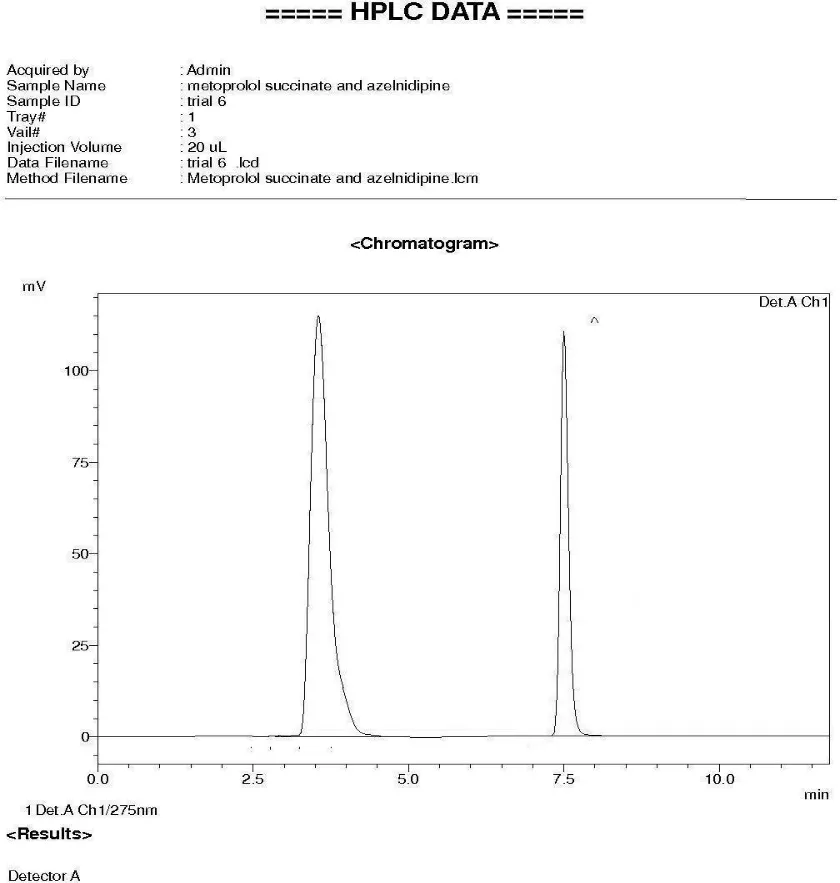
3.2. Metoprolol succinate and Azelnidipine HPLC Method Development Trial Result:
Column : - C18, 250mm × 4.6mm, 5µ Agilent Zorbax
Wavelength : - 275nm
Flow : - 1.0ml/min
Temperature : - 37°C
Injection Volume : - 20µL
Buffer Preparation:
Prepare 0.01M Ammonium Dihydrogen
Orthophosphate in 1000ml of water
Standard Preparation: -
Measure accurately 16mg Azelnidipine API and 25mg Metoprolol succinate API transfer it into a 25ml volumetric flask then add 15ml of methanol and sonicate till dissolve and makeup volume with methanol. Take both 5ml of above solution in 50 ml of volumetric flask and volume makeup by using methanol.
Observation:
Peak is Observed & Method optimize.
3.3 QbD Reports:
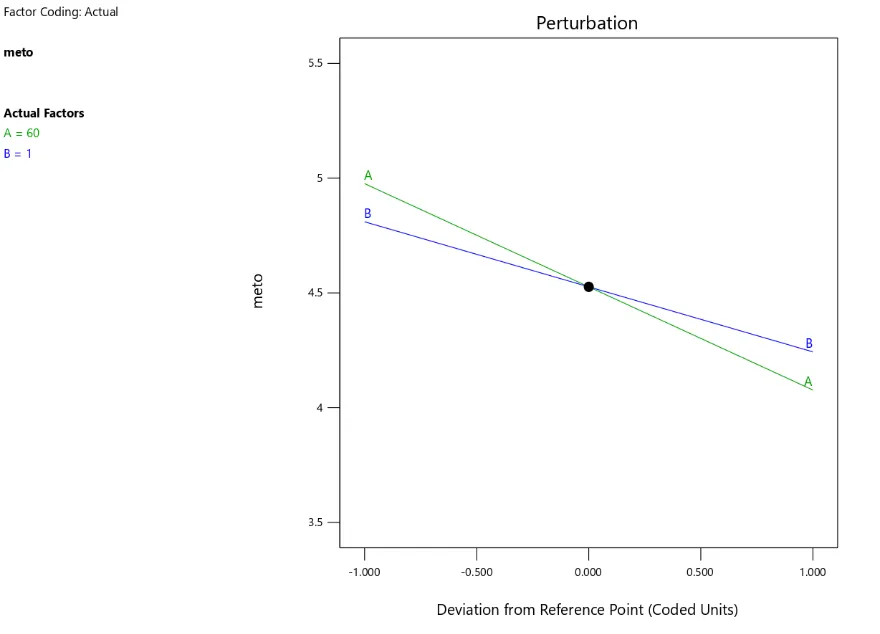
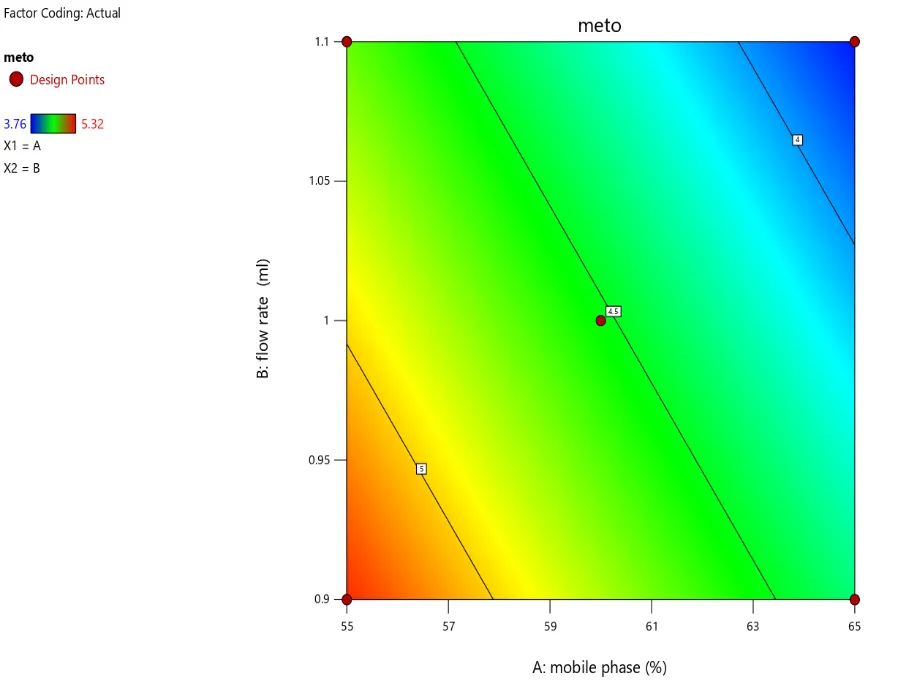
ANOVA for Linear model Response 1: Metoprolol Succinate
Factor coding is Coded.
Sum of squares is Type III – Partial
The Model F-value of 410.56 implies the model is significant.
P-values less than 0.0500 indicate model terms are significant. In this case A, B are significant model terms. Values greater than 0.1000 indicate the model terms are not significant. If there are many insignificant model terms (not counting those required to support hierarchy), model reduction may improve your model.
|
Source |
Sum of Squares |
df |
Mean Square |
F-value |
p-value |
|
Model |
2.26 |
2 |
1.13 |
410.56 |
< 0.0001 |
|
A-mobile phase |
1.62 |
1 |
1.62 |
587.76 |
< 0.0001 |
|
B-flow rate |
0.6421 |
1 |
0.6421 |
233.36 |
< 0.0001 |
|
Residual |
0.0165 |
6 |
0.0028 |
||
|
Cor Total |
2.28 |
8 |
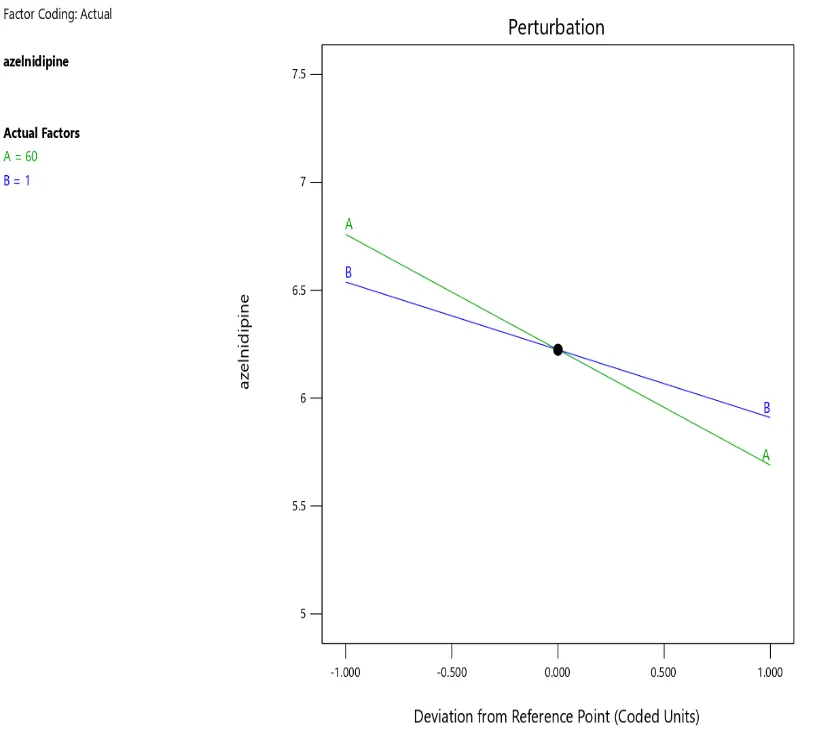
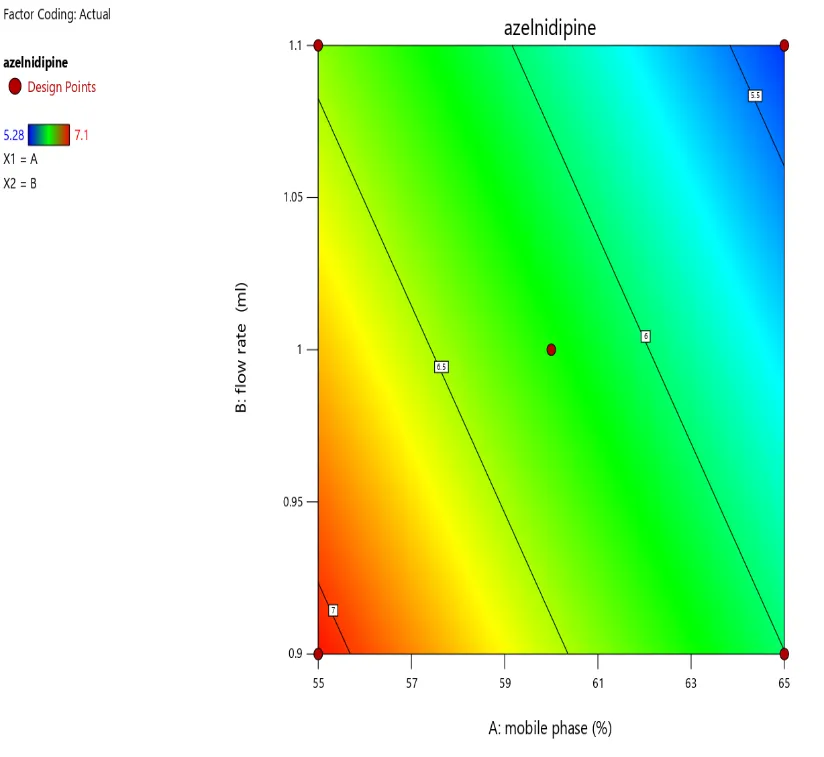
ANOVA for Linear model Response 2: Azelnidipine
Factor coding is Coded.
Sum of squares is Type III – Partial.
The Model F-value of 88.81 implies the model is significant. There is only a 0.01% chance that an F-value this large could occur due to noise.
P-values less than 0.0500 indicate model terms are significant. In this case A, B are significant model terms. Values greater than 0.1000 indicate the model terms are not significant. If there are many insignificant model terms (not counting those required to support hierarchy), model reduction may improve your model.
|
Source |
Sum of Squares |
df |
Mean Square |
F-value |
p-value |
|
Model |
3.08 |
2 |
1.54 |
88.81 |
< 0.0001 |
|
A-mobile phase |
2.29 |
1 |
2.29 |
132.06 |
< 0.0001 |
|
B-flow rate |
0.7899 |
1 |
0.7899 |
45.56 |
0.0005 |
|
Residual |
0.1040 |
6 |
0.0173 |
||
|
Cor Total |
3.18 |
8 |
CONCLUSION
The Overall study determines the successful QbD driven method development of UV Spectroscopic and RP-High Performance Liquid Chromatography methods and validation study for quantitative analysis of Azelnidipine and Metoprolol Succinate. Both methods were rigorously validated following ICH guidelines, are mainly simple, precise, accurate, linear, and robust for routine pharmaceutical analysis [11].
Acknowledgement
I would like to express my heartfelt gratitude to my guide for their continuous guidance throughout this research work. Their valuable insights and assistance played an important role in the successful completion of this study. I am also deeply thankful to my parents for their unwavering love, constant encouragement, and endless support. Their belief in me has been a great source of motivation and strength throughout my academic journey, and I am truly grateful for everything they have done for me.
REFERENCES

Nikita Vishnu Mawal*, Smita S. Aher, A Quality By Design Approach To The Development Of RP-HPLC Methods For Metoprolol Succinate And Azelnidipine, Int. J. Sci. R. Tech., 2026, 3 (7), 162-171. https://doi.org/10.5281/zenodo.21246278
 10.5281/zenodo.21246278