

We use cookies to ensure our website works properly and to personalise your experience. Cookies policy
Rohilkhand College of Nursing, Bareilly, (U.P.)
Objectives of the study To assess the level of knowledge regarding excessive use of internet gaming among intermediate Students. To find the association between level of knowledge regarding excessive use of internet gaming among intermediate students with their selected demographic variables. The study was descriptive research in nature, the sampling technique used was non – probability convenient sampling techniques and sample size was 100 intermediate students in selected schools (Om Prakash Memorial Inter College) Bareilly, U.P. a structured knowledge questionnaire was used for data collection. Major Findings Of Study: The findings are summarized to as follows: As per the study objectives, a set of questionnaire has been developed to find out the level of knowledge regarding excessive use of internet gaming among intermediate students. The majority of 73 (73.00%) were in the age group of 17-18 years, 60 (60.00%) were male. Highest percentage of 50 (50.00%) students having art stream, majority of 45 (45.00%) students having nuclear family, 40 (40.00%) intermediate students used mobile phone for playing internet gaming, 45 (45.00%) intermediate students played 2-3 hours internet game, 42 (42.00%) intermediate students play internet gaming during day time and 54 (54.00%) agreed that they had previous awareness about internet addictive gaming. There was association between knowledge score with demographic variable i.e. age (x2=12.47), stream (x2=12.83), family type (x2=11.43), device used for internet gaming (x2=10.01) and there was no association between knowledge score with demographic variable gender (x2=9.05), duration of internet gaming (x2=6.01), time of playing internet gaming (x2=5.59) and previous awareness about internet addictive gaming (x2=6.07).
The digital era has transformed entertainment, education, and communication, but excessive exposure to online gaming has raised new public health challenges. Internet Gaming Disorder (IGD) has been recognized by the World Health Organization (WHO, 2019) as a behavioral addiction characterized by impaired control over gaming, increasing priority given to gaming over other activities, and continuation of gaming despite negative consequences. With the popularity of high-tech devices (such as computers, tablet in this modern era, technology plays an important role in every walk of human life. People are and smart phones) and internet use in recent years, playing online games has become a popular activity especially among the younger people. In this virtual world online gaming touches its highest level.1
Intermediate students, who are generally in the age group of 17-19 years and above 19 years, are at a stage of physical, emotional, and intellectual development. During this period, they are more attracted to online activities such as internet gaming. While playing internet games in moderation can be enjoyable and sometimes improve certain cognitive skills, excessive use may lead to negative effect. Excessive internet gaming can affect students‟ academic performance, concentration, sleep patterns, and social relationships. It may also lead to problems such as addiction, stress, anxiety, and reduced physical activity. Because of these potential effects, excessive internet gaming has become a growing concern among parents, teachers, and health professionals.2
In India, the rapid growth of affordable smart phones and internet access has led to a surge in online gaming among youth. According to the Internet and Mobile Association of India, nearly 67% of adolescents spend more than three hours daily on gaming platforms. Such behaviors can cause academic decline, poor sleep, aggression, and social withdrawal.3
Information and communication technology experiences rapid advancements. One of the advancements is the finding of the internet. The internet users' activities comprise fun activities such as watching video clips or listening to the audio, chatting, downloading music or playing game. The most recent survey published by Indonesia Internet Service Provider Association (APJII) in 2017 reported that there were 143.26 million active internet users in Indonesia, it was about 54.68% of Indonesia's total population. This development also triggers the development of online games. These studies also provide evidence supporting 21st century cognitive skills such as integrating knowledge, developing skills such as accessing prior knowledge, facilitating identification of main learning. These skills help students organize the knowledge they are acquiring. The advent of the Internet and the increasing possibilities for digital use, including online gaming, offers many opportunities for people and for learning.4
Excessive use of internet games leads to internet gaming disorder. Minors are known to be particularly susceptible to problematic internet gaming use owing to age related underdevelopment of cognitive control. Persistent and recurrent use of the internet to engage in games, often with other players leading to clinically significant impairment or distress. Such adolescents are expected to exhibit prominent relationships among the family environment, parent child relationships, academic performance and sleep disturbances. it may lead to problems such as addiction, stress, anxiety and reduced physical activity.5
According to World Health Organization, out of 7.2 billion people worldwide, over billion are younger than 25 years, making up 42% of the world population. Around 1.2 billion of these young people are adolescents aged between 10 and 19 years. The most active adopters of the Internet and modern technologies have been adolescents and young adults, reflecting the fact that they have grown up in an environment with a well-developed internet.6
NEED FOR THE STUDY
In 11th revision of international classification of disease (ICD-11) by World Health Organization (WHO) recognized internet gaming disorder as a mental health condition. "Gaming disorder is characterized by impaired control on gaming over any other activities, increase priority for gaming." On the basis of available evidence by various experts, technical consultation undertaken by WHO make the decision for inclusion of Gaming disorder in ICD 11 researchers are going on for standardized the gaming disorder criteria.16
American Psychiatric Association DSM-5 TR (Diagnostic And Statistical Manual Disorders) referred gaming disorder as Internet Gaming Disorder (IGD), with symptoms such as lack of control on time spending in playing internet game, giving priority to game over all other task and responsibility, avoid all other activity for family, work, social life, using game to avoid or escape from any negative situation or emotions etc. lasting longer than 12 month.17
Internet gaming addiction is a behavioral problem that has been classified and explained in numerous ways. According to Griffiths, bio psychosocial processes lead to the development of addictions, such as Internet gaming addiction, which include the following components. First, the behavior is salient (the individual is preoccupied with gaming). Second, the individual uses the behavior in order to modify their mood (Le, gaming is used to escape reality or create the feeling of euphoria). Third, tolerance develops (the individual needs increasingly more time to feel the same effect). Fourth, withdrawal symptoms occur upon discontinuation of the behavior (the individual feels anxious, depressed, and irritable if they are prevented from playing). Fifth, interpersonal and intra-personal conflict develops as a consequence of the behavior (the individual has problems with their relationship, job, and hobbies, and lack of success in abstinence). Finally, upon discontinuation of the behavior, the individual experiences.18
In the olden days computer networks didn't have a standard way to communicate with each other. Transfer control protocol was established at that time, and it was a new communication protocol. This new establishment allows different kinds of network to talk to each other. In January 1, 2024 the defense data network and ARPANET were changed to TCP/IP standard and this day is also celebrated as the birthday of the internet. Due to internet technology all other networks could now be connected by universal language.19
The increasing prevalence of problematic gaming behavior among Indian adolescents calls for early preventive strategies. Research shows that nearly 8–10% of adolescents exhibit symptoms of gaming addiction (Kuss & Griffiths, 2023). Excessive gaming is associated with poor academic performance, aggression, obesity, and disrupted family relationships. A study by Choi et al. (2022) in South Korea found that students with internet gaming addiction scored lower in school performance and exhibited higher levels of depression and anxiety. Similar trends are emerging in India. Despite this, awareness about IGD and its management remains limited among school children. Hence, the current study was conducted to assess the effectiveness of an awareness program me in enhancing knowledge and promoting preventive attitudes toward Internet Gaming Disorder.20
As regards Uttar Pradesh video gamers, a survey conducted by ISFE (2022) showed that the 41% of Uttar Pradesh population use Video Games regularly, while 25% reported a weekly gaming habit and 82% usually play online. To our knowledge, only one study tackled the issue of Video Game addiction in Uttar Pradesh. This study found a relation between the Versatility (i.e., preference for different genres of Video Games) and the risk of addiction. However, data were collected only among male adolescents, and the authors did not provide prevalence for Video Game addiction.23
Researchers selected this topic because during their clinical postings and also in our community and at home, we observed that many youngsters spend excessive time on internet gaming. this can affect their health, sleep, and academic performance. Therefore, Researcher felt the need to assess the level of knowledge regarding excessive use of internet game among intermediate students as there is a smaller number of studies done regarding it.
OBJECTIVE OF THE STUDY
1. To assess the level of knowledge regarding excessive use of internet gaming among intermediate Students.
2. To find the association between level of knowledge regarding excessive use of internet gaming among intermediate students with their selected demographic variables.
3. The study was descriptive research in nature, the sampling technique used was non – probability convenient sampling techniques and sample size was 100 intermediate students in selected schools (Om Prakash Memorial Inter College) Bareilly, U.P. a structured knowledge questionnaire was used for data collection.
HYPOTHESIS
H1: There will be a significant association between the level of knowledge regarding excessive use of internet gaming among intermediate students with their selected demographic variables.
MATERIALS & METHODS:
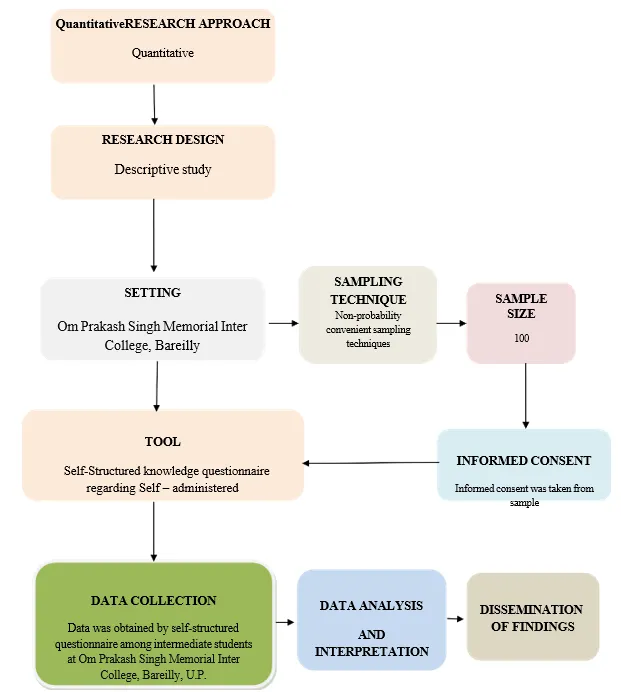
ANALYSIS AND INTERPRETATION:
Table 1: Frequency and Percentage Distribution of Intermediate Students According to Their Demographic Variables N = 100
| S.No. | Demographic Variables | Frequency | Percentage |
|---|---|---|---|
| 1. | Age 17-18 years 19 years and above |
73 27 |
73.00% 27.00% |
| 2. | Gender Male Female |
60 40 |
60.00% 40.00% |
| 3. | Stream Art Science Commerce |
50 35 15 |
50.00% 35.00% 15.00% |
| 4. | Family type Nuclear family Joint family Single-parent family Step family |
45 30 25 0 |
45.00% 30.00% 25.00% 0.00% |
| 5. | Device used for internet gaming Mobile Phone Laptop Tablet Desktop |
40 30 22 8 |
40.00% 30.00% 22.00% 8.00% |
| 6. | Duration of internet gaming Less than 1 hour 2-3 hours More than 3 hours |
25 45 30 |
25.00% 45.00% 30.00% |
| 7. | Time of playing internet gaming Day time Night time Both |
42 25 33 |
42.00% 25.00% 33.00% |
| 8. | Previous awareness about internet addictive gaming Yes No |
54 46 |
54.00% 46.00% |
Table 2: Association Between Level of Knowledge Regarding Excessive Use of Internet Gaming with Their Selected Demographic Variables.
| S.NO | DEMOGRAPHICAL VARIABLE | ADEQUATE | MODERATE | INADEQUATE | DF | CHI SQUARE TEST | LEVEL OF SIGNIFICANCE | ||||
|---|---|---|---|---|---|---|---|---|---|---|---|
| F | % | F | % | F | % | ||||||
| 1. | Age 17-18 years 19 years and above |
33 9 |
33 9 |
15 13 |
15 13 |
25 5 |
25 5 |
5 | 12.47 | S | |
| 2. | Gender Male Female |
25 | 25 | 20 | 20 | 15 | 15 | 6 | 9.05 | NS | |
| 30 | 30 | 8 | 8 | 2 | 2 | ||||||
| 3. | Stream Art Science Commerce |
30 9 |
30 9 |
13 16 |
13 16 |
7 10 |
7 10 |
2 | 12.83 | S | |
| 5 | 5 | 5 | 5 | 5 | 5 | ||||||
| 4. | Family type Nuclear family Joint family Single-parent family Step family |
10 6 7 0 |
10 6 7 0 |
14 13 5 0 |
14 13 5 0 |
21 11 13 0 |
21 11 13 0 |
4 | 11.43 | S | |
| 5. | Device used for internet gaming Mobile Laptop Tablet Desktop |
20 10 7 8 |
20 10 7 8 |
5 10 5 0 |
5 10 5 0 |
15 10 10 0 |
15 10 10 0 |
6 | 10.01 | S | |
| 6. | Duration of internet gaming Less than 1 hour 2-3 hours More than 3 hours |
11 10 10 |
11 10 10 |
9 15 8 |
9 15 8 |
5 20 12 |
5 20 12 |
5 | 6.01 | NS | |
| 7. | Time of playing internet gaming Day time Night time Both |
18 0 10 |
18 0 10 |
24 3 11 |
24 3 11 |
0 22 12 |
0 22 12 |
2 | 5.59 | NS | |
| 8. | Previous awareness Yes No |
24 10 |
24 10 |
10 5 |
10 5 |
20 31 |
20 31 |
4 | 6.07 | NS | |
Significant at p < 0.05* and Not significant at p #
REFERENCES






Dheeraj, Danish Khan, Divyanshi Singh, Diya Gupta, Akansh Alexander, Abhay Singh, “A Study to Assess the Level of Knowledge Regarding Excessive Use of Internet Gaming Among Intermediate Students of Selected Schools of Bareilly, U.P. with the View to Develop an Informational Pamphlet”, Int. J. Sci. R. Tech., 2026, 3 (11), 1412-1418. https://doi.org/10.5281/zenodo.24559567
 10.5281/zenodo.24559567