

We use cookies to ensure our website works properly and to personalise your experience. Cookies policy
Rohilkhand College of Nursing, Bareilly, (U.P)
Good health is imperative for all individuals to function as citizens, interact with others and be economically productive. Health is very important for each and every individual. Health can be affected due to many causes that may range from physical, social, and mental afflictions. One among them is the silent killer, cancer. Cells are the smallest structural and functional units of the body and are called the building blocks of life. Normally, healthy cells grow, divide, and replace themselves in an organized way to maintain body tissues. Sometimes cells lose control over their growth and start dividing rapidly and irregularly. These abnormal cells become useless, spread through blood to other parts of the body, and form secondary tumors. Such uncontrolled and destructive cell growth is called Cancer or neoplasm, which can invade tissues and metastasize to other parts of the body. [1] Objectives:- To assess the level of knowledge regarding safe handling and precaution of chemotherapy drugs among staff nurses working in selected cancer hospitals, To assess the effectiveness of the structured teaching programme by comparing pre-test and post-test knowledge scores, To find out the association between the level of pretest knowledge score of staff nurses working in oncology unit with their selected demographic variable. Materials and Method:- This study was conducted at Rohilkhand cancer Institute, Bareilly. A total of 50 Staff nurses were selected using a purposive sampling technique. Data were collected using a validated self-structured questionnaire comprising 30 questions covering socio-demographics, data was analyse b descriptive and inferential statistics. Ethical clearance and informed consent were obtained. Results:-Previous training shows highly statistically significant association with knowledge levels at p value 0.05 with Chi square 29.53 as H2 is accepted, post test (24.66) has higher score than pre test (12.84) the mean difference between pre-test and post-test is (11.82) and t-test is 13.43 that is significant at p value 0.05 as H1 is accepted. Conclusion:- result shows low to moderate knowledge need to conduct more studies .
Good health is imperative for all individuals to function as citizens, interact with others and be economically productive. Health is very important for each and every individual. Health can be affected due to many causes that may range from physical, social, and mental afflictions. One among them is the silent killer, cancer. Cells are the smallest structural and functional units of the body and are called the building blocks of life. Normally, healthy cells grow, divide, and replace themselves in an organized way to maintain body tissues. Sometimes cells lose control over their growth and start dividing rapidly and irregularly. These abnormal cells become useless, spread through blood to other parts of the body, and form secondary tumors. Such uncontrolled and destructive cell growth is called Cancer or neoplasm, which can invade tissues and metastasize to other parts of the body. [1]
According to the World Health Organization (WHO), cancer is the leading cause of death globally, accounting for nearly 10 million deaths annually. The word meaning of oncology in English refers to the specialized branch of medicine that focuses on the medical cancer treatment of various types of cancers. This discipline plays a crucial role in diagnosing, managing, and treating cancer effectively.
The oncology definition stems from the Greek words “onkos,” meaning mass or tumor, and “logos,” meaning study. Hence, oncology translates to the oncology science that deals with the diagnosis, treatment, and prevention of cancer. The term covers a wide range of cancer care aspects, including medical, surgical, and radiation oncology. [2]
Many times the health care professionals handling these drugs fail to follow the safety
guidelines while handling these drugs and hence are more vulnerable to the toxic effects
of these cytotoxic drugs. Nursing personnel’s play a significant role during chemotherapy
preparation and administration. [4]
Administration of anticancer drugs is a complex process tense with the possible for patient damage. Despite safety risks, there are many national standards for safe administration of chemotherapy drugs especially in the outpatient adult oncology setting. To meet this need, the American Society of Clinical Oncology and the Oncology Nursing Society created a collaborative project in 2008 to develop standards for safe chemotherapy administration to adult cancer patients.[7]
NEED FOR STUDY
Cancer is a significant global health concern, with India ranking second in Asia and third in the world in terms of cancer incidence. Regular monitoring and updates on cancer statistics are vital for assessing the impact and burden of the disease and the effectiveness of cancer control measures. [11]
The estimated incidence of cancer cases in India for 2024 is 1,533,055, according to the Indian Council of Medical Research’s National Cancer Registry Programme data, Prataprao Jadhav, minister of state in the Union Ministry of Health and Family Welfare told the Lok Sabha on August 8, 2025.[12]
Handling of chemotherapeutic drugs is an essential responsibility of nurses working in oncology units. However, these drugs are highly hazardous and improper handling may lead to occupational exposure among healthcare workers. Recent studies (2020–2025) indicate that approximately 5–8 million healthcare workers worldwide are exposed to hazardous drugs, including chemotherapeutic agents, during preparation, administration, and disposal. Research also shows that a significant proportion of oncology nurses experience accidental exposure such as skin contact, inhalation, or drug spills while handling cytotoxic drugs. In addition, nearly one-third of nurses report symptoms related to cytotoxic drug exposure, including skin irritation, headache, and other health problems. [15]
Based on recent studies (2024-2025), the incidence of exposure to chemotherapeutic drugs due to mishandling in India remains a significant concern, with studies indicating that a high percentage of oncology nursing staff (ranging from 56% to over 75% depending on the specific study and criteria) exhibit poor practice or suboptimal safety measures during chemotherapy handling. [21]
Research studies have shown that many nurses do not have adequate knowledge about the safe handling of chemotherapeutic drugs. In addition, their practices are often inconsistent and not fully aligned with safety guidelines. This lack of proper knowledge and practice may be due to insufficient training, absence of regular educational programs, and limited awareness regarding safety precautions while handling these drugs.
OBJECTIVES OF THE STUDY
1. To assess the level of knowledge regarding safe handling and precaution of chemotherapy drugs among staff nurses working in selected cancer hospitals.
2. To assess the effectiveness of the structured teaching programme by comparing pre-test and post-test knowledge scores.
3. To find out the association between the level of pretest knowledge score of staff nurses working in oncology unit with their selected demographic variables
HYPOTHESIS
1. H1:There will be a significant difference between the pre-test and post-test knowledge scores regarding safe handling and precautions of chemotherapeutic drugs among staff nurses working in oncology unit after implementation of the structured teaching programme.
2. H2: There will be a significant association between the pre-test knowledge scores and selected demographic variables (such as age, educational qualification, years of experience, etc.).
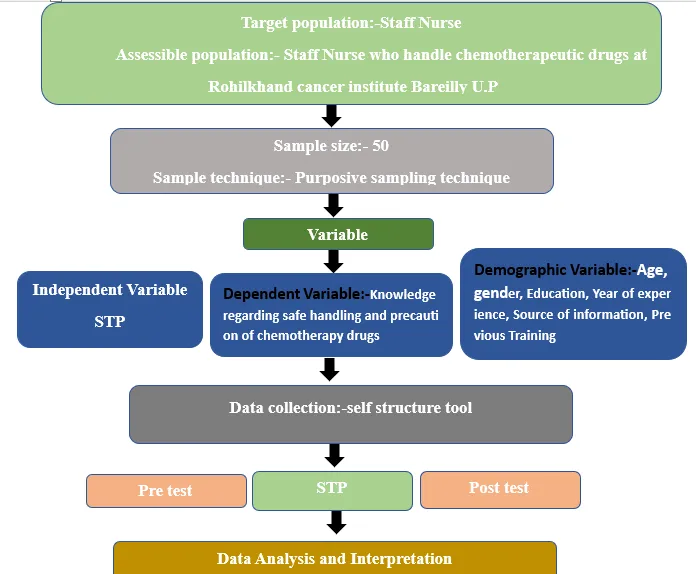
Research approach:- Quantitative research approach Research setting:- Rohilkhand Cancer Institute Bareilly, U.P. Variable Dependent Variable:-Knowledge regarding safe handling and precaution of chemotherapy drugs Independent Variable STP Data collection:-self structure tool Pre test Post test STP Data Analysis and Interpretation
ANALYSIS AND INTERPRETATION:
Section A:- Frequency wise distribution of demographic performa. n=50
| DEMOGRAPHIC VARIABLES | TOTAL FREQUENCY | PERCENTAGE (%) |
|---|---|---|
| AGE | ||
| 21 - 25 years | 18 | 36% |
| 26-30 year | 20 | 40% |
| 31-35 year | 12 | 24% |
| 36-40 year | 0 | 0% |
| GENDER | ||
| Male | 17 | 34% |
| Female | 33 | 66% |
| EDUCATION | ||
| GNM | 21 | 42% |
| B.Sc Nursing | 18 | 36% |
| Post B.Sc Nursing | 11 | 22% |
| M.Sc Nursing | 0 | 0% |
| EXPERIENCE IN ONCOLOGY UNIT | ||
| Less than 1 year | 19 | 38% |
| 1-2 year | 12 | 24% |
| 3-4 year | 11 | 22% |
| More than 4 year | 8 | 16% |
| SOURCE OF INFORMATION | ||
| Seminar | 10 | 20% |
| inservice | 02 | 4% |
| Book | 33 | 66% |
| internet | 05 | 10% |
| PREVIOUS KNOWLEDGE/ TRAINING ON SAFE HANDLING | ||
| Yes | 12 | 24% |
| No | 38 | 76% |
Table no:- 6
Comparison of mean and SD of pre-test and post-test knowledge score of staff nurses regarding safe handling and precautions of chemotherapy drugs
| Test | Mean | S D | Mean difference | T value |
|---|---|---|---|---|
| Pre test | 12.84 | 5.60 | 11.82 | 13.43 |
| Post test | 24.66 | 2.72 |
H1 Is accepted as t value is significant at p value 0.01
Section C: Association Between Pre test Knowledge to their Demographic Variables
| S.N | Demographic variable | Level of knowledge | Total | Chi-square | P value | ||||
|---|---|---|---|---|---|---|---|---|---|
| Very poor | Poor | Average | Good | Excellent | |||||
| 1 | Age group 21 - 25 years 26 - 30 years 31 - 35years 36- 40 year |
2 1 2 0 |
5 8 3 0 |
8 8 5 0 |
3 3 2 0 |
0 0 0 0 |
18 20 12 0 |
1.805 | Not significant At p<0.05 |
| 2 | Gender Male Female |
4 3 |
7 12 |
4 11 |
2 7 |
0 0 |
17 33 |
2.655 | Not significant At p<0.05 |
| 3 | Education: GNM B.Sc. Nursing Post B.Sc. Nursing M.Sc. Nursing |
5 0 1 0 |
6 5 5 0 |
8 10 2 0 |
2 3 3 0 |
0 0 0 0 |
21 18 11 0 |
9.324 | Not significant At p<0.05 |
| 4 | Experience in Oncology Unit Less than 1 year 1-2 year 3-4 year Above 4 year |
2 2 0 0 |
3 4 4 2 |
10 3 2 1 |
4 3 5 3 |
0 0 0 0 |
19 12 11 8 |
9.828 | Not significant At p<0.05 |
| 5 | Source of information a. Seminar/workshop b. Inservice training c. Books d. internet |
2 0 3 1 |
4 2 10 2 |
2 0 8 1 |
2 0 12 2 |
0 0 0 0 |
10 02 33 5 |
5.738 | Not significant At p<0.05 |
| 6 | Previous training related to safe handling Yes No |
0 9 |
1 14 |
3 14 |
8 1 |
0 0 |
12 38 |
29.53 | significant At p<0.05 |
* significant at 0.05
Above table shows that that age, gender, educational qualification, experience in the oncology unit, and source of information were not significantly associated with the level of knowledge among staff nurses. However, previous training as chi square is 29.53 Hence, research hypothesis (Hâ‚‚) is accepted.
REFERENCES






Shivani Devi, Shivani Kashyap, Shweta Sahu, Sindhu Rathore, Chandraprabha Joshi, Vatsala Gautam, “Effectiveness of Structured Teaching Programme on Knowledge Regarding Safe Handling and Precautions of Chemotherapeutic Drugs Among Staff Nurses Working in Oncology Unit of Selected Hospital Bareilly U.P.”, Int. J. Sci. R. Tech., 2026, 3 (10), 938-942. https://doi.org/10.5281/zenodo.23411311
 10.5281/zenodo.23411311