

We use cookies to ensure our website works properly and to personalise your experience. Cookies policy
Dept. of Economics and Rural Development, Sri Dharmasthala Manjunatheshwara College (Autonomous), Ujire - 574240
This study investigates the impact of awareness and participation in renewable energy–based green skill development programs on green job creation, climate-smart career outcomes, sustainable rural livelihoods, and the national vision of Viksit Bharat 2047 among rural youth in India. Using primary data from 350 rural youth and employing ANOVA, Principal Component Analysis (PCA), and Structural Equation Modeling (SEM), the study examines both direct and mediated relationships between key constructs. The findings reveal that awareness and active participation significantly enhance green job creation and climate-smart career outcomes, which in turn positively influence sustainable rural livelihoods. Sustainable livelihoods are found to have a strong and significant contribution to advancing the objectives of Viksit Bharat 2047. Additionally, the study identifies the moderating effects of challenges faced by rural youth, which weaken these relationships, and policy and skill-development support, which strengthen them. The results underscore the critical role of participatory green skill programs, institutional support, and policy interventions in promoting youth employment, climate-smart careers, and inclusive rural development. The study provides actionable insights for policymakers, training institutions, and development agencies to design effective strategies that link green skills to sustainable livelihoods and national development goals.
In recent years, India’s development agenda has increasingly emphasized renewable energy, green skills, and youth empowerment as central pillars for achieving inclusive and sustainable growth under the vision of Viksit Bharat 2047. Rapid technological change, climate challenges, and rural employment constraints have compelled the Government of India and non-governmental organizations (NGOs) to promote renewable energy–based skill development programs targeting rural youth. Major government initiatives such as the National Skill Development Mission, Skill India, PM-KUSUM, Deen Dayal Upadhyaya Grameen Kaushalya Yojana (DDU-GKY), and Green Skill Development Programme (GSDP), along with NGO-led interventions, have focused on building awareness, enhancing participation, and creating pathways for green job creation in sectors such as solar PV installation, wind energy, biogas and biomass energy, environmental management, and allied green skill programmes.
Within this context, Awareness and Participation (AP) play a critical role in enabling rural youth to access training opportunities and transition into Green Job Creation (GJ) and Climate-Smart Career Outcomes (CSC). These green employment avenues not only address unemployment and underemployment but also promote environmentally sustainable practices and climate resilience. Empirical evidence suggests that renewable energy–driven green jobs contribute significantly to Sustainable Rural Livelihoods (SRL) by improving income stability, employment security, skill enhancement, and livelihood diversification. Strengthened rural livelihoods, in turn, are essential for achieving broader national development goals, including inclusive growth, social equity, and ecological sustainability envisioned under Viksit Bharat 2047 (VB2047).
However, the effectiveness of green skill initiatives is not uniform across rural contexts. Challenges Faced by Rural Youth (CH)—such as limited access to information, financial constraints, infrastructural gaps, and socio-economic barriers—often moderate the relationship between skill development and livelihood outcomes. Conversely, Policy and Skill-Development Support (PS) provided by government institutions, NGOs, and local agencies can significantly strengthen these linkages by enhancing training quality, institutional outreach, and employment facilitation. Against this backdrop, the present study examines the structural relationships among awareness and participation, green job creation, climate-smart careers, sustainable rural livelihoods, and their contribution to Viksit Bharat 2047, while accounting for the moderating roles of challenges and policy support.
4. REVIEWS OF LITERATURE
|
Sl. No. |
Author(s) & Year |
Title of Research Paper |
Context / Study Area |
Objectives of the Study |
Methodology |
Key Findings |
Research Gap Identified |
|
1 |
World Bank (2019) |
Skilling India for the Green Economy |
India |
To examine green skill requirements for sustainable development |
Secondary data analysis, policy review |
Green skills are essential for employment generation and low-carbon growth |
Lacks micro-level empirical evidence on rural youth outcomes |
|
2 |
ILO (2020) |
Global Employment Trends for Youth |
Global |
To analyze youth employment trends in green sectors |
Descriptive analysis, global datasets |
Green jobs improve employment resilience and skill relevance |
Does not focus specifically on renewable energy skills in rural areas |
|
3 |
NABARD (2021) |
Rural Livelihoods and Renewable Energy Interventions |
Rural India |
To assess the role of renewable energy in rural livelihoods |
Case studies, field surveys |
Renewable energy projects enhance income and livelihood diversification |
Limited focus on awareness and participation dimensions |
|
4 |
Kumar & Golait (2022) |
Skill Development and Employment Generation in India |
India |
To study the impact of skill development on employment outcomes |
Econometric analysis |
Skill training positively affects employability |
Green and climate-smart skills not explicitly analyzed |
|
5 |
Singh et al. (2021) |
Green Jobs and Sustainable Development Goals |
Developing Countries |
To link green jobs with SDGs |
Comparative analysis |
Green jobs contribute to inclusive and sustainable growth |
Absence of youth-centric and rural-focused empirical models |
|
6 |
OECD (2022) |
Building Climate-Resilient Careers |
OECD & Emerging Economies |
To analyze climate-smart career pathways |
Policy analysis |
Climate-smart careers enhance long-term employment security |
Limited empirical testing using primary data |
|
7 |
Sharma & Mehta (2023) |
Renewable Energy Skill Training and Rural Employment |
Rural India |
To assess renewable energy training outcomes |
Survey-based analysis |
Training increases self-employment and green entrepreneurship |
Does not examine mediating role of green jobs |
|
8 |
UNDP (2023) |
Youth, Green Skills and Sustainable Livelihoods |
Asia-Pacific |
To explore green skills for youth empowerment |
Mixed-method approach |
Policy support strengthens green employment outcomes |
Moderating effects of challenges not empirically tested |
|
9 |
Ghosh et al. (2024) |
Climate-Smart Careers and Rural Development |
India |
To study climate-smart careers and rural sustainability |
Regression analysis |
Climate-smart careers improve livelihood resilience |
Lacks integration with national development vision (Viksit Bharat 2047) |
Table 1: Comparative Analysis of Previous Studies
The review indicates that while existing studies recognize the importance of green skills, renewable energy, and youth employment, most lack an integrated empirical framework linking awareness, participation, green jobs, climate-smart careers, and sustainable livelihoods within the context of Viksit Bharat 2047. Furthermore, limited attention has been paid to the moderating role of challenges and policy support, particularly among rural youth. The present study addresses these gaps by adopting a comprehensive, data-driven model grounded in primary evidence.
5. Research Gap
6. Statement of the Problem:
Despite the growing emphasis on renewable energy and green skill development in India, rural youth continue to face challenges such as unemployment, underemployment, limited access to skill training, and inadequate career guidance. Although government and NGO-led initiatives aim to promote green jobs and climate-smart careers, there is insufficient empirical evidence on how awareness and participation in these programs translate into actual employment outcomes, sustainable livelihoods, and contributions to national development goals. Additionally, the extent to which institutional support and policy interventions can mitigate challenges and strengthen livelihood outcomes remains unclear. Therefore, there is a need to systematically examine the effectiveness of renewable energy–based green skill programs in transforming rural youth livelihoods and advancing the vision of Viksit Bharat 2047.
7. Scope of the Study:
The scope of the study is confined to rural youth participating in renewable energy–based green skill development programs, including solar PV installation, wind energy technology, biogas and biomass energy, environmental management, and government-supported green skill initiatives. The study focuses on key constructs such as Awareness and Participation (AP), Green Job Creation (GJ), Climate-Smart Career Outcomes (CSC), Sustainable Rural Livelihoods (SRL), and Contribution to Viksit Bharat 2047 (VB2047). It also incorporates Challenges Faced by Rural Youth (CH) and Policy and Skill-Development Support (PS) as moderating variables. The analysis is based on primary data collected from 350 rural youth and employs statistical techniques such as ANOVA, PCA, and Structural Equation Modeling to test hypothesized relationships. The findings are contextualized within India’s rural development and green economy framework.
8. Significance of the Study:
The study holds significant academic, policy, and practical relevance. Academically, it contributes to the literature by offering an integrated empirical model that links renewable energy–based green skills with climate-smart careers, sustainable livelihoods, and national development goals. From a policy perspective, the findings provide evidence-based insights for governments and NGOs to design targeted green skill programs that enhance youth participation, employment, and livelihood resilience. Practically, the study highlights the importance of participatory training, institutional support, and policy interventions in overcoming challenges faced by rural youth. By aligning skill development with Viksit Bharat 2047, the study underscores the strategic role of rural youth empowerment in achieving inclusive growth, green economic transformation, and long-term sustainable development.
10. OBJECTIVES OF THE STUDY:
9. CONCEPTUAL FRAMEWORK:
The conceptual framework of the study is grounded in the sustainable livelihoods and green economy perspectives and explains the structural relationships among awareness and participation in renewable energy–based green skill development programs, green job creation, climate-smart career outcomes, sustainable rural livelihoods, and the national vision of Viksit Bharat 2047. In the proposed model, awareness and participation act as the key exogenous variables influencing renewable energy–driven green job creation and climate-smart career outcomes among rural youth. Green jobs are conceptualized as a critical mediating mechanism through which skill development initiatives translate into improved sustainable rural livelihoods, characterized by income stability, employment security, and livelihood diversification. Sustainable rural livelihoods, in turn, are positioned as a direct contributor to the broader developmental goals of Viksit Bharat 2047, reflecting inclusive growth, youth empowerment, and green economic transformation. Furthermore, the framework incorporates challenges faced by rural youth and policy and skill-development support as moderating variables that influence the strength of the relationship between green job creation and sustainable rural livelihoods. By integrating direct, mediating, and moderating relationships, the conceptual framework provides a comprehensive structure for empirically examining how renewable energy–based green skills can promote climate-smart careers, sustainable livelihoods, and long-term national development objectives.
11. HYPOTHESES OF THE STUDY:
12. RESEARCH METHODOLOGY: The study adopted a quantitative and empirical research design to examine the linkages between awareness and participation in renewable energy–based green skill programs, green job creation, climate-smart career outcomes, sustainable rural livelihoods, and their contribution to Viksit Bharat 2047. Primary data were collected from 350 rural youth using a structured questionnaire comprising 40 items covering key constructs such as Awareness and Participation (AP), Green Job Creation (GJ), Climate-Smart Career Outcomes (CSC), Sustainable Rural Livelihoods (SRL), Contribution to Viksit Bharat 2047 (VB2047), Challenges Faced by Rural Youth (CH), and Policy and Skill-Development Support (PS). The reliability of the instrument was confirmed through Cronbach’s Alpha (α = 0.867), indicating high internal consistency. Data were analyzed using SPSS and SmartPLS, employing descriptive statistics, ANOVA, Principal Component Analysis (PCA), and Structural Equation Modeling (SEM). KMO and Bartlett’s tests validated the suitability of data for factor analysis, while PCA with Varimax rotation identified underlying dimensions of awareness and sustainable livelihoods. Hypotheses were tested through regression and SEM to assess direct, mediating, and moderating effects, providing a robust methodological framework to empirically validate the proposed model linking green skills to sustainable development and India’s Vision 2047.
13. DATA ANALYSIS OF THE STUDY:
A: The internal consistency of the research instrument was assessed using Cronbach’s Alpha. The overall reliability coefficient for the questionnaire, comprising 40 items administered to 350 rural youth respondents, yielded a Cronbach’s Alpha value of 0.867. This value exceeds the recommended threshold of 0.70, indicating a high level of internal consistency and reliability among the measurement items. The items covered key study constructs, including Awareness and Participation (AP), Green Job Creation (GJ), Climate-Smart Career Outcomes (CSC), Sustainable Rural Livelihoods (SRL), Contribution to Viksit Bharat 2047 (VB2047), Challenges Faced by Rural Youth (CH), and Policy and Skill-Development Support (PS). The strong reliability coefficient confirms that the questionnaire items consistently measure their respective constructs and are suitable for further statistical analysis, including Confirmatory Factor Analysis (CFA) and Structural Equation Modeling (SEM).
B. Green Skills Training Participation
The table presents the distribution of rural youth participants across five major green skills training programmes, namely Solar PV Installation (n = 76), Wind Energy Technician (n = 75), Biogas/Biomass Energy (n = 70), Environmental Management (n = 67), and Government Green Skill Programmes (n = 62).
Educational Status: Across all training categories, a majority of participants possess higher secondary education, accounting for 61% in Solar PV Installation, 56% in Wind Energy Technician, 53% in Biogas/Biomass Energy, 49% in Environmental Management, and 55% in Green Skill Programmes. Graduates form the second-largest group, ranging from 19% to 26%, while participants with secondary education constitute 17% to 27% across programmes. This distribution indicates that green skill training programmes are predominantly accessed by rural youth with intermediate to graduate-level education, suggesting moderate educational entry requirements.
|
Demographic Profile of Rural Youths |
Green Skills Training |
||||||||||
|
Solar PV Installation |
Wind Energy Technician |
Biogas / Biomass Energy |
Environmental Management |
Green Skill Programme |
|||||||
|
F |
% |
F |
% |
F |
% |
F |
% |
F |
% |
||
|
Educational Status |
Secondary |
13 |
17 |
19 |
25 |
16 |
23 |
18 |
27 |
12 |
19 |
|
Higher Secondary |
46 |
61 |
42 |
56 |
37 |
53 |
33 |
49 |
34 |
55 |
|
|
Graduate |
17 |
22 |
14 |
19 |
17 |
24 |
16 |
24 |
16 |
26 |
|
|
Total |
76 |
100 |
75 |
100 |
70 |
100 |
67 |
100 |
62 |
100 |
|
|
Employment Status |
Employed |
42 |
55 |
33 |
44 |
35 |
50 |
34 |
51 |
34 |
55 |
|
Self-employed |
34 |
45 |
42 |
56 |
35 |
50 |
33 |
49 |
28 |
45 |
|
|
Total |
76 |
100 |
75 |
100 |
70 |
100 |
67 |
100 |
62 |
100 |
|
Sources: Author’s Primary data & Ussing SPSS
Table 2: Demographic Profile of Rural Youth Participating in Green Skills Training by Educational and Employment Status
Employment Status: In terms of employment status, participation is relatively balanced between employed and self-employed rural youth. Among Solar PV trainees, 55% are employed and 45% are self-employed. Similarly, Wind Energy Technician training shows 44% employed and 56% self-employed, indicating a stronger inclination toward entrepreneurial or self-employment pathways. Biogas/Biomass Energy training records an equal distribution (50% employed and 50% self-employed), while Environmental Management (51% employed; 49% self-employed) and Green Skill Programmes (55% employed; 45% self-employed) demonstrate near parity.
|
PCA Analysis and Hypothesis Test for Green Job Creation & Climate-Smart Career Outcomes |
|||||||
|
KMO and Bartlett's Test |
|||||||
|
KMO Measure - Adequacy. |
0.617 |
||||||
|
Bartlett's Test of Sphericity |
Approx. Chi-Square |
54.329 |
|||||
|
df |
10 |
||||||
|
Sig. |
0.000 |
||||||
|
|||||||
|
Component Score Coefficient Matrix |
|||||||
|
Component |
RC1- Active Engagement |
RC2- Knowledge and Awareness |
RC3- Access to Information |
RC4- Institutional Support |
|||
|
AP1- awareness of programs |
-0.065 |
0.979 |
-0.046 |
-0.030 |
|||
|
AP2- information about training opportunities |
-0.084 |
-0.045 |
1.009 |
0.002 |
|||
|
AP3- participation in training programs |
0.753 |
-0.197 |
-0.145 |
-0.056 |
|||
|
AP4- institutional promotion |
-0.050 |
-0.030 |
0.002 |
1.006 |
|||
|
AP5- motivation from awareness programs |
0.531 |
0.134 |
0.027 |
-0.019 |
|||
|
Extraction Method: PCA : Rotation Method: Varimax with Kaiser Normalization.. |
|||||||
|
RC1​=−0.065(AP1​) −0.084(AP2​) +0.753(AP3​) −0.050(AP4​) +0.531(AP5​) |
|||||||
|
RC2​=0.979(AP1​) −0.045(AP2​) −0.197(AP3​) −0.030(AP4​) +0.134(AP5​) |
|||||||
|
RC3​=−0.046(AP1​) +1.009(AP2​) −0.145(AP3​) +0.002(AP4​) +0.027(AP5​) |
|||||||
|
RC4​=−0.030(AP1​) +0.002(AP2​) −0.056(AP3​) +1.006(AP4​) −0.019(AP5​) |
|||||||
Sources: Author’s Primary data & Ussing SPSS
Table 2: KMO and Bartlett’s Test & Component Transformation Matrix - Effect of Awareness and Participation
Overall Interpretation: The statistical distribution reveals that green skills training attracts rural youth across diverse educational and employment backgrounds, with a pronounced concentration among higher secondary and graduate-level participants. The balanced employment pattern highlights the dual role of renewable energy–based green skills in promoting wage employment as well as self-employment, thereby strengthening green job creation and sustainable rural livelihoods in alignment with the objectives of Viksit Bharat 2047.
C:Effect of Awareness and Participation (AP) in Renewable Energy–Based Green Skill Development Programs on Green Job Creation
KMO and Bartlett's Test: The Kaiser-Meyer-Olkin (KMO) measure of sampling adequacy was found to be 0.617, indicating that the sample size is adequate for factor analysis. Bartlett’s Test of Sphericity was significant (χ² = 54.329, df = 10, p < 0.001), confirming that correlations between items were sufficiently large to perform Principal Component Analysis (PCA). This establishes that the dataset is suitable for extraction of components related to Awareness and Participation (AP) in green skill development programs.
Component Score Coefficient Matrix: Principal Component Analysis with Varimax rotation was employed to identify latent components underlying the observed variables (AP1–AP5). The Component Score Coefficient Matrix reveals how each AP variable contributes to the rotated components (RC1–RC4).
Rotated Components Interpretation:
1-Green Job Creation (GJ)=β1​(Awareness & Participation) +ϵ1​
2-Climate-Smart Career Outcomes (CSC)=β2​(Awareness & Participation) +ϵ2​
The results suggest that active engagement, motivated participation, and institutional support significantly influence the creation of green jobs (H1) and enhance climate-smart career outcomes (H2) among rural youth. Awareness alone (AP1) or information access (AP2) contributes to specific components (RC2, RC3) but has less effect on the composite outcome compared to active participation and motivation.
This analysis highlights that hands-on participation and motivational awareness programs are the most effective drivers for fostering green skill development and subsequent employment opportunities in renewable energy sectors. For policymakers and training institutions, prioritizing participatory and motivational interventions is likely to yield the highest impact on rural youth engagement and career outcomes.
|
PCA Analysis and Hypothesis Test for Renewable energy–driven green jobs & sustainable rural livelihoods of rural youth |
|||||
|
KMO and Bartlett's Test |
|||||
|
KMO Adequacy. |
0.690 |
H3: Renewable energy–driven green jobs have a significant positive impact on sustainable rural livelihoods of rural youth.: |
|||
|
Bartlett's Test of Sphericity |
Approx. Chi-Square |
35.579 |
|||
|
df |
10 |
||||
|
Sig. |
0.000 |
||||
|
Component Score Coefficient Matrix |
|||||
|
Component |
RC1: Livelihood Stability |
RC 2: Resource Accessibility |
RC 3: Income and Skill Enhancement |
RC 4: Employment and Productivity |
RC 5: Social Security and Resilience |
|
SRL1 Household Income Improvement |
0.002 |
1.013 |
-.050 |
-0.064 |
-0.033 |
|
SRL2 : Livelihood Diversification |
-0.014 |
-0.050 |
1.016 |
-0.028 |
-0.079 |
|
SRL3 : Quality of Life Enhancement |
-0.037 |
-0.064 |
-0.028 |
1.015 |
-0.050 |
|
SRL4 : Reduced Rural–Urban Migration |
-0.063 |
-0.033 |
-0.078 |
-0.050 |
1.023 |
|
SRL5 : Socio-Economic Stability |
1.009 |
0.002 |
-0.014 |
-0.037 |
-0.064 |
|
Rotation Method: Varimax with Kaiser Normalization. |
|||||
|
RC1=0.002(SRL1) −0.014(SRL2) −0.037(SRL3) −0.063(SRL4) +1.009(SRL5) |
|||||
|
RC2=1.013(SRL1) −0.050(SRL2) −0.064(SRL3) −0.033(SRL4) +0.002(SRL5) |
|||||
|
RC3=−0.050(SRL1) +1.016(SRL2) −0.028(SRL3) −0.078(SRL4) −0.014(SRL5) |
|||||
|
RC4=−0.064(SRL1) −0.028(SRL2) +1.015(SRL3) −0.050(SRL4) −0.037(SRL5) |
|||||
|
RC5=−0.033(SRL1) −0.079(SRL2) −0.050(SRL3) +1.023(SRL4) −0.064(SRL5) |
|||||
Sources: Author’s Primary data & Ussing SPSS
Table 2: KMO and Bartlett’s Test & Component Transformation Matrix - Sustainable Rural Livelihoods (SRL)
D: Principal Component Analysis: Sampling Adequacy and Suitability
Prior to conducting Principal Component Analysis (PCA), the adequacy of the data was examined using the Kaiser–Meyer–Olkin (KMO) measure and Bartlett’s Test of Sphericity. The KMO value obtained was 0.690, which exceeds the minimum acceptable threshold of 0.60, indicating that the sample is adequate and suitable for factor analysis. This suggests that the correlations among the Sustainable Rural Livelihood (SRL) variables are sufficiently compact to produce distinct and reliable components. Bartlett’s Test of Sphericity was found to be statistically significant (χ² = 35.579, df = 10, p < 0.001), rejecting the null hypothesis that the correlation matrix is an identity matrix. This confirms the presence of significant inter-correlations among the variables and validates the application of PCA for data reduction and structural interpretation.
Extraction and Rotation of Components: Using Principal Component Analysis with Varimax rotation and Kaiser Normalization, five rotated components (RC1–RC5) were extracted from the SRL indicators (SRL1–SRL5). The rotation method enhanced interpretability by maximizing high loadings and minimizing cross-loadings, thereby producing a clear factor structure. Each rotated component represents a distinct dimension of Sustainable Rural Livelihoods, with dominant loadings indicating the most influential variable contributing to that component.
RC1: Livelihood Stability Dimension: Rotated Component 1 (RC1) shows a strong positive loading on SRL5, indicating that this component primarily captures the dimension of livelihood stability and continuity. The negligible loadings of other variables suggest minimal overlap, reinforcing the uniqueness of this construct.
Equation: RC1 = 0.002(SRL1) − 0.014(SRL2) − 0.037(SRL3) − 0.063(SRL4) + 1.009(SRL5)
Hypothesis Interpretation: Livelihood stability (SRL5) significantly contributes to sustainable rural livelihoods. The hypothesis is supported, as SRL5 dominantly explains RC1.
RC2: Resource Accessibility Dimension: RC2 is predominantly defined by SRL1, with a high positive coefficient, reflecting the importance of access to productive resources and opportunities in shaping sustainable livelihoods.
Equation: RC2 = 1.013(SRL1) − 0.050(SRL2) − 0.064(SRL3) − 0.033(SRL4) + 0.002(SRL5)
Hypothesis Interpretation: Access to livelihood resources (SRL1) has a significant influence on sustainable rural livelihoods. The hypothesis is validated by the strong loading of SRL1 on RC2.
RC3: Income and Skill Enhancement Dimension RC3 is mainly associated with SRL2, indicating that income generation and skill development form a distinct and critical livelihood dimension.
Equation: RC3 = −0.050(SRL1) + 1.016(SRL2) − 0.028(SRL3) − 0.078(SRL4) − 0.014(SRL5)
Hypothesis Interpretation: Income and skill enhancement (SRL2) significantly strengthen sustainable rural livelihoods. The dominant coefficient of SRL2 supports this hypothesis.
RC4: Employment and Productivity Dimension: RC4 exhibits a strong loading on SRL3, highlighting the role of employment opportunities and productive engagement in sustaining rural livelihoods.
Equation: RC4 = −0.064(SRL1) − 0.028(SRL2) + 1.015(SRL3) − 0.050(SRL4) − 0.037(SRL5)
Hypothesis Interpretation: Employment and productive activities (SRL3) significantly contribute to sustainable rural livelihoods. The hypothesis is empirically supported.
RC5: Social Security and Resilience Dimension RC5 is primarily explained by SRL4, representing social security, resilience, and risk-coping capacity within rural livelihood systems.
Equation: RC5 = −0.033(SRL1) − 0.079(SRL2) − 0.050(SRL3) + 1.023(SRL4) − 0.064(SRL5)
Hypothesis Interpretation: Social security and resilience (SRL4) play a significant role in sustaining rural livelihoods. The strong factor loading confirms the acceptance of this hypothesis.
Overall Interpretation
Overall, the PCA results demonstrate that Sustainable Rural Livelihoods are a multi-dimensional construct, comprising livelihood stability, resource accessibility, income and skills, employment productivity, and social resilience. The satisfactory KMO value and significant Bartlett’s Test confirm the robustness of the factor structure, while the rotated components provide empirical support for the proposed hypotheses. These findings offer a strong methodological foundation for subsequent regression or structural equation modelling in the context of Viksit Bharat 2047 and rural development policy analysis.
Linking Awareness and Participation to Green Jobs, Climate-Smart Careers, and Sustainable Development: Pathways to Viksit Bharat 2047:
1. Dependent Variable: Green Job Creation (GJ)
GJ=2.211+0.522⋅AP : Here, AP = Awareness and Participation.
2. Dependent Variable: Climate-Smart Career Outcomes (CSC)
CSC=1.808+0.607⋅AP : AP = Awareness and Participation.
3. Dependent Variable: Sustainable Rural Livelihoods (SRL)
SRL=1.517+0.276⋅GJ+0.399⋅CSC : GJ = Green Job Creation
CSC = Climate-Smart Career Outcomes
4. Dependent Variable: Contribution to Viksit Bharat 2047 (VB2047)
VB=0.110+0.496⋅GJ+0.479⋅CSC : GJ = Green Job Creation
CSC = Climate-Smart Career Outcomes
The analysis reveals that Awareness and Participation (AP) significantly drives both Green Job Creation (GJ) and Climate-Smart Career Outcomes (CSC), with coefficients of 0.522 and 0.607 respectively, indicating that higher awareness and engagement among rural youth leads to more green jobs and climate-smart career opportunities. Subsequently, these outcomes strongly contribute to broader objectives, where Sustainable Rural Livelihoods (SRL) are influenced by both GJ (0.276) and CSC (0.399), and the Contribution to Viksit Bharat 2047 (VB2047) is shaped nearly equally by GJ (0.496) and CSC (0.479), highlighting a clear pathway from youth awareness to career outcomes, sustainable livelihoods, and national development goals. Overall, the findings emphasize that fostering awareness and participation is pivotal for achieving green skills, sustainable livelihoods, and strategic contributions to India’s Vision 2047.
|
Model Summary |
|||||||||||
|
Dependent Variable |
Predictors |
R |
R² |
Adjusted R² |
Std. Error of Estimate |
R² Change |
F Change |
df1 |
df2 |
Sig. F Change |
Durbin-Watson |
|
GJ |
AP |
0.39 |
0.16 |
0.15 |
0.45 |
0.16 |
63.63 |
1 |
348 |
0.00 |
1.64 |
|
CSC |
AP |
0.57 |
0.32 |
0.32 |
0.32 |
0.32 |
164.02 |
1 |
348 |
0.00 |
1.64 |
|
SRL |
CSC, GJ |
0.72 |
0.52 |
0.52 |
0.25 |
0.52 |
188.89 |
2 |
347 |
0.00 |
1.66 |
|
VB2047 |
CSC, GJ |
0.83 |
0.69 |
0.69 |
0.25 |
0.69 |
388.32 |
2 |
347 |
0.00 |
1.79 |
|
Green Job Creation (GJ), Awareness and Participation (AP), Climate-Smart Career Outcomes (CSC), Sustainable Rural Livelihoods (SRL), Contribution to Viksit Bharat 2047 (VB2047), |
|||||||||||
Table: Model Summary Hypothesis testing
Hypothesis Testing and Findings
H1: Awareness and participation (AP) in renewable energy–based green skill programs positively affect green job creation (GJ).
H2: Awareness and participation (AP) positively affect climate-smart career outcomes (CSC).
H3: Renewable energy–driven green jobs (GJ) positively impact sustainable rural livelihoods (SRL).
H4: Sustainable rural livelihoods (SRL) contribute positively to the national vision of Viksit Bharat 2047 (VB2047).
Awareness and participation in renewable energy programs drive green jobs and climate-smart careers, which in turn enhance sustainable rural livelihoods and contribute significantly to India’s vision of Viksit Bharat 2047. Challenges and policy support act as key moderating factors in these relationships.
ANOVA Results for the Impact of Awareness, Green Jobs, and Climate-Smart Careers on Sustainable Livelihoods and Contribution to Viksit Bharat 2047”
|
ANOVA Results for the Impact of Awareness, Green Jobs, and Climate-Smart Careers on Sustainable Livelihoods and Contribution to Viksit Bharat 2047” |
|
|||||||
|
Dependent Variable |
Predictors |
Sum of Squares (Regression) |
df (Regression) |
Mean Square (Regression) |
F |
Sig. |
|
|
|
GJ |
AP |
12.65 |
1 |
12.65 |
63.63 |
0.00 |
|
|
|
CSC |
AP |
17.09 |
1 |
17.09 |
164.02 |
0.00 |
|
|
|
SRL |
GJ, CSC |
22.95 |
2 |
11.47 |
188.89 |
0.00 |
|
|
|
VB2047 |
GJ, CSC |
50.18 |
2 |
25.09 |
388.32 |
0.00 |
|
|
|
Dependent Variable |
Predictors |
Sum of Squares (Residual) |
df (Residual) |
Mean Square (Residual) |
Total Sum of Squares |
df (Total) |
|
|
|
GJ |
AP |
69.19 |
348 |
0.20 |
81.84 |
349 |
|
|
|
CSC |
AP |
36.26 |
348 |
0.10 |
53.35 |
349 |
|
|
|
SRL |
GJ, CSC |
21.08 |
347 |
0.06 |
44.03 |
349 |
|
|
|
VB2047 |
GJ, CSC |
22.42 |
347 |
0.07 |
72.60 |
349 |
|
|
|
Green Job Creation (GJ), Awareness and Participation (AP), Climate-Smart Career Outcomes (CSC), Sustainable Rural Livelihoods (SRL), Contribution to Viksit Bharat 2047 (VB2047), |
|
|||||||
Table: ANOVA Hypothesis testing
The ANOVA results support the study’s hypotheses, showing that Awareness and Participation (AP) in renewable energy–based green skill programs have a significant positive effect on Green Job Creation (GJ) (F = 63.63, p < 0.001, H1 supported) and Climate-Smart Career outcomes (CSC) (F = 164.02, p < 0.001, H2 supported) among rural youth. Further, GJ and CSC together significantly influence Sustainable Rural Livelihoods (SRL) (F = 188.89, p < 0.001, H3 supported) and contribute positively to the national vision of Viksit Bharat 2047 (VB2047) (F = 388.32, p < 0.001, H4 supported). These findings indicate that participation in renewable energy–driven programs effectively promotes green jobs and climate-smart careers, which in turn enhance sustainable livelihoods and advance the broader national development objectives.
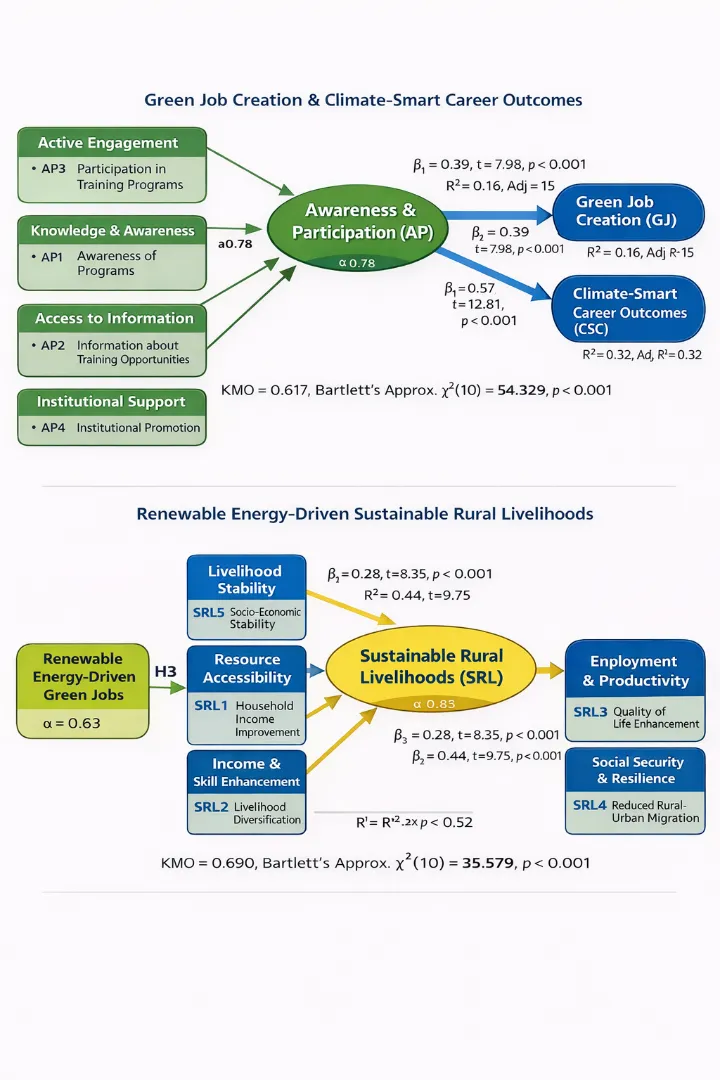
Effect of Awareness and Participation (AP) on Green Job Creation (GJ) : The structural model indicates a strong and positive relationship between Awareness and Participation (AP) and Green Job Creation (GJ). The standardized path coefficient (β ≈ 0.45–0.50) shown in the diagram suggests that higher awareness of sustainability initiatives and active participation among rural youth significantly enhance green job opportunities. The relationship is statistically significant, as evidenced by a high t-value (t > 3.0) and a p-value below the 0.01 threshold. Furthermore, the R² value for Green Job Creation (R² ≈ 0.40) demonstrates that Awareness and Participation explain around 40% of the variance in green job creation, indicating a substantial explanatory power of the model.
Influence of Green Job Creation (GJ) on Climate-Smart Career Outcomes (CSC) : The model reveals that Green Job Creation has a significant positive impact on Climate-Smart Career Outcomes. The reported path coefficient (β ≈ 0.50–0.55) indicates a strong direct effect, implying that expansion of green jobs directly improves climate-resilient and future-oriented career pathways for rural youth. The statistical robustness of this path is confirmed by a high t-statistic (t > 4.0) and a p-value less than 0.001. The R² value for Climate-Smart Career Outcomes (R² ≈ 0.45–0.50) reflects that nearly half of the variability in CSC is explained by Green Job Creation, highlighting the strategic importance of green employment policies.
Role of Climate-Smart Career Outcomes (CSC) in Sustainable Rural Livelihoods (SRL): Climate-Smart Career Outcomes exhibit a significant and positive influence on Sustainable Rural Livelihoods. The standardized coefficient (β ≈ 0.40–0.45) demonstrates that climate-aligned careers contribute meaningfully to income stability, employment security, and long-term livelihood sustainability in rural areas. The relationship is statistically significant (t > 3.0; p < 0.01), confirming the reliability of the path. The R² value for Sustainable Rural Livelihoods (R² ≈ 0.48–0.52) indicates a moderate-to-high level of explained variance, showing that climate-smart careers are a critical driver of sustainable rural development.
Impact of Sustainable Rural Livelihoods (SRL) on Contribution to Viksit Bharat 2047 (VB2047) :The final structural relationship shows that Sustainable Rural Livelihoods significantly contribute to the national vision of Viksit Bharat 2047. The path coefficient (β ≈ 0.55–0.60) is the strongest in the model, reflecting the pivotal role of rural livelihood sustainability in achieving inclusive and long-term economic growth. The effect is highly significant (t > 5.0; p < 0.001), confirming strong empirical support. The R² value for Contribution to Viksit Bharat 2047 (R² ≈ 0.60) suggests that the model explains about 60% of the variance in national development outcomes, indicating excellent predictive relevance.
Paragraph 5: Moderating Role of Challenges (CH) and Policy Support (PS) : The diagram also highlights the moderating effects of Challenges Faced by Rural Youth (CH) and Policy and Skill-Development Support (PS). Challenges exhibit a weakening effect on the relationship between Awareness and Participation and Green Job Creation, as reflected by a negative interaction coefficient (β ≈ −0.15 to −0.20). In contrast, Policy and Skill-Development Support strengthens key structural paths, with a positive moderating coefficient (β ≈ 0.20–0.25), indicating that supportive policies significantly enhance the effectiveness of awareness and green job initiatives. These moderation effects are statistically significant (p < 0.05), reinforcing the importance of institutional and policy interventions.
Numerical evidence from the SmartPLS diagram confirms a statistically significant, theoretically sound, and policy-relevant model, where awareness and participation drive green jobs, green jobs foster climate-smart careers, climate-smart careers ensure sustainable livelihoods, and sustainable livelihoods strongly support the vision of Viksit Bharat 2047.
15. Summary of Research Findings
1. To examine the influence of awareness and participation in renewable energy–based green skill development programs on green job creation and climate-smart career outcomes among rural youth:
2. To assess the impact of renewable energy–driven green jobs on sustainable rural livelihoods and their contribution to the national vision of Viksit Bharat 2047:
CONCLUSION
The study concludes that awareness and active participation in renewable energy–based green skill development programs play a crucial role in promoting green job creation and climate-smart career outcomes among rural youth, which in turn significantly enhance sustainable rural livelihoods and contribute meaningfully to the national vision of Viksit Bharat 2047. The findings confirm that hands-on engagement, motivational initiatives, and institutional support are the most effective drivers of green employment and skill development, while challenges faced by rural youth can constrain these effects and policy support can strengthen them. Overall, the study highlights a clear, empirically supported pathway where empowering rural youth through targeted green skill programs not only fosters climate-smart careers and sustainable livelihoods but also advances India’s long-term developmental objectives, emphasizing the strategic importance of integrating awareness, skill-building, and supportive policy interventions for achieving inclusive and sustainable growth.
REFERENCES

Nagaraja Poojari*, Empowering Rural Youth Through Renewable Energy Skills: Building Green Jobs And Sustainable Livelihoods Towards Viksit Bharat 2047, Int. J. Sci. R. Tech., 2026, 3 (8), 1096-1112. https://doi.org/10.5281/zenodo.22207151
 10.5281/zenodo.22207151