

We use cookies to ensure our website works properly and to personalise your experience. Cookies policy
U.G Scholar, Dept. of Electrical and Electronics Engineering, K.Ramakrishnan College of Technology, Tiruchirappalli, Tamil Nadu
Respiratory rate is an important physiological parameter because changes in breathing pattern can indicate an abnormal condition. The proposed paper presents a low-cost Arduino-based respiratory monitoring and sleep apnea alert prototype using a Force Sensitive Resistor (FSR) mounted on an elastic chest belt. During inhalation and exhalation, chest expansion and contraction produce changes in the force applied to the sensor, causing a corresponding change in its electrical resistance. The Arduino Uno reads this analog signal, identifies breathing cycles, estimates respiratory rate, and displays the result on an LCD. When significant respiratory movement is absent for a predefined demonstration interval, the controller identifies a possible apnea event, activates a buzzer, and switches a relay connected to a mini DC air pump. The pump supplies ordinary ambient air to a balloon or similar safe demonstration load to visualize automatic airflow activation. The proposed system is intended as an educational prototype for demonstrating sensing, signal processing, decision logic, alert generation, and load control; it is not a medical diagnostic or oxygen-delivery device.
General:
Respiration is a continuous physiological process in which air is inhaled and exhaled to support the exchange of gases in the body. Respiratory rate is therefore a useful parameter for observing breathing activity. Wearable respiration monitors commonly detect chest or abdominal motion using strain, pressure, piezoresistive, inductive, optical, or other sensing methods. Recent research has demonstrated that chest belts and textile sensors can provide non-invasive respiratory measurements while allowing the subject to move more freely than with conventional laboratory equipment. A 2019 study by Vanegas, Igual, and Plaza specifically demonstrated a wearable breathing system using a piezoresistive FlexiForce sensor attached to a common chest strap, showing the suitability of force-sensitive sensing for respiratory-rate estimation. Table 1 shows the Respirate rate for each group.
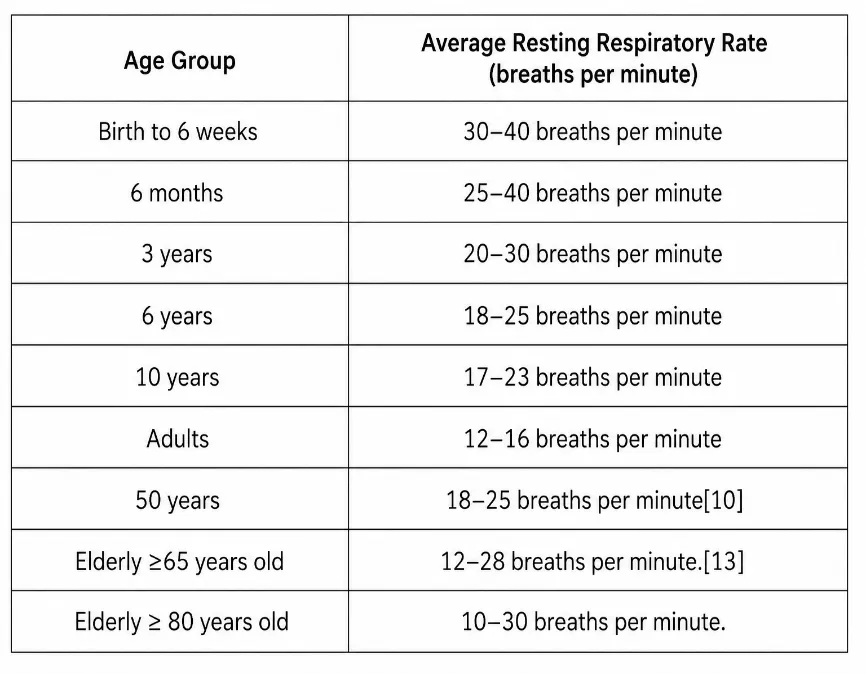
Table 1: Respiratory Rate for Different Age Groups
Inhalation is the process of breathing air into the lungs. During inhalation, the diaphragm contracts and moves downward, while the chest cavity expands. This causes the chest and abdomen to move outward. In our system, this chest expansion produces pressure on the FSR sensor placed inside the respiratory belt. The change in pressure changes the resistance of the FSR, producing an electrical signal that is detected by the Arduino.
Exhalation is the process of releasing air from the lungs. During exhalation, the diaphragm relaxes and moves upward, causing the chest cavity to decrease in size. The chest and abdomen move inward, reducing the pressure applied to the FSR sensor. The resulting change in the FSR signal is detected by the Arduino and is used to identify the completion of a breathing cycle. Figure 1 shows the inhalation and exhalation.
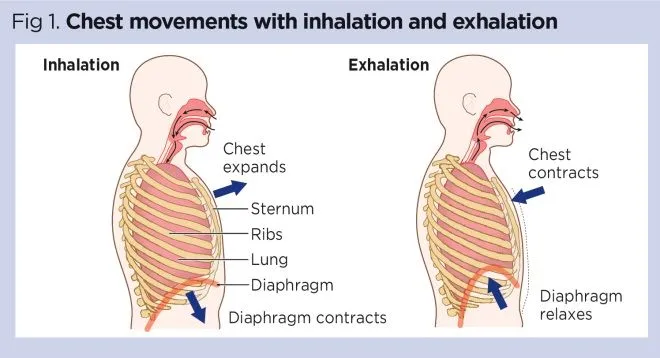
Figure 1: Inhalation and Exhalation
Sleep apnea is characterized by repeated interruptions or reductions in breathing during sleep. Clinical diagnosis is normally more comprehensive than simply observing chest movement, but respiratory effort is an important part of sleep monitoring. Research has also shown that low-cost respiratory belts can provide useful information for sleep-apnea pre-screening and automated respiratory-event analysis. The present student paper adopts the same basic sensing principle at prototype level and focuses on simple real-time detection and alert logic rather than clinical diagnosis.
Literature Survey:
Lo Presti et al. (2017) have investigated a wearable textile for respiratory monitoring using fiber Bragg grating sensors. Their study focused on how the position of the sensor affects the respiratory signal obtained from the wearable system. The researchers have examined the relationship between sensor placement and the quality of respiratory measurements. Their work has provided useful information for designing wearable systems for respiratory monitoring [1].
Molinaro et al. (2018) have developed a wearable textile based on a silver-plated knitted piezoresistive sensor for respiratory monitoring. They have evaluated the ability of the sensor to estimate respiratory rate using a wearable textile structure. The estimated respiratory rate has been compared with measurements obtained from a spirometer. Their study has demonstrated the potential of piezoresistive textile sensors for wearable respiratory monitoring [2].
Vanegas, Igual and Plaza (2019) have developed a piezoresistive breathing-sensing system using a FlexiForce sensor attached to a chest strap. The sensor has been used to detect breathing-related changes through the chest strap arrangement. The researchers have also integrated the electronic components into a compact wearable casing. Their work has provided a practical approach for implementing a compact wearable breathing-sensing system [3].
Kristiansen et al. (2023) have clinically evaluated a low-cost strain-gauge respiration belt for respiratory monitoring. Their study has examined the use of the belt together with machine-learning methods for sleep-apnea pre-screening. The evaluation has been performed using home sleep recordings. Their work has shown the relevance of low-cost respiration belts for respiratory monitoring and preliminary sleep-apnea assessment [4].
Nassi et al. (2021) have demonstrated automated respiratory-event detection using deep neural networks. Their approach has used respiratory-effort signals obtained from polysomnography for identifying respiratory events. The study has focused on applying automated computational methods to respiratory signals. Their work has indicated that respiratory-effort measurements have potential for supporting automated detection of abnormal breathing events [5].
Dhruba et al. (2022) have proposed an IoT-based sleep-apnea monitoring system that combines physiological sensors with remote monitoring. The system has been designed to collect physiological information and provide monitoring capabilities beyond the local device. Mobile notification has also been incorporated into the proposed approach. Their work has demonstrated how IoT technologies have been applied to sleep-apnea monitoring and remote notification systems [6].
Romano et al. (2024) have developed a flexible textile-sensor smart T-shirt for respiratory monitoring. Their research has investigated how the position of the sensor influences the quality of the respiratory signal. The study has considered the use of textile-based sensing for wearable respiratory monitoring. Their findings have contributed to understanding the importance of sensor placement when designing smart clothing for respiratory applications [7].
Carneiro, Silva and Tavakoli (2026) have studied wearable respiration-rate estimation using printed strain sensors. Their research has examined the effects of sensor geometry and thoracic placement on respiratory measurements. They have also investigated different cycle-detection methods for estimating respiration rate. Their study has highlighted the importance of sensor design, placement and signal-processing methods in wearable respiratory monitoring [8].
Finnsson et al. (2026) have investigated the use of respiratory inductance plethysmography for quantifying changes in ventilation in obstructive sleep apnea. Their work has focused on respiratory measurements that can provide information about changes in ventilation. The study has considered respiratory monitoring in relation to obstructive sleep apnea. Their research has demonstrated the relevance of respiratory inductance measurements for observing breathing-related changes during sleep [9].
Jash et al. (2026) have presented a wearable system for real-time respiratory-rate monitoring during daily activities. Their work has explored continuous respiratory-rate monitoring using wearable sensing approaches. The researchers have also discussed limitations associated with wearable PPG-based respiratory-rate estimation. Their study has emphasized the challenges involved in obtaining reliable respiratory measurements while a person is performing normal daily activities [10].
Reidy, Meier and Holz (2024) have introduced a chest-strap wearable system using ultra-wideband radar for continuous respiratory-rate monitoring. Their system has used a chest-strap arrangement to obtain respiratory information continuously. The research has considered respiratory monitoring during motion, where wearable systems can face challenges in maintaining signal quality. Their work has demonstrated another approach for implementing continuous respiratory-rate monitoring using wearable technology [11].
Baraeinejad et al. (2024) have described an IoT-based respiratory-motion sensor using an FSR attached to a mechanical structure. The FSR has been used to sense respiratory-related motion and convert it into information that can be processed electronically. The system has also incorporated Bluetooth Low Energy for data streaming. Their work has provided a useful reference for combining FSR-based respiratory sensing with wireless communication and IoT-based monitoring [12].
Hosseini, Khatounabadi and Fakharzadeh (2026) have presented a low-power wearable respiratory sensor using an FSR embedded in an abdominal belt. Their system has used the FSR to monitor respiratory movement without requiring invasive measurement methods. The abdominal-belt arrangement has provided a wearable structure for positioning the sensor close to respiratory movement. Their work has supported the use of FSR-based belt systems as a practical approach for non-invasive respiratory monitoring [13].
Xu et al. (2026) have proposed an optical-fiber strain sensor integrated into smart clothing for respiratory monitoring. Their research has focused on obtaining robust respiratory measurements using a sensor incorporated into wearable clothing. The study has considered environmental and motion variations that can affect wearable respiratory signals. Their work has demonstrated the continued development of smart-clothing-based sensing approaches for respiratory monitoring applications [14].
Yoon et al. have investigated wearable respiratory-sensing approaches based on stretchable strain sensors. Their work has focused on monitoring breathing movements using flexible sensing structures. The sensors have been considered for applications involving physical activity, where body movement can influence respiratory measurements. Their research has contributed to the study of wearable strain-sensing techniques for observing breathing movements during different activities [15].
Studies using respiratory inductance plethysmography have established chest and abdominal movement as useful signals for observing respiratory effort during sleep studies. These studies have shown that movement of the chest and abdomen can provide information about breathing patterns. Respiratory effort measurements have therefore been used as an important source of information in sleep-related respiratory monitoring. This research has provided a foundation for wearable systems that detect breathing movement through the chest or abdomen [16].
Research on smart textiles have shown that sensor location and mechanical coupling strongly influence the amplitude and quality of respiratory signals. The position of a sensor has an important effect on how effectively breathing-related movement is transferred to the sensing element. Researchers have therefore considered sensor placement when developing wearable textile systems. These findings have provided useful guidance for designing wearable respiratory-monitoring systems with suitable sensor positioning [17].
Research on piezoresistive wearable sensors have indicated that simple voltage-divider circuits can convert mechanical deformation into an analog electrical signal. The change in sensor resistance has been used to produce a corresponding electrical output that can be processed by an embedded controller. Such circuits have provided a relatively simple method for interfacing resistive wearable sensors with electronic systems. This approach has therefore been useful for developing low-cost wearable sensing prototypes [18].
Work on automated respiratory-event detection have indicated that respiratory-effort signals can support the detection of abnormal breathing events. Researchers have applied signal-processing techniques and machine-learning methods to analyze respiratory measurements. These approaches have provided methods for identifying changes in breathing patterns from recorded respiratory signals. The research has therefore demonstrated the potential of automated processing for respiratory-event monitoring and sleep-related applications [19].
Across the reviewed literature, wearable belts, strain sensors, FSR-based sensing, and embedded controllers have provided a practical foundation for low-cost respiratory monitoring systems. Previous studies have explored different sensor types, wearable structures, sensor positions and signal-processing techniques. These works have demonstrated that respiratory movement can be measured using relatively compact wearable sensing arrangements. The reviewed research has therefore provided the foundation for developing our proposed low-cost educational respiratory-rate monitoring and sleep-apnea alert system [20].
Problem Statement:
Continuous observation of breathing is difficult when a person is not directly supervised. A simple prototype is required to detect chest movement, calculate respiratory rate, and recognize a prolonged absence of respiratory movement. The system should provide a clear visual indication of the measured rate and an audible warning when the no-breathing condition persists beyond the programmed demonstration threshold. For a safe classroom demonstration, the automatic response should use a small air pump and ordinary ambient air rather than medical oxygen.
Scope of the Study:
The study covers the design and construction of a wearable FSR-based respiratory sensing belt, Arduino signal acquisition, respiratory-cycle detection, LCD display, apnea-alert logic, relay control, and a small airflow demonstration. The system can be extended with Bluetooth or Wi-Fi logging, additional physiological sensors, improved filtering, a rechargeable power system, and more advanced respiratory-event classification. The present prototype does not replace polysomnography, clinical respiratory monitoring, CPAP, or medical oxygen equipment.
PROPOSED SYSTEM:
The proposed system is divided into five functional stages: sensing, signal conditioning, controller processing, output indication, and airflow demonstration. The FSR is positioned inside an elastic chest belt with a small compliant pad so that chest expansion and contraction produce repeatable pressure changes. The FSR is connected as a voltage divider, and the resulting analog voltage is applied to the Arduino Uno analog input. The controller samples the signal, detects successive breathing peaks or threshold crossings, and calculates the respiratory rate from the time interval between detected cycles. The measured rate and system status are displayed on an LCD. If the signal remains below the breathing-detection threshold for the programmed interval, the controller activates the buzzer and relay. The relay supplies the switching interface for the mini air pump, which produces ambient-air flow for demonstration. Figure 2 shows the block diagram of the Respiratory rate monitoring system.
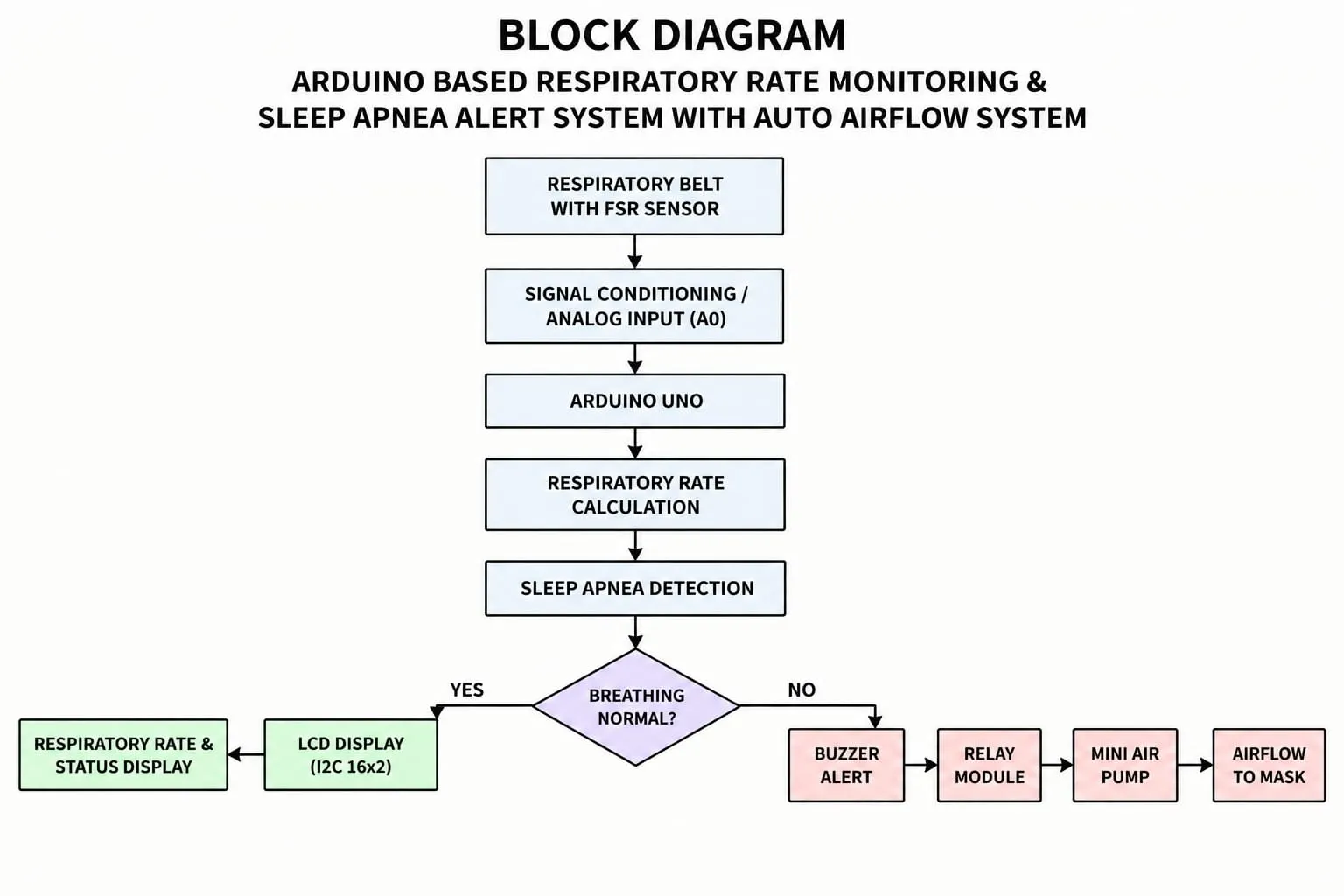
Figure 2: Block Diagram of the Respiratory Rate Monitoring System
Hardware Components and Working:
The main hardware consists of an Arduino Uno, an FSR sensor, an elastic respiratory belt, a 10 kΩ resistor for the voltage-divider circuit, a 16×2 I2C LCD, a piezo buzzer, a one-channel relay module, a 12 V mini DC air pump, a 12 V adapter, tubing, a balloon for airflow demonstration, a breadboard, jumper wires, and a suitable enclosure. The Arduino provides the control logic. The FSR acts as the non-invasive sensing element. The LCD gives immediate feedback to the user. The buzzer provides the alert and the relay permits the low-power Arduino output to control the pump load.
Respiratory Sensing and Signal Processing:
An FSR does not directly measure airflow; instead, it senses a change in applied force. When the belt is worn around the chest or upper abdomen, inhalation and exhalation cause small changes in the mechanical pressure transferred to the sensor. The FSR resistance changes with applied force. With a fixed resistor, this resistance variation becomes a changing voltage that can be sampled by the Arduino's analog-to-digital converter. A simple threshold-and-timing method is sufficient for a student prototype: a valid breathing cycle is identified when the signal crosses a calibrated threshold in the expected direction and a minimum interval has elapsed since the previous cycle. The respiratory rate can then be estimated as the number of valid cycles per minute or from the measured cycle period.
Sleep Apnea Alert Logic:
The prototype uses a programmable no-breathing timer rather than claiming clinical apnea diagnosis. During normal operation, every valid respiratory movement resets the no-breathing timer. If no valid movement is detected continuously for the selected demonstration interval, the controller changes the status to 'APNEA ALERT', activates the buzzer, and energizes the relay. The relay switches the mini air pump, and the pump sends ordinary ambient air through tubing to a balloon or other safe visual load. When respiratory movement is detected again, the alarm and pump can be switched off according to the programmed logic. The airflow stage is strictly a demonstration of automatic actuation and must not be connected to a person or used as a substitute for prescribed respiratory support.
Circuit Diagram:
The FSR and 10 kΩ resistor form a voltage divider. One end of the FSR is connected to 5 V and the other end is connected to the Arduino A0 input and the fixed resistor to ground. The I2C LCD uses the Arduino Uno A4 (SDA) and A5 (SCL) pins. A digital output controls the relay module and another digital output drives the buzzer. The air pump is powered from its separate 12 V supply through the relay's load contacts. The Arduino ground and low-voltage control circuit are connected as required by the relay module, while the pump current is kept out of the Arduino I/O pin. Figure 3 shows the circuit diagram.
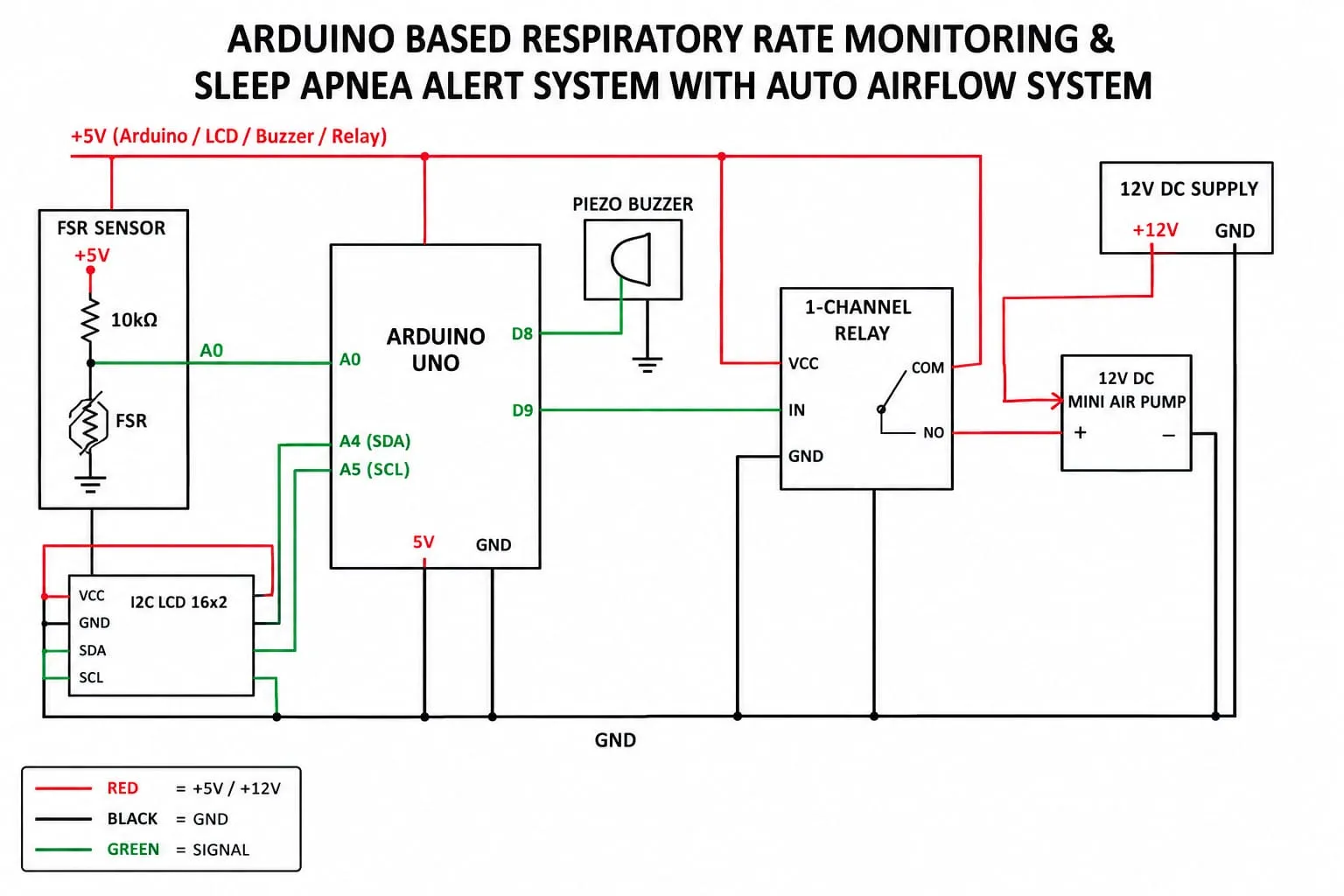
Figure 3: Circuit Diagram
EXPECTED RESULTS AND DISCUSSION:
During normal breathing, the FSR output should show a repeating waveform or changing analog level corresponding to chest movement. The Arduino should count these cycles and show a respiratory rate on the LCD. During a controlled classroom demonstration, temporarily reducing respiratory movement should cause the no-breathing timer to increase. After the selected threshold is reached, the LCD should indicate the alert condition, the buzzer should sound, and the relay should switch the mini air pump. The pump should inflate a small balloon or create visible airflow through tubing, demonstrating the automatic response. Figure 4 shows the output waveform.
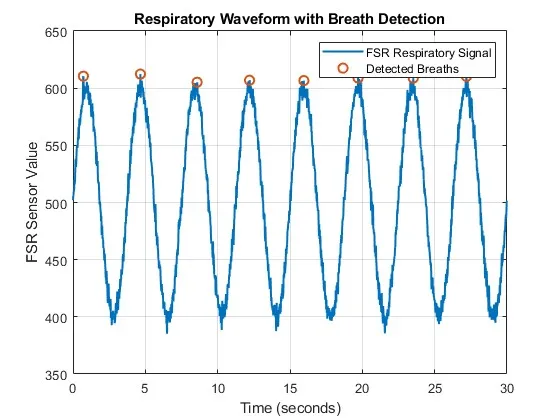
Figure 4: Output Waveform
CONCLUSION:
The proposed Arduino-based respiratory rate monitoring and sleep apnea alert prototype demonstrates how a simple wearable FSR sensor can be interfaced with a microcontroller to detect respiratory movement and estimate breathing rate. The addition of an LCD, buzzer, relay, and mini air pump extends the paper from basic sensing to automatic decision-making and load control. The paper is therefore suitable as an educational biomedical instrumentation and digital/electronics prototype, while its limitations are clearly separated from clinical respiratory diagnosis and medical oxygen delivery.
REFERENCES


Dhayanithi S., Daniel D., Vishaal M., Respiratory Rate Monitoring and Sleep Apnea Alert System with Automatic Airflow Activation, Int. J. Sci. R. Tech., 2026, 3 (10), 719-727. https://doi.org/10.5281/zenodo.23311716
 10.5281/zenodo.23311716