

We use cookies to ensure our website works properly and to personalise your experience. Cookies policy
Department of Electronics and Communication Engineering, Er. Perumal Manimekalai College of Engineering, PMC TECH, Hosur, Tamil Nadu, India.
Medicine distribution is a routine but important activity in hospitals. Staff members regularly transport medicines between pharmacies, wards and patient-care areas. When this work is performed manually, it can add to staff workload and may make delivery status difficult to track across different locations. Mobile robots offer a practical way to support these internal transport activities. This paper reviews research on healthcare robotics and hospital delivery systems, with particular attention to indoor navigation, obstacle handling, secure medicine access and remote monitoring. Published studies show that hospital robots have been developed for several roles, including transportation, pharmacy support, telepresence and patient assistance. Research on medicine-delivery robots also demonstrates different approaches, such as user-controlled medical dispatch systems, mobile robot platforms using path planning and line-following robots with notification features. At the same time, hospital environments introduce challenges involving people, moving equipment, hygiene, workflow changes and operational safety. Based on the reviewed literature, this paper discusses the need to consider delivery navigation and medicine security together rather than as separate functions. It then presents the scope of a smart hospital medicine delivery robot that aims to combine autonomous indoor movement, obstacle detection, multi-tier authentication, controlled medicine-compartment access and cloud-connected delivery monitoring. The proposed concept is intended to support hospital staff and improve delivery traceability. It is not presented as a clinically validated system; practical performance and safety must be established through prototype testing in a controlled environment.
Hospitals depend on the timely movement of medicines and other essential items between pharmacies, storage areas, nursing stations and patient wards. These movements form part of everyday hospital operations. Although each delivery may appear simple, repeated trips can consume staff time and compete with other responsibilities such as patient observation, documentation and direct care. The need to coordinate deliveries across different wards can also make it difficult to maintain a clear record of where a medicine package is located and whether it has reached the intended destination.
Robotics has become an established area of research in healthcare. Robots are used or studied for surgery, rehabilitation, telepresence, pharmacy operations, disinfection and the transportation of materials. Morgan et al. identified ten broad roles for robots in healthcare and included delivery and transport among them [1]. Their review also indicates that the extent of research differs between application areas. This is important because the existence of healthcare robots does not automatically mean that every hospital task has been fully automated or validated for routine use.
Autonomous delivery robots are of interest because they can move items between specified locations while reducing the need for a staff member to accompany every trip. A review by Srinivas et al. discusses the development of autonomous robot-driven delivery and identifies operational challenges that affect the use of such systems [2]. In a hospital, these challenges are more specific than those found in an ordinary delivery environment. A robot may need to pass through narrow corridors, share space with patients and staff, avoid temporary obstacles and stop at the correct ward or nursing station.
Medicine delivery also requires attention to access control. A robot that reaches the correct location is not necessarily sufficient if its medicine compartment can be opened by an unintended person. The delivery process therefore needs a way to confirm that the person requesting or receiving the medicine is authorized. Depending on the hospital workflow, this confirmation may involve more than one level of authentication. Delivery events should also be recorded so that staff can review the status of a task and identify unusual conditions.
This paper reviews relevant work and discusses a project concept titled “Smart Hospital Medicine Delivery Robot: Autonomous Medicine Delivery with Multi-Tier Authentication and Real-Time Cloud Monitoring.” The project focuses on the combined consideration of autonomous indoor navigation, obstacle detection, secure medicine access and cloud-based status monitoring. The paper is a literature-based review and system concept discussion. It does not claim measured performance, clinical validation or completed implementation results.
REVIEW SCOPE AND APPROACH:
This review examines healthcare robotics, autonomous delivery, hospital medicine distribution, indoor navigation, obstacle avoidance, secure medicine storage and remote monitoring. It discusses different approaches, their key contributions and limitations, with particular attention to safety, reliability and practical use in healthcare environments.
The studies are analysed qualitatively by comparing their methods, applications and findings. Since different systems use different technologies and testing conditions, their performance cannot be directly compared. The review therefore highlights the main developments, challenges and possible improvements in healthcare delivery robotics.
RELATED WORK:
Healthcare Robotics and Hospital Applications:
Morgan et al. reviewed the use of robots across healthcare settings and grouped the identified applications into ten roles, including surgery, rehabilitation and mobility, telepresence, pharmacy, disinfection, imaging assistance and delivery or transport [1]. The review shows that robotics is not limited to direct patient treatment. Robots can also support operational tasks that help healthcare professionals manage equipment and materials. However, the review describes a broad healthcare landscape and does not provide a complete design for a secure medicine delivery robot. Its value to the present project is the wider context it provides for hospital transport automation.
Cruz et al. examined robotics applications in the hospital domain and discussed both application areas and practical issues associated with implementation [8]. Their review highlights that the adoption of robots depends not only on technical capability but also on safety and the conditions of the hospital environment. This supports the need to consider navigation, interaction with people, workflow integration and monitoring as connected design requirements.
Autonomous Delivery and Medicine Distribution:
Srinivas et al. reviewed autonomous robot-driven delivery systems and discussed recent developments, operating conditions and future directions [2]. Although their work addresses delivery applications more broadly, it is relevant to hospital logistics because it explains the operational factors that affect autonomous delivery. A hospital robot must be able to travel between locations while responding to changes in its environment. It must also operate within rules established by the facility and avoid disrupting people moving through shared spaces.
Ozsahin et al. described a medical dispatcher designed to deliver medicine within pharmaceutical centres and hospitals [3]. The system was described as being controlled by an operator through a computer system and was intended to transport medicines to patients while enabling communication with the medical expert controlling it. This work demonstrates an early approach to medicine delivery using a combination of hardware and software. Its operator-controlled approach also provides a useful contrast with systems that aim for greater autonomy. The chapter does not establish a universal solution for secure, autonomous delivery across different hospital layouts.
Stoev et al. presented the development of a mobile robot for distributing medicine in hospitals [4]. Their work describes the robot's mechanical design and working principle and includes a medicine-distribution scenario using path planning. The study is relevant because it treats medicine distribution as a mobile robotics problem and discusses the use of path planning for movement between locations. The reported scope is centred on the mobile platform and distribution scenario. Secure medicine access and cloud-based delivery traceability are not the main focus of the paper.
Su and Young proposed an autonomous system for fever detection, medicine delivery and environmental disinfection in a pandemic-prevention setting [5]. Their system uses a mobile robot manipulator and combines several functions intended for a fever station and isolation ward. The authors describe experiments in a hospital-like environment, including navigation among static obstacles and moving people. This work demonstrates how medicine delivery can be integrated with other healthcare tasks. Its wider pandemic-prevention scope differs from a dedicated ward-to-ward medicine transport system focused on access authentication and delivery records.
A 2025 conference paper introduced MediBot, a line-following medicine delivery robot using an ESP8266-based platform, IR and ultrasonic sensors, a rotating storage arrangement and notifications through mobile and web interfaces [9]. The study is directly relevant to low-cost medicine transport and caregiver notification. A line-following approach can be suitable for a controlled route, but it depends on the availability and maintenance of the marked path. A hospital layout may change due to temporary equipment, closed corridors or altered patient-care arrangements. These conditions make flexibility and obstacle response important considerations.
Robots in Isolation and Clinical Workflows:
Yoo et al. conducted a scenario-based preliminary study of mobile robots in hospital isolation-room settings [6]. The work considered the perspectives of nurses and examined the usability and acceptability of robots in clinical nursing scenarios. The study identifies the potential for mobile robots to support communication and task delegation while reducing some forms of physical contact. Its contribution is particularly relevant to the human and workflow side of hospital robotics. It also reminds designers that a technically functioning robot must be usable by clinical staff and appropriate for the care environment.
Safety and Risk Considerations:
Bernhard et al. proposed a structured classification of risks associated with integrating mobile robotic assistance systems into hospitals [7]. Their classification addresses environmental complexity, hygiene, interactions with people and objects, workflow flexibility and autonomy. These categories are important for medicine delivery because a hospital is a dynamic environment rather than a fixed industrial floor. A robot may encounter patients, visitors, beds, carts, cleaning equipment and temporary obstructions. It must also meet hygiene requirements and operate in a way that fits clinical routines.
The reviewed work collectively indicates that hospital delivery robots should not be evaluated only by whether they can move from one point to another. A suitable system must also consider the identity of the destination, the safety of movement, the control of stored items and the availability of reliable delivery information. These requirements are closely related and should be considered together during system design.
TECHNICAL CONSIDERATIONS FOR A SMART MEDICINE DELIVERY ROBOT:
Autonomous Indoor Navigation:
Autonomous indoor navigation enables a robot to travel between defined hospital locations with limited manual intervention. The navigation approach may depend on the intended operating area, available infrastructure and cost. A line-following system can provide a simple route in a controlled environment. However, the robot's movement is tied to the marked path, and route changes may require physical modification. More flexible approaches use a map or a path-planning method to identify a route between a start point and a destination.
The hospital medicine distribution work by Stoev et al. discusses path planning for a mobile robot and demonstrates a distribution scenario [4]. The wider autonomous delivery review by Srinivas et al. also shows why route planning and operational conditions matter to delivery systems [2]. For the project considered here, the navigation function should identify the selected destination, support movement through indoor corridors and provide a safe response when the planned route is unavailable. The precise navigation algorithm should be selected only after the prototype environment and available sensors have been defined.
Obstacle Detection and Safe Movement:
Hospital corridors are shared spaces. People may cross the robot's path, and objects such as wheelchairs, beds and supply carts may be moved without notice. Obstacle detection is therefore an essential part of safe movement. A robot should be able to detect an obstruction and respond by slowing down, stopping or selecting an alternative route where its navigation system supports that action.
The study by Su and Young includes navigation among static obstacles and moving people in a hospital-like setting [5]. The risk classification by Bernhard et al. further emphasizes interactions with persons and objects as distinct areas that must be considered when integrating mobile robots into hospitals [7]. These findings support a cautious design approach. Obstacle sensing alone should not be treated as proof of safety; the complete robot must be tested under representative conditions, including crowded corridors and unexpected obstructions.
Multi-Tier Authentication and Secure Medicine Access:
Medicine compartments require controlled access because delivery involves items intended for specific patients or authorized staff. A simple arrival notification does not confirm that the correct person has opened the compartment. A multi-tier authentication process can be designed to check authorization at more than one stage. For example, the system concept may require a delivery request to be associated with an intended ward or recipient and then require an authorized credential before the compartment is unlocked. A second verification step may be used where the hospital workflow requires stronger confirmation.
The reviewed medicine-delivery studies demonstrate different forms of delivery and notification, but the available sources do not establish one standard authentication method that is suitable for every hospital. Therefore, the authentication sequence should be designed in consultation with the intended users and institutional procedures. The project objective is to include multi-tier authentication and secure medicine-compartment access. The exact credentials, verification order and access policy remain implementation decisions that must be validated rather than assumed.
Access control should also include a clear response to unsuccessful or incomplete verification. The compartment should remain locked when authentication fails. The system should record relevant events and notify an authorized staff member when repeated failures or abnormal conditions occur. These measures can improve accountability, but they do not replace hospital medication-handling procedures or professional supervision.
Cloud-Based Monitoring and Delivery Traceability:
Cloud-connected monitoring can provide hospital staff with a remote view of the robot's delivery state. Useful status information may include the current task, selected destination, movement state, delivery completion and alerts generated during operation. Such information can help staff understand whether a delivery is pending, in progress or completed. It can also provide a record of important events for later review.
The MediBot study reports notifications through mobile and web interfaces [9], while the broader healthcare robotics literature identifies the importance of infrastructure and communication capabilities for successful adoption [1], [8]. A cloud monitoring layer should therefore be treated as a support function rather than as a substitute for local robot control. The robot should retain a safe local response if network connectivity is interrupted. The system should also limit access to monitoring information and protect any patient-related data in accordance with the hospital's policies.
Hospital Workflow and Human Interaction:
A hospital robot operates within a complex service environment. Its route, delivery point and handover process must fit the work of nurses, pharmacists and other staff. Yoo et al. show that staff perspectives are relevant when evaluating mobile robots in isolation-room scenarios [6]. Bernhard et al. similarly identify workflow flexibility and autonomy as important risk dimensions [7]. These findings suggest that the robot should be easy to request, monitor and stop when necessary.
The delivery process should define who prepares the medicine, who authorizes dispatch, where the robot is permitted to travel, who can open the compartment and how a completed delivery is confirmed. These operational details cannot be determined by the robot alone. They require agreement with hospital personnel and should be documented before trials begin.
PROPOSED PROJECT CONCEPT:
The title “Smart Hospital Medicine Delivery Robot” is intended to support the internal transportation of medicines between designated hospital locations. Its central idea is to combine autonomous indoor movement with controlled medicine access and remote delivery monitoring. The project objectives listed in the initial review presentation include autonomous navigation, obstacle detection, multi-tier authentication, cloud-connected delivery status, alerts for completion or abnormal conditions and a simple monitoring interface for hospital staff.
At a functional level, the proposed system can be considered as five connected stages. First, a delivery task is created and associated with a destination. Second, the robot travels towards that destination using its indoor navigation function. Third, obstacle detection supports safe movement through the operating area. Fourth, access to the medicine compartment is controlled through the defined authentication process. Finally, the delivery status and relevant events are sent to a cloud-connected monitoring interface (Figure 1).
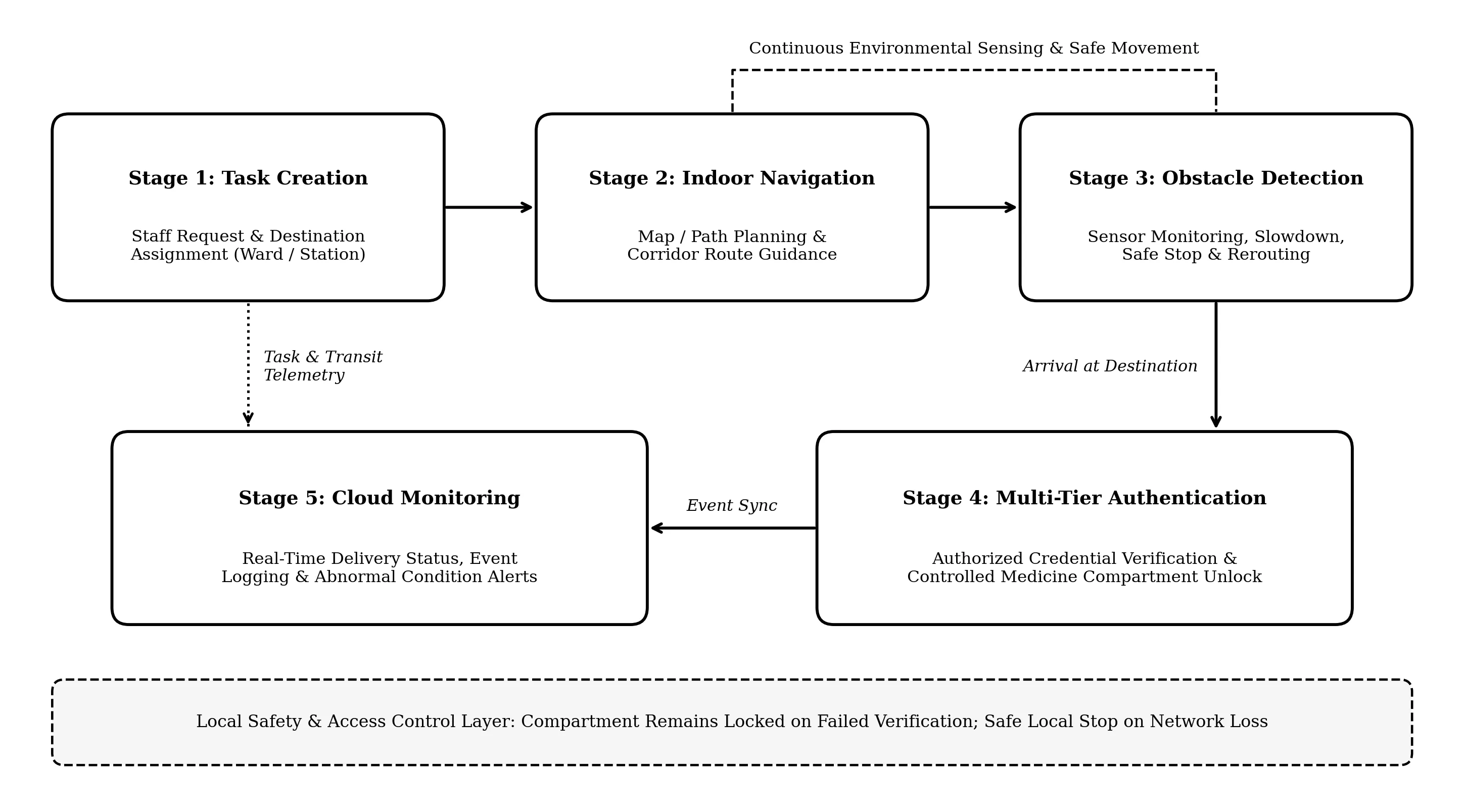
Figure 1: Conceptual 5-Stage Functional Workflow of the Smart Hospital Medicine Delivery Robot
This sequence describes the intended system concept rather than a verified implementation. The project presentation does not provide measured navigation accuracy, delivery time, authentication success rate, network latency, battery endurance or clinical trial results. These values should not be added to a journal paper until they have been measured using a documented test procedure. Likewise, the system should not be described as clinically approved or ready for hospital deployment without the required safety and institutional evaluation.
The expected contribution is an integrated design approach that considers movement, access security and delivery traceability in one medicine transport workflow. This should be understood as an improvement in the integration of established technologies rather than a claim that each individual function is entirely new. The reviewed literature already demonstrates mobile medicine delivery, path planning, obstacle-aware movement, staff notifications and hospital risk assessment. The project brings these concerns together with a specific emphasis on multi-tier authentication and cloud-based delivery monitoring.
COMPARATIVE DISCUSSION:
The literature shows several different levels of automation. The medical dispatcher described by Ozsahin et al. relies on a remote operator to control medicine delivery [3]. The MediBot system uses line-following movement and provides notifications to caregivers [9]. Stoev et al. focus on a mobile platform and path planning for medicine distribution [4]. Su and Young describe a broader mobile robot system that combines medicine delivery with fever detection and disinfection [5]. These approaches demonstrate that medicine delivery can be addressed through different combinations of mobility, sensing and user interaction.
The studies also differ in the way they address the hospital environment. General autonomous delivery research provides useful operating principles [2], while the hospital-specific risk classification emphasizes hygiene, human interaction, object interaction and workflow flexibility [7]. The isolation-room study adds a clinical-user perspective by examining nurses' views of mobile robot use [6]. Together, these sources show that technical performance and practical acceptance must be considered together.
A recurring design consideration is the difference between reaching a destination and completing a secure delivery. Navigation and obstacle detection address the robot's movement. Authentication and compartment control address who can access the medicine. Cloud monitoring addresses the visibility and traceability of the delivery process. A system that includes only one or two of these functions may leave gaps in the overall workflow. The proposed project therefore treats them as complementary parts of one system.
The comparison also highlights limitations in the available evidence. Some studies are conceptual or scenario-based, while others describe specific prototypes or broader reviews. Their operating environments and evaluation methods are not identical. It would therefore be misleading to claim that one approach is universally superior or to compare performance values that were not measured under the same conditions. A fair evaluation of the proposed robot will require a defined test environment and repeatable measurements.
RESEARCH GAPS AND DESIGN CHALLENGES:
One important gap is the need to combine flexible indoor navigation with practical hospital operation. A route that works in an empty corridor may not remain suitable when beds, people or equipment obstruct it. Future testing should include both planned routes and temporary changes to the environment. The robot should be able to stop safely when it cannot continue and should provide a clear alert rather than attempting an unsafe movement.
A second challenge is the secure handover of medicines. The literature includes systems for medicine transportation and caregiver notification, but the reviewed sources do not establish a single multi-tier authentication procedure for all hospital settings. The project must define the authorized users, credential types, verification sequence, failed-attempt handling and event-recording policy. These choices should be based on the hospital's workflow and privacy requirements.
A third challenge concerns dependable monitoring. Cloud connectivity can make delivery information more visible, but wireless networks may be unavailable or unreliable in some areas. The robot should maintain local safety functions during a network interruption and should synchronize event records when connectivity returns. The monitoring interface should show clear status information without exposing unnecessary patient details.
A fourth challenge is hygiene and maintainability. Hospital equipment is subject to cleaning and infection-control requirements. Robot surfaces, storage compartments and frequently touched components must be considered during mechanical design. Bernhard et al. identify hygiene as one of the risk dimensions for mobile robotic systems in hospitals [7]. This makes cleaning procedures and material selection part of the design process rather than optional finishing details.
A fifth challenge is human acceptance and workflow integration. Staff should understand what the robot can and cannot do, how to request a delivery and how to intervene if a task fails. A robot that adds complicated steps or creates confusion may not reduce workload in practice. Usability assessment with intended users is therefore an important part of future evaluation, as reflected in the isolation-room study by Yoo et al. [6].
Finally, a complete evaluation must examine more than whether the robot moves. Relevant measures may include successful arrival at the correct destination, obstacle detection response, number of safe stops, authentication success and rejection behaviour, accuracy of delivery-event records, alert delivery and operation during network loss. These are proposed evaluation measures, not results of the current project.
FUTURE WORK AND EVALUATION PLAN:
The next stage should convert the system concept into a working prototype and document each subsystem. The mechanical platform and medicine compartment should first be designed for the intended payload and indoor operating area. The navigation and obstacle-detection functions should then be tested separately before they are integrated with authentication and cloud monitoring. This staged approach will make it easier to identify faults and determine whether an issue originates in sensing, control, communication or the mechanical system.
Navigation testing should use a clearly defined indoor route with controlled changes to the environment. Tests should record whether the robot reaches the selected destination, how it responds to obstacles and whether it stops safely when the route is blocked. Authentication testing should include authorized and unauthorized attempts, incomplete credentials and repeated failures. The compartment should remain secured whenever verification is unsuccessful.
Cloud monitoring should be tested under normal connectivity and during temporary network interruptions. The evaluation should confirm whether task status and event records are displayed correctly, whether alerts are generated for the specified conditions and whether records can be recovered after connectivity returns. The project should also document how user access is controlled and how sensitive information is protected.
After subsystem tests, an integrated demonstration can be conducted in a controlled mock-hospital layout. Feedback from intended users can be collected to assess the clarity of the interface, ease of requesting deliveries and suitability of the handover process. Any trial involving real medicines, patients or clinical workflows would require appropriate institutional permission and safety review. Only after these stages should performance claims be made about the complete system.
CONCLUSION:
This paper reviewed research related to hospital robotics, autonomous delivery, medicine distribution, obstacle-aware movement, clinical workflow and hospital safety. The reviewed studies demonstrate that robots can support several healthcare activities and that medicine transportation is a relevant application of mobile robotics. They also show that hospital deployment involves challenges beyond basic navigation, including hygiene, interaction with people, workflow flexibility and operational risk.
The project concept, Smart Hospital Medicine Delivery Robot, focuses on combining autonomous indoor navigation, obstacle detection, multi-tier authentication, secure medicine-compartment access and cloud-based delivery monitoring. The literature supports the relevance of these functions, while also indicating that they must be designed as part of a complete hospital workflow. The proposed contribution is the integration of established technologies around a secure and traceable medicine delivery process. Since the current project material describes objectives rather than validated experimental results, prototype development, controlled testing and user evaluation remain necessary before making claims about performance or clinical suitability.
REFERENCES




V. P. Krishnammal, Lokesh Kumar T., Jayasurya V., Hari Das G., Smart Hospital Medicine Delivery Robot: A Review of Autonomous Navigation, Multi-Tier Authentication and Cloud-Based Monitoring, Int. J. Sci. R. Tech., 2026, 3 (11), 987-994. https://doi.org/10.5281/zenodo.24457293
 10.5281/zenodo.24457293