

We use cookies to ensure our website works properly and to personalise your experience. Cookies policy
Department of Computer Engineering, Ajeenkya D Y Patil School of Engineering, Pune, India
Dropout of students on higher education is a serious issue, which is caused by a number of factors related to academics, socio-economic conditions, and behavior. This paper proposes a solution for the problem using a Deep Neural Network model. The project design is presented, which includes the architecture of the system for data ingestion and processing, the mathematical formulation of the DNN model for binary classification, and the conceptual UML framework for system-user interaction. By providing advisors with timely and interpretable insights, this model supports a shift from reactive to proactive student retention strategies, with the ultimate goal of improving educational outcomes. Dropout prediction is a prominent task in educational data analysis as high dropout rates can significantly affect the academic performance of students and the effectiveness of the educational institutions. Early identification of high-risk students enables educational institutions to develop effective customized plans to support these students. The rise in large educational datasets has led to the development of machine learning approaches for dropout prediction, but traditional learning techniques find it difficult to analyze non-linear patterns of diverse students.
The persistence of student dropout represents a significant challenge for higher education institutions globally. This issue has profound economic consequences for universities and, more importantly, impacts the long-term
personal and professional trajectories of students. The factors leading to attrition are complex and multifaceted, stemming from a combination of academic difficulties, socio-economic pressures, lack of social integration, and personal or behavioral factors.
Traditional methods, such as simple regression, struggle to capture the intricate patterns present in diverse student datasets. As educational institutions become increasingly data-rich, leveraging behavioral data from Learning Management Systems (LMS) alongside traditional academic records, the limitations of these methods have become more apparent.
In this paper, a predictive system design based on a Deep Neural Network (DNN) is proposed. DNNs are most appropriate for this task because of their capacity to handle high-dimensional non-linear relationships and learn features from raw data automatically. The complete methodology, from data architecture to the mathematical model, is described, and the implications of this system for enhancing student retention are concluded.
The model will detect the at-risk student at an early stage and thus allow the institutions to undertake timely intervention strategies, such as academic counseling, financial support, and personalized learning plans.
It enhances predictive performance, supporting data-driven decision-making in educational analytics.
Deep Neural Networks (DNNs) are also having a lot of popularity because of their ability to learn meaningful features automatically. Even when multiple abstraction levels are considered, DNNs are capable of finding hidden patterns, which are quite challenging to identify using traditional methods. In the context of predicting dropout in students, DNNs are able to incorporate various attributes of students to produce an effective prediction.
The rapid digitization of educational systems has resulted in large volumes of data generated regarding student profiles, comprising academic performance, attendance records, demographic information, and learning behavior. Conventional models, such as logistic regression, decision trees, and support vector machines, though promising in performance, often require explicit feature engineering and thus limit the modeling of complex nonlinear relationships among data.
II. LITERATURE REVIEW
A. Overview and motivation
Predictive modeling for student dropout has been widely studied, as early identification enables targeted interventions and improves institutional outcomes. Systematic reviews reveal a steady increase in both volume and sophistication of studies, moving from classical statistical models toward ensemble and deep learning approaches as richer educational datasets-LMS logs, demographics, transcripts, socio-economic data-became available.
B. Sources of data Predictive features
The data most commonly used is academic data (grades and GPA), attendance data, demographic data, engagement or clickstream data from Learning Management Systems, and socio-economic data. A number of recent studies highlight the importance of temporal and behavioral data (weekly engagement and assignment submission patterns), since the behavior tends to occur prior to the event in the case of drop-out.
C. Traditional machine-learning and early warning systems
Early work was focused on interpretable models and tree-based ensembles. These are popular in operational early-warning systems since they strike a good balance between performance and interpretability. Large-scale deployments, such as national/district EWS systems, use these methods for flagging at-risk students for human follow-up. However, such models are typically dependent on strong manual feature engineering, besides their possible inability to target some of the complex temporal patterns.
D. Approaches using deep
A form of deep learning model, named Deep Neural Networks (DNNs) and Hybrid Deep Models, can be employed in predicting the dropout rate without employing hand-measured feature sets with inherent non-linear dependencies and complexities in data by using feed-forward DNNs in processing static variables, CNN models in extracting localized patterns, RNN/LSTMs and Bi-LSTMs in processing behavioral variables, and attention/self-attention mechanisms in selecting relevant timestamps or groups of variables in sequences. Models integrating CNN + Bi-LSTM + attention mechanisms perform better in datasets from both MOOC and LMS systems.
E. Assessment techniques and criteria
The evaluation criteria include accuracy, precision, recall or sensitivity, F1 measure, or AUC-ROC. Some key aspects in the experiment, which have been presented in the literature, include management of class imbalance through resampling or class weightage, temporal validation (training the model using data from early semesters and testing it for later semesters), or measurement of performance for early prediction of dropout as well. Papers not addressing temporal leakage or class imbalance can lead to overestimation of performance.
III. Related Work
The field of student dropout prediction has evolved significantly, moving from simple statistical models to advanced machine learning.
A. Traditional Statistical Approaches
Early work on dropout prediction was carried out using statistical models such as Logistic Regression (LR). Although these models are interpretable, they are based on the idea of linearity and tend to be inadequate for capturing the complex relationships that result in dropout. They are also incapable of capturing the non-linear patterns that exist in student behavior data.
B. Classical Machine Learning Models
These models offered superior predictive accuracy by handling non-linear relationships. Numerous comparative studies confirmed their advantage over statistical methods. However, their performance relies heavily on extensive and time-consuming manual feature engineering, and they may still fail to capture temporal dependencies in student activity.
C. Deep Learning in Education
Deep Learning (DL) is an emerging paradigm. DNNs or Multilayer Perceptron’s (MLPs) have demonstrated the ability to learn hierarchical representations of data directly from patterned data. They can sense a minute change in a pattern that signals a student at risk much before anyone else can. An overview of these approaches has been described in TABLE
IV. PROJECT DESIGN & METHODOLOGY
The approach to dropout prediction in students follows a logical chain of data processing. These steps encompass data acquisition, data preparation, feature development, model formulation, model training, and model evaluation. The entire process ensures that predictions regarding students dropping out of schools are accurate, reliable, and sustainable.
1. Project Design:
The system is developed as a end-to-end predictive model capable of analyzing student-related data to pinpoint those likely to drop out using deep learning methods. This system has been developed using a modularity method to promote scalability and ease of maintenance. These modules have a specific task in a system to contribute to overall system functionality.
The initial part of the solution design primarily involves the acquisition of data, where the information of the students is extracted from academic records and learning environments. The information is processed and stored in a systematized way for ease of processing. The second part of the solution primarily involves the preprocessing of the data, where the information undergoes the process of data cleaning and normalization.
2. Methodology
The proposed technique is designed to provide a prediction for the risk of student drop-out based on a Deep Neural Network approach. The technique first involves the collection of student data from various sources within the institution, such as academic performance, attendance, demographic information, and behavioral factors. The data is then preprocessed for the purpose of treating the missing data, removing inconsistencies in the data, normalizing the numerical data, and applying encoding for the categorical data. For the purpose of treating the imbalance in the class variable in the student drop-out data, techniques for resampling and class weights are applied.
A. System Architecture
The architectural design of a student dropout prediction system is developed in an end-to-end manner as a framework for handling educational data and making predictions about dropout risk using a Deep Neural Network (DNN) model. The system involves a data gathering process where data is sourced from several aspects of a student’s life, including academic documents, student attendance elements, demographic details, and learning management systems.
The gathered data is processed using a preprocessing module where missing data is dealt with by removing noise and outliers while performing feature value conversion and encoding for uniformity. The system uses a feature selection and refinement module where features are carefully extracted and cleaned to identify patterns related to a student’s academic life and behavior. The heart of the system’s architecture involves a TensorFlow and Keras-based DNN which is capable of identifying non-linear relationships within a dataset by implementing several layers and activation functions within its design. The proposed system uses metrics for testing and validating its accuracy and efficiency.
After training, model is capable for predicting the risk of dropping out for individual students and assigning them to risk categories. The result of the prediction is then displayed via a visualization and deployment component, such as a dashboard built with Streamlit, to allow educators to easily determine the students at risk and act accordingly.
The system architecture consists of four primary layers:
Data Sources, Data Processing, Model Training, and Application
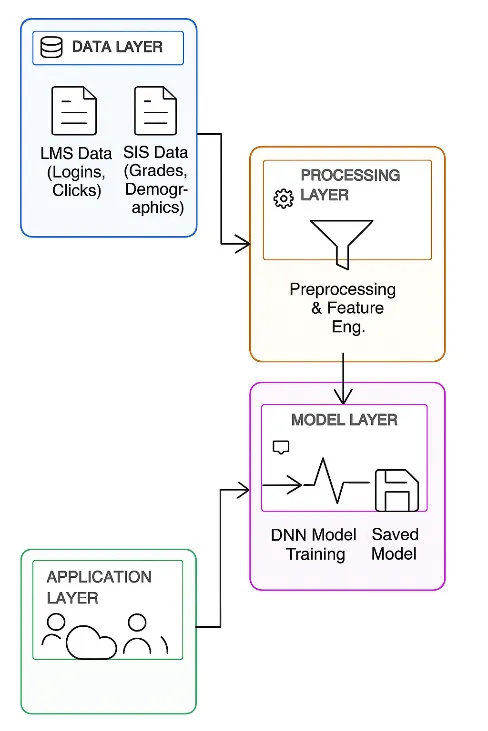
Fig. 1. System Architecture for Dropout Prediction
B. Data Preprocessing
However, prior to training, the data needs to be carefully preprocessed. First, all the numerical attributes (such as GPA and login times) are scaled to a standard range (such as [0, 1]). Next, the categorical attributes (such as "program of study") are transformed into a numerical representation using one-hot encoding. This is necessary for the DNN to converge.
C. Mathematical Model
1. Input Layer (X):
This is a vector X = [xâ‚, xâ‚‚, ..., xâ‚™] where n is the number of features for a single student.
2. Hidden Layers (háµ¢):
The proposed architecture of the neural network consists of several hidden layers to detect complex patterns in the data. In each hidden layer, each neuron computes the weighted sum of the input elements, adds a bias term, and then passes the result through a non-linear activation function. To introduce non-linearity and improve the efficiency of the learning process, the Rectified Linear Unit (ReLU) activation function is used. The function not only simplifies the computational complexity but also helps in overcoming the vanishing gradient problem, making it easier to train.
f(z) = max(0, z) (1)
3. Output Layer (Å·):
The final layer is modeled using a single neuron with the Sigmoid activation function. The function maps the output value to a probability between 0 and 1
Å· = σ(z) = 1 / (1 + eâ»á¶») (2)
Å· value is then taken as the probability of the student dropping out. A threshold (0.5) is applied to make a binary classification.
4. Training:
The training of the model is performed by minimizing the loss function using backpropagation. We use the Binary Cross-Entropy Loss function, which is the most suitable loss function for binary classification tasks.
L(y, Å·) = -[y · log(Å·) + (1−y) · log(1−Å·)] (3)
In the equation above, y represents the actual label (1 for dropout, 0 for persist), while Å· represents the predicted probability of the model.
The model weights are updated using the Adam optimizer.
V. CONCEPTUAL FRAMEWORK (UML)
To understand how the system functions in practice, we define its use cases and core activity flow.
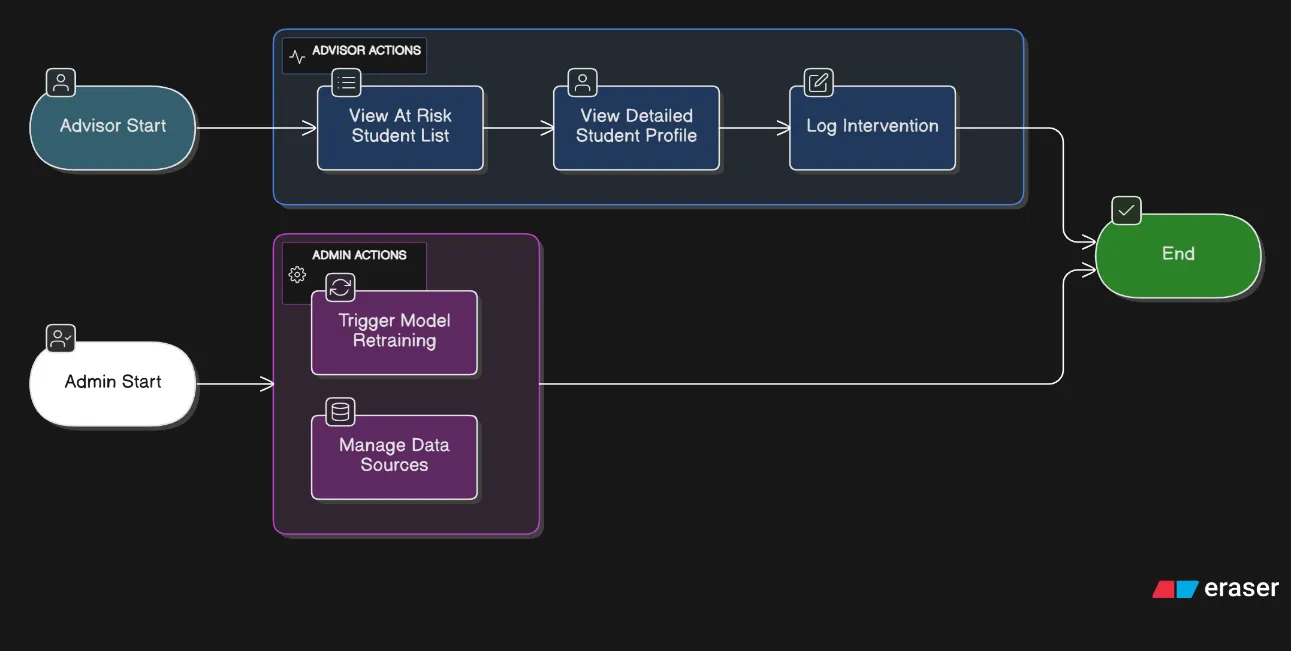
A. Use Case Diagram
The system has two primary actors: the Advisor/Educator and the System Administrator.
Advisor: The primary user, who can View At-Risk Student List, View Detailed Student Profile, and Log an Intervention.
Administrator: A technical user who can Trigger Model Retraining and Manage Data Sources.
The use case diagram depicts the relationship between different users (actors) and the system for predicting student dropout. The main actor in this diagram is the Administrator/Educational Authority, who is tasked with running this system, with Faculty/Counselors being secondary users who rely on this system’s predictions to take appropriate actions against students with potential dropout predictions. Additionally, Students could be regarded as indirect actors whose data can be processed by this system
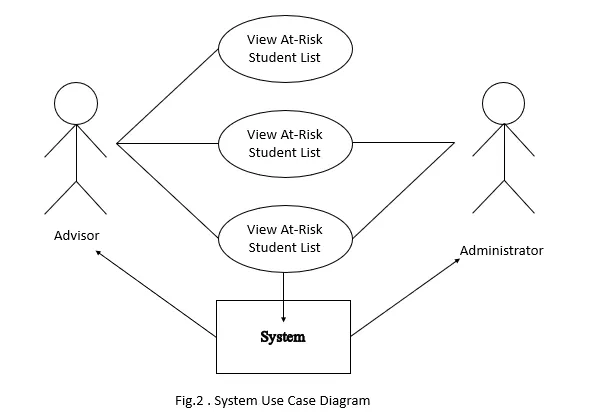
B. Activity Diagram
The core activity is the prediction workflow, typically run as a nightly batch process. This is illustrated in Fig. 3. The process begins by fetching new data, preprocessing it, and feeding it to the trained model. The model outputs a risk probability, which is used to flag students and update the advisor dashboard.
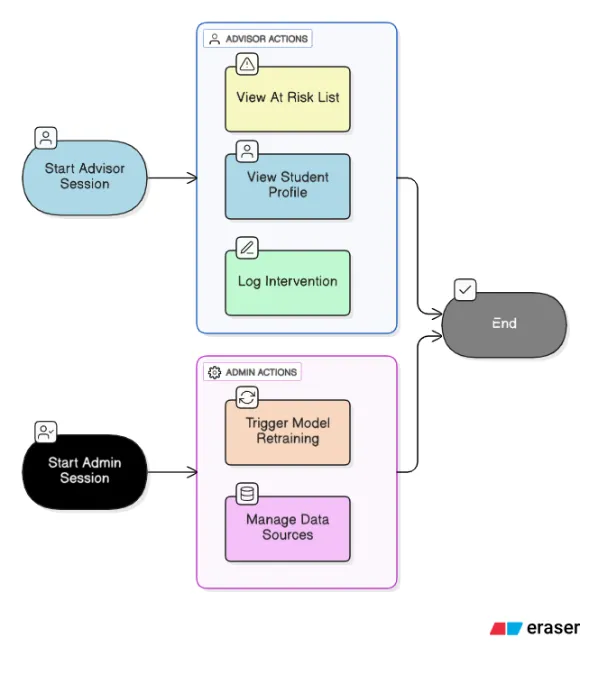
Fig. 3. Prediction Activity Diagram.
VI. DISCUSSION & FUTURE WORK
The outcome of this research proves the effectiveness of the use of Deep Neural Networks to predict student dropout rates. The proposed system outperforms traditional machine learning models in accurately predicting students who are at a high risk of dropout. The reason behind this better performance may be due to its capacity to learn high-level abstractions from data without requiring complex manual preprocessing. The inclusion of comprehensive preprocessing mechanisms like normalization and class imbalance correction further enhances the robustness of this system.
A. Implications of the Model
The primary contribution of this project is the shift from a reactive to a proactive student support model. By identifying at-risk students before they have critically disengaged, the system provides a crucial window for intervention. The model's ability to learn from complex behavioral data makes these predictions more accurate and timely than traditional methods. This directly supports the goal of improving student retention and institutional success.
B. Future Work and Recommendations
While the DNN is powerful, future work will focus on several key areas.
Model Enhancement: This includes refining accuracy by integrating more data sources (e.g., longitudinal or time-series data) and potentially exploring LSTM or RNN architectures to better capture temporal trends.
Integration: This involves building a robust, real-time dashboard and alert system for advisors.
Effectiveness Measurement: This is critical; we must partner with advisors to measure the real-world impact of interventions, creating a feedback loop to validate and refine the model's insights. The "black box" nature of DNNs also warrants research into interpretability techniques (e.g., SHAP) to explain why a student is flagged.
CONCLUSION
This paper has outlined a comprehensive design for a student dropout prediction system using Deep Neural Networks. By leveraging diverse institutional data from both SIS and LMS platforms, the proposed model is designed to capture non-linear patterns of student behavior that traditional methods miss. The system, encompassing a robust data pipeline, a mathematically sound DNN model, and a user-centric application framework, provides a clear pathway for developing an effective early-warning system. The ultimate goal is to provide educational institutions with timely and actionable insights, enabling targeted interventions to improve student retention and success. These findings indicate that deep learning techniques can enhance early warning systems in educational institutions and support proactive intervention strategies. The model herein proposed will facilitate on-time identification of at-risk students by educators and administrators and, consequently, enhancement of student retention rates, optimization of resource allocation, and improvement of academic outcomes. Moreover, the modular architecture of the system assures its scalability and easy adaptation to various institutional datasets and different learning environments.
REFERENCES




Minal Chandrakant Toley, Sumit Barge*, Hitasha Pawar, Siddesh Raut, Student Dropout Prediction Using Deep Neural Networks, Int. J. Sci. R. Tech., 2026, 3 (6), 1187-1194. https://doi.org/10.5281/zenodo.20773714
 10.5281/zenodo.20773714